Trinidad & Tobago Trip Report (Nov 29 – Dec 10, 2025)
Day 1 (November 29): Arrivals @ Asa Wright Nature Centre
As participants arrived, we spent our first day getting settled and exploring at the world-famous Asa Wright Nature Centre – our home for the first five wonderful days in Trinidad. For many, the first few hours were the most beautiful and overwhelming of the entire trip – seeing for the first time the majestic view from the lodge’s verandah and the swarms of bright, colourful birds visiting the garden and feeders. Gaggles of Bananaquit, Purple & Green Honeycreeper, six species of Tanager (White-lined, Silver-beaked, Blue-grey, Palm and occasionally Turquoise and Bay-headed), Violaceous Euphonia and Crested Oropendola were everywhere we looked. As many as twelve species of hummingbird also buzzed around – sometimes just inches away! While the smart-looking Copper-rumped Hummingbird was most abundant, they were joined by many others such as White-necked Jacobin, White-chested Emerald, Brown Violetear, Black-throated Mango, and Long-billed Starthroat. We especially enjoyed our first glimpses of the tiny (but highly prized) Tufted Coquette. Green, Rufous-breasted and Little Hermits all made regular appearances, and on one occasion a much hoped-for Ruby Topaz Hummingbird even swooped in for a few short visits! This frenzy of avian splendour would become the backdrop to our entire week.

Purple Honeycreeper © Jared Clarke

Long-billed Starthroat © Jared Clarke

Turquoise Tanager © Jared Clarke
Day 2 (November 30): Blanchiseusse Road & The Northern Range
This morning we met our local guide Dave Ramlal and struck out on the first of many adventures – this time heading up the winding Blanchisseuse Road and to the higher elevations of the Northern Range. The lush rainforests and quaint villages here provide excellent birding, and we were not disappointed. Working our way up the mountain roads, we stopped to find and appreciate a wonderful array of birds including Great Antshrike, Tropical Parula, Golden-crowned Warbler and Blue Dacnis. At one stop we even found all three of the island’s trogon species – Green-backed, Guianan and Collared!
Our highest elevation for the day at Las Lapas Trace offered some exciting birds in addition to awesome views over the valley and down to the Caribbean. With plenty of patience, we managed to get glimpses of two very skulky species – Black-faced Antthrush and Pale-breasted Spinetail, along with a “near miss” of a White-bellied Antbird that called and rustled bushes right along the trail. A pair of Hepatic Tanagers were more cooperative, vying for our attention as they moved down from the canopy and foraged at eye level while most of us were still trying to spot that elusive antbird. The hands-down highlight of the morning, though, were two Ornate Hawk-Eagles including a young bird that eventually flew out of cover and sat in the open for prolonged views, photos and even video. Jared was especially relieved in these moments, as it had been a long-time nemesis of his. What a fantastic bird!

Collared Trogon © Jared Clarke

Ornate Hawk-Eagle © Jared Clarke
Our lunch stop at Brasso Seco was well timed as it gave us some cover from some short but heavy rain showers – and where many of us partook of some delicious local chocolate. We were even able to enjoy some great birds during lunch, including our only Southern Beardless Tyrannulet of the trip and a large mixed flock of both Blue-headed and Orange-winged Parrots feeding in nearby trees. Just down the road we enjoyed a raucous colony of Yellow-rumped Caciques and tried in vain to spot a Ferruginous Pygmy Owl calling from the canopy. A White Hawk posed beautifully along the way, giving the hawk-eagle a run for its money in the “stunning looks” department 😉

Yellow-rumped Cacique © Jared Clarke

White Hawk © Jared Clarke
We ended our afternoon at the quaint village of Morne La Croix where we were treated to more new birds including Rufous-tailed Jacamar, Giant Cowbird, Boat-billed Flycatcher, Piratic Flycatcher, and Northern Tropical Peewee.

Boat-billed Flycatcher © Jared Clarke
Day 3 (December 1): Aripo Savannah & Nariva Swamp
As with most mornings, the great birding began even before breakfast with lots of bird activity around the lodge and verandah. The first stop on today’s field trip was just a few miles Asa Wright, when a pair of Grey-throated Leaftossers flew across the road in front of us. With a little patience, the entire group was able to get looks at these always tough-to-see birds – a great start to the day!

Gray-throated Leaftosser © Jared Clarke
Most of our morning was spent exploring some fantastic lowland habitats – the relatively arid, grassy and agricultural areas known as the Aripo Savanna. Here we encountered several raptors that specialize in open grasslands: Crested Caracara, Yellow-headed Caracara, Zone-tailed Hawk and Savannah Hawk. The latter were seen on several occasions perched on wires, sitting on perches and stalking through the grass with the aid of their characteristic long legs. We enjoyed great looks at one of our main targets for the morning, a brilliant Red-breasted Meadowlark sitting regally atop a fence post. Nearby we found a pair of flitty Yellow-chinned Spinetails, our first Gray Kingbird and both Pied Water-Tyrant and White-headed Marsh Tyrants posing cooperatively in the roadside shrubs.

Yellow-chinned Spinetail © Jared Clarke

White-headed Marsh-Tyrant © Jared Clarke
After a breezy lunch alongside the ocean at Manzanilla Beach, we headed southeast along the coast to the rich mangroves and flooded fields of Nariva Swamp. An initially “quick” stop near the mouth of the Nariva River proved very birdy with great views of Black-crested Antshrike, the normally skulky Silvered Antbird, Northern Scrub Flycatcher and a Bicolored Conebill among others. Most exciting was a handsome Rufous Crab Hawk sitting quietly among the mangroves – we could easily have missed it except for Kenna Sue’s eagle eyes! We also spied three kingfishers along the river – Ringed, Green and the diminutive American Pygmy Kingfisher.
We had to tear ourselves away to squeeze in our final birding destination at the town of Kernaham, where we scoured the vast flooded fields (mostly former rice paddies) for a variety of wetland species. Highlights included Purple Gallinule, Striated Heron, Limpkin, Yellow-hooded Blackbird and Yellow Oriole. A Long-winged Harrier soared by twice, provided excellent eye-level views. An added surprise popped up in the way of a several Yellow-headed Amazons heading off to roost for the evening.

Silvered Antbird © Jared Clarke

Long-winged Harrier © Jared Clarke

American Pygmy Kingfisher © Jared Clarke
Day 4 (December 2): Asa Wright Nature Centre
We spent today closer to “home”, exploring the trails and property at Asa Wright Nature Centre and enjoying some leisure time on the verandah which never disappoints. As sunrise warmed up the valley below us, Channel-billed Toucans sat perched in the canopy and soaked it in, while a Lineated Woodpecker chiseled away at its favourite tree. We enjoyed the extra time to get better acquainted with scarcer birds in the garden and at the feeders such as Blue-chinned Sapphire, Tufted Coquette, Bay-headed Tanager and Barred Antshrike. A short walk down the driveway produced our only looks at tiny Long-billed Gnatwrens, a very uncooperative Rufous-breasted Wren and a chatty flock of Red-crowned Ant-tanagers – all before a sudden rain shower sent us scrambling back to the coziness of the lodge.

Channel-billed Toucan © Jared Clarke

Tufted Coquette © Jared Clarke

Rattling Voice Tree Frog © Jared Clarke
Late morning, we hiked down the valley to see the enigmatic Oilbird roosting in Dunstan Cave. These almost mythical birds are the only nocturnal fruit-eating birds in the world, using a combination of echolocation (just like bats!) and specially adapted eyesight to navigate in the dark. We earned our views of this very special bird, clamouring over rocks and wading through water over our boots to access their cave – but the reward was worth it! The hike itself was little quiet, but did include our best views of a male Golden-headed Manakin and some very vocal Green Hermits defending their favourite flowers.

Oilbird © Jared Clarke

Our group at Dunstan Cave © Jared Clarke
Late afternoon we walked the Discovery Trail in search of Bearded Bellbirds – perhaps the loudest birds in the world, and a sought-after species in these forests. We had seen them distantly from the verandah, calling from atop the canopy below – but with lots of patience we managed to spot two at much closer range and were awed by their deafening “clang”. We also stopped to watch a group of male White-bearded Manakins displaying at their lek – snapping their wings and hopping from twig to twig over their carefully curated “arenas”. Such fun birds!!

Bearded Bellbird © Jared Clarke

White-bearded Manakin © Jared Clarke
Day 5 (December 3): Waterloo & Caroni Swamp Bird Sanctuary
This morning we braved rainy conditions and headed to the agricultural area of Orange Grove Estates – mostly birding from the vehicle except for short walks between the showers. As the rain began to peter out we headed southwest to the fishing community of Waterloo, where our only gulls of the trip were spotted – dozens Laughing Gulls flying over the ocean and following fishing boats. Shorebirds were also enjoying the exposed feeding areas – several Spotted Sandpipers, Willets, Black-necked Stilts, and even Hudsonian Whimbrel were probing the muddy water’s edge while a group of Ruddy Turnstones loafed on a moored boat. A surprisingly large group of 57 American Flamingos were also hanging out along the flats. A distant Great Blue Heron was our first of the trip, while Little Blue Herons, Snowy Egrets and Western Cattle Egrets were taking advantage of the good feeding. More than a hundred Brown Pelicans lounged around just offshore, while Black Skimmers and Magnificent Frigatebirds patrolled the waters further out. Driving away, we spotted two brilliant Saffron Finches sitting on a fence and shaking off the raindrops. We made a short stop to see the beautiful Hanuman Temple and statue, but also scored views of several Fork-tailed Palm Swifts hawking over the parking lot.
The wetlands at Sumaria Trace were equally productive, highlighted by a very cute Green-rumped Parrotlet, great looks at our only Green-throated Mango of the tour and small flocks of both Common Waxbill and Tricoloured Munia.

Green-throated Mango © Jared Clarke

Tricolored Munia © Jared Clarke
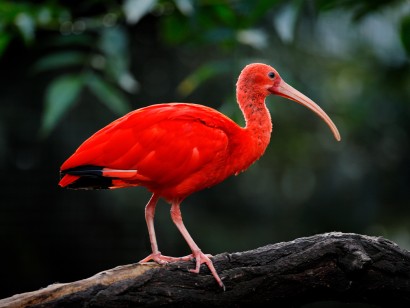
Finally, we made our way to the famous Caroni Swamp Bird Sanctuary – a vast estuary comprising more than 500 hectares of mangroves and marshes. Our tour along the quiet channels and into the main estuary was fantastic – both for scenery as well as birds. A pair of Straight-billed Woodcreepers performed well for us, as did a little troupe of Greater Ani and an obliging Scarlet Ibis showing off its gaudy colour. Not so easy to spot was a secretive Little Cuckoo that crept through the tangles after teasing us by flying across the canal and over our bow. A group of seven American Flamingos were spotted in the more open waters – a testament to the new and growing population here in the last few years. Other wildlife included Mangrove Crabs, a lone Silky Anteater and a very up-close Cook’s Tree Boa clinging to branches.
The grand finale took place as evening set in – the incredible arrival and roosting of hundreds of Snowy Egret, Little Blue Heron, Tricolored Heron and thousands of Scarlet Ibis on a single small island. The beautiful backdrop, still waters of the swamp and stunning birds combine for an experience unlike any other. Heading back at dusk we spotted a Common Potoo camouflaged high on a branch, while a half dozen Common Parauque, several Spectacled Caiman and even a Capybara & Black-eared Possum (both very briefly) were spotted after darkness set in. What a fantastic way to end our day!

Scarlet Ibis © Jared Clarke

Scarlet Ibis in flight © Jared Clarke

Our group in Caroni © Jared Clarke
Day 6 (December 4): Bajnath’s Estate Hummingbird Sanctuary & Grand Riviere
This morning we bid farewell to Asa Wright Nature Centre and made our way to Grand Riviere, on the northeast coast of Trinidad. About halfway along, we made a much anticipated lunch stop at Bajnath’s Estate Hummingbird Sanctuary in Matura National Park. Our host Josh and his mother, Andrea, treated us to an amazing home-cooked meal – a trip favourite for the entire group. We also found ourselves surrounded by rows of wildflowers and dozens of hummingbird feeders, all attended by an incredible flurry of birds. The eleven species of hummingbird included a pair of Ruby-topaz Hummingbirds, showing off their flashy tails and (in the case of the male) shining orange throat.

Ruby Topaz © Jared Clarke

Blue-chinned Sapphire © Jared Clarke
We arrived at the beautiful Mount Plaisir Estate in Grand Riviere for late afternoon. After taking a few short minutes to appreciate our delightful accommodations, we headed off for a late afternoon outing. The hands-down highlight was our first Trinidad Piping-Guan (Pawi) – an endemic, endangered and rather unique bird! This cool yet awkward looking species lives its life in the canopy, munching on fruits and rarely coming down the ground. These two were hiding quietly in the centre of a large nutmeg tree, and we would have missed them completely if not for a hot tip provided by our friendly local driver.

Mount Plaisir © Jared Clarke
Day 7 (December 5): Grand Riviere
Early the next morning, our driver picked us up once again and transferred us to the top of Monte Video Road – an area known as “Pawi House Hill” due to its reliability for seeing these sought-after birds. While Trinidad Piping-Guan were notably scarce today, we did manage to refind two in the same nutmeg tree as the previous afternoon, sitting a little more in the open. Throughout the morning, we were also rewarded with lots of other birdlife including a very vocal (and cooperative!) Ferruginous Pygmy Owl, a Little Tinamou calling tantalizingly close to the road (but never seen), brief glances at a secretive White-bellied Antbird, displaying Crested Oropendola, Rufous-browed Peppershrike and a pair of Rufous-breasted Wrens among many others.

Trinidad Piping-Guan © Jared Clarke
Following an afternoon siesta, we took a leisurely stroll through the community where we enjoyed a surprising diversity of species. An adult Common Black Hawk posed in the golden light, keeping an eye on a younger bird nearby. Our first Bat Falcon of the trip zipped gracefully along the road and over a ridge, while a Gray-lined Hawk perched on a dead tree atop the hill. The air was filled with the sound of dozens of Orange-winged Parrots coming in to roost, a Green Kingfisher hunted in a wet field, a White-tipped Dove paraded around a yard and an Olive-gray Saltator sat silhouetted by the setting sun as we walked back to the lodge for yet another delicious meal.

Common Black Hawk © Jared Clarke

Green Kingfisher © Jared Clarke
Day 8 (December 6): Trinidad > Tobago
We departed early this morning for the airport and a short flight to Tobago – the smaller but equally exciting island of this wonderful country. After arriving, we quickly unpacked our birding gear and headed for a birder’s paradise – the sewage lagoons (!) at Bon Accord. We quickly added a whole bunch of new species from Black-bellied Whistling Duck and White-cheeked Pintail to Least Grebe and Mangrove Cuckoo. Among the shorebirds foraging in the roadside wetlands were both Greater and Lesser Yellowlegs, Short-billed Dowitchers, Willets and Hudsonian Whimbrels, while two Wilson’s Snipe were on the edge of the lagoons. Green Herons eyed the water from low perches, an Anhinga dried its outstretched wings, and a locally rare Glossy Ibis foraged alongside the more usual suspects.

Black-bellied Whistling Ducks © Jared Clarke
We took our packed lunches to Adventure Farms – a private “sanctuary” with an array of hummingbird and fruit feeders as well as a lovely garden and trails. Always entertaining, the owners simply put out fresh fruit and ring a dinner bell, leading to a swarm of birds emerging from every tree and shrub on the property! Among the hungry visitors was our first Trinidad Motmot allowing amazingly close views, confiding Red-crowned Woodpeckers, a pair of Barred Antshrikes, Shiny Cowbirds, Spectacled Thrush and Blue-gray Tanager. While the hummingbird diversity is lower than on Trinidad, we did appreciate excellent views of Rufous-breasted Hermit and Ruby-topaz Hummingbird just feet from our faces (and cameras!). A stroll through the gardens offered up great views of Rufous-tailed Jacamar and our first pair of Northern White-fringed Antwrens.

Trinidad Motmot © Jared Clarke

Blue-gray Tanager © Jared Clarke
We ended the day by checking in to our very relaxed beachside accommodations at Blue Waters Inn, on the outskirts of Speyside. The chill Tobago vibes are very real!

Blue Waters Inn © Jared Clarke
Day 9 (December 7): Little Tobago Island
This morning was a much anticipated one. After a leisurely breakfast, we boarded a boat with Captain Troy and headed just offshore to Little Tobago – a wonderful little island with some big birding opportunities. Since the boat was glass-bottomed, we took time to appreciate some of the coral reefs and accompanying creatures (fish, crabs, snails, etc.) along the way. After landing on a narrow jetty, we hiked and birded along the trail that leads uphill through the forest. A pair of Brown-crested Flycatchers peered down at us from the canopy, a large Hermit Crab ambled across the path, and we stopped to appreciate the ingenuity of a Trapdoor Spider.
The climb to the top of the island was worth every step, since we found ourselves overlooking a large colony of Red-billed Tropicbird – perhaps one of the most beautiful and sought-after seabirds in the world. They soared around above, below and often right in front of us – a fantastic opportunity for the photographers in our group. The same cliffs were also home to dozens of nesting Brown and Red-footed Booby, while marauding Magnificent Frigatebirds circled around looking to steal an easy lunch. The spectacle of Little Tobago – a fantastic experience for everyone and the perfect way to end our birding adventure!

Brown-crested Flycatcher © Jared Clarke

Red-billed Tropicbird © Jared Clarke
Back at the hotel property and adjacent Starwood Track, we managed to find several other target birds including a migrant Broad-winged Hawk, a smart-looking Northern White-fringed Antwren, Ochre-lored Flatbill and a flock of understated Scrub Greenlets.

Northern White-fringed Antwren © Jared Clarke

Ochre-lored Flatbill © Jared Clarke
Day 10 (December 8): Main Ridge Forest Reserve
We headed off early this morning to explore the Main Ridge Forest Reserve – lush rainforest atop Tobago’s highest elevations. Designated a reserve in 1776, this is the oldest protected area in the western hemisphere and conserves some of the most pristine natural forests in the region. While eating breakfast at the visitors centre, a Golden-olive Woodpecker came in to check us out, perching on a high snag for all to see! We spent a couple hours hiking and birding along the famous Gilpin Trace trail. It didn’t take us long to find one of our main targets for the day – the beautiful and spunky Blue-backed Manakin. We were extremely fortunate to find two males displaying and posing at eye-level, while three others stayed deeper in the canopy as they often do. We also caught quick glimpses of two White-tailed Sabrewing, a beautiful hummingbird that doesn’t occur on nearby Trinidad. We also enjoyed spotting an unusually cooperative Stripe-breasted Spinetail, a female Red-legged Honeycreeper, several White-necked Thrush and an always exciting Trinidad Motmot. Following our hike, we stopped in at the Shurland James Hummingbird Sanctuary where we enjoyed very close views of White-tailed Sabrewing – as several came right to us and fed from handheld hummingbird feeders! We made another stop along the road on the way back down, spotting Rufous-tailed Jacamar, Red-rumped Woodpecker and a number of other species to clue up our morning.

Blue-backed Manakin © Jared Clarke

White-tailed Sabrewing © Jared Clarke

Rufous-tailed Jacamar © Jared Clarke
The afternoon was a very relaxing one with swims in the ocean, dips in the pool and probably a nap or two enjoyed amongst the group ☺ A rest well earned!
Day 11 (December 9): Back to Trinidad
A few of us took in one last bird walk along the Starwood Trace this morning, seeing many of our old friends plus a pair of Black-faced Grassquits. The last new bird for our trip, however, was an Eared Dove sitting on the wires as we later drove back to the Tobago airport.

Our group on Little Tobago Island © Jared Clarke
This afternoon we made our way back to Trinidad and a final dinner in Trincity (near Port of Spain). The time to bid farewell to this birding paradise came much too quickly – but the incredible birds, amazing experiences and new friendships will stick with us for years to come. Everyone departed the next morning, taking those wonderful memories with them.