New Brunswick & Grand Manan Trip Report (Aug 3 – 12, 2025)
Our fun-loving group of nature lovers and two guides explored birding hotspots across New Brunswick (including the lovely island of Grand Manan) from August 3-12. This beautiful province has much to offer in late summer – lush boreal forests, spectacular shorebird migration and tons of seabirds just to name a few – and this tour was a wonderful way to sample it all.
August 3-4: Moncton, Sackville & Johnson Mills Shorebird Reserve
Our group met in Moncton – the perfect homebase to explore our first cross-section of New Brunswick from Johnson Mills to Kouchibouguac National Park. We enjoyed dinner at a nearby restaurant, getting acquainted with the very fun group we would be sharing this adventure with.
We began our first morning with a visit to Shepody Bay and the Johnson Mills Shorebird Reserve – just in time for the spectacle we were all anticipating. Arriving just as the famous Bay of Fundy tides were reaching their peak, we were awed by the sight of ~20,000 Semipalmated Sandpipers whirling and twirling over the water in beautiful murmurations. Eventually the flocks settled on the mudflats as they were exposed by the receding tides, allowing us to appreciate their frantic feeding and pick out a few Least Sandpipers and Semipalmated Plovers in their midst. Two Black-bellied Plovers also dropped in, and a flock of Black Scoters bobbed around in the waters further offshore. A Bald Eagle gave us a great show as it soared along at eye-level right along the roadside.

Semipalmated Sandpiper flock © Mitch Doucet
Throughout the morning, we also stopped at several wetlands. The Reid McManus Nature Reserve in Memramcook had few waterfowl, but the surrounding trees buzzed with songbirds such as Eastern Phoebe, Gray Catbird, American Redstart, Yellow Warbler and Rose-breasted Grosbeak – along with the first of many Cedar Waxwings encountered during the tour. A local junkyard offered great views over the Sackville retention ponds – including a number of Short-billed Dowitcher, Great & Lesser Yellowlegs and a pair of Killdeer.
After lunch, we visited the nearby Sackville Waterfowl Park. As its name suggests, there was a variety of ducks and other water-loving birds to keep us busy – American Wigeon, Gadwall and Mallards in the water, along with several families of Pied-billed Grebe including some lovely patterned fledglings. Red-winged Blackbirds called from the surrounding reeds while Belted Kingfishers entertained us as they hovered, dove and rattled away. Several Chimney Swift zipped over the pond, providing our only views of the week. An afternoon drive through the agricultural fields of Jolicure, near the Nova Scotia border, offered up nearly a dozen Northern Harriers, a family of American Kestrels hunting over the meadows and numerous Barn Swallows enjoying the bugs.

Pied-billed Grebes © Jared Clarke
August 5: Kouchibouguac National Park & the Acadian Coast
The following day was spent in the heartland of Acadian culture and history – Bouctouche & Kouchibouguac National Park. Acadian pride, rich accents and quaint coastal villages were on full display – as were plenty of great birds. Our first stop at Kouchibouguac National Park was beautiful Kelly’s Beach, where we enjoyed a stroll along the boardwalk and sandy beach overlooking the warm waters of the Northumberland Strait. Great Blue Herons hunted in the estuary, Common Terns fished off the coast and several Grey Seals were caught poking their heads up to “people watch”. Ten species of shorebirds paraded the beach and mudflats including Black-bellied Plovers, Ruddy Turnstone and our best views of White-rumped Sandpipers of the trip. Two very obliging Willets foraged very close to the boardwalk and unbothered by our attention, while two Whimbrel allowed only brief looks as they flew past over the dunes.

Willet © Mitch Doucet

Common Tern © Jared Clarke
A late morning hike on the Bog Trail produced great looks at our target eastern Palm Warbler, two Blue-headed Vireos, a less cooperative Alder Flycatcher and a plethora of interesting plants and flowers that call this amazing habitat home.

Palm Warbler © Mitch Doucet
The coast from Cap-Lumière to Bouctouche was lovely as always, with idyllic Acadian towns and beautiful vistas. We encountered our first Common Eiders and Bonaparte’s Gulls of the week, along with our only Bank Swallows. The lagoons at Bouctouche were packed with birds including Wood Duck, Northern Shoveler, Green-winged Teal and Lesser Scaup. That being said, the highlight of this hot afternoon may have been the ice cream stop at “Le Petit Cremerie”.

Birding at Cap Lumeiere © Jared Clarke
A few of us headed out this evening to look and listen for “night birds”. As the sun set and light faded, we were rewarded by hearing two Eastern Whip-poor-wills calling around the nearby farm fields – a rare breeder in New Brunswick and a special treat even for the guides! We also heard at least two Common Nighthawks “peenting” over the treetops and a Veery belting out its ethereal evening song.
August 6: Moncton, Salisbury and Saint John
We spent quite a bit of this morning birding the Bell Street Marsh in Moncton – a large, rich wetland with a wonderful walking trail throughout. We tallied more than 50 species in just over two hours, including skulky species such as American Bittern, Virginia Rail and Sora! Raptors were surprisingly cooperative with a pair of Merlin and Northern Harrier hunting over the marsh, and several Bald Eagle chasing down an Osprey as it tried to make a getaway with a large fish – an epic battle to watch. Numerous Eastern Kingbirds hawked insects from snags, Purple Finch twittered in the bushes, Marsh Wrens called but remained invisible in the thick reeds and at one point we had three species of woodpecker (Downy, Hairy and Northern Flicker) in the same tree!

American Bittern © Sumeet

Osprey with fish © Mitch Doucet
Several stops at nearby Salisbury produced even more wetland birds – especially the trails at Highland Park. A hands-down highlight here was a family of young Sora foraging on the open mudflats -an amazing chance to observe these otherwise very secretive birds. Continuing on to Saint John, we stopped at Marsh Creek where we spotted to Common Goldeneye and a seasonally uncommon Bufflehead among other waterfowl and shorebirds.

Sora © Mitch Doucet
August 7-10: Grand Manan & The Bay of Fundy
After a night in Saint John and a very entertaining dinner at one of our guides’ favourite restaurants, we made our way to Black’s Harbour and the gateway to the next leg of our adventure. We soon caught our ferry and sailed off for three days of exploring beautiful Grand Manan. This island, situated in the Bay of Fundy, is a wonderful mix of great scenery, maritime culture and exciting birding.
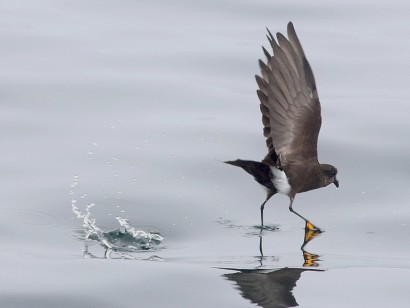
Pelagic birding is always a highlight of our time in Grand Manan, and this year was no different. Our first Black Guillemots were spotted while waiting for the ferry in Black’s Harbour – a species we would become familiar with over the next few days. We had calm, sunny conditions for our ferry trip and were able to spot birds such as Pomarine Jaeger, Great Shearwater, Razorbill and Common Murre. Two Fin Whales also made an appearance, exciting even the other “non-birding” passengers on deck. The day of our pelagic boat tour was also beautiful, and the flat calm conditions were perfect for a day on the bay. We sailed well south of Grand Manan, making our way through “the prong” and the edge of the northeastern bank. Dozens of Great Shearwaters, Wilson’s Storm-Petrels, Leach’s Storm-Petrels, several Sooty Shearwaters and two Manx Shearwaters sailed effortlessly over the waves while occasional flocks of both Red and Red-necked Phalaropes skittered by.

Leach’s Storm-petrel © MItch Doucet

Parasitic Jaeger and Red-necked Phalarope © Jared Clarke
Several Great Cormorants were spied lounging on the “Black Rocks”, and plenty of Atlantic Puffins appeared to entertain us as we coasted along. Two Parasitic Jaegers flew past our boat creating some excitement (one in hot pursuit of a phalarope!), and a South Polar Skua checked us out as it flew directly over the boat and provided amazing views. A little more unexpected was a Long-tailed Jaeger – the first one reported in the region this summer. Perhaps the most exciting birds of the tour were two Cory’s Shearwaters, including one that joined the flocks of gulls and other shearwaters enjoying the “chum” behind our boat, making several close passes – a lifer for almost everyone!

Long-tailed Jaeger © Mitch Doucet

Cory’s Shearwater © Mitch Doucet
Our terrestrial wanderings took us to all corners of Grand Manan – from the sheer, rugged cliffs of Southwest Head to the rolling rocks at Swallowtail Lighthouse and many points between. Highlights included two locally rare Redheads, several Red-throated Loons, Whimbrel, Nelson’s Sparrow, Magnolia Warbler and numerous Northern Parula among many others.

Redhead © Mitch Doucet

Swallowtail Lighthouse © Jared Clarke
One morning we made a short skip over the water to neighbouring White Head Island, where we found our only Great Egret of the trip, a lingering Baltimore Oriole and a fun mixed flock of migrants that included Least Flycatcher, Red-breasted Nuthatch, Hermit Thrush and Black-throated Green Warbler among others. We also spared time to appreciate other little critters from butterflies to seals, a lovely sunset and many stunning seascapes. We also celebrated an exciting milestone for Sumeet, one of our participants – 1000 (and counting) species of birds photographed!!

Great Egret © Sumeet

Sunset at The Whistle © Jared Clarke
Our return ferry trip was a little less “birdy” than the first, but the perfect weather and flat seas made for a very enjoyable sail. We headed back to Saint John and a lovely dinner at the famous Reversing Falls.
August 11: Hampton, Fundy National Park & Mary’s Point
We began our last full day of the tour with a stop at nearby Hampton. The town’s sewage lagoons at the Rotary Nature Park were busy with lots of Wood Ducks, Northern Shovelers, Green-winged Teal, Common Goldeneyes and other ducks – but it was the surrounding trail and trees that were most hopping with birdlife. A mixed flock of early migrants hosted nine species of warblers including Cape May, Bay-breasted, Blackburnian and Black-throated Blue among others. Least Flycatcher, Red-eyed Vireo, Purple Finch, Song Sparrow and Northern Cardinal also numbered among the group. A Solitary Sandpiper probing in the mud was our only one of the tour, and provided great views as we strolled back along the trail. A “committee” of more than 20 Turkey Vultures circled overhead as we were leaving.

Wood Duck © Mitch Doucet

Solitary Sandpiper © Jared Clarke

Turkey Vulture © Mitch Doucet
The next few hours were spent exploring the landscapes of Fundy National Park. While many of the park’s trails were closed due to dry conditions and wildfire concerns, we were still able to enjoy some exploring in more open areas and some excellent birding. A pair of Common Loons, complete with chick, were swimming and calling loudly at Wolfe Lake – a fun and profoundly Canadian experience. Two Red Crossbills were singing in the nearby trees, eventually flying out over our heads and calling as they crossed the lake. Even our picnic lunch was highlighted by several birds, including a Blackburnian Warbler, Black-throated Green Warbler and Downy Woodpecker.
Ending on a high note, we saved one final highlight for our very last stop of the tour. We arrived at Mary’s Point Bird Sanctuary, on the opposite side of Shepody Bay from where we started on August 4, at high tide and walked down to the narrow strip of beach that remained. Out over the water was a HUGE murmuration of more than 100,000 (!!) Semipalmated Sandpipers – whirling, twirling and twisting into ever-changing shapes like a stunning art exhibit. We watched the show for several minutes, even as a Peregrine swooped through the swarm and sent them in a flurry of directions and eventually over the horizon and out over the bay. What an incredible spectacle to celebrate the end of an amazing week!

Our group
Back in Moncton, we reminisced and shared our favourite memories over dinner before setting off on our various paths home. What a fantastic trip, with a wonderful group of people!