Cambodia & South Vietnam
Highlights
Highlights
- Search for rare and migratory shorebirds along the tidal mudflats of Vietnam's Mekong coast.
- Explore Cat Tien National Park's tropical forests in search of colourful pittas, broadbills, hornbills and elusive pheasants.
- Discover the endemic-rich highland forests of the Da Lat Plateau, home to distinctive laughingthrushes and other regional specialties.
- Seek rare ibises, woodpeckers and other forest birds in Cambodia's dry dipterocarp forests at Tmatboey.
- Explore the grasslands and wetlands of Tonle Sap and Ang Trapeang Thmor in search of cranes, threatened grassland birds and large waterbirds.
- Experience the magnificent temples of Angkor Wat and Angkor Thom, combining birding with Cambodia's remarkable cultural heritage.
Map
Map
Overview
Tour Overview
Cambodia and southern Vietnam offer an exceptional variety of birding experiences, from coastal mudflats and tropical lowland forests to cool highland woodlands, dry dipterocarp forests and expansive wetlands. Our Cambodia & South Vietnam birding tour explores these contrasting habitats in search of sought-after regional specialties, including numerous endemic and threatened birds.
In southern Vietnam, we search the Mekong coast for the critically endangered Spoon-billed Sandpiper and other migratory shorebirds and explore the rich lowland forests of Cat Tien National Park. Here, our targets include Germain’s Peacock-Pheasant, Siamese Fireback and colourful pittas and broadbills. The southern highlands offer a different selection of birds, with visits to Di Linh, Nui San Pass and the Da Lat Plateau, where distinctive species such as Collared Laughingthrush, Gray-crowned Crocias, Vietnamese Cutia and Vietnamese Greenfinch are among the many possibilities.
In Cambodia, we explore the magnificent temples of Angkor Wat and Angkor Thom and visit the grasslands around Tonle Sap in search of the endangered Bengal Florican. The dry dipterocarp forests of Tmatboey provide opportunities to look for Giant Ibis, White-shouldered Ibis and other forest specialties. A boat excursion to Prek Toal Bird Sanctuary brings us into the wetlands of Tonle Sap Lake, where large waterbirds such as Greater Adjutant, Milky Stork and Spot-billed Pelican are important targets. We also visit Ang Trapeang Thmor, known for its wintering Sarus Cranes and diverse wetland birdlife.
Led by an experienced Eagle-Eye Tours guide alongside knowledgeable local guides, this journey combines the remarkable birdlife of two countries with varied landscapes, fascinating habitats and Cambodia’s extraordinary cultural heritage.
Dates & Prices
Dates & Prices
What's Included
Tour Price Includes
- One internal flight included
- Accommodation excellent to moderate, comfortable and adequate hotels and lodges
- 6 to 12 participants with an Eagle-Eye Tours leader and a local guide throughout
- All meals and soft drinks
- Airport transfers
- Ground transportation
Tour Price Does Not Include
- Flights to and from start/end
- Travel Insurance
- Alcoholic beverages
- Items of a personal nature
Gallery
Gallery


Itinerary
Itinerary
Day 1: Arrival in Ho Chi Minh City, Vietnam
Our Cambodia & South Vietnam birding tour begins in Ho Chi Minh City. This evening, we gather for a welcome dinner and briefing, providing an opportunity to meet our fellow travellers and guides and discuss the birding adventures ahead.
Night in Ho Chi Minh City.

Day 2: Mekong Coast Shorebirds and Transfer to Cat Tien National Park
We depart Ho Chi Minh City early this morning and head towards the Mekong coast, where tidal mudflats and coastal wetlands provide important feeding habitat for migratory shorebirds travelling along the East Asian–Australasian Flyway.
Our principal target is the critically endangered Spoon-billed Sandpiper, one of the world's rarest shorebirds. We will carefully search suitable feeding areas for this remarkable species, while also looking for Terek Sandpiper, Broad-billed Sandpiper, Red-necked Stint, White-faced Plover, Tibetan Sand-Plover, Greater Sand-Plover and Chinese Egret, among other coastal birds.
The timing of our birding will depend on the tides, which influence where shorebirds gather and feed.
Following our coastal birding, we travel north to Cat Tien National Park, an important area of protected lowland forest in southern Vietnam. Depending on our arrival time, we may have an opportunity for some introductory birding before dinner.
Night in Cat Tien National Park.

Days 3 & 4: Cat Tien National Park
We have two full days to explore Cat Tien National Park, where tropical lowland evergreen forest, bamboo, wetlands and forest edges support a remarkable variety of birds. Our birding will take us along forest trails, tracks and other productive areas, with early mornings particularly important for some of the more elusive forest species.
Among our principal targets are Germain's Peacock-Pheasant and Siamese Fireback, two highly sought-after forest birds. We will also search for Green Peafowl and Scaly-breasted Partridge, while the forest floor offers opportunities for Blue-rumped Pitta and Bar-bellied Pitta.
Cat Tien is also excellent habitat for broadbills, and we will look for Black-and-red, Banded and Dusky Broadbills. Other possibilities include Pale-headed and Black-and-buff Woodpeckers, along with hornbills, barbets and a variety of other forest birds.
Our guides will adjust our birding activities according to local conditions and bird activity, allowing time to explore different habitats and revisit promising areas.
Nights in Cat Tien National Park.

Day 5: Transfer Cat Tien to Di Linh and Nui San Pass
After an early-morning birding session in Cat Tien National Park, we leave the lowland forests behind and travel to Di Linh in the southern highlands, where cooler conditions and different forest habitats bring a new selection of birds.
If time permits, we will spend part of the afternoon birding around Nui San Pass. This area offers opportunities to search for Blue Pitta, Rusty-naped Pitta, Green Cochoa and Spotted Forktail, as well as regional specialties such as White-cheeked and Black-hooded Laughingthrushes.
Night in Di Linh.

Day 6: Nui San Pass and Transfer to Da Lat
We return early to Nui San Pass to continue exploring its highland forests. Along with another opportunity to search for the pittas and other elusive species, we will look for Orange-breasted Laughingthrush, Vietnamese Cutia, Black-headed Parrotbill and mixed flocks of forest birds.
We then continue to Da Lat on the Langbian Plateau, with possible stops along the way. Known as the “City of Eternal Spring,” Da Lat has a cooler climate and a landscape of pine forests, lakes and highland woodlands. The surrounding plateau is recognized as an Endemic Bird Area for its concentration of distinctive regional birdlife.
Night in Da Lat.

Days 7 & 8: Da Lat Plateau — Mount Langbian, Ta Nung Valley and Surrounding Forests
We have two full days to explore the forests of the Da Lat Plateau, including Mount Langbian, Ta Nung Valley and other productive birding areas. The region supports an impressive concentration of Vietnamese endemics, near-endemics and highland specialties.
Around Mount Langbian, we will search for Collared Laughingthrush, Yellow-billed Nuthatch, Black-crowned Fulvetta, Vietnamese Greenfinch, Black-headed Sibia and other montane forest birds. Bar-backed Partridge and Silver Pheasant are additional possibilities.
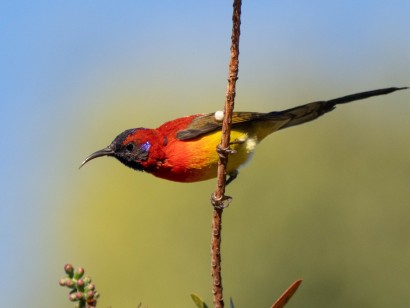
Ta Nung Valley is an important location for the range-restricted Gray-crowned Crocias. Other targets in the surrounding forests include Vietnamese Cutia, White-browed Shrike-Babbler (Dalat) and Mrs. Gould's Sunbird.
Our daily plans will remain flexible, allowing our local guides to adjust the sequence of birding sites according to weather, access and bird activity.
Nights in Da Lat.

Day 9: Da Lat to Ho Chi Minh City
We begin the day with a final morning of birding around Da Lat, providing another opportunity to search for highland specialties that may have eluded us during our previous outings.
Among the birds we may look for are Gray-crowned Crocias, Collared Laughingthrush, Vietnamese Cutia and Vietnamese Greenfinch. Our guides will select suitable birding locations based on recent activity and the species already encountered.
Following our morning birding, we leave the highlands and return to Ho Chi Minh City, where we spend the night before travelling to Cambodia.
Night in Ho Chi Minh City.

Day 10: Flight to Siem Reap, Cambodia
Today we leave Vietnam and fly to Siem Reap, Cambodia, the gateway to the magnificent temples of Angkor and the diverse birding habitats of northwestern Cambodia.
Upon arrival, we transfer to our hotel. Depending on our flight schedule, there may be time to relax or enjoy a short introduction to the surrounding area.
Night in Siem Reap.

Day 11: Angkor Wat and Angkor Thom
Today we explore the extraordinary temple complexes of Angkor Wat and Angkor Thom, among Cambodia's most important cultural and historical sites. These remarkable monuments, surrounded by woodland, provide an opportunity to combine birding with an introduction to the history and architecture of the Khmer Empire.
We will spend time exploring the temples and their surroundings, with our guides helping us appreciate both the cultural significance of the area and its birdlife.
The surrounding woodlands, temple grounds and moats provide habitat for a variety of resident and wintering species. We will look for Great Hornbill, Alexandrine and Blossom-headed Parakeets, Lineated Barbet, Coppersmith Barbet, Asian Barred Owlet, White-throated Rock Thrush and Forest Wagtail, among other birds.
Night in Siem Reap.

Day 12: Tonle Sap Grasslands and Transfer to Tmatboey
This morning we travel to the grasslands around Tonle Sap Lake, where our principal target is the endangered Bengal Florican. These open grassland habitats support a variety of birds, and we will spend time searching suitable areas for this distinctive species.
Other possibilities include grassland birds and raptors, with our guides selecting birding locations according to local conditions.
Following our morning birding, we continue north towards Tmatboey, travelling into a landscape of dry dipterocarp forest that supports several of Cambodia's most sought-after birds.
If time permits, we may begin exploring the surrounding forest after our arrival.
Night in Tmatboey.

Day 13: Tmatboey Dry Dipterocarp Forest
We spend today exploring the dry dipterocarp forests around Tmatboey, a distinctive habitat characterized by relatively open woodland and seasonal waterholes known locally as trapeangs.
Our principal targets are Giant Ibis and White-shouldered Ibis, two threatened species associated with these forests and their seasonal wetlands. We will search suitable areas with the assistance of our local guides, who are familiar with the birds and their habitat.
The surrounding forest also supports an interesting selection of woodpeckers and other regional specialties. Among the possibilities are Black-headed Woodpecker, Great Slaty Woodpecker, White-bellied Woodpecker, Rufous-winged Buzzard, White-rumped Falcon and various parakeets and other dry forest birds.
Depending on local conditions and the group's energy, there may also be an opportunity for some night birding.
Night in Tmatboey.

Day 14: Tmatboey to Siem Reap
We have another opportunity to explore the dry forests around Tmatboey this morning, concentrating on species we may have missed during our previous birding sessions.
Giant Ibis and White-shouldered Ibis remain important targets, along with the area's woodpeckers, parakeets, raptors and other forest specialties.
Later, we travel back to Siem Reap. Depending on our schedule, we may make additional birding stops along the way.
Night in Siem Reap.

Day 15: Prek Toal Bird Sanctuary, Tonle Sap Lake
Today we explore the wetlands of Tonle Sap Lake with a boat excursion to Prek Toal Bird Sanctuary, an important breeding area for large waterbirds.
Travelling through wetland and flooded-forest habitats, we will search for Greater and Lesser Adjutants, Milky Stork, Painted Stork, Asian Openbill, Spot-billed Pelican and Oriental Darter. Herons, egrets and other wetland species add to the variety of birds we may encounter.
The timing and extent of our excursion will depend on water levels, boat access and local conditions, with our guides adjusting the day's activities accordingly.
After our excursion, we return to Siem Reap.
Night in Siem Reap.

Day 16: Ang Trapeang Thmor
Our final full day of birding takes us to Ang Trapeang Thmor, a wetland reserve comprising a reservoir, surrounding grasslands, agricultural areas and patches of dry forest.
The reserve is an important wintering area for Sarus Crane, one of our principal targets today. We will explore suitable wetland habitats in search of these impressive birds, along with a variety of waterfowl, waders and other wetland species.
Other possibilities include Indian Spot-billed Duck, Cotton Pygmy Goose, Garganey, Black-backed Swamphen, Pheasant-tailed Jacana, Bronze-winged Jacana, Spot-billed Pelican and Painted Stork.
We return to Siem Reap for our final evening together.
Night in Siem Reap.

Day 17: Departure from Siem Reap
Our Cambodia & South Vietnam birding tour ends today after breakfast. We will transfer you to Siem Reap International Airport for international departures. You can depart anytime today.
What to Expect
What to Expect
Overview
The Cambodia & South Vietnam tour is a fast-paced birding tour, with early mornings and some long days in the field. Our visit to Angkor Wat combines birding with exploring the remarkable temples and their history. If Angkor Wat is a particular highlight for you, consider allowing an extra day or two in Siem Reap to explore the vast temple complex at your own pace.
Food
We generally begin birding at daybreak, returning to our accommodation for breakfast. Most lunches are taken at the hotel or a local café, although we may occasionally have a picnic-style lunch to maximize our time in the field. Dinner is usually at our accommodation or a nearby restaurant.
Each evening after dinner, we compile the day’s checklist, review our bird and mammal sightings and other observations, and discuss plans for the following day.
Accommodation
Accommodation ranges from basic hotels to comfortable lodges. All accommodations have private bathrooms with hot water.
Walking
Walking on this tour is mostly easy, with one moderately difficult walk on Mount Langbian, where the trail becomes quite steep in places. We take this walk slowly, with frequent stops along the way.
Driving
Most days involve a small to moderate amount of driving, apart from transfers between accommodations, which can take up to four hours.
Climate
We encounter a range of climatic conditions during the tour. In southern Vietnam, the lowlands are generally hot, humid and sunny, with occasional afternoon showers. At higher elevations around Di Linh and Da Lat, conditions range from warm to cool, particularly in the early mornings. Overcast skies and rain are also possible.
Cambodia is generally hot and humid, with daytime temperatures approaching 32°C (90°F). Much of the woodland habitat is relatively open, with considerable exposure to the sun.

Frequently Asked Questions
Land Tours FAQs
Whether you’re a seasoned birder or new enthusiast, these FAQs cover important details about our tours, including schedules, fitness requirements, group dynamics and more.
Featured Wildlife
Featured Wildlife
The species below are among the birds and mammals we may encounter on this tour. Sightings vary from year to year and cannot be guaranteed.
- Germain's Peacock-Pheasant
- Collared Laughingthrush
- Gray-crowned Crocias
- Blue-rumped Pitta
- Black-headed Parrotbill
- Vietnamese Cutia
- Red-vented Barbet
- Silver Pheasant
- Siamese Fireback
- Bengal Florican
- Giant Ibis
- White-shouldered Ibis
- Spoon-billed Sandpiper
- Vietnamese Greenfinch
- Sarus Crane
Past Tour Checklists
Past Tour Checklists
View the list of birds and other wildlife we encountered on our past tours.
- Cambodia & South Vietnam species list 2026 (eBird)
- Cambodia & South Vietnam species list 2025 (eBird)
- Cambodia & South Vietnam species list 2024 (eBird)
- Cambodia & South Vietnam species list 2020 (eBird)
- Cambodia & South Vietnam species list 2018
- Cambodia & South Vietnam species list 2013
- Cambodia & South Vietnam species list 2012
Compare your life list to our last tour
Get an estimate of how many new species you may see.
Try our Lifer tool