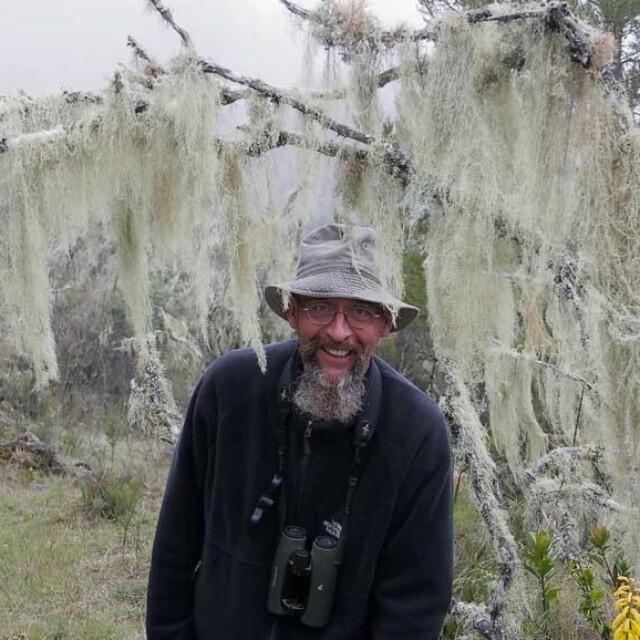
Uganda: Birds, Gorillas & Chimpanzees Trip Report 2026
On this 17-day Uganda tour, we explored an extraordinary range of habitats, from papyrus swamps and the Nile’s riverbanks to open savannas and the montane forests of the Albertine Rift. We enjoyed unforgettable highlights including Shoebill at Mabamba, rhinos at Ziwa, boat cruises in Murchison Falls and Queen Elizabeth National Parks, and superb birding in Budongo, Kibale, and Semliki. We trekked to spend time with both Eastern Chimpanzees and Mountain Gorillas in Kibale and Bwindi—truly profound wildlife encounters. Along the way we recorded 514 bird species, the Big Five, and more than a dozen additional primate species. It was one of the most comprehensive and rewarding wildlife journeys in tropical Africa.
The diversity of habitats in Uganda embraced as “faunal preserves” fancifully resembles a necklace of pearls, an imaginary line threaded along the Equator. The pearls make Uganda truly unique. Were a foreign naturalist able to visit only one or two countries in tropical Africa then I feel friendly Uganda should be one (the other might be Tanzania!). So Uganda is a nature destination for our times. A compact bird-rich land on the Equator, astride the northern shore of Victoria-Nyanza, Africa’s largest lake.
Uganda’s wealth of “ecological capital” also provides a refuge for “Big Nature”. Amazingly so, when one considers the teeming human population the country supports. A refuge of resplendent tropical mountain forest, bedecked in dense and brilliant greens. Forests where our closest surviving neighbours on the tree of evolution, hang by the strength of their hands and, in comparison with we – the “Homo sapiens” ape – by virtue of a more fundamentally gentle disposition.
In fact the “Protectorate of Uganda” one hundred years ago was described by a notoriously loquacious Winston Churchill as a “Pearl of Africa”. One hundred years later, for the travelling naturalist, the metaphor still resonates. Such a wealth of wild lands, replete with mammals and birds within one small country, is of inestimable global significance. And so, to this day, Uganda can boast of possessing not one but a complete necklace of beautiful pearls.
Our recently refurbished tour enjoys as many pearls as time will allow. Sixteen field-days enables the Eagle-Eye Tours participant to savour a broader cross-section of Uganda’s diverse habitats than any other tour of comparable duration. From the open, and seasonally burnt, Guinea savanna of the north-west, around the thundering seven metre wide Nile gorge at Murchison Falls, to the vertiginous mountain forests of Bwindi in the far south-west along the border with Rwanda and the DRC.
We began our January adventure with an afternoon bird-walk through the Entebbe Botanical Gardens. Entebbe is a spacious well-timbered town, that straddles the swampy shoreline of vast Lake Victoria, where our various international flights had arrived on January 12. Vast marshes of papyrus and sedge lie only a short ferry ride westwards across the water from Entebbe. So early next morning we boarded narrow boats at the by-now-famous “shoebill swamps” of Mabamba go pay our respects to the great stork.
On our second full field day we set-off on the safari proper. We drove swiftly north from the Equator, skirting the outer limits of the sprawling capital city of Kampala, to alight by lunchtime in the tranquil savanna woodlands of Ziwa Rhino Sanctuary. After a close and entirely peaceful encounter with a family of four White Rhinoceros, and our first pair of Northern Ground Hornbills, we proceeded to the town of Masindi where we overnighted at the oldest ‘international hotel’ in Uganda. A hotel once frequented by the likes of Ernest Hemingway.
Next morning we departed early for a stealthy bird-rich stroll along the fabled (at least by global-birders) “Royal Mile” of Budongo Forest. Thence on to Murchison Falls National Park where we would spend two nights at Pakuba next to the mighty Nile. Here we explored dry Guinea savanna landscapes which characterise the north west of Uganda. An afternoon here was devoted to a boat trip to view the thundering falls and enjoy the equally impressive wildlife that was busy foraging along the bank of the river.

Birding Royal Mile © James Wolstencroft
Leaving Murchison and “The Nile” we climbed a wall of the Rift Valley and drove through densely populated undulating agricultural country of the central highlands (making two birdy stops) to arrive at our next lodgings south of the western city of Fort Portal. From our base at Guereza Canopy View Lodge we made the essential trek to visit a group of Chimpanzees and spent a third morning birding Bigodi swamp and its agricultural environs. Guereza is an onomatopoeic Amharic name for the calls of the splendidly attired Black-and-White Colobus monkey. We slept three nights here in the warm embrace of the famous “chimpanzee forests” of Kibale National Park.

Birding the Rift Valley escarpment © James Wolstencroft

Bigodi swamp boardwalk © James Wolstencroft

Bigodi Swamp © James Wolstencroft

Birding in Kabale Forest © James Wolstencroft
On the in-between morning of our three night stay at “Guereza” we set-off even earlier than usual for the biologically renowned lowland extension of the Congolian forests in Semliki National Park. A day that was crammed with exciting ornithological observations. We returned east, skirting the Rwenzori Mountains to Fort Portal, in the late afternoon.
After the relatively dry evergreen hill forests and luxuriant swamps of Kibale, Bigodi and the incomparable Semliki jungles we transferred to Queen Elizabeth II national park for a stay of two nights. Here in late afternoon sunshine we took the third, of our four, wonderfully productive river cruises.
Between terrestrial exploration of the two extremes of partially burnt dry season savanna and moist montane forest, we certainly welcomed these leisurely trips by motorised launch. Frequently puttering about, at almost stall-speed, going shore-to-shore we would pass between floating logs, who would morph into Nile Crocodiles, or around shiny mud-banks that suddenly revealed themselves as snorting, disgruntled Hippopotamus when we approached a little too close for their comfort.

Nile Crocodile © James Wolstencroft
Along the fringes of the rivers and large wetlands we were treated to a superlative wealth of avian life, of waterbirds in particular. A pageant of waders, most of them incredibly tame, birds that ranged in size from the diminutive grey Little Stints in Queen Elizabeth National Park to the stupendous Shoebill (formerly known as the Whale-headed Stork) in the papyrus swamps. This iconic bird is the epitome of a feathered dinosaur if ever there was one.
One group favourite, below Mweya Lodge in Queen Elizabeth park was the panorama of piebald African Skimmers. These great terns were prone to ‘dread’, rising from the sand bars in a squeaking, creaking, whirling flock. Falling around us in unison like so many arrows, as if released from a thousand quivers, from invisible archers hiding in the riparian scrub. The variety and number of herons, from the tiny Little to the true Goliath, of storks and egrets and shorebirds fussing and foraging here was as heart-warming as it was spectacular. Especially so when the engine was cut and we drifted closer, so close that we could delight in the plumage texture of so many different species. An exquisiteness of fine detail was easily visible in the shorebirds, the field marks and morphology of the various sandpipers and plovers were evident, the difference between the Greenshanks and Ruff was apparent plus the emboldened lapwings, ostentatiously ornamented by their wattles and spurs. Such boat trips greatly enhance the Uganda wildlife experience.
From Queen Elizabeth ( NP) we gradually ascended through lowland forest and moist savanna to the south-western highlands. Our destination a community-run eco-lodge at Bakiga in Ruhija the quietest gorilla tracking sector of the awe inspiring Bwindi Impenetrable Forest National Park. Three nights were spent here.

Gorilla trek © James Wolstencroft

Gorilla treking © James Wolstencroft
On our two full days at Bwindi we undertook long treks into magical mountain forest. We were blessed with dry weather, as is typical of this time of year, and on our first day had no problem locating and following the Bitukura family of Mountain Gorillas. A profoundly unique experience that creates a much anticipated hinge-and-high point of any Uganda nature tour. The next day we made a slightly less arduous yet dedicated trek “endem-birding” toward a hidden highland swamp. There were so many birds and butterflies to look at however that we only got half way there!
Apart from one day at Mburo NP, toward the end of our tour, the sun shone daily so that our explorations went essentially unimpeded. This was most fortunate, especially for our days in the forest. Days when we trekked for up to two and a half hours in a human chain of guides, porters, rangers and armed guards to sneak a peek into the private lives of the Eastern Chimpanzees and Mountain Gorillas. Words could never convey the feelings aroused by sharing, if only for an hour at a time, the home and habits of these gentle jungle denizens. We appreciated that we were true adventurers, simply to be here, connecting with these last ingenious inhabitants in a sufficiently remote corner of an overwhelmingly humanised Earth. Outliers both in a 21st-century where fulfilment supposedly can be delivered to us as contact-on-demand.
It is a credit to the administration of Uganda that despite struggling to support a population of over 50 million folk they can preserve viable populations of these endangered agile apes in their thick forest homes. Forests that seem to be forever shrinking. Disappearing in the face of our relentless demand, a global demand, for high-tech gadgets and advanced weaponry, as well as for delicious varieties of tropical fruit or vegetable. A demand not simply for land for the humble ‘Irish potato’, the staple crop, upon which the locals highlanders rely.
Uganda and her primates make up what is without doubt a must see “destination”. Anyone who has dreamt of Africa and her darkest recesses should make the pilgrimage to visit our boisterous “chimping” next of kin and our more placid vegan relatives the gorillas. Only our patronage and our money will keep them safe, at least in the medium term tucked away, secure for now at least, in their own little forested world.
Somewhat reluctantly we left them and their ‘endemic-rich’ Albertine Rift highlands after our allotted three nights and descended to Lake Mburo National Park. Here we made our last, but by no means least productive, boat trip of the tour. There was some unseasonal rain in the south west of Uganda, (a spin-off from a cyclone over Madagascar), for part of the last two full days of our tour, yet we still earned for ourselves some fascinating watery observations. The seven magnificent African Finfoot becoming another high point of our tour.

African Finfoot chick © David Lai
But what, I hear you say, of the forest birds specifically?
Of course for every individual observer on a tour there’s a different selection of birds encountered that subsequently spring to mind in the memory. Nevertheless who could forget, as an example, the outrageous and noisy Great Blue Turaco, that gloriously attired clown of the Congolian rainforest? Who wouldn’t be amazed, rendered breathless even, when any one of the smaller turaco species which we found, glides past, catching shafts of sunlight between the dark trees of the forest? Thereby revealing wings emblazoned by the uniquely red turacine, a pigment of its primary feathers? A red so wonderfully intense that it is an accredited colour, scientifically proven. I must also mention again the Lake Mburo boat trip where the seven African Finfoot which we found after a disconcertingly long search – especially for the senior guide – of over half an hour, included a mother with two ostentatious fluffy chicks! Absolutely spell binding!

Great Blue Turaco © David Lai

Ross’s Turaco in flight © David Lai
One place that we visit, that lamentably is neglected by many travel companies, is the lowland valley of the Semliki, a river flowing into Congo behind the fabled Mountains of the Moon along the border with DRC. Here thanks to the combined talents of Paul and Alex, our wonderful local guide and a true forest birder, we found some birds that are very rarely seen. We went ‘off piste’ to dance our way through soldier ant-infested thickets in a highly successful quest for the Rufous-sided Broadbill. Presently we investigated a somewhat secret spot, known only to Alex, and sure enough managed glimpses of a female chocolate brown Bates’s Nightjar. Undoubtedly we were also extremely fortunate to see both Red-billed Dwarf and Eastern Little Hornbill on the same afternoon in Semliki.

Rufous-side Broadbill © David Lai
In the forest of the Royal Mile we found a Uganda Woodland Warbler. It was flitting and hovering in the lower canopy, admittedly it is an “LGJ”, a very dull little greenish leaf warbler, an avian manifestation of an olivaceous ‘old world glory’, yet it is a prize rarity nonetheless. At the Royal Mile I even found myself a lifer, in the form of a far more colourful and exotic bird, the evocatively named Chocolate-backed Kingfisher.
For me one of the best bird walks of the tour was earlier that same Bodongo day. Our eager line of observers spent an action-packed hour stumbling around in a “shamba” on a hillside, an area surrounded by sugar cane plantations, with local guide Raymond. Shamba is a Bantu name for a family’s small holding. Highly productive agricultural systems these, that incorporate many techniques of “old-fashioned” market gardening elsewhere. Birds in these African weedy plots of cassava and sweet potato are always plentiful. They give us a glimpse into how rich things used to be everywhere, even in the old family farms of what is nowadays an arguably over-developed modern world. Here on the hills above the Budongo Forest were many commensal African birds. Birds with very African names and exhuberant characteristics. In addition to the ubiquitous Doves, Bulbuls, Babblers, Prinias and Waxbills there were Boubous, Gonoleks, Twinspots, Olivebacks and Widowbirds.
Admittedly on our tour all of we birders accumulated “a ton of glimpses” and frequently the glimpses were of sought-after Albertine endemics. Range-restricted feathered fiends these are, prone to not only “NOT perform”, but worse, prone it seemed, to dash or dart forever deeper into cover. To disappear, within a trillion leaves and twigs of a dark green jungle wall, or up into the midstorey or worse yet, off into the lofty forest canopy usually “against the light”. The name “Impenetrable Forest” of “Mubwindi” (meaning “place of darkness” in the Runyakitara language) has come to characterise this fantastic Albertine Rift region, most easily accessible here, albeit tucked-away, in the far south west of what is now Uganda.
Out in the sunny savanna however it’s an entirely different story and we often got up close and rather personal with the nature. As with the four dozing White Rhinoceros in Ziwa Sanctuary, the more so since that warm afternoon we were all on foot. Whilst in the hours from boat or ‘truck’ we met with lots and lots of elephants. We briefly savoured the surprise of seeing a Leopard out in the open, in the misty light of early morning. We saw a lioness too, and close, one sunny afternoon. We saw thousands upon thousands of sniffy, occasionally steaming, Cape Buffalo. Often they were together with an abundance of “smaller game”: Impala, Topi, Uganda Kob, Eastern Bushbuck and Defassa Waterbuck, the delightful Oribi. All from the comfortable security of our “pop-top” Toyota landcruiser. In addition to lots of other humans, and the two great apes, we saw a further twelve species of diurnal primate. We saw a lot of butterflies and quite a few big moths. This senior guide was delighted, more especially in the high altitude forests, by an abundance of colourful and exotic flies several of whom remain completely nameless!

Elephants Queen Elizabeth NP © James Wolstencroft
Finally, none of us will forget those few undeniably comedic moments of pure jungle joy! Jolts of adrenalin: The time when Eileen, point guide on the chimpanzee trek, together with a male member of our group came stumbling and crashing past us, back down the line. She was waving, shouting something incomprehensible, it was muffled by the tangled undergrowth. Stopping, somewhat breathless having momentarily lost her cool. We soon heard that she had just bumped into a three metre Forest Cobra (a beautiful shining black beast with narrow golden ventral bars Ed.) The slender snake had swung up out of harms way, or so it thought, to hang at about head height in a blue-flowered nightshade bush, nevertheless it soon found itself alarmingly close to yet more human shoulders, when cautiously we pressed-on to scan ahead for the somewhat perplexed and long-suffering chimps.
All too soon we were back at the comfortable Papyrus Guest House in Entebbe. The place where we’d come together. And now we prepared for those long-haul flights, out of Equatorial Africa, for some of us back home to what many people are prone to call modernity. Alternatively – the biologically impoverished zones of (declining) affluence aka “The Global North”.
Throughout we were expertly driven by our wonderful guide Paul. A total of 1,400 kilometres, and as said we enjoyed four delightful boating excursions. We amassed a bird list of 514 species. We saw the Big Five of “the game hunter’s animals” and the two great ape species, these together with at least twelve “lesser” species of primate.

Patas Monkey © James Wolstencroft
The national bird of Uganda is the Grey Crowned Crane, fittingly so, for these birds are not only hauntingly beautiful, they also symbolise fidelity, peace and harmony. They are a free-living exhortation for all of us to do the right thing, to help save by whatever means what’s left of “The Wild”.

Our group image after Chimpanzee trek