Eastern Australia Trip Report (Sep 19 – Oct 5, 2026)
Day 1:
On the first night, we all met for dinner at the delicious Balinese restaurant connected to the hotel. Keen as anything, many of the group had already spent the day birding around Cairns, with some awesome sightings to celebrate and photos to identify.
Day 2: Cairns and surrounds
Our first stop was Cattana Wetlands. The resonant, almost prehistoric calls of two large songbirds had us out of the vans and birding before we even reached the carpark. The songsters – Green Oriole and Black Butcherbird – were seen well in their lush environs. In the carpark, we also enjoyed an obliging Black-faced Monarch, a Varied Triller, and a female Leaden Flycatcher.
Walking around the lakes, we picked up some quintessential northern Australian waterbirds including Plumed Egret, Comb-crested Jacana trotting across the lily pads, and the very ornate Green Pygmy-Geese.
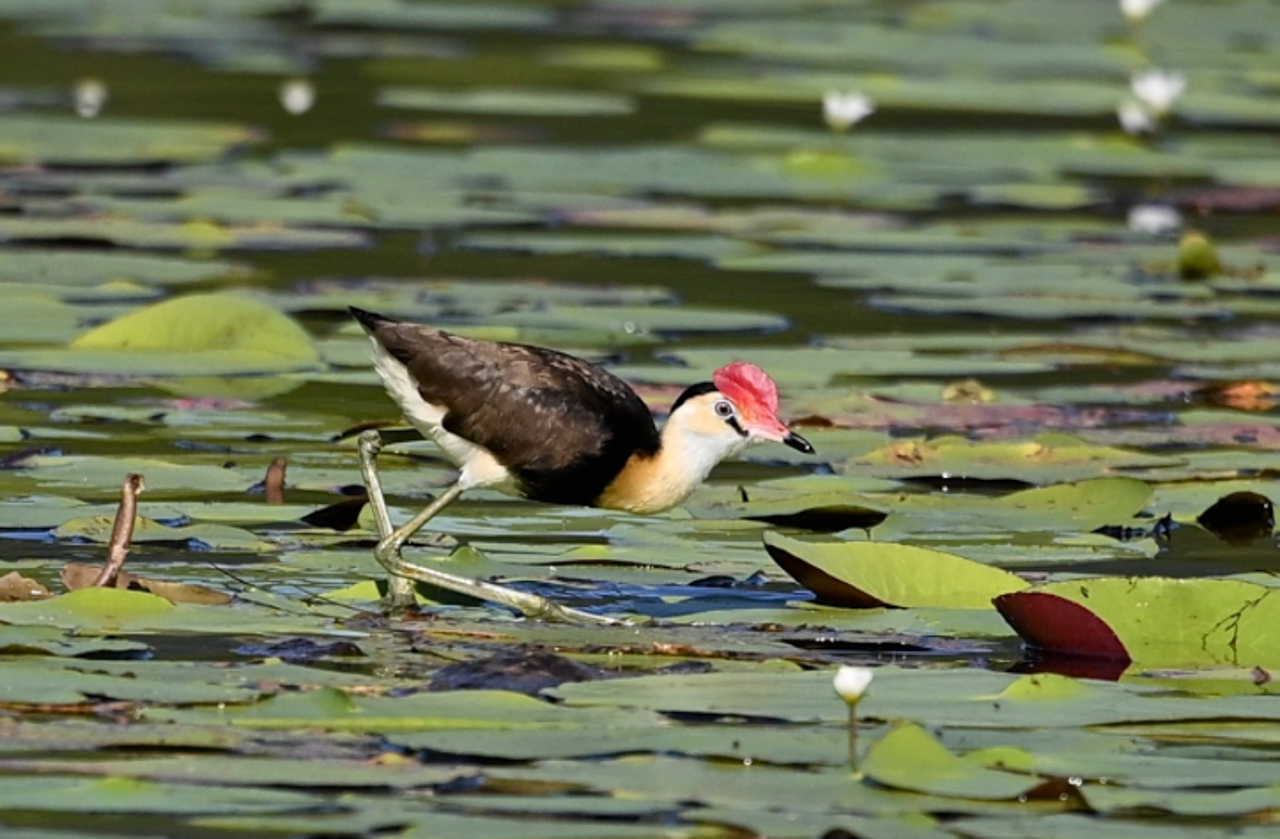
Comb-crested Jacana © Joe Wujcik
On the islands in the middle of the lake, we scoped out Little Black and Little Pied Cormorants, a pair of Rainbow Bee-eaters hawking in the morning light, and even a pair of Double-eyed Fig-Parrots boring a nest hollow in the dead wood of a paperbark. With Australia’s smallest parrots halfway across the lake, we all benefitted from scope-views of these tiny green bundles of joy.
Our resident scope-master, Deb, also spotted our most uncommon sighting at Cattana – a White-browed Crake! Eventually everyone got onto the bird as it darted in and out of the grassy lakeside, displaying elegant facial markings.
In the forest, a Brown-backed Honeyeater and a Large-billed Gerygone played hard to get, while Helmeted Friarbirds and Brown Honeyeaters were easy enough. Finally, everyone was wooed by a pair of Sahul Sunbirds feeding at eye height in the Crimson Bottlebrush, showing off their banana-yellow underparts and the male’s glossy blue bib.
On the road again, we made a very worthwhile pitstop at a swamp. Black-fronted Dotterels were active on the wing and on foot, while a little further off Marsh Sandpipers poked around with their long needle-like bills. They were joined by a Common Greenshank and a group of Sharp-tailed Sandpipers, and then a pair of Pied Stilts. What a joy to see such a nice array of waders.
A hundred metres further and we spotted a group of Royal Spoonbills feeding along with Great and Little Egrets too. And, finally, everyone’s highlight, a Black-necked Stork floated in on large black and white wings and bright orange legs. The bird landed, displaying the iridescent blue, purple and green on the head feathers that make ‘Black-necked’ such a sorry descriptor for this incredible species. And then took off again with big pink legs trailing, leaving us all in awe at a bird of such great size.
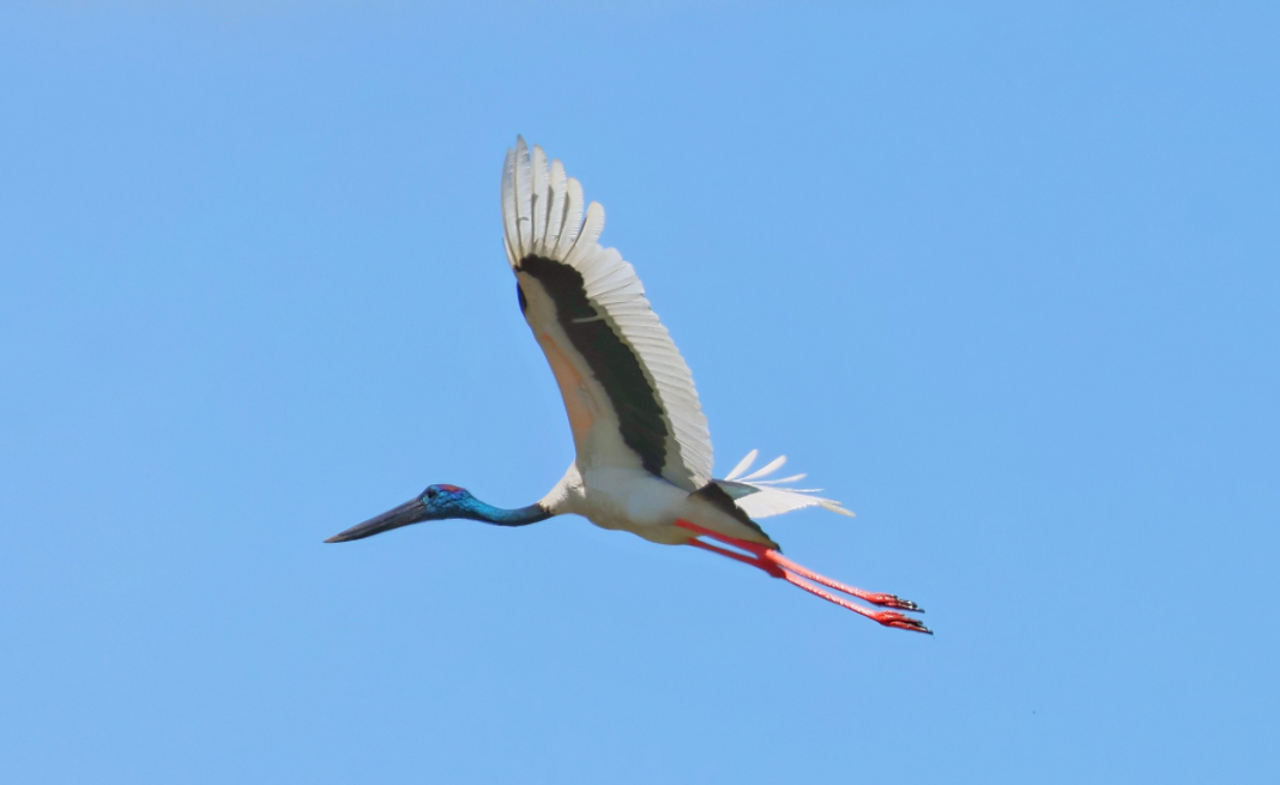
Black-necked Stork © Paul Prappas
We moved on to the Cairns Esplanade, surely one of Australia’s most pleasant and rewarding shorebirding locations. Settling under the shade of a fig tree, we scanned the mudflats and picked out a wonderful range of species: Black-bellied Plover, Red-capped Plovers, both Greater and Siberian Sand-Plovers, a Whimbrel or two, Gray-tailed Tattlers, a Far Eastern Curlew, Red-necked Stints and more. Even a vagrant Kelp Gull – a very unlikely bird in Northern Queensland – was scoped out. Sacred Kingfishers hunted nearby, and their much larger cousin – the hefty Torresian Kingfisher – was also spotted moving between the mangroves and mudflats.
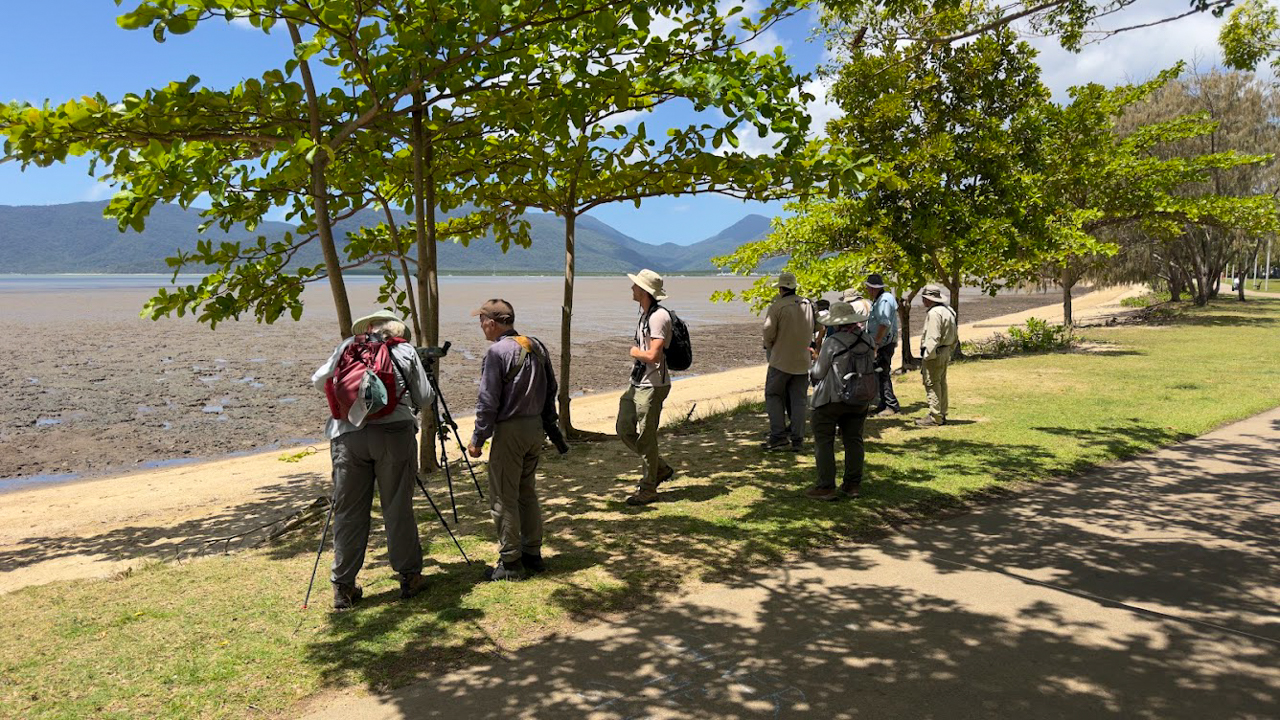
Birding on the Esplanade © Edward Sako
Varied Honeyeaters called in the trees around us, drawing us away from the mudflats and towards the mangroves. There we heard the mangrove specialist Mangrove Robin and saw the flash of a tail. Jackson persisted with the Robin hunt, while others were more than happy watching a much more confiding Willie-wagtail, one of Australia’s most beloved birds. Though the Robin remained elusive, the Willie-wagtail chased tiny insects springing from the grass, performing extraordinary acrobatics just centimetres from our heads. The photographers among us had to take a big step back!
We crossed the road for a delicious café lunch, before being drawn back to the Esplanade for more shorebirds and the colourful Figbirds and Fig-Parrots feeding in (you guessed it) a fig tree!
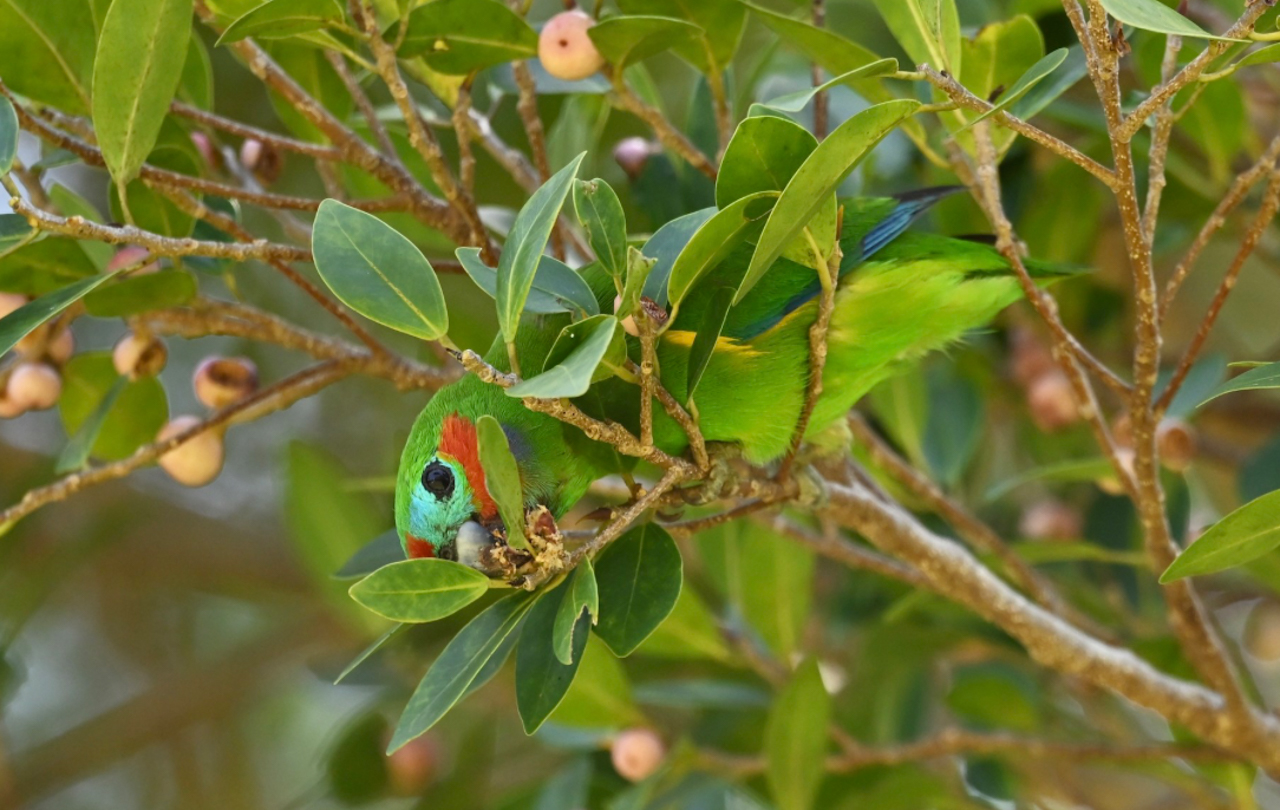
Double-eyed Fig-Parrot © Joe Wujcik
An afternoon walk in the Cairns Botanic Gardens yielded great views of birds like Radjah Shelduck, Metallic Starling, Yellow Honeyeater, Australasian Darter and the cartoonish Orange-footed Megapode.
We strolled along the streets of Cairns to dinner in the haunting company of gangly Bush Thick-knees. The male Rufous Owl, one of a well-known local pair, was spotted out hunting. A stretch of street trees looked at first like they were laden with oranges, but were in fact filled with Rainbow Lorikeets and Metallic Starlings settling in to roost. Their chatter was deafening, but on the way home from dinner they’d all settled down and were quite adorable all huddled together in pairs.
All in all, our first full day of birding showcased the awesome biodiversity of Australia’s Wet Tropics.
Day 3: Great Barrier Reef
The first of our trip’s three boat rides took us out of Cairns Harbour and into the Coral Sea, where the Great Barrier Reef stretches along the Queensland coast in a string of turquoise atolls and glowing white sand cays.
On the way out, we got a fly-by of a mixed group of terns – mostly Sooty, with their large, black, bat-like wings, along with one Common Noddy and a single pure white tern. Jackson was quick to pick the latter as a Black-naped Tern, and some speedy photos from Joe and Paul confirmed this pretty cool sighting!
Then the large, chocolate-brown wings of a Booby appeared on the horizon. And another, and another. As we approached our destination – the small lump of bright white sand called Michaelmas Cay – the horizon began to swirl with birds.
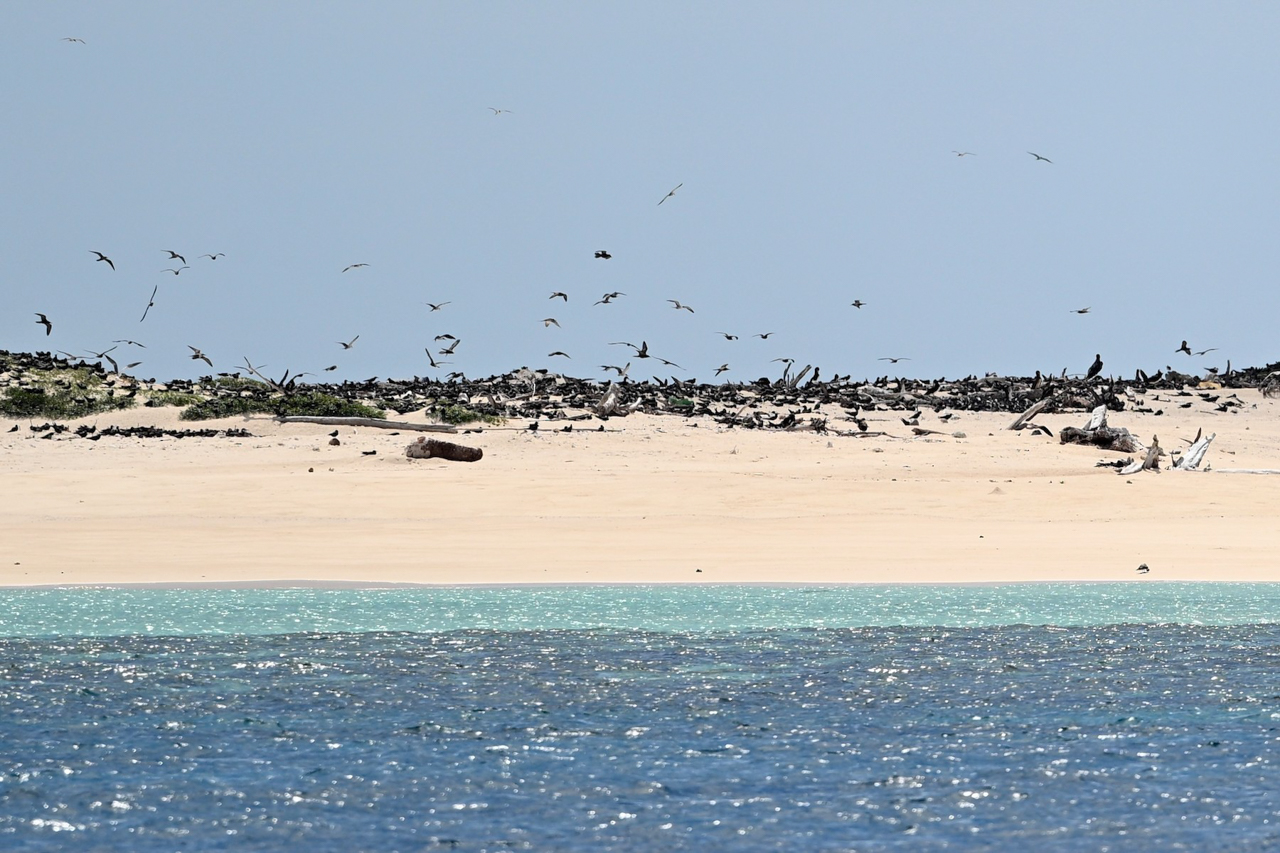
Michaelmas Cay © Joe Wujcik
Impatient, we tried scoping the island from the boat (not a great strategy). Before being ferried ashore in groups, a fish-feeding frenzy was set to take place, and we marvelled at the rainbow colours of large tropical fishes of five or six species from the starboard side of the ship.
The fish outdid the birds in the colour department, but the birds trumped them in sheer spectacle. It was exhilarating to step onto the island and get so close to seabirds nesting just metres from our lenses.
Sooty Terns and Common Noddies numbered in the hundreds. Brown Booby nests peppered the Cay, and we watched the birds ferry driftwood back and forth in their bright blue beaks. Some Booby nests already contained huge, fluffy white chicks.
Three Great Frigatebirds took to the air on giant wings. Great Crested and Lesser Crested Terns flew over, angelic and white against the deep blue sky, while a few Ruddy Turnstones scurried between the nesting seabirds.
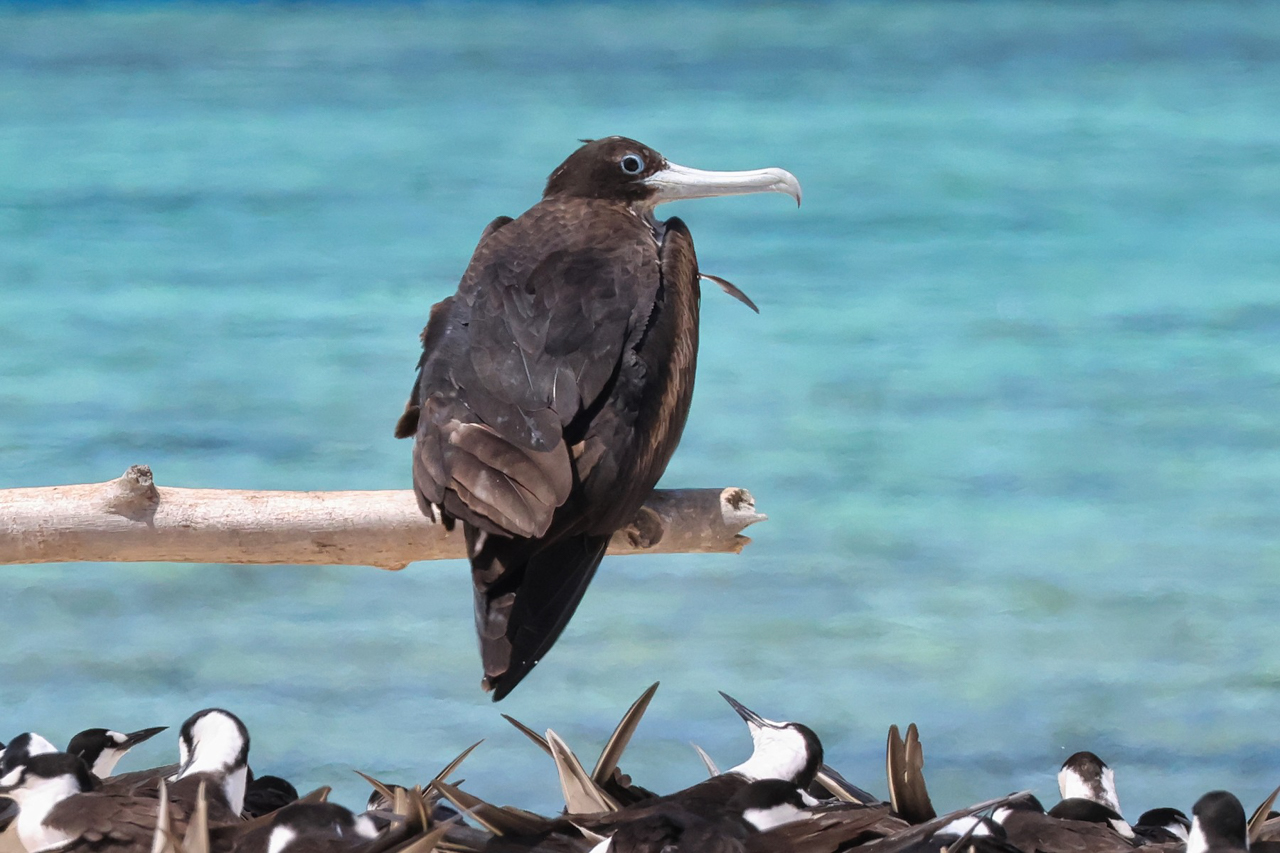
Great Frigatebird above Sooty Tern colony © Paul Prappas
While half the group watched the birds, the other half went snorkelling or took a glass-bottom boat trip to marvel at the reef, its fish and turtles. Some said they’d never seen anything quite like it.
And just when we thought all the excitement was over, Paul picked out a juvenile Red-footed Booby resting on the cay! It was almost like an apparition, suddenly appearing and disappearing, only to reappear just in time for the rest of the group to get a good look before we headed back to the boat.
Kindly, the captain arranged for one of the skippers to take us on an extra boat trip to view the roosting terns from the other end of the island. We got great views of Bridled Terns resting on a buoy: long white eyebrows, silvery plumage and a more delicate frame than the Sooties. We also enjoyed views of roosting Great Crested and Lesser Crested Terns, distinguished from one another by their bill colour.
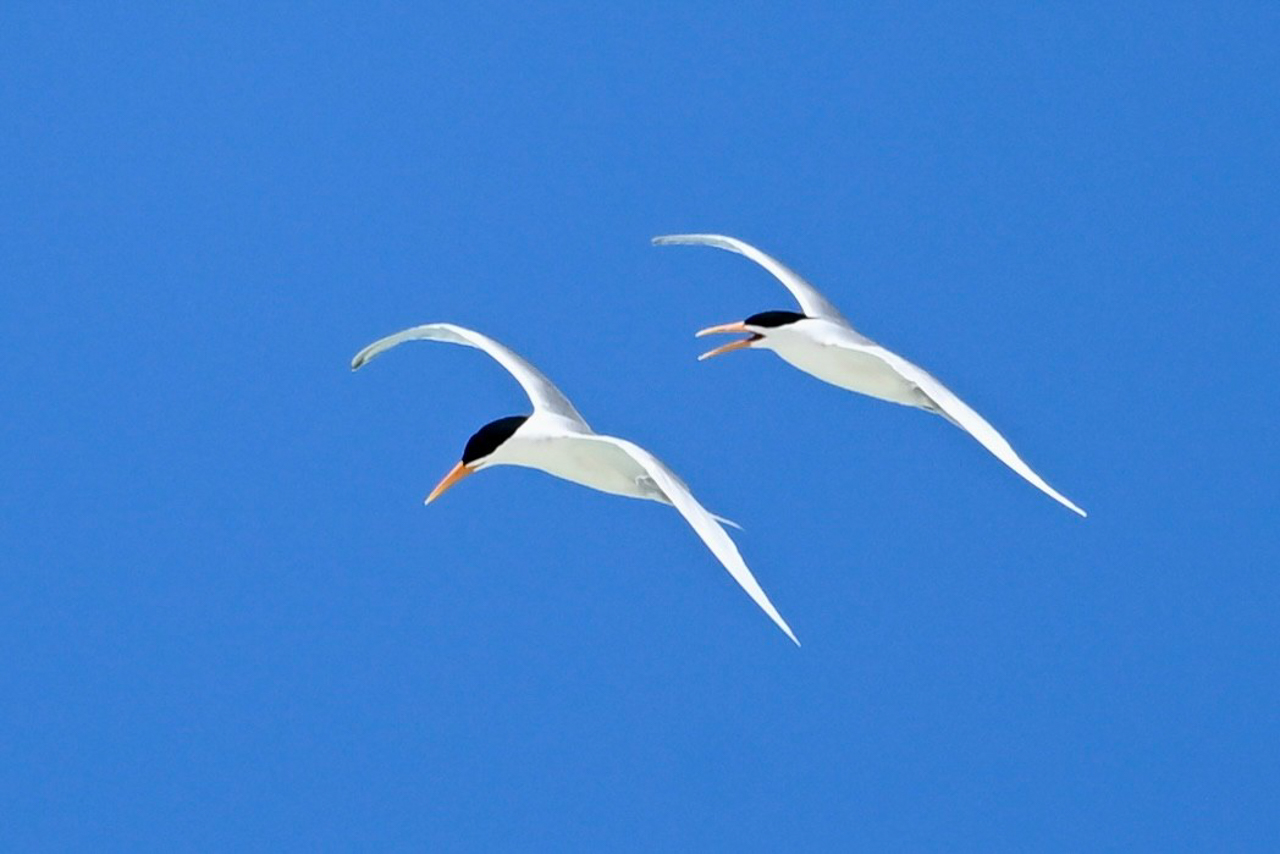
Lesser Crested Tern © Joe Wujcik
Back on the mainland, we strolled along the southern end of the Esplanade, spotting Nankeen Night Heron and White-faced Heron in flight while Peaceful Doves and the weird and wonderful Bush Thick-knees wandered around on the ground. Roosting egrets in a tree were eventually identified as white-morph Pacific Reef-Herons (Eastern Reef Egrets), thanks to their heavy bills.
To wrap up the day, half the group headed to Les Davies Park to wait for the nesting pair of Rufous Owls. And we were rewarded, witnessing the large female leave the nest hollow (Jenni captured a lovely little video) before the male joined her at last light. We also met a local 13-year-old girl who watches the owls most evenings with her grandparents, and she enthusiastically shared her observations with us.
Day 4: Port Douglas
On our way up to Port Douglas, we stopped at the scenic Barron River estuary for some morning birding. We enjoyed close views of myriad shorebirds in the beautiful morning light. Highlights included Pacific Golden-Plover, breeding Red-capped Plovers, Far Eastern Curlew and Pied Oystercatcher, among plenty more. But the show was thoroughly stolen by a Beach Thick-knee, whose heavy bill, cartoonish facial features and gangly legs were admired by all.
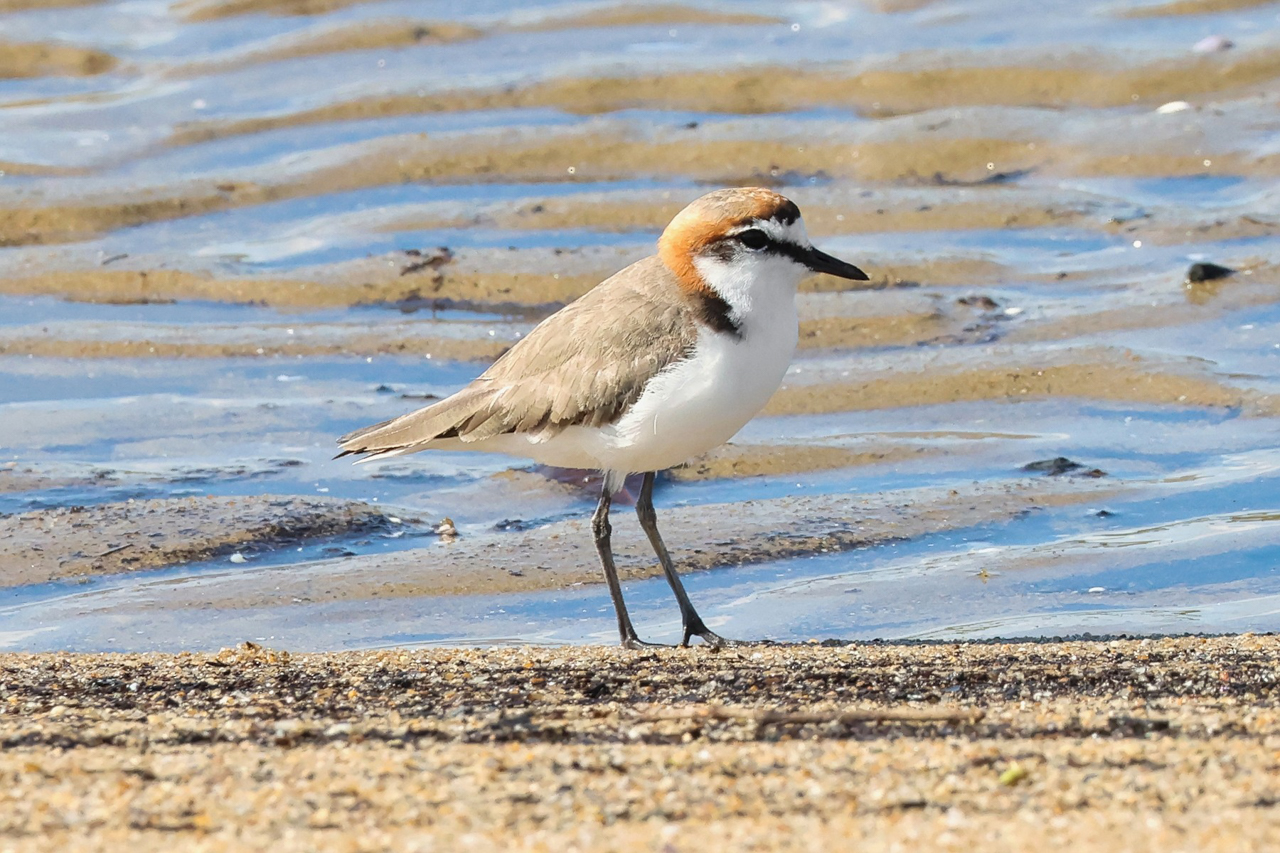
Red-capped Plover © Paul Prappas
In the bush behind the beach, we were stoked to see our first Laughing Kookaburras – always a highlight. We watched these overgrown Kingfishers hunting lizards from perches in the understorey. Varied Triller and Mistletoebird were also observed, while a juvenile Brahminy Kite briefly confused us into thinking it was a Little Eagle. We were quick to set our eBird list straight!
In a nearby park, Helmeted Friarbirds and Rainbow Lorikeets fed noisily among the flowers of a Moreton Bay Chestnut tree, while Australian Ibis and Straw-necked Ibis wandered across the grass.
We then headed to Redford Road, where good grassland promised some interesting grassland birds. A Golden-headed Cisticola leapt out of the grass and showed well. Further down the road, we scoped a gorgeous group of Plumed Whistling-Ducks resting beside a dam, looking fantastic with their distinctive elongated belly feathers.
{{Plumed Whistling-Ducks – Paul Prappas}}
Some high, tinkling calls in the grass caught our attention. Then came a bright flash of Crimson Finch – such gems! Among them was another grassland target, a group of three Red-backed Fairywrens. Fairywrens are an endemic family to Australasia, mostly coloured blue. The Red-backed stands out as the only one dressed in the striking red-black combo.
Joining the fairywrens and finches was another target, the Chestnut-breasted Munia, balancing atop the grasses and swaying in the breeze, giving everyone a good look at its smart outfit of black, white, yellow and chestnut orange. A Black-faced Cuckooshrike was spotted in the distance, while Brown and Yellow Honeyeaters flitted among the Callistemon. Black and Whistling Kites cruised overhead, as did Egrets and Torresian Imperial-Pigeons.
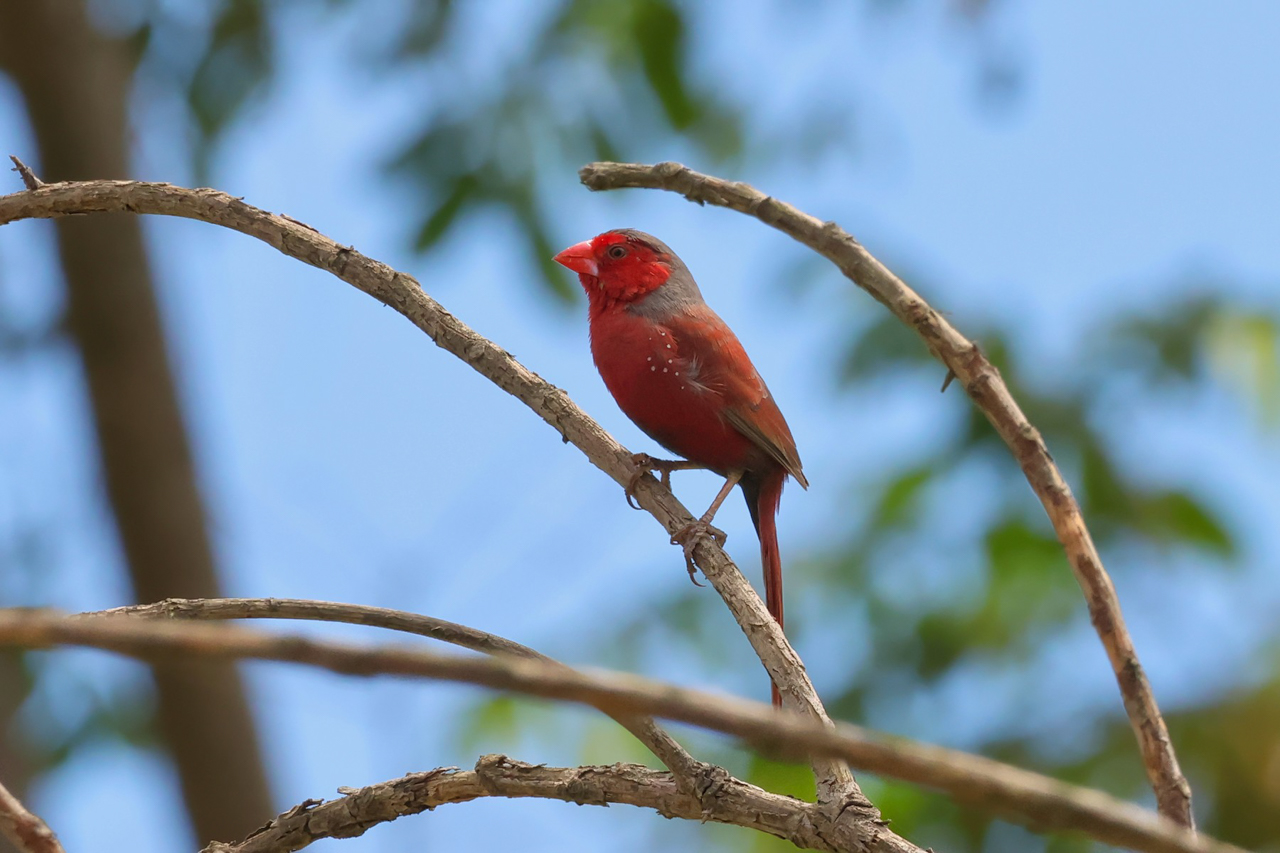
Crimson Finch © Paul Prappas
The drive to Port Douglas took us along a scenic stretch of road where steep, rainforest-covered hills meet the sea. After lunch at a nice café, we checked into our accommodation, where Deb managed to find one of the local Papuan Frogmouths roosting in a Paperbark tree. An awesome sighting, not least because Papuan Frogmouths are the largest representatives of the weird Frogmouth family. Some of us struggled to (literally) make heads or tails of the funny, mottled-brown lump we were looking at!
We headed out for evening birding, waving hello to the roadside Australasian Swamphens before stopping to admire a group of Magpie Geese nibbling at the grassy verge. We also picked up Bar-shouldered Dove.
At the first dam on Ferrero Road, we learnt to distinguish Tree Martins from the Welcome Swallows and White-breasted Woodswallows sharing the airspace. We spotted a Dusky Moorhen in the shadows and watched a Brown-backed Honeyeater weaving her pendulous nest. A flyover Osprey was a nice addition.
Further along the road, a big flock of Plumed Whistling-Ducks occupied one side, while a flock of Scaly-breasted Munias (Nutmeg Mannikins) kept us busy on the other. Both Forest and Sacred Kingfishers perched on the powerlines. Australasian Grebes and Wandering Whistling-Ducks sat picturesquely on the water in the evening light, while a White-bellied Cuckooshrike perched on a palm frond. The maniacal cackle of a Blue-winged Kookaburra echoed in the distance, and a friendly local resident came down for a chat about the birds.
By the time the nocturnal Bush Thick-knees started piping up, we knew it was our cue to head for dinner. A yummy Italian meal satisfied us all.
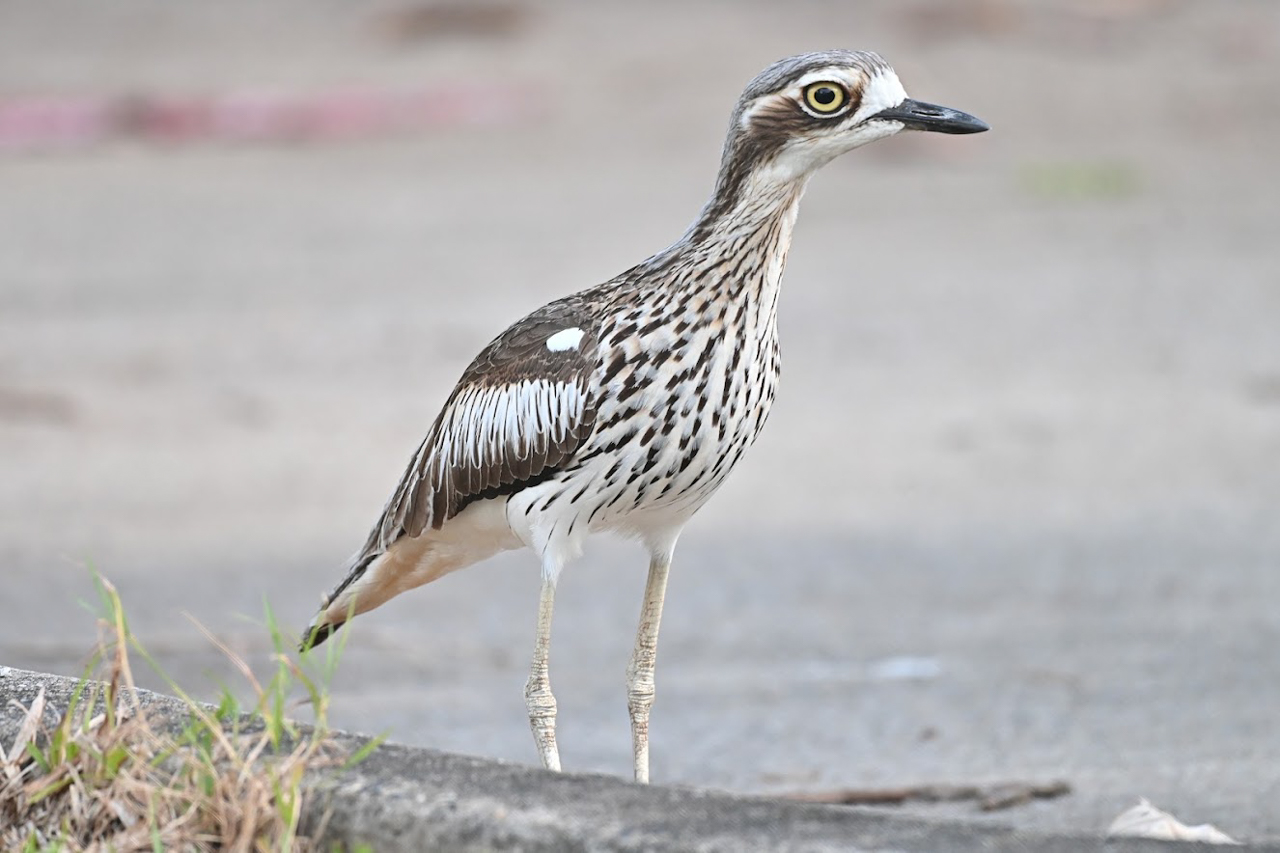
Bush Thick-knee © Edward Sako
Day 5: From Daintree River Rainforest to Savannah Woodland
The guides put out a breakfast spread at 5:30 a.m. for our 6 a.m. departure to the magical Daintree River. It was a misty morning with patchy rain – a lovely atmosphere for a boat trip through the rainforest.
On the drive in, Kingfishers and Kookaburras perched on telephone wires, while some of the group spotted the long-tailed, lumbering shape of a Pheasant Coucal flying over canefields.
The cruise began with excellent views of Shining Flycatchers in the riverside vegetation. Higher up, another iridescent bird flitted through the trees: a Little (Gould’s) Bronze-Cuckoo, Australia’s smallest cuckoo species, with its red eye-ring and strongly barred front. Overhead, a hundred Australian Swiftlets filled the skies.
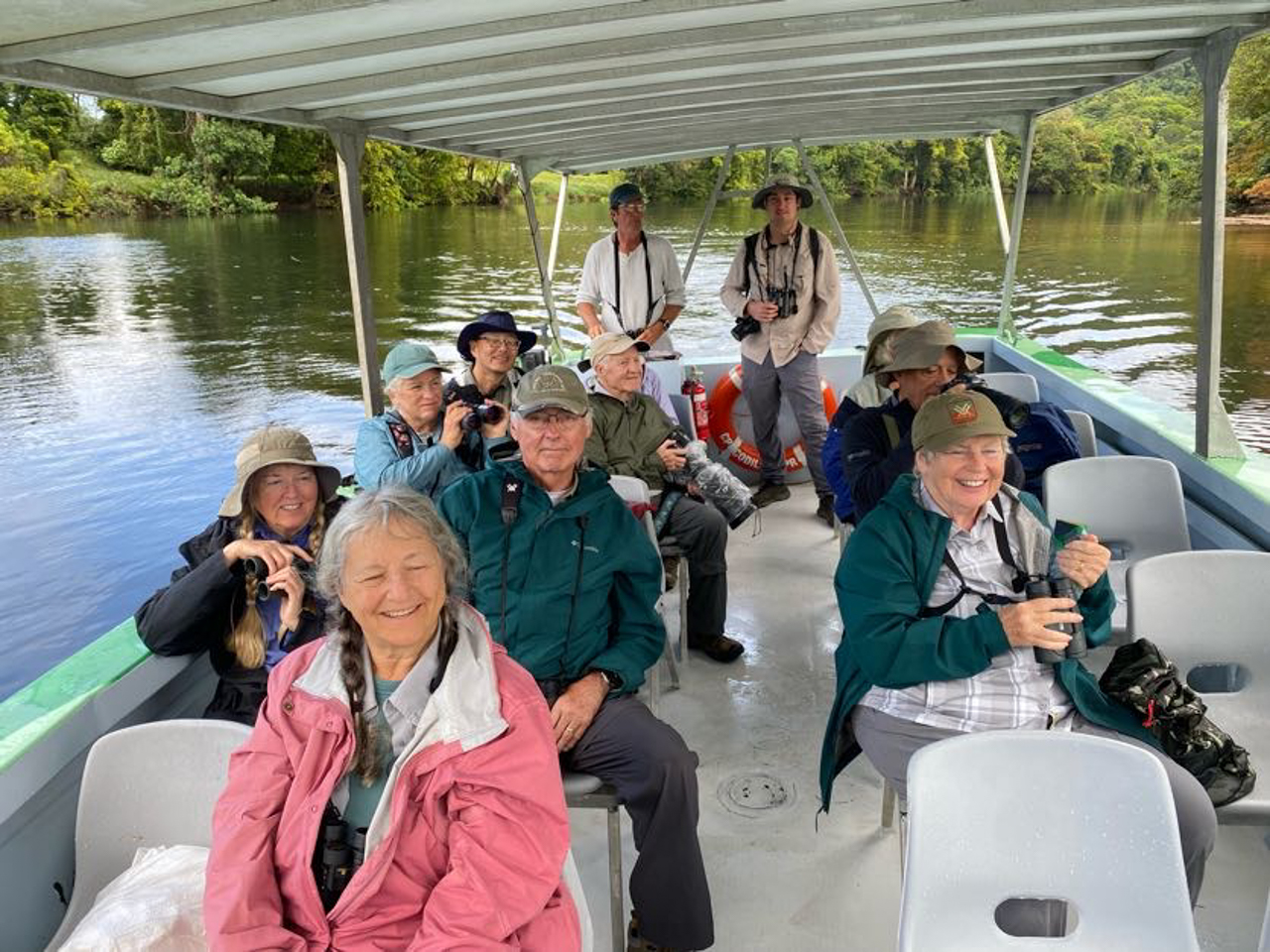
Group shot Daintree River © Henry Coleman
While we enjoyed the little birds, our guide Alex spotted one of the biggest – the Great-billed Heron: an almost mystical bird that haunts only the most inaccessible waterways of Northern Australia. We were lucky enough to cruise right alongside Australia’s largest heron as he fished for breakfast. We had to make a point to the North Americans onboard about why this bird was so special (after all, their Great Blue Heron is just as impressive, and not nearly so rare!)
We drifted back along the river to a tree where Alex knew there was a Papuan Frogmouth nest. Cue a lengthy, convoluted description of angled branches, twisted vines and patches of light and dark leaves – the bird’s top-notch camouflage made it difficult to pick out, despite the fact that we drifted quite close.
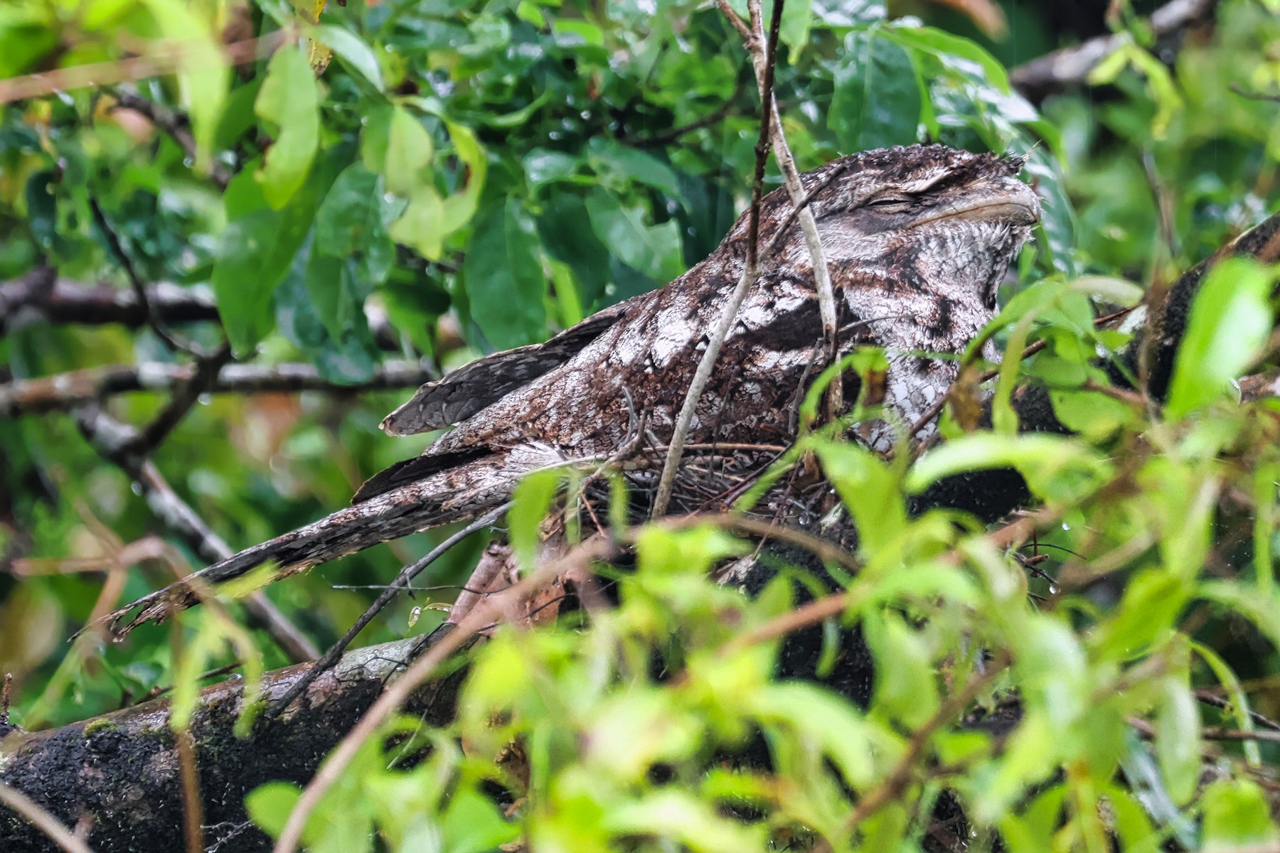
Papuan Frogmouth © Paul Prappas
As the rain grew heavier, we were grateful for the covered boat and enjoyed a misty drift along an unspoilt stretch of Daintree rainforest, with its towering trees and blankets of vines. A Saltwater Crocodile surfaced briefly before drifting nonchalantly into the murky depths. We spotted the deep blue of an Azure Kingfisher and headed over to the bank, where several more birds sat in the riverside trees. These included Green Oriole, Spangled Drongo, Black Butcherbird and Shining Bronze-Cuckoo (not to be confused with the Little Bronze-Cuckoo from earlier), all looking rather wet and sorry for themselves.
Back upriver, we enjoyed great views of another Azure Kingfisher (one of Alex’s best mates, apparently), along with a Radjah Shelduck, a Brown-backed Honeyeater weaving its nest, and more Shining Flycatchers. Quite a few Welcome Swallows decided our boat was as good a place as any to rest their pretty little wings, providing close-up views.
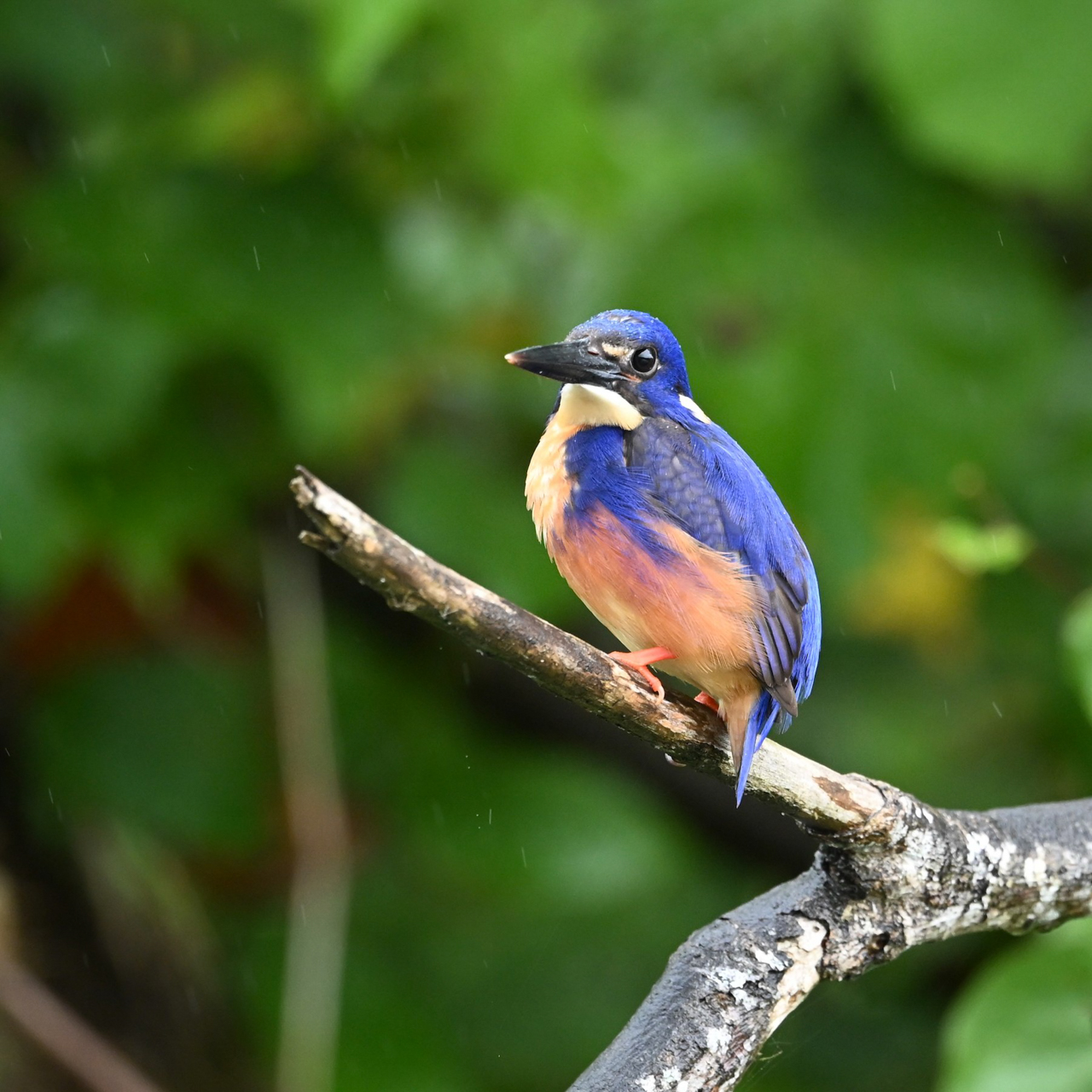
Azure Kingfisher © Joe Wujcik
Back on (not-so-dry) land, the whole group enjoyed a female Pacific Koel feeding on red fruits high in a palm tree. We also enjoyed coffees and hot chocolates at a sweet little café in the village.
On the way out, we stopped outside a retirement village in Mossman. But nobody was being dropped off for admission 😉 Rather, we’d come to witness quite a spectacle: hundreds upon hundreds of Metallic Starlings at their nesting colony, with beautifully woven nesting bags filling a couple of large trees. It was awesome to see their iridescent colours and beady red eyes up close, and to observe their social antics. A very worthwhile detour.
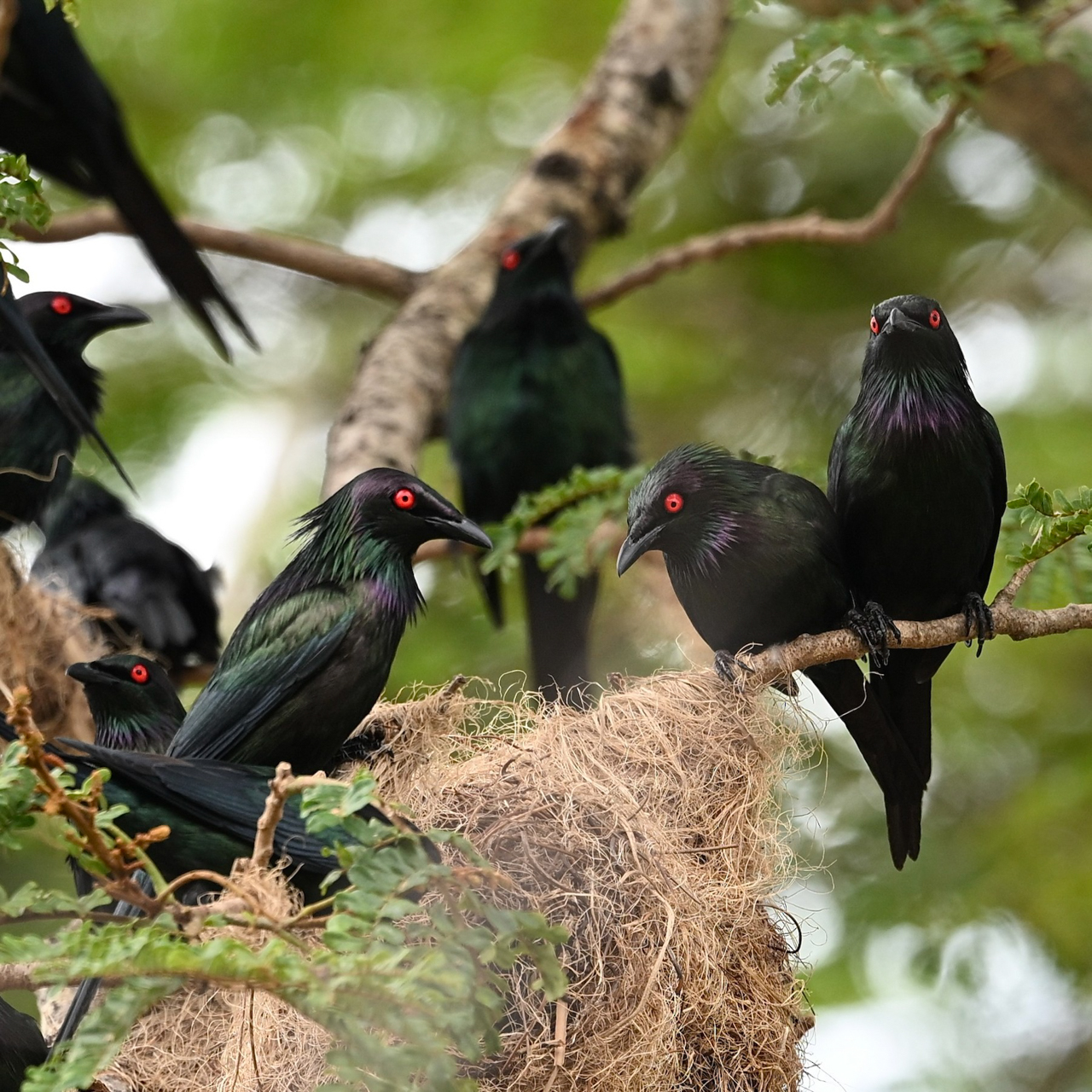
Metallic Starlings at their colony © Joe Wujcik
We continued up, up and up the Great Dividing Range, entering a whole new array of habitats. We headed straight to Mount Carbine Caravan Park, where the mountains’ rain shadow was protecting tropical savannah woodland from the wet weather.
Here, our group caught up with a whole new cast of crazy avian characters. This is the land of cheeky Galahs, Little Friarbirds and their vulture-headed Noisy cousins, clever Australian Magpies and gangs of Blue-faced Honeyeaters and Apostlebirds. The lanky Great Bowerbird was hopping around, and we even got to watch him at his bower – an avenue of sticks decorated with piles of white objects (old shells, bones and stones) peppered with red plastic bottle caps and bulbous green Kapok seedpods. What artistry!
And, of course, the delightful Blue-winged Kookaburras were wonderful to see at close range: large kingfishers with glaring white eyes. We watched one swoop through the trees and snatch an enormous locust, which it somehow managed to get down its gullet!
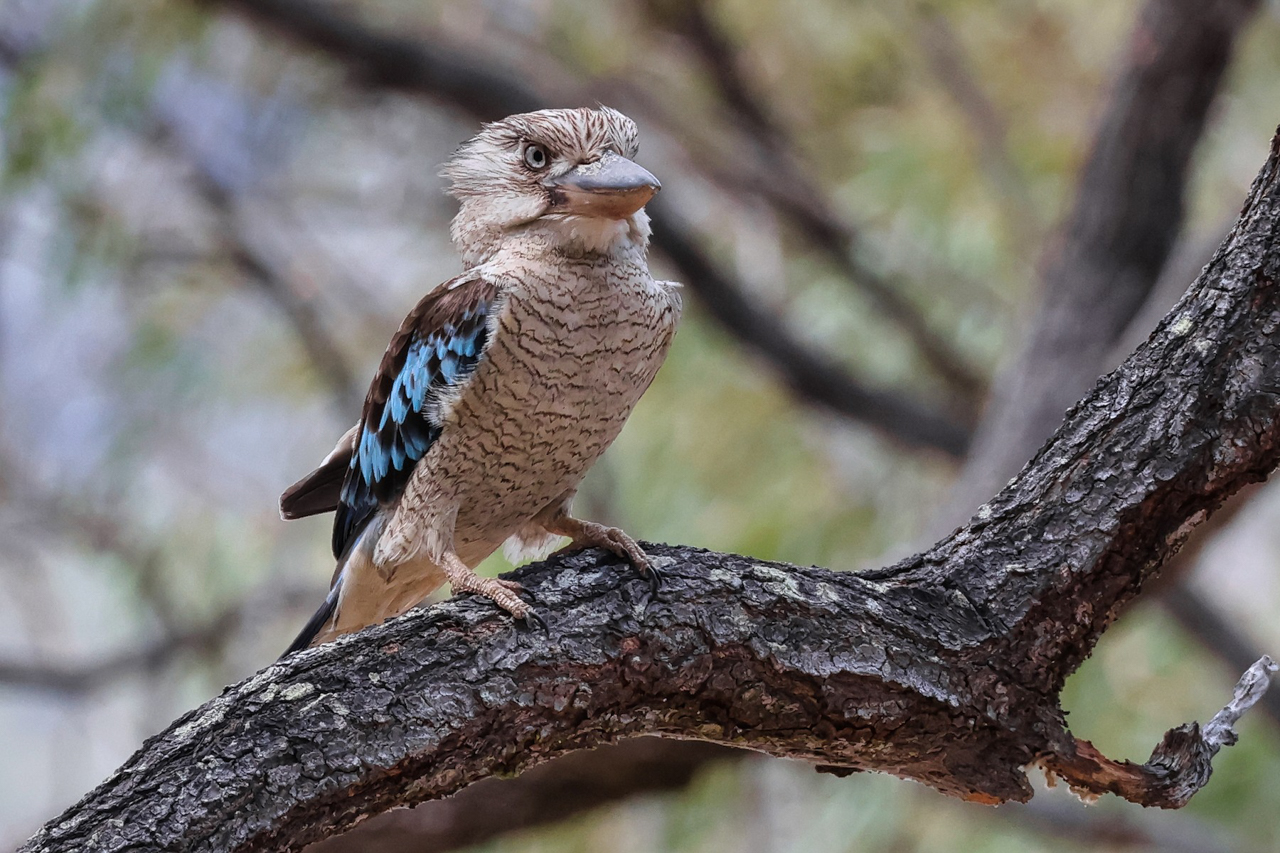
Blue-winged Kookaburra © Paul Prappas
Around the caravan park we also saw an Agile Wallaby with a joey, Magpie-larks, Brown and White-throated Honeyeaters, Sahul Sunbirds, Pied Butcherbirds and Peaceful Doves. While the guides put out a delicious lunch spread (yes, we do say so ourselves), Crested Pigeons and pretty yellow-and-blue Pale-headed Rosellas populated a nearby tree.
We left the caravan park satisfied on many levels, but our next stop wasn’t far away. On Mary River Road, we searched for the Australian Bustard, one of the world’s heaviest flying birds, and, despite the high yellow grass, got good looks at four individuals strutting their stuff.
We also spotted Black-shouldered Kites and a Nankeen Kestrel on the wing with unlucky mice in their talons. We had an all-too-quick fly-by of Red-winged Parrots.
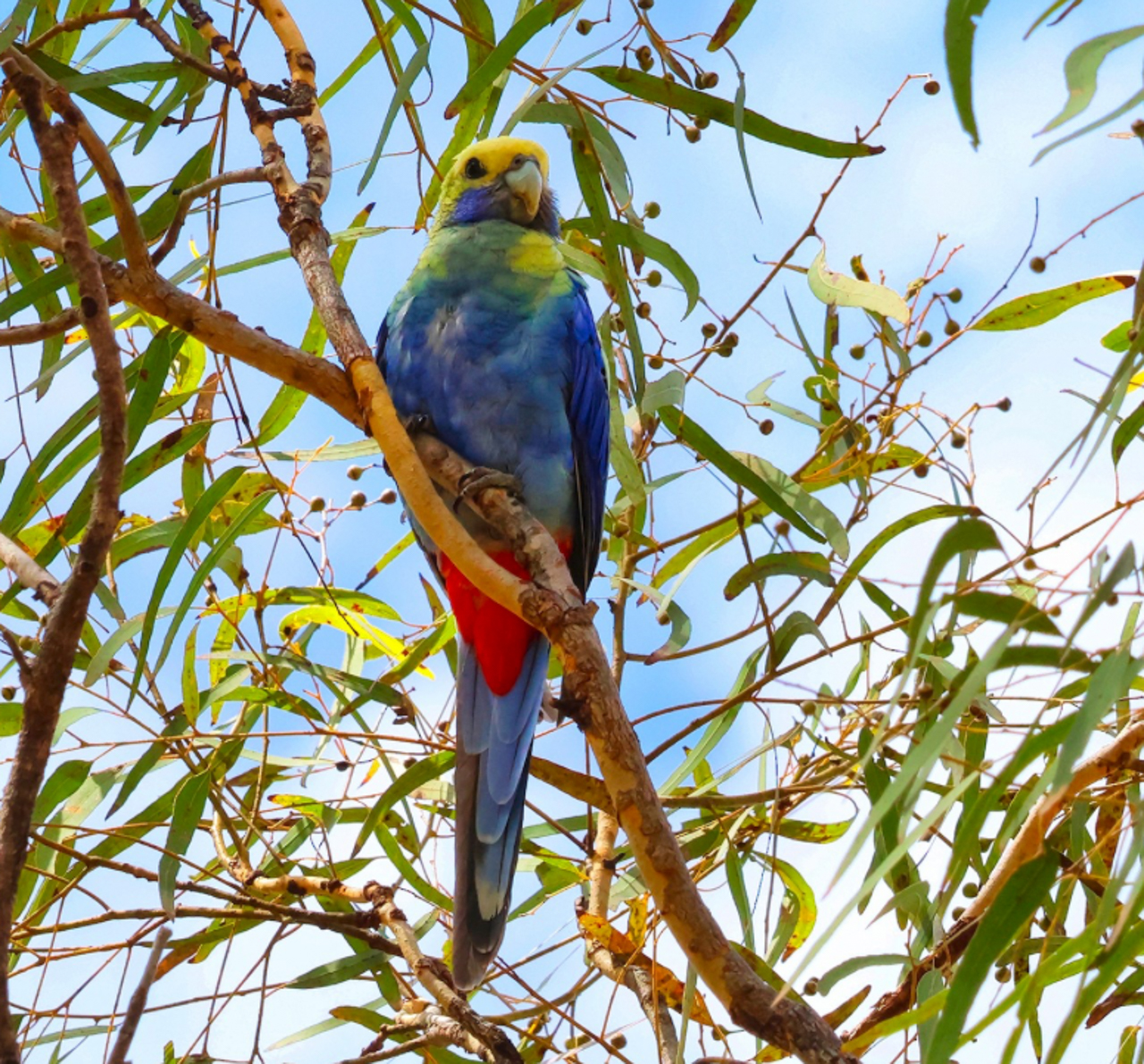
Pale-headed Rosella © Paul Prappas
We ended the day watching Brown Honeyeaters and Dusky Myzomelas feeding at eye level in a Crimson Bottlebrush, followed by Gray-crowned Babblers of the rufous northern subspecies playing beside a school playground.
What a big day, covering myriad habitats and many kilometres. And every stop was worth it.
Day 6: Atherton Tablelands and Granite Gorge
We woke to rain and had breakfast in the guides’ room before heading up into the mountains. There was no escaping the weather, so we braved it in our raincoats. In Julatten, we watched Cryptic Honeyeaters and Macleay’s Honeyeaters feeding at eye level in the large magenta (not purple!) flowers of a Syzygium (Lilly-pilly), while Spectacled Monarch, Large-billed Scrubwren and Little (Rufous) Shrikethrush hunted in the understorey. A back-lit Bridled Honeyeater flew into the trees overhead. A Pale-yellow Robin perched on a hanging vine, then dove down to the ground and back again – but as the rain picked up we had to head for shelter.
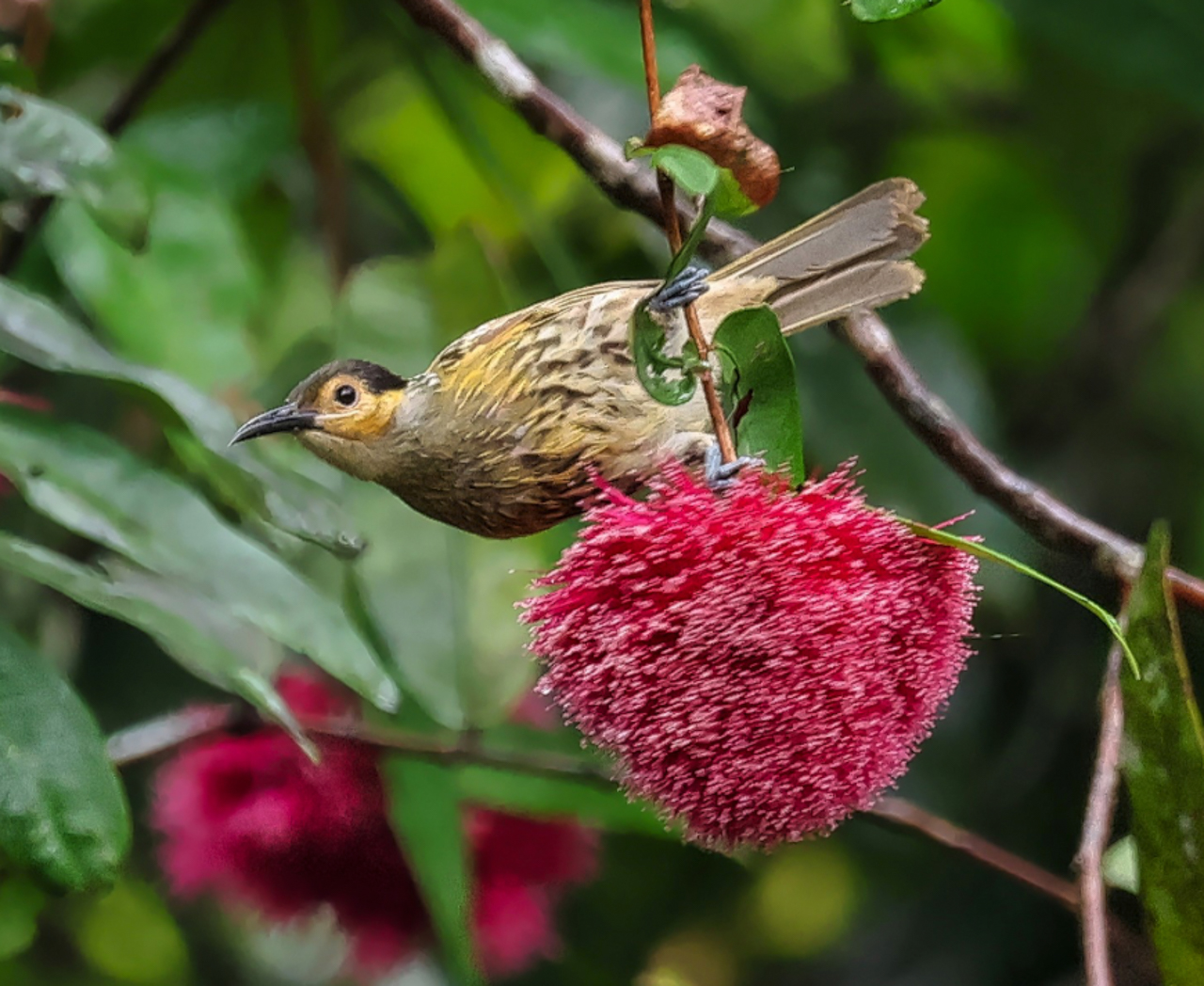
Macleay’s Honeyeater © Paul Prapaps
We tried another spot further down the road, where White-headed Pigeons perched at the top of a tall eucalypt, while the booming of a Superb Fruit-Dove remained heard-only. A chatty group of Silvereyes appeared alongside a Yellow-spotted Honeyeater, and a pair of Forest Kingfishers worked the paddock across the road. But the rain eventually sent us to a sheltered rest stop for snacks.
Soon enough we were back at it, birding Abattoir Swamp – a gorgeous patch of bushland-meets-wetland. We started with Northern Fantail, Rufous Whistler, Gray Shrikethrush and White-throated, Cryptic and Dusky Honeyeaters. Heavily flowering bottlebrush on the walk to the bird hide also attracted the boldly-marked White-cheeked Honeyeaters.
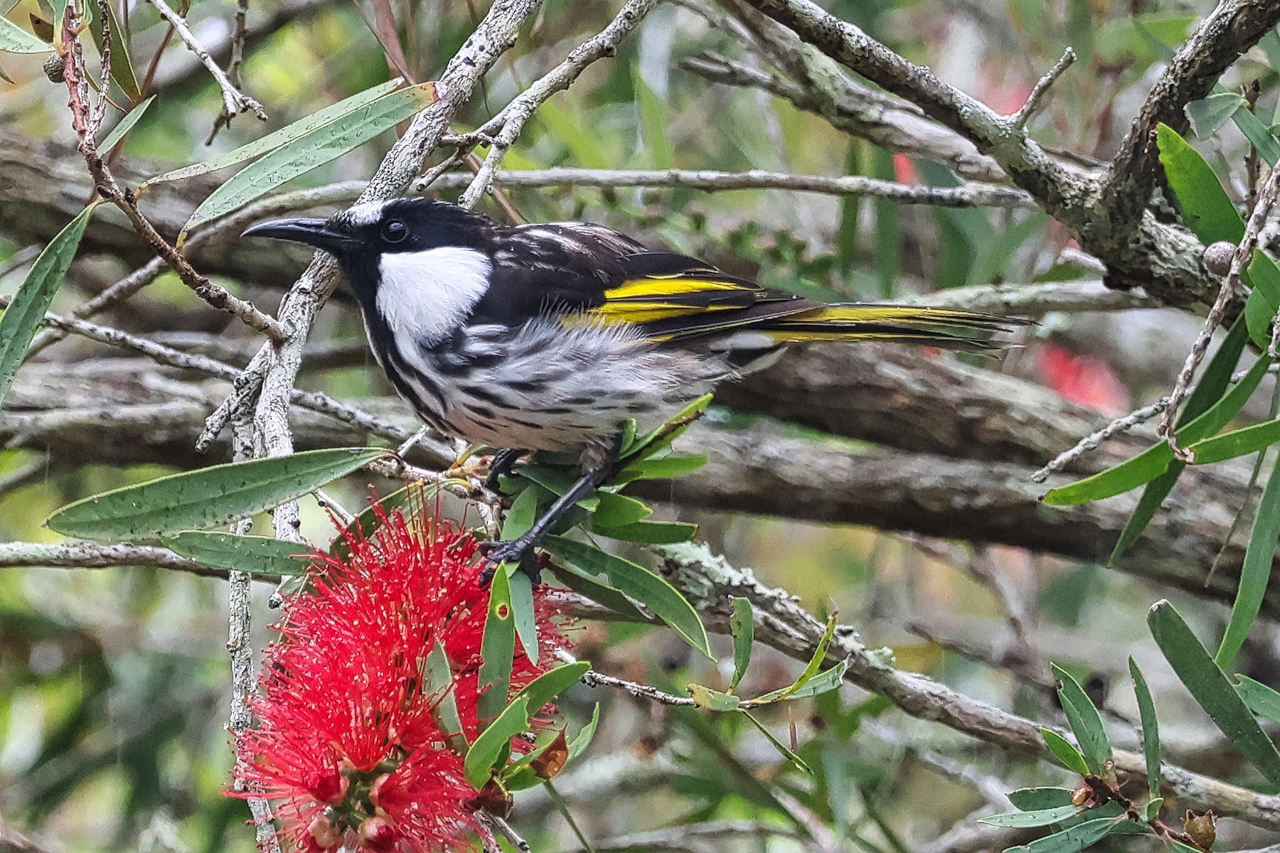
White-cheeked Honeyeater © Paul Prappas
The White-cheeked being the 20th Honeyeater of the trip already, we were all beginning to appreciate just how mega-diverse the Honeyeaters of Australia are – kinda overwhelming in a good way, right??
In the swampy grass, a Pheasant Coucal was expertly scoped out, much to everyone’s delight. We reached the hide just in time for another rain shower, watching Eastern Cattle-Egrets and Red-backed Fairywrens from shelter, while a Mistletoebird called nearby.
All these birds were lovely, but none so lovely as the Lovely Fairywren! On the way back to the car, we picked out the subtle calls of this North Queensland endemic and chased them down a wonderland-like rabbit hole. They played hard to get, and we got distracted by Gray Whistlers, Silvereyes and Fairy Gerygones – all desirable species in their own right. But eventually the Lovely Fairywrens stole the show in all their electric-blue glory. The female is unique among fairywrens in also having extensive blue in her plumage; some would argue she’s just as pretty as the male.
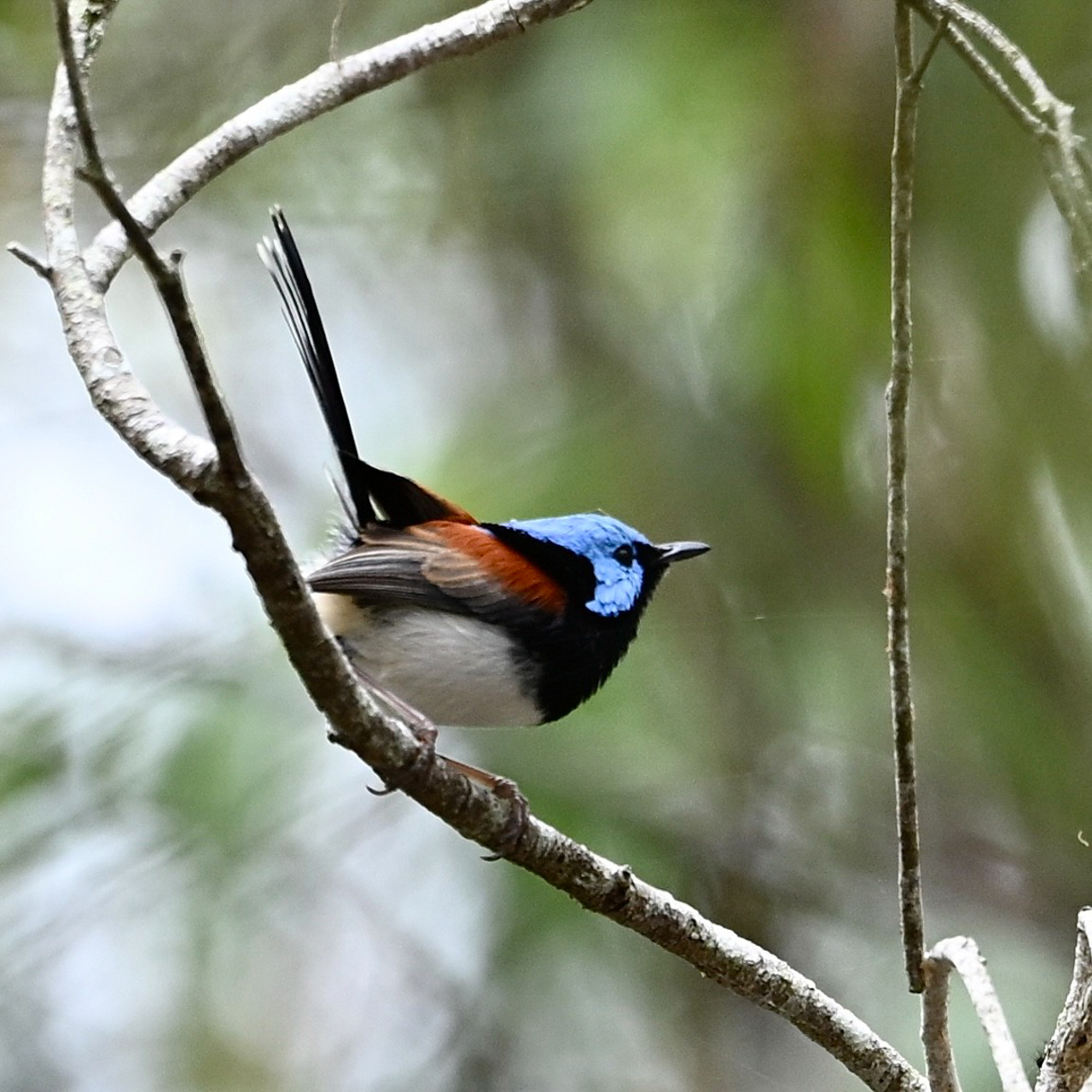
Lovely Fairywren male © Joe Wujcik
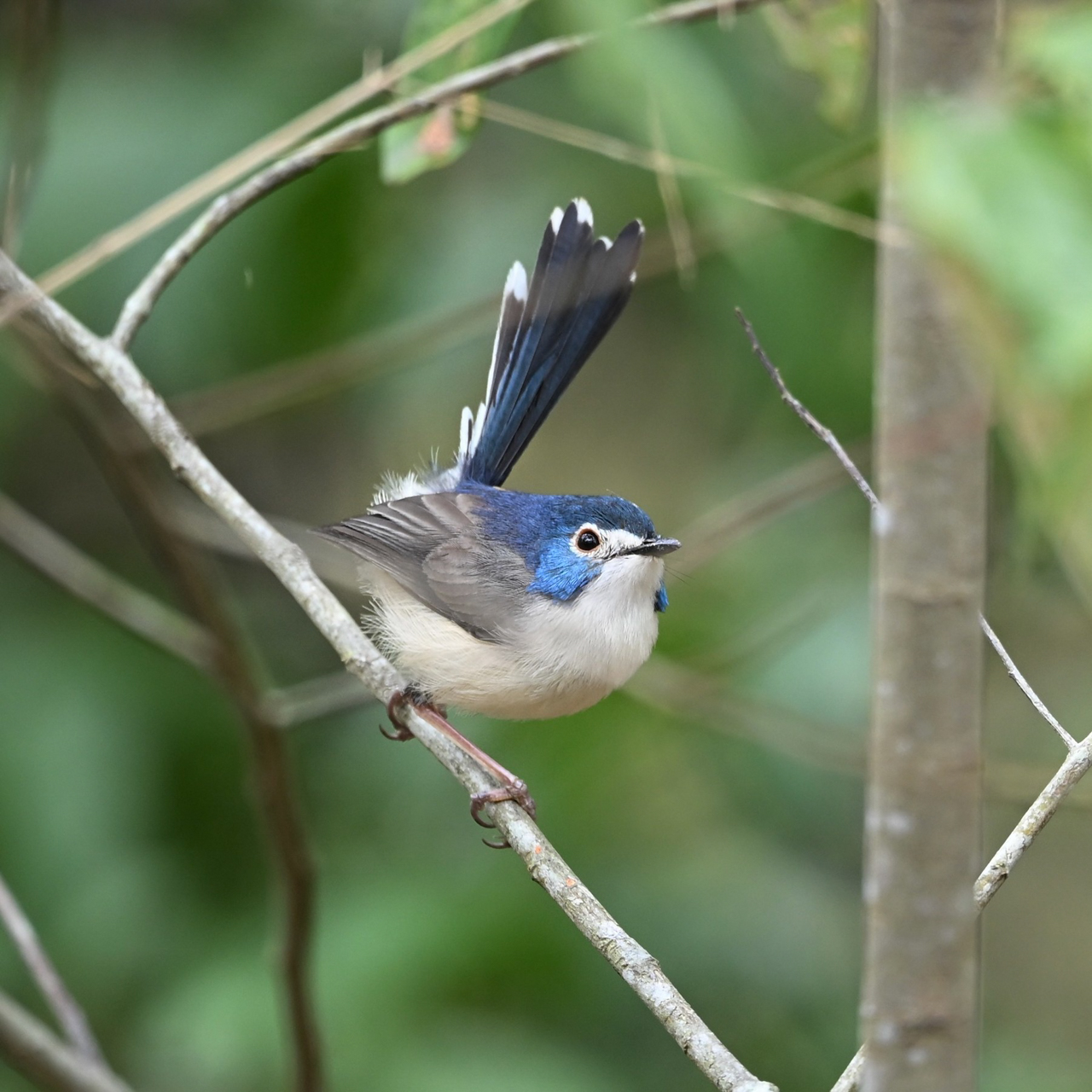
Lovely Fairywren female © Joe Wujcik
By the time we emerged from our lovely forest maze, it was lunchtime. A well-deserved spread of wraps, dips, cheese, veggies, falafels, ham and more awaited us. The sun-dried tomato pesto was a particular hit with Allan!
We headed south and west to Granite Gorge Nature Park, where the clouds had thinned to reveal a lovely afternoon. Jumping out of the vans, we found a Silky Oak in full orange bloom, attracting a host of visitors, including Scaly-breasted Lorikeets.
While the group watched the lorikeets, Henry chatted to some campers. Only five minutes into the conversation did they mention the Red-tailed Black-Cockatoos feeding quietly just a few trees away! The whole group rushed over. Debby noted how much bigger they were than the white cockatoos, and everyone got to appreciate the fiery colours in their tails. Truly awesome birds.
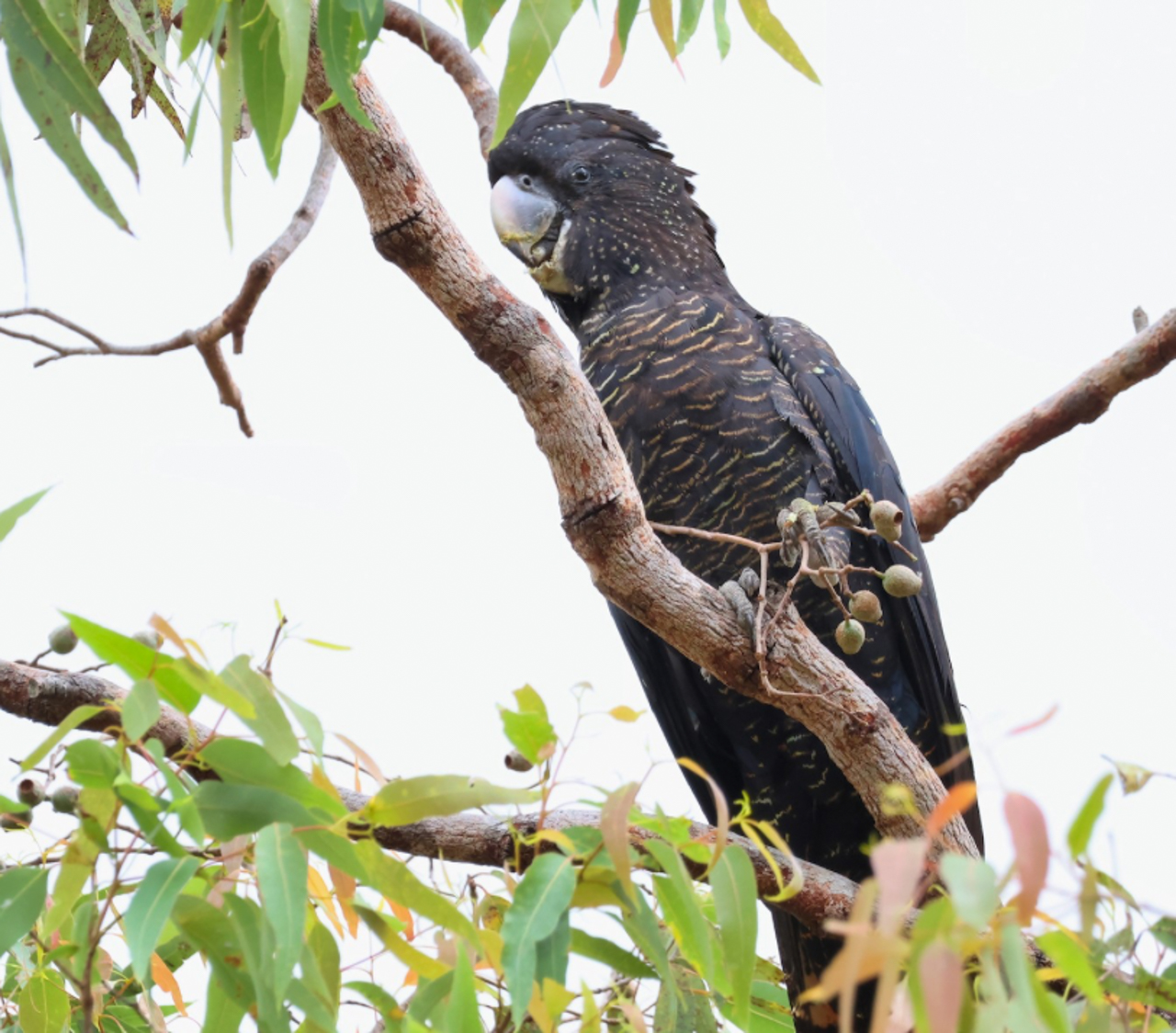
Red-tailed Black-Cockatoo © Paul Prappas
We walked down the road to a pretty little creek, where the smaller birds put on a show. Honeyeaters, Sacred Kingfishers, Leaden Flycatchers and Bronze Cuckoos were keeping us busy, when suddenly a Striated Pardalote appeared right beside us. We were overjoyed to step back and watch this tiny, adorable creature dropping from the treetops to its nesting burrow, feeding its loved ones with as much lerp as it could carry. Lerp is a sugary treat collected from gum leaves, and a key food source for many Australian birds.
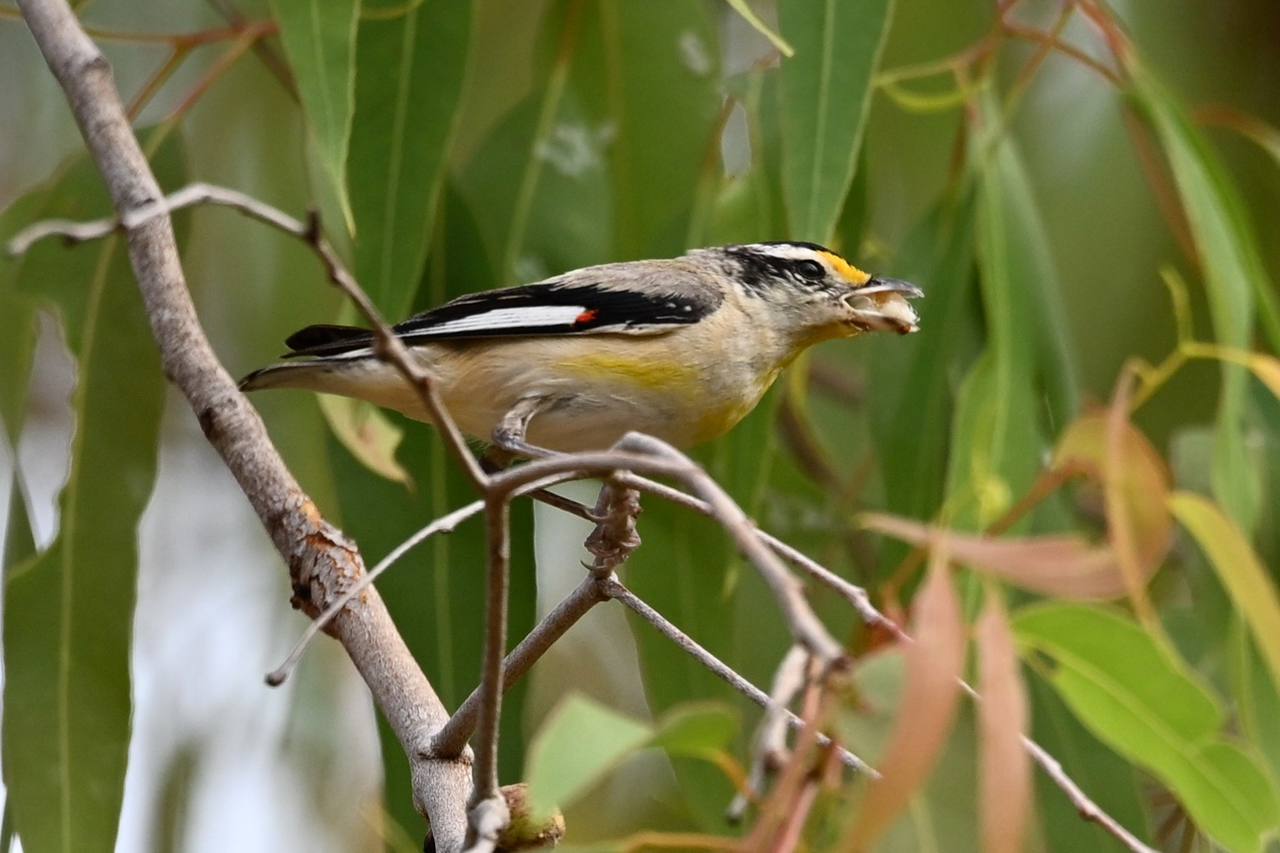
Striated Pardalote with a mouthful of lerp © Joe Wujcik
Just as we’d finished admiring the pardalote, a silhouette with enormous upswept wings banking behind the canopy announced the cameo appearance of a White-bellied Sea-Eagle! A fair way from the sea, we noted that these eagles also inhabit inland waterways. An Olive-backed Oriole was spotted in the trees nearby.
We then wandered down to the granite rocks of Granite Gorge, where we admired the sheer agility – and sheer cuteness – of the colony of Mareeba Rock Wallabies bounding around. Australian Brushturkeys scrambled over the rocks too, and we talked about how male dominance is signified by the size of the yellow wattles dangling around their ugly, bald, bright-red heads (gotta love ’em).
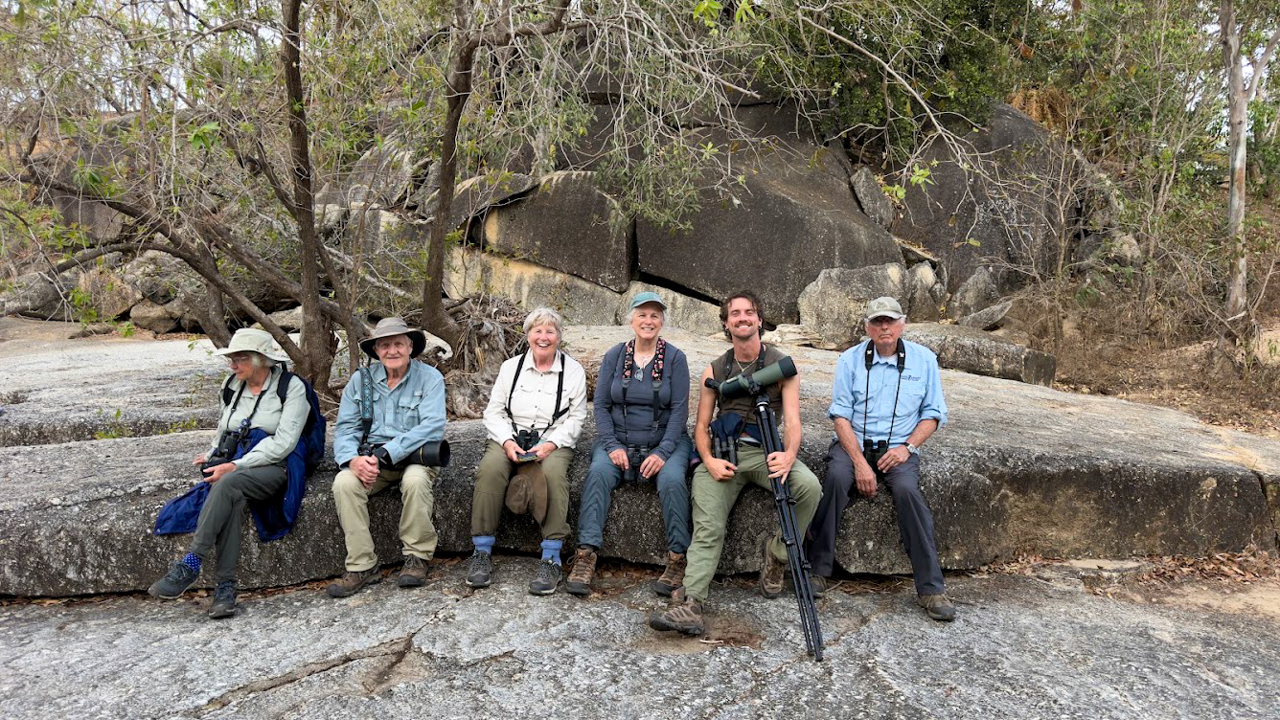
An incomplete group shot © Edward Sako
On the way out, a spiky little Echidna foraging through the leaf litter spurred a learning curve about the weirdness of monotremes. Then Joanie spotted a bird we’d been hoping for all along – a Squatter Pigeon! Minding his own business scratching along the roadside, he hurried off as we crept closer. Funny little guy.
We drove east towards our accommodation in Yungaburra, straight back into the rain cloud. While the guides checked in, the group spotted a pair of Topknot Pigeons perched high in a tree. A pub meal at the local pub was a great way to end another big day.
Day 7: Atherton Tablelands Gondwanan Rainforest
We got up and into the vans, ready for a day of notoriously neck-craning rainforest birding. But it was a different kind of crane that started our day – the Sarus Crane! A field full of them at sunrise. A gorgeous spectacle. 71, we counted. And joining them, two Brolga – Australia’s more widespread crane species.
Far North Queensland is a stronghold for Sarus Crane. But, interestingly enough, they have a disjunct population occurring in India and Myanmar. In fact, ‘saras’ means ‘crane’ in Hindi.
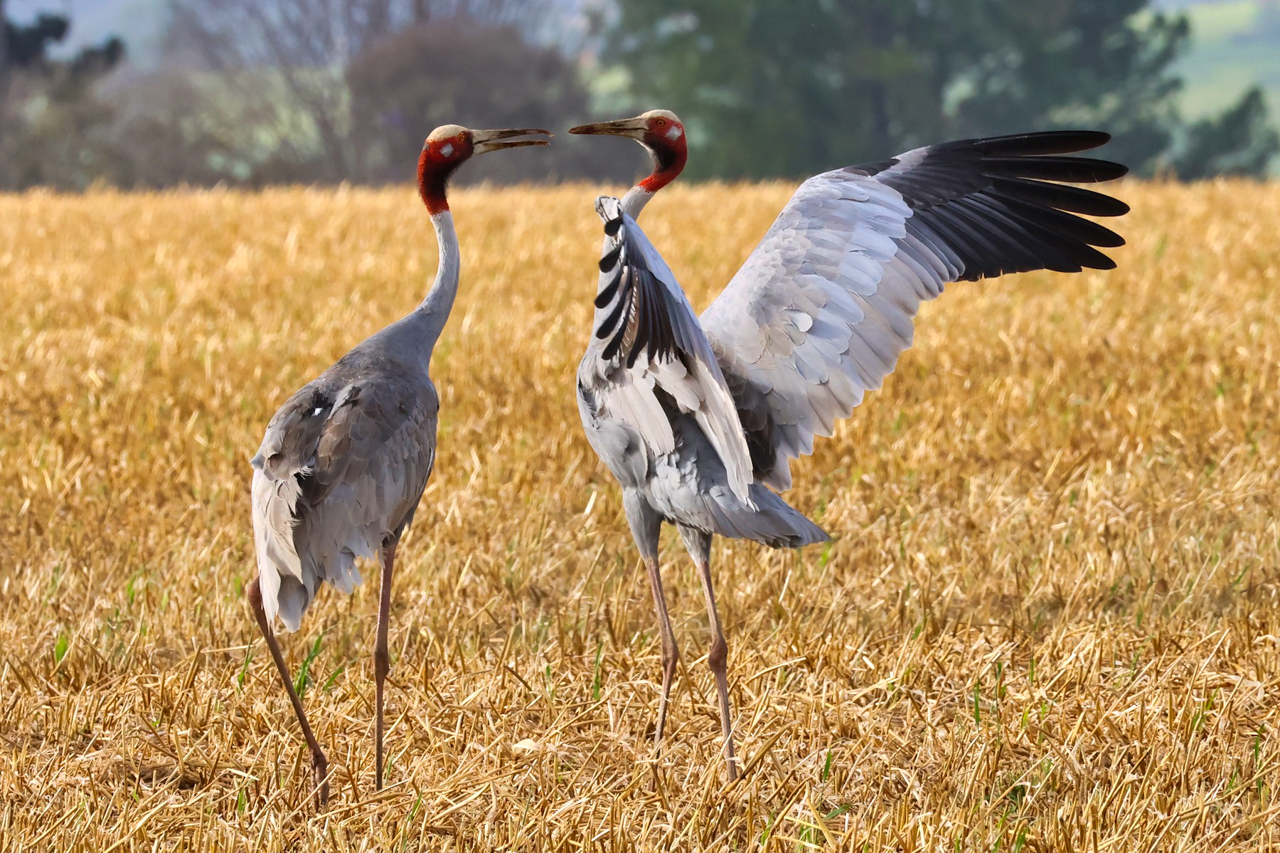
Sarus Crane © Paul Prappas
The road to Mount Hypipamee winds through the emerald green fields of the Atherton Tablelands and alongside patches of remnant rainforest. As we approached the mountain, the rainforest grew thicker and the air mistier. A confiding Wet Tropics endemic, the smartly-dressed Gray-headed Robin, welcomed us in the carpark.
He was joined by a Pale-yellow Robin, with a kind of squished and very cute face, and a Lewin’s Honeyeater. Another endemic, the Atherton Scrubwren, hopped on the forest floor at the edge of the carpark. A Gray Fantail flitted extremely close and curious… or perhaps just hungry for the insects our feet disturbed!
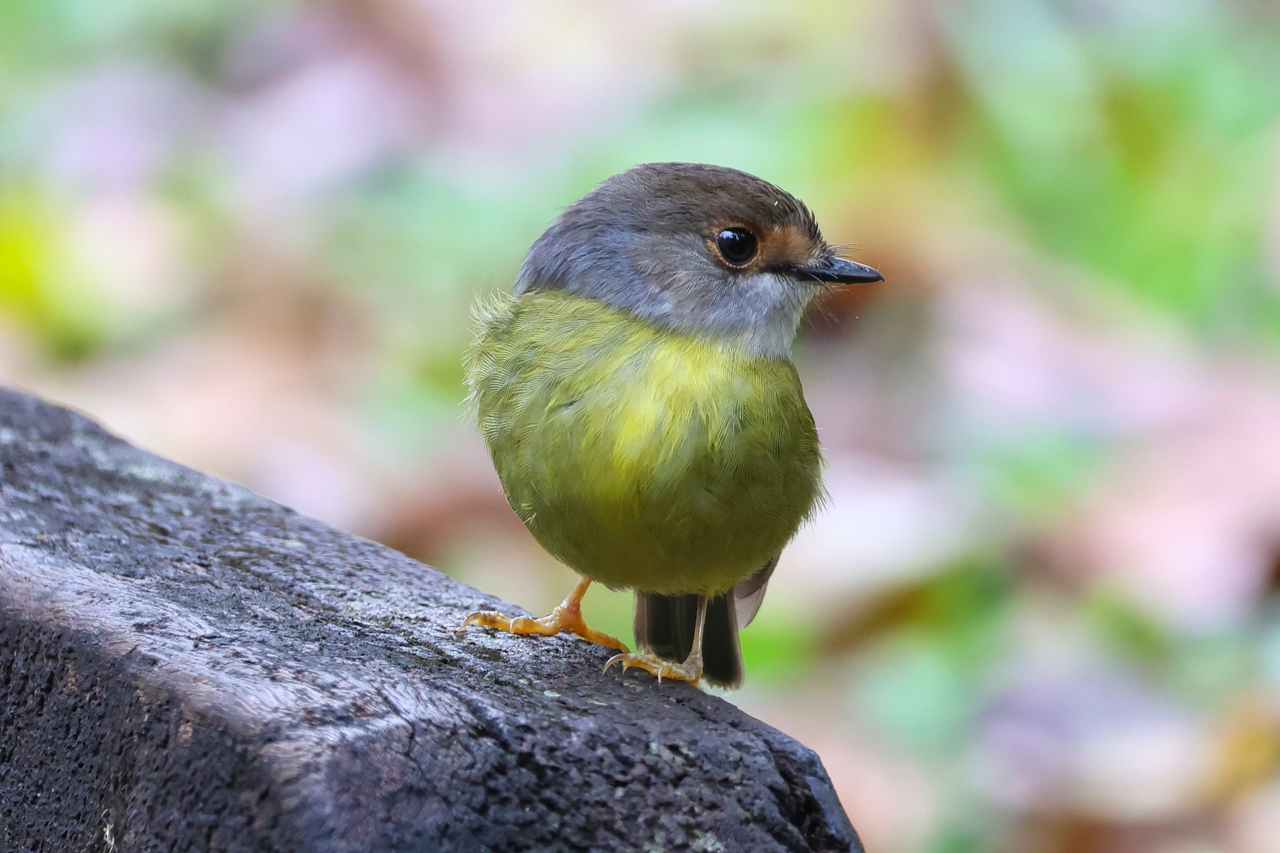
Pale-yellow Robin © Paul Prappas
Our forays into the thick rainforest yielded Tooth-billed Bowerbirds feeding so damn high in the canopy. The size of the trees themselves was worth admiring. And there was some action in the undergrowth too, with Large-billed and Yellow-throated Scrubwrens, Brown Gerygone, Spectacled Monarch.
While stopping for Brown Gerygone, some of the group got a dazzling view of a Pied Monarch – a really striking black and white bird with a blue eye-ring. Very cool!
We then wandered up the other side of the forest into the trees, serenaded by the melodious calls of Golden Whistlers. A White-throated Treecreeper was spied, while a female Victoria’s Riflebird offered little more than a glimpse.
A slippery, muddy little track dog-legged off from the main road, and we all climbed up. (Huge props to dear Barbara for getting up here – what a trooper!) And it was well worth it, because the reward was not only a view of the mystical Golden Bowerbird’s maypole bower, but also a view of the bird himself! Shining yellow in the gloom, Australia’s smallest and rarest bowerbird was seen superbly well by some, and glimpsed by others. We didn’t expect his visit, so what a treat it was!
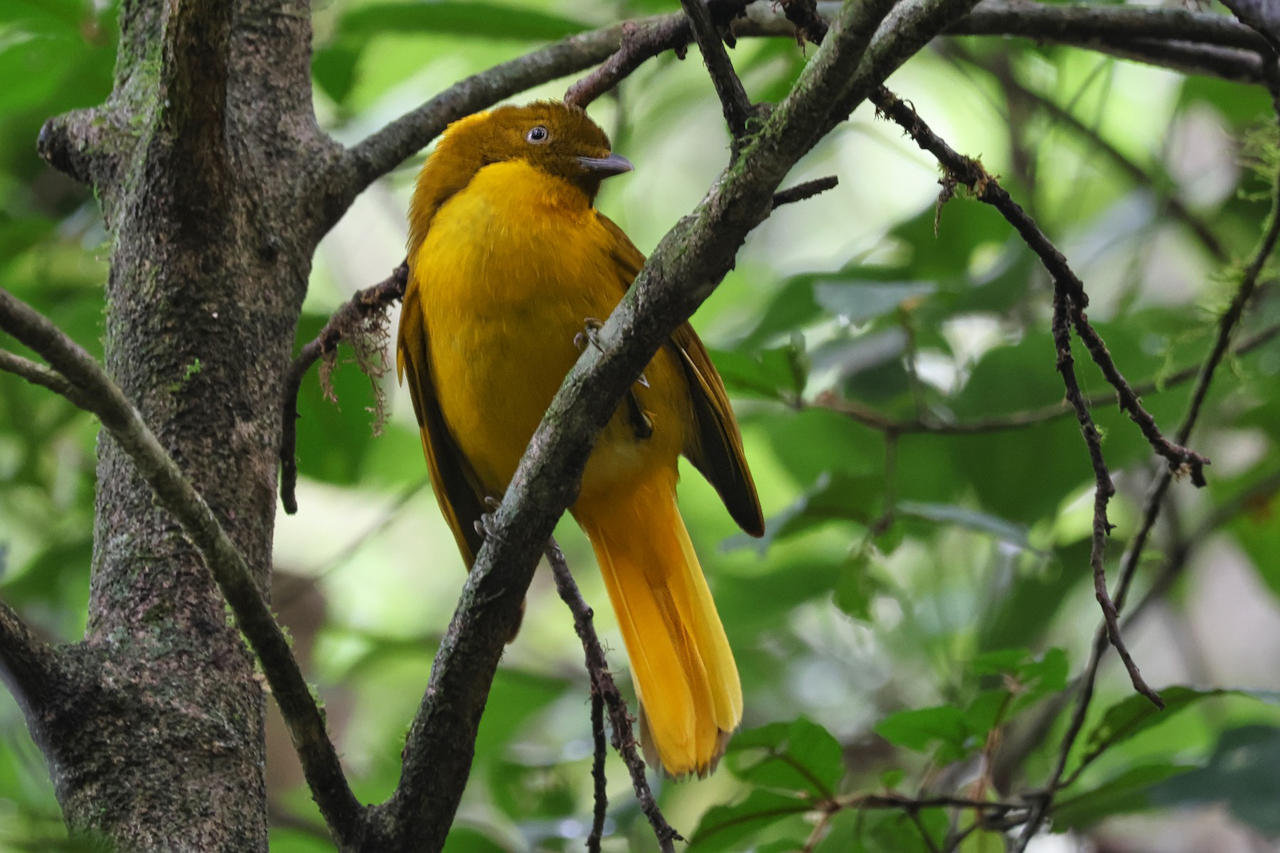
Golden Bowerbird © Paul Prappas
We drove back down to Malanda for coffee. The café-owner was adorable and gave us all cards with bird illustrations on them as thanks for our patronage. We watched Helmeted Friarbird, Rainbow Lorikeet, Pied Currawong and even a momentary glimpse of Bridled Honeyeater in town, before driving up to Jackson’s friend Martin’s place.
From Martin’s deck, we sat and waited, listening to the calls of Tooth-billed Bowerbird. Then, the raspy call of Victoria’s Riflebird, a member of the Paradisaeidae (Birds-of-paradise). He called once, twice, then closer, then again. Henry spied his eye just metres away, but the bird remained concealed behind some foliage… so when he hopped out into full view – jet black with more than a flash of bright iridescent blue – he truly took our breath away. There was a collective gasp – extraordinary!
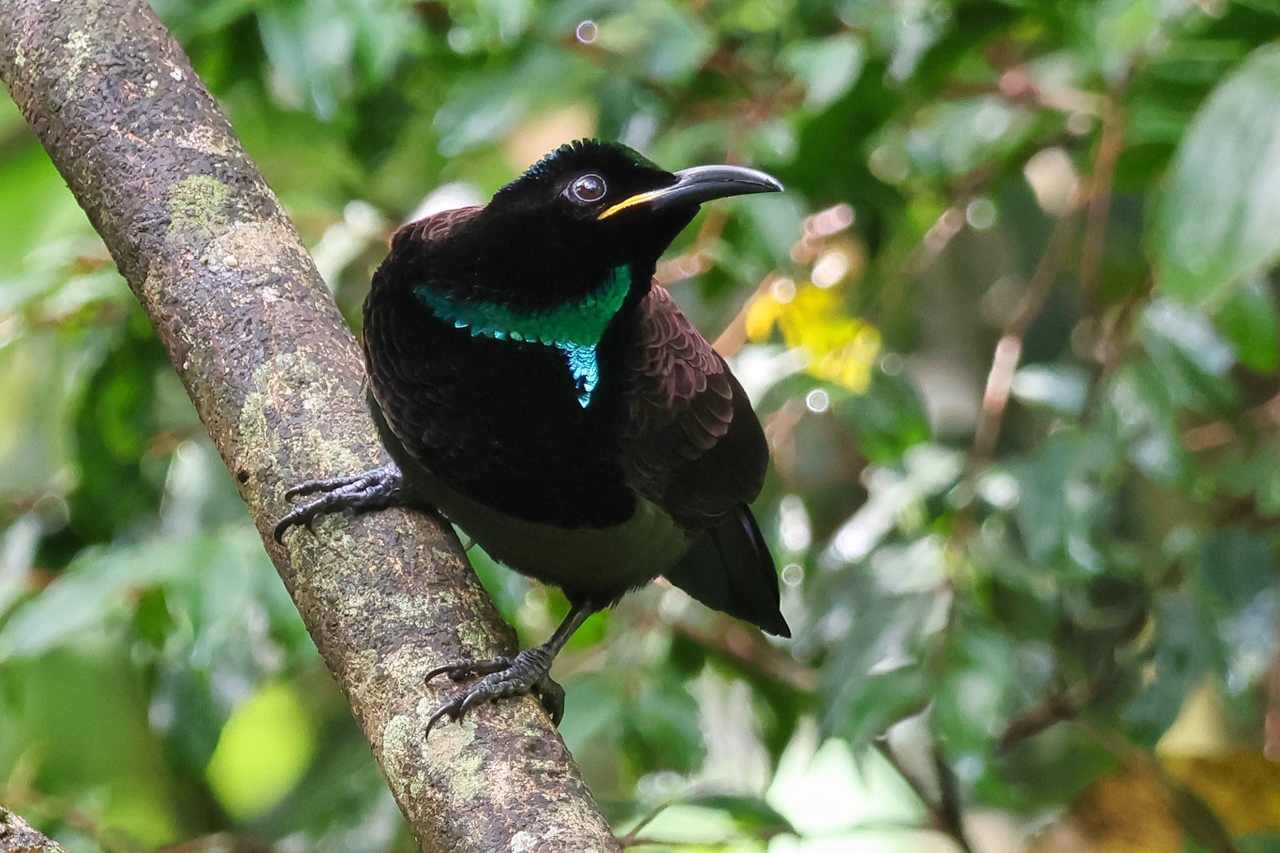
Victoria’s Riflebird © Paul Prappas
Joanie recounted how she would often screen videos of the Riflebird’s courtship display to her students in science class. It was a long-time dream for her to see one in real life, and it was a great delight to share that moment with her. ☺
The Riflebird was joined by honeyeaters, a Pacific Emerald Dove, and a Spotted Catbird – a large and boldly patterned member of the Bowerbird family. Catbirds, unlike other bowerbirds, are monogamous, do not build bowers, and sexes are similar.
On the ground in front of the balcony, Red-legged Pademelons – small, forest-dwelling cousins of kangaroos and wallabies – were hopping around. What a wonderful stop this was – big thanks Martin!!
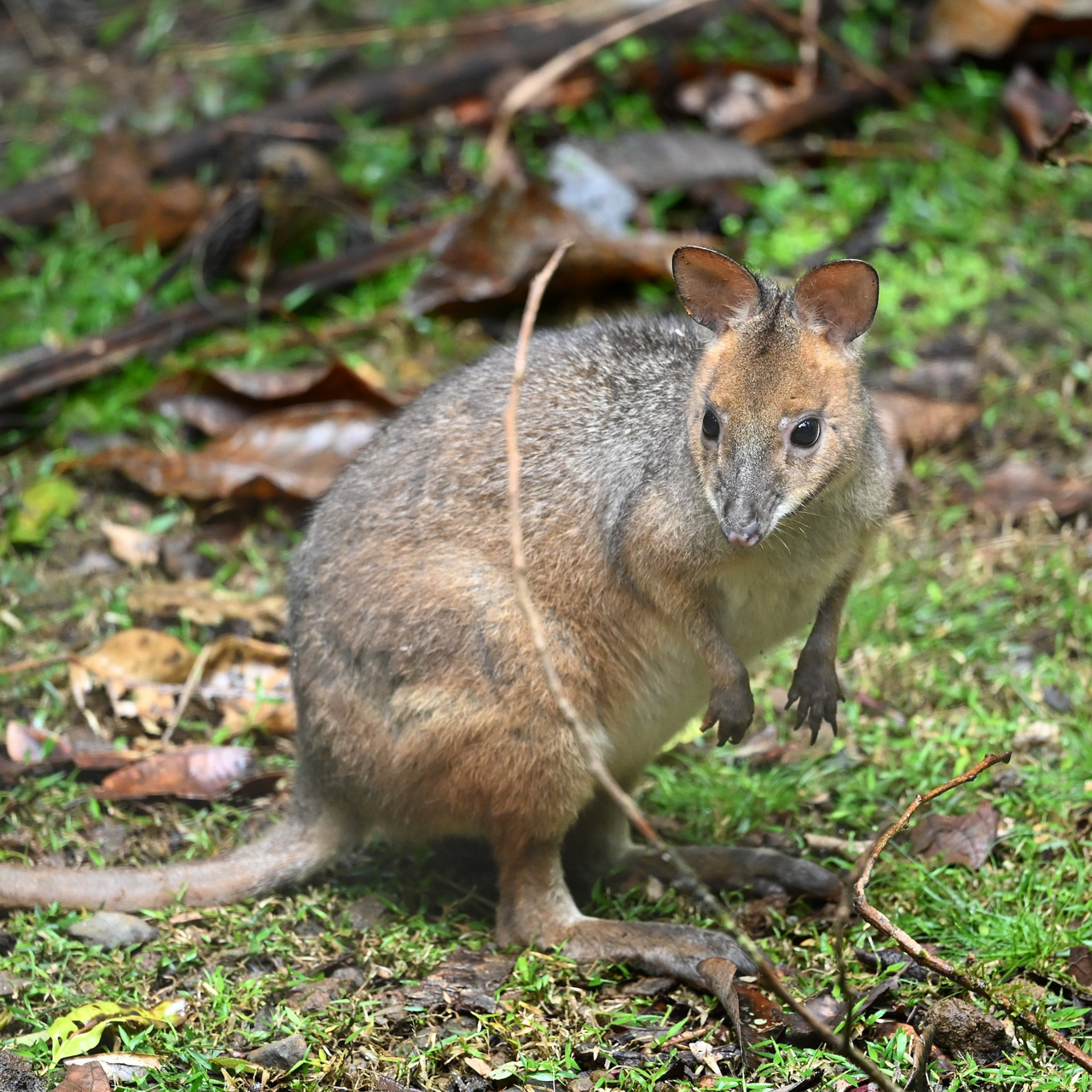
Red-legged Pademelon © Joe Wujcik
We headed to Chambers for one last rainforest birding session in the ancient forest that has apparently changed little since the days when Australia was part of the supercontinent Gondwana. Our resident botanist Shiela particularly enjoyed the towering Tree-Ferns (genus Cyathea), whose lineage stretches back over 200 million years. Craning our necks for the birds, we managed to see Treecreepers and the Pied Monarch, and added Yellow-breasted Boatbill to our list.
A Brown Cuckoo-Dove sat elegantly in an umbrella tree, and all three Fruit-Doves were heard calling. We stayed around just long enough to see the Rose-crowned Fruit-Dove fly in and sit for a moment. Such a tiny dove, he wowed us with his lollipop colours.
We hurried off for one last appointment for the day – this time with a mammal. But not just any mammal – this one lays eggs and has webbed feet and a duck-bill: the Platypus. We rocked up at the creek-side, and he made our job easy. There he was – paddling around, taking dives, and showing off for us pretty well (so much for their secretive reputation)! It was a real joy for us all to observe this unique creature.
Day 8: Coasting for Cassowaries
Our eighth day started out back at another mate of a mate’s house, Angus, who welcomed us warmly to his backyard creature-feeding station. It didn’t take long for Victoria’s Riflebird (this time the female), Spotted Catbirds, Macleay’s and Lewin’s Honeyeaters, and a Pacific Emerald Dove to arrive.
Then came the rockstar: a Red-necked Crake! These secretive rainforest ground-dwellers are surely among Australia’s hardest birds to see… unless you’re mates with Angus! With its burnt orange neck and lime green beak, it skulked around the back of the garden, snatching bites of banana and orange.
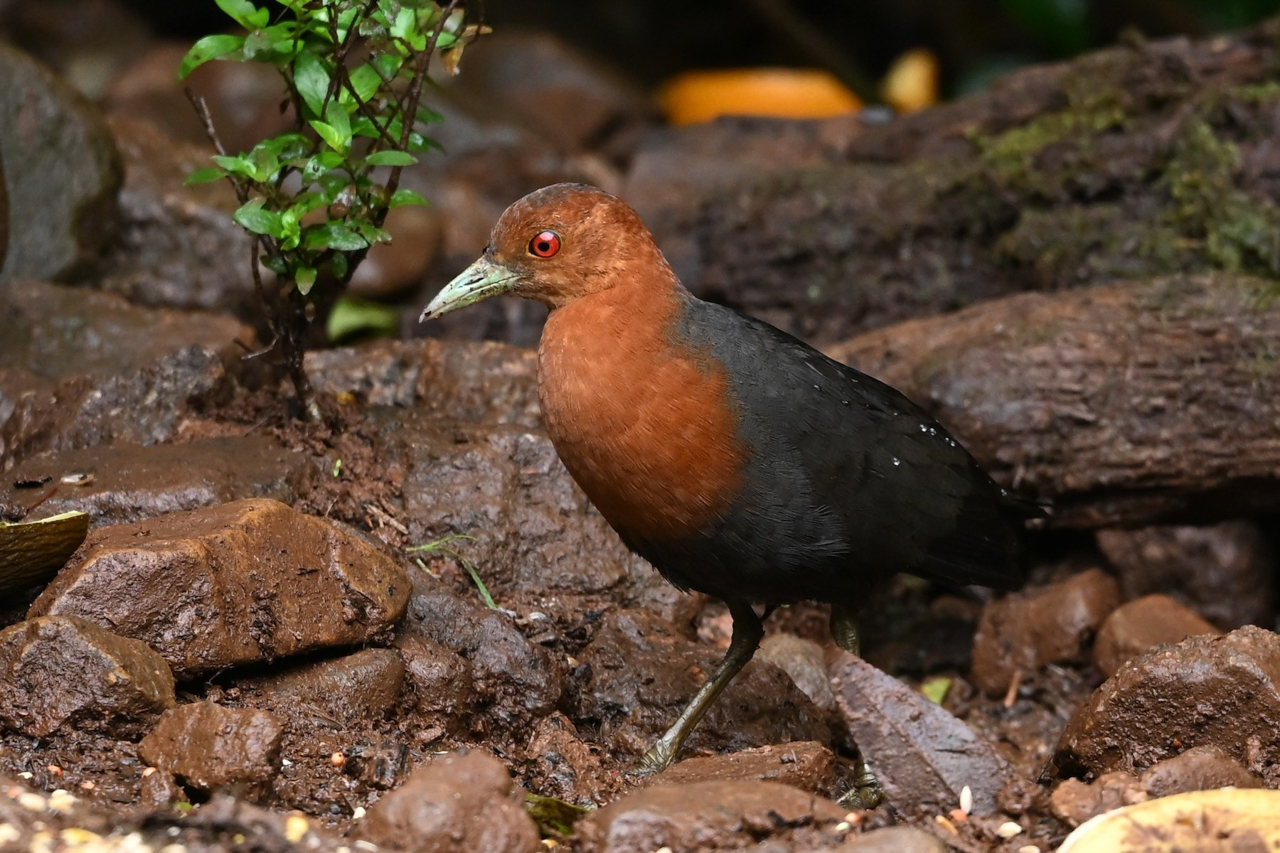
Red-necked Crake © Joe Wujcik
A Musky Rat-Kangaroo, the Kangaroo’s smallest relative, emerged from the shade also – the crake’s mammalian equivalent in its scurrying ways. And we were very entertained by Angus’s red Cattle-Dog, who was a bird identification expert, and would police the feeding station from pesky Brush-Turkeys.
Next to come for a feed were the Red-browed Firetails. These forest finches delighted everyone with their pretty faces and lovely colours, coming super close. A Bower’s Shrikethrush put in a brief appearance.
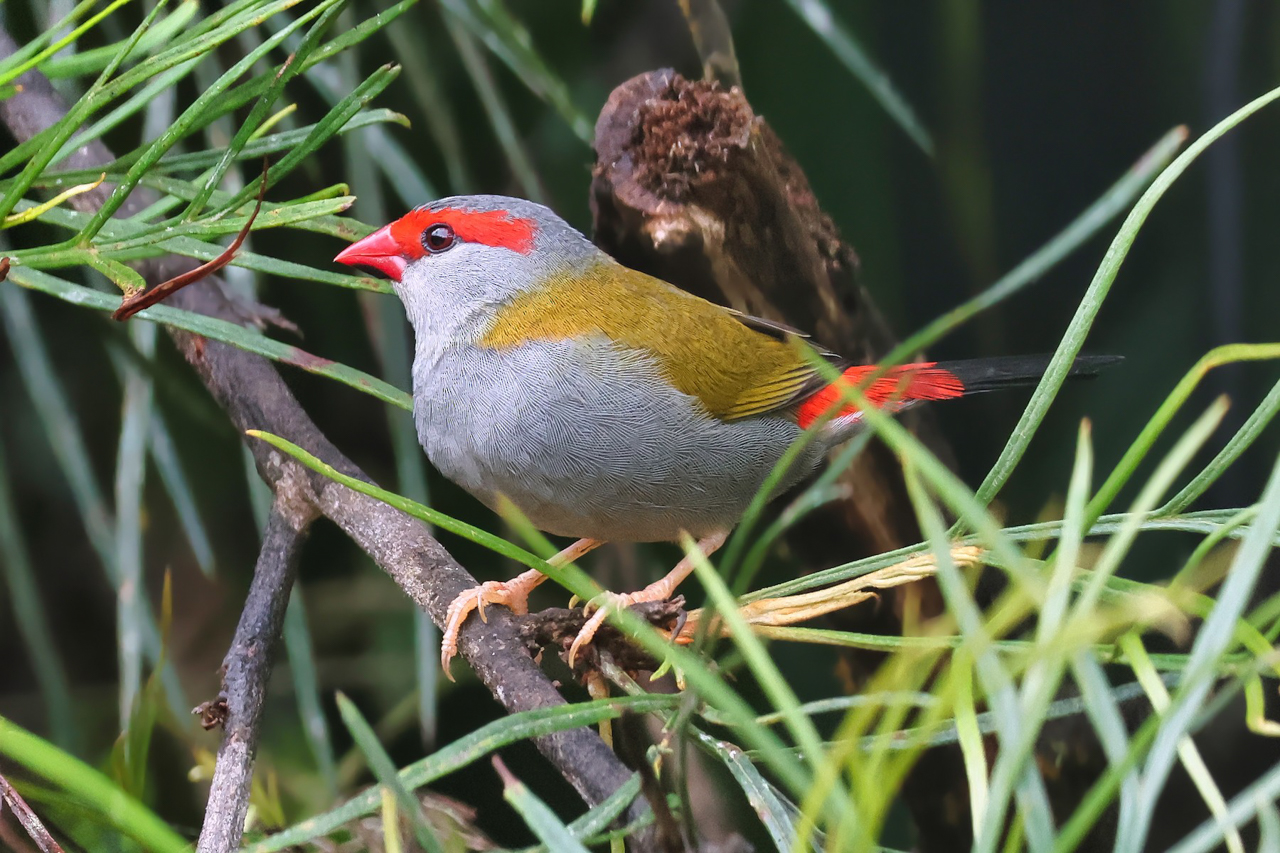
Red-browed Firetail © Paul Prappas
We headed to Lake Barrine in Crater Lakes National Park, stopping first at the café that overlooks the lake. We spotted impressive rafts of Great Crested Grebes, Little Black Cormorants, and a couple of Australasian Grebes.
Our forest stroll took us past giant, ancient Kauri Pines. Bird sightings were limited, but Whistlers and Monarchs were vocal. Turning back, we stopped at the sound of heavy flapping in the canopy. Through a gap in the leaves appeared a deep-purple breast and lemon-yellow undertail – Wompoo Fruit-Dove! We spent long minutes staking it out, trying to get views of this magnificent rainforest pigeon, which remained frustratingly hidden. Then, suddenly, there it was, sitting out in the open: a great pigeon coloured more like a parrot.
The afternoon’s mission was single-minded: Cassowary. We had a few spots to try on the Atherton Tablelands, winding along back roads through pastoral country. Our first surprise was a group of Latham’s Snipe flushing from the roadside and probing a wet field. They’d surely only recently returned from their breeding grounds, worlds away in the mountains of Japan.
Continuing on at 60 km/h, Jackson somehow picked up a lump high in a tree. How he managed this, in less-than-favourable light, beats me. But thank god he did, because there, high in a remnant patch of rainforest, was a pair of surely one of Australia’s – nay, the world’s – coolest mammals: Lumholtz’s Tree Kangaroo!
These large, long-tailed, arboreal macropods are endemic to the Atherton Tablelands. We were blessed to see what looked like a mother and her teenage offspring huddled together in the cool misting rain. This precious sighting brought a tear to Henry’s eye :’)
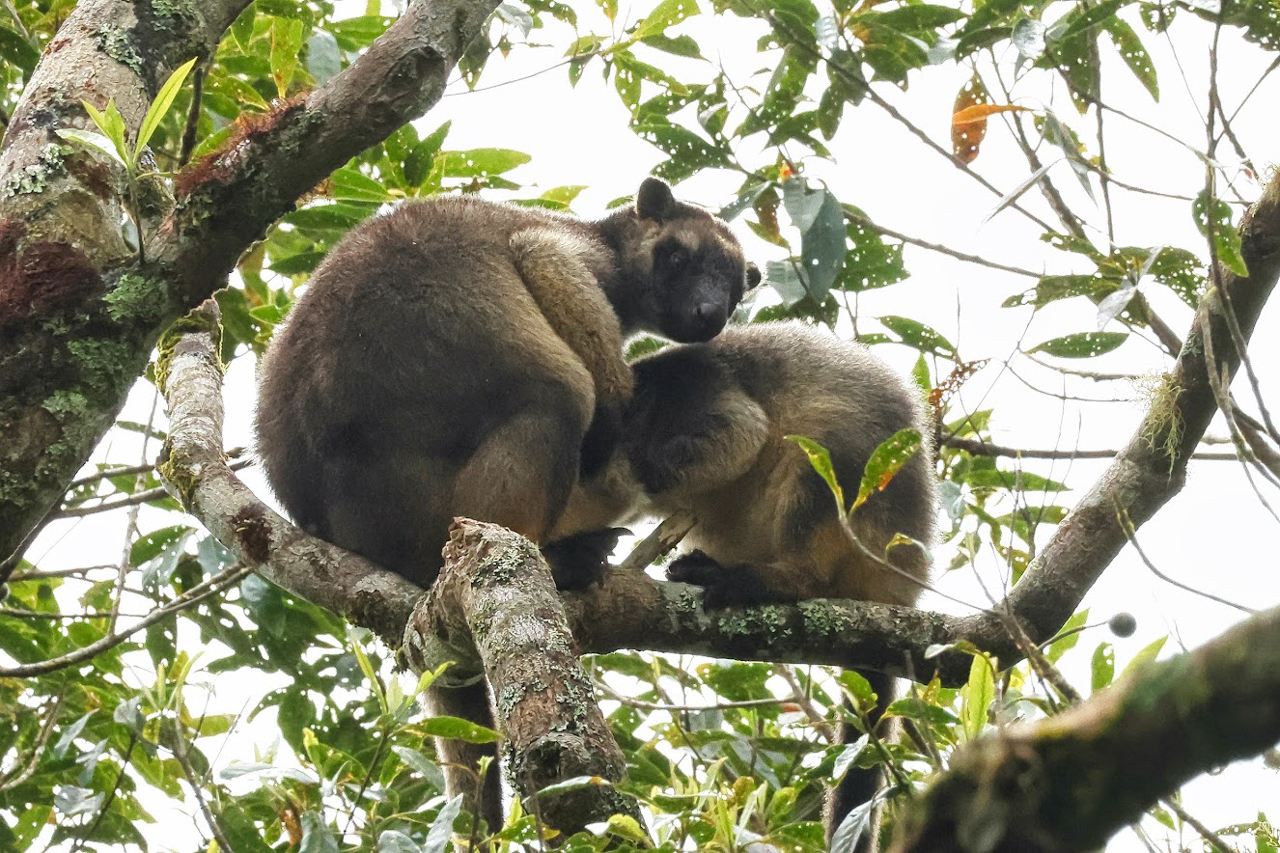
Lumholtz’s Tree-Kangaroos © Paul PRappas
With no Cassowary luck on the tablelands, we drove down to the coast – descending through endless folds and steep, misty, thickly forested hills – to Etty Bay on the aptly named Cassowary Coast.
Everyone scanned the cane-fields and forest edges as we drove in. All of a sudden, Jenni piped up from the back: “There’s one! It was standing right there in the driveway we just passed.”
“Really?!”
“At least, I think it was one… it could have been a statue…”
We spun the vans around. Sure enough, in the driveway an enormous, dinosaur-like Southern Cassowary. His mate and youngster were quick to join him. Hulking black backs with feathers like fur, and their technicolour heads so bright they could easily have been painted in the brightest acrylics.
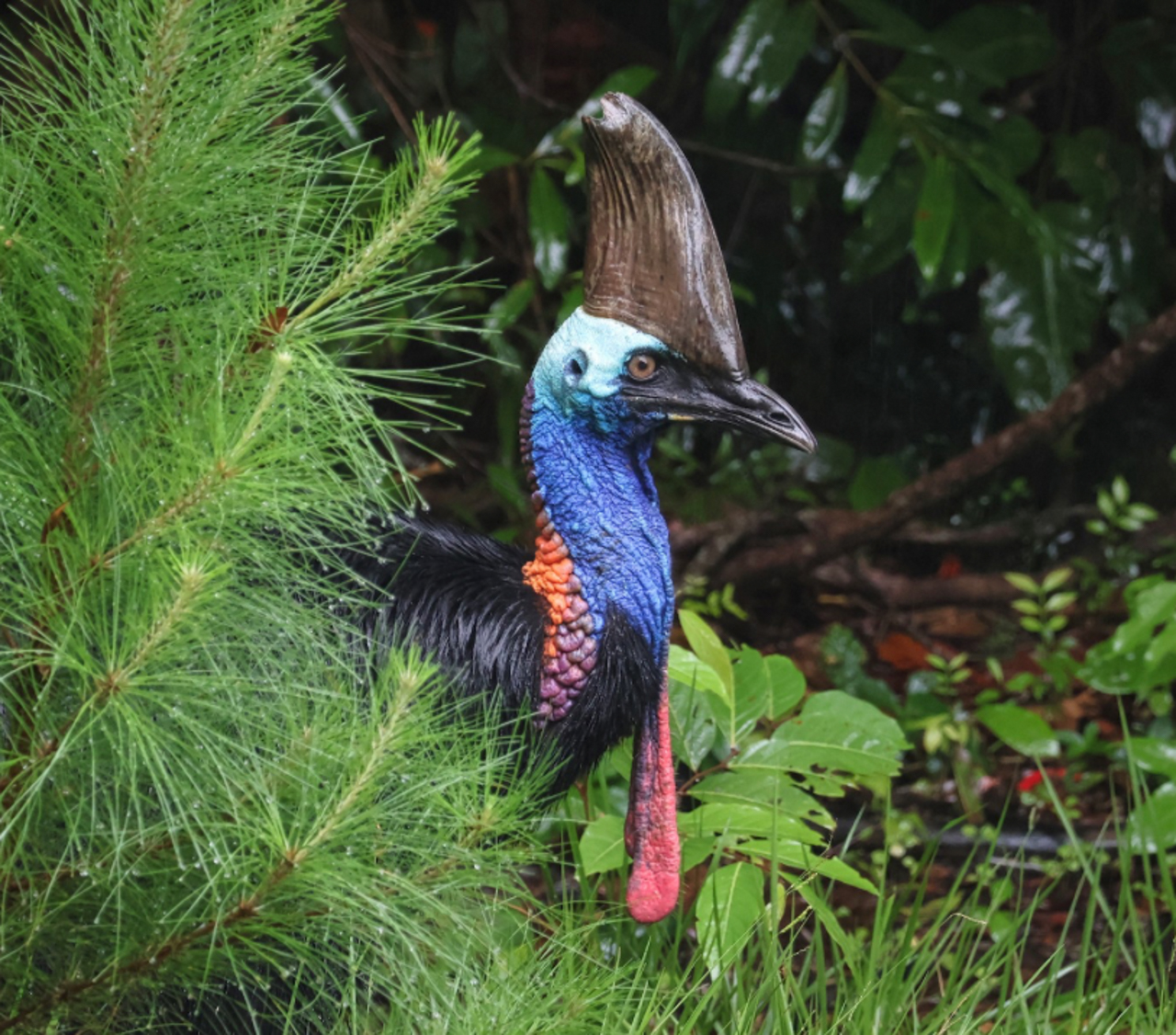
Southern Cassowary © Paul Pappas
We slowly got out and followed the Cassowaries as they munched on leaves. Their brownish juvenile followed behind, walking right along the road (road strikes are a major threat to this endangered bird). We admired their incredible colours, their intimidating glares and bony head-casques, and their thick powerful legs and toes. They really are living dinosaurs.
After a snack down at Etty Bay beach, Deb spotted another dadda Cassowary with a chick further down the beach, while Topknot Pigeons and Torresian Imperial-Pigeons flew overhead.
This marked the end of the North Queensland leg of our trip. And what an excellent time we’d had. From crakes to cassowaries, platypus to tree-kangaroos, we’d done well – rainy weather notwithstanding.
But the dampener on the trip was that, on arriving back in Cairns, we had to say goodbye to dear Barbara, who couldn’t continue with us for health reasons. We were all so sad to see her go, but glad she’d been able to join us for a week in the most biodiverse part of Australia.
Day 9: Transfer to Brisbane and Coffee with Koalas
We woke up early! Like, early early. Today was our flight down to Southeast Queensland to experience O’Reilly’s – one of the premier birdwatching lodges in Australia – beset in temperate rainforests which host quite a different cadre of species.
After a relaxing plane ride, our first stop was a café at Mt Gravatt on the edge of Brisbane – a place where you can see the skyline of the city and the ridges of the mountain ranges far in the distance. And also a place with a good population of Koalas!
Stepping out of the van, we had Scaly-breasted, Rainbow and a few Little Lorikeets feeding in a heavily flowering eucalypt. Laughing Kookaburras hunted all around. And we had Noisy Miners – the first ones of the trip. It was refreshing to see the group show interest in a bird that is nauseatingly common for most Australians! Thereafter ensued a debate about whether the Southern Cassowary or the Noisy Miner was to be crowned as the 200th bird of our trip… (oh please, eBird, let it be the Cassowary!)
We scanned the top of the trees for grey lumps, explaining to everyone that Koalas are notoriously hard to spot because they are so lazy and still most of the time. Of course, we were proven wrong when Jackson spotted one showing ridiculously well in the crook of the tree right beside the café. The Koala clambered around the entire tree, gorging on eucalypt leaves, displaying its weird anatomy, pink fluffy ears and double thumbs.
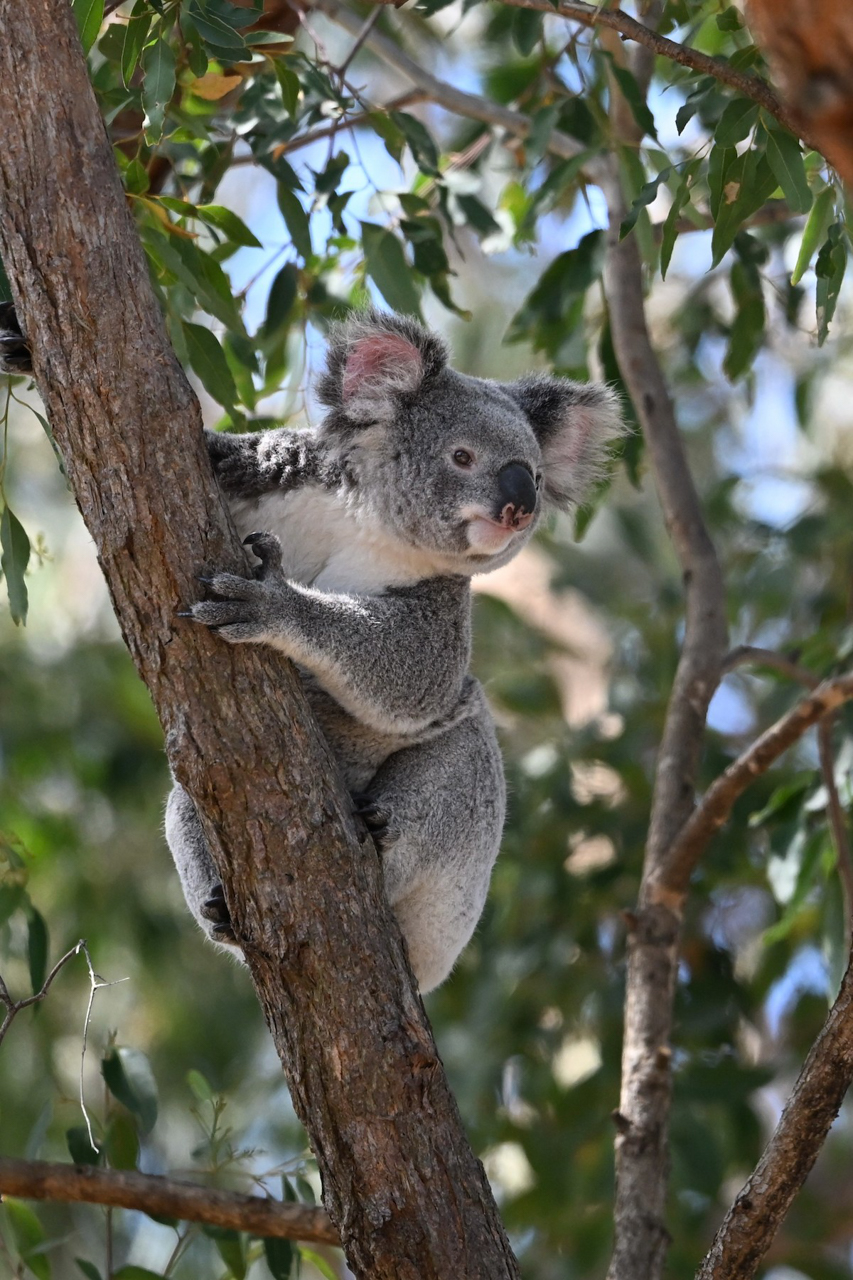
Koala © Joe Wujcik
Our spotting of the Koala turned the whole café onto the poor guy, who had gone completely unnoticed up until that point. Thanks to us, he became the subject of thousands of phone pics and surely made it onto countless Instagram stories that day.
But we left him in peace when a bird of prey swooped overhead and perched in a tree a short walk away. We all ended up getting great views of the little crest, yellow eyes, and boldly barred breast of a Pacific Baza – one of Australia’s prettiest birds of prey. Until a Magpie swooped in and drove him off.
We paused for coffees, milkshakes and a sandwich, and watched our resident lepidopterist, Paul, chase all manner of butterflies around the forest edge.
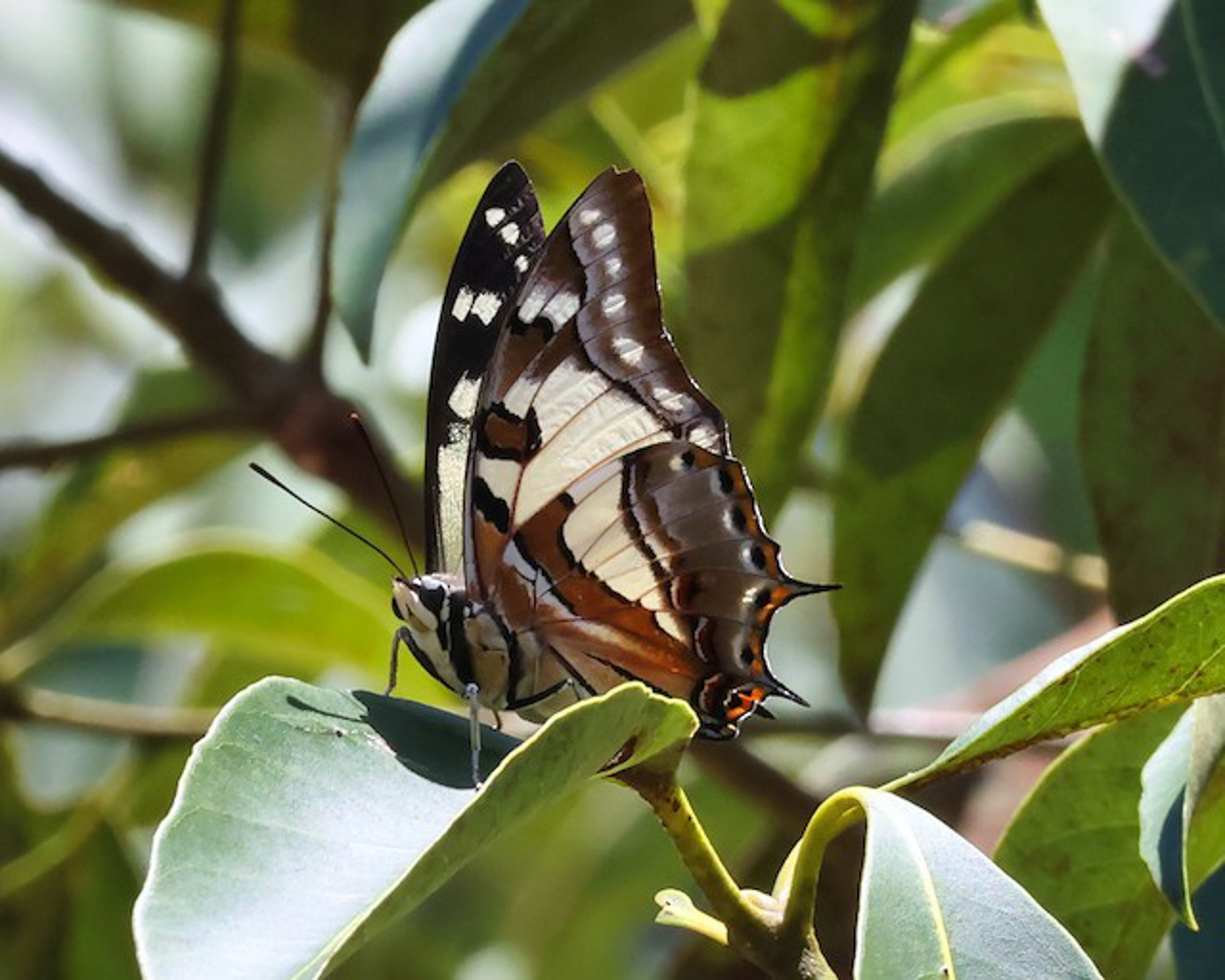
Tailed Emperor © Paul Prappas
And while some of us cleaned up a spilt milkshake (or three!) others spotted yet another bird of prey, this time soaring high above us. But the light was good and the views were clear – Square-tailed Kite! One of Australia’s more uncommon raptor species. Finally, a Gray Butcherbird was the cherry on the cake.
Having done well at Mt Gravatt, we drove up the mountain towards O’Reilly’s. On the way up, some of us saw wallabies and flying foxes, and others saw a nice big Goanna (Spotted Lace Monitor) feeding on some roadkill.
Thanks to the call of Bell Miners, we stopped at a spot where the sclerophyll woodland begins to transition to rainforest. We quickly located a pair of White-naped Honeyeaters feeding a chick in a nest, although it was well camouflaged. Watching these dainty little honeyeaters, we were alerted to yet another nest – this time, of Varied Sittella – Australia’s answer to the Nuthatches of Eurasia and America. We watched these adorable bark-feeding specialists with upturned bills feeding young in their attractive bark-tiled cup in the fork of a tree.
We continued winding up and up until we reached O’Reilly’s, where they feed the local avifauna. The big, colourful and tame birds made for quite a different birding experience indeed. Australian King-Parrots and Crimson Rosellas flocked around us with their bright reds and soft blues and deep greens – some of them even landing on our heads! Wonga Pigeons wandered on the grass nearby.
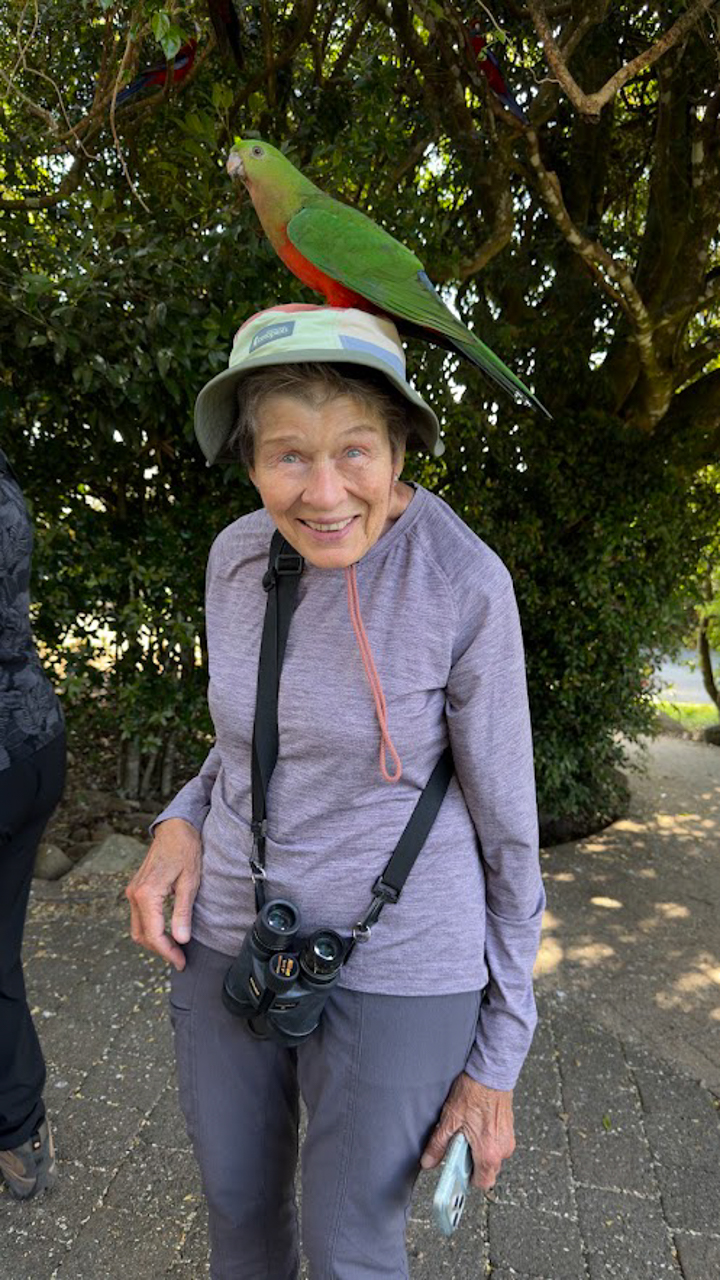
Debby with female King-Parrot © Edward Sako
After spending some time with the parrots – whose exquisite beauty was perhaps a little cheapened by the frenzied feeding station – we followed the wheezy, metallic calls of Bowerbirds into the forest.
Crouched down in the shadows, we peered between leaves and sticks to get a look at quite the spectacle – a male Satin Bowerbird in full courtship dance. His performance is striking and kind of retro and robotic, almost like something out of an 80s science-fiction film. And his satiny blue plumage sets off his purple eye and ivory-white bill. What a gorgeous bird. More from him later.
Other denizens of the forest floor were hopping around – Yellow-throated Scrubwren, White-browed Scrubwren, Eastern Yellow Robin, and even a pair of Russet-tailed Thrushes (one of only two ‘true’ thrushes native to Australia).
We then took a needed rest in the accommodation (…all except for Jenni and Ed, who went out for a wee stroll, and ended up with pictures of the prize endemic bird, the Albert’s Lyrebird!) We were all keen to match their sighting.
But before that, we enjoyed a delicious buffet dinner, and a cheery toast to Allan and Shiela’s wedding anniversary!
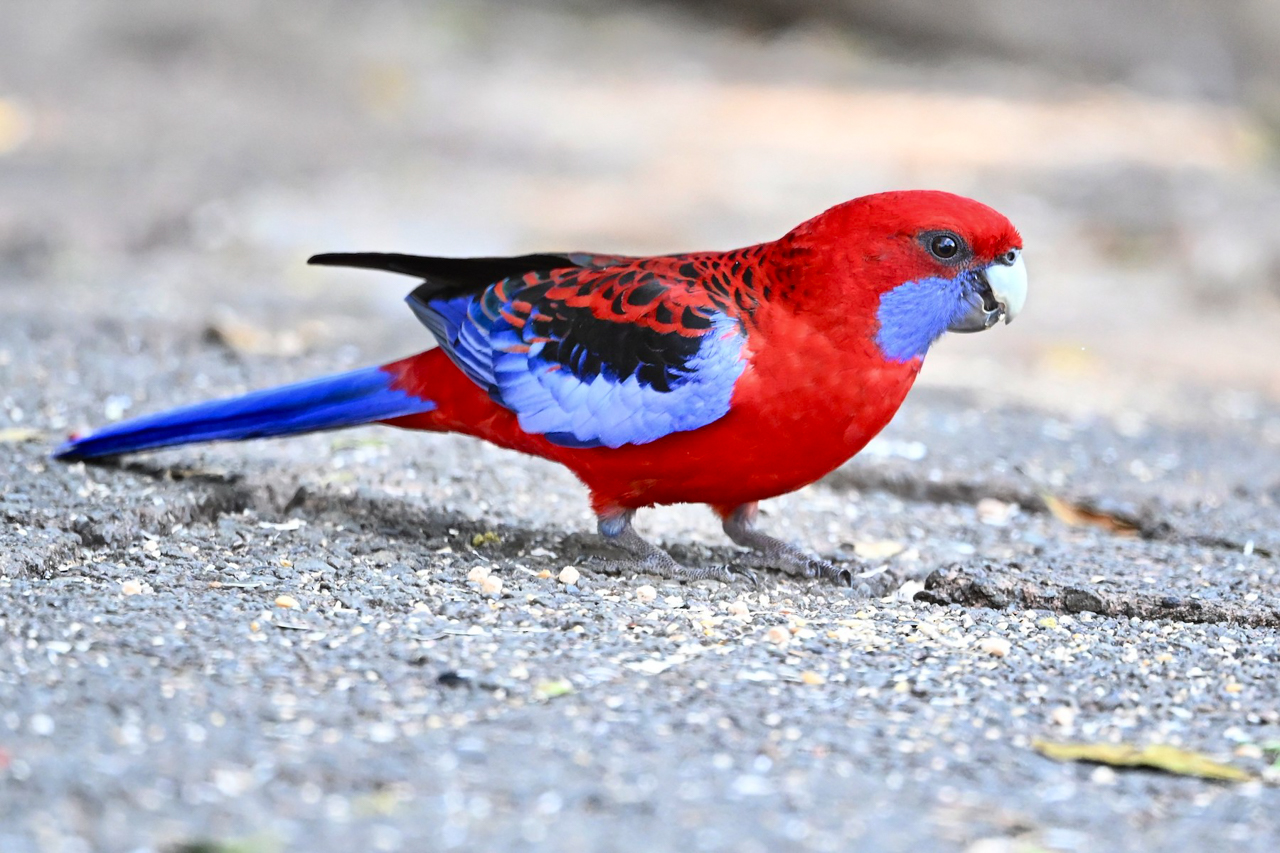
Crimson Rosella © JOe Wujcik
Day 10: O’Reilly’s and Lamington National Park
We woke up in a raincloud, but didn’t let it dampen our spirits. Our walk around the Border Loop in Lamington National Park delivered some nice new ones for us, including Rose Robin, Fan-tailed Cuckoo, Gray Shrikethrush, Eastern Whipbird, and Australian Logrunner. The latter is a subtropical rainforest endemic; a quail-like passerine with hardened spiny tail feathers. These special adaptations make them the ninjas of the forest floor. We were entertained watching them tear apart the leaf litter in an industrious flurry.
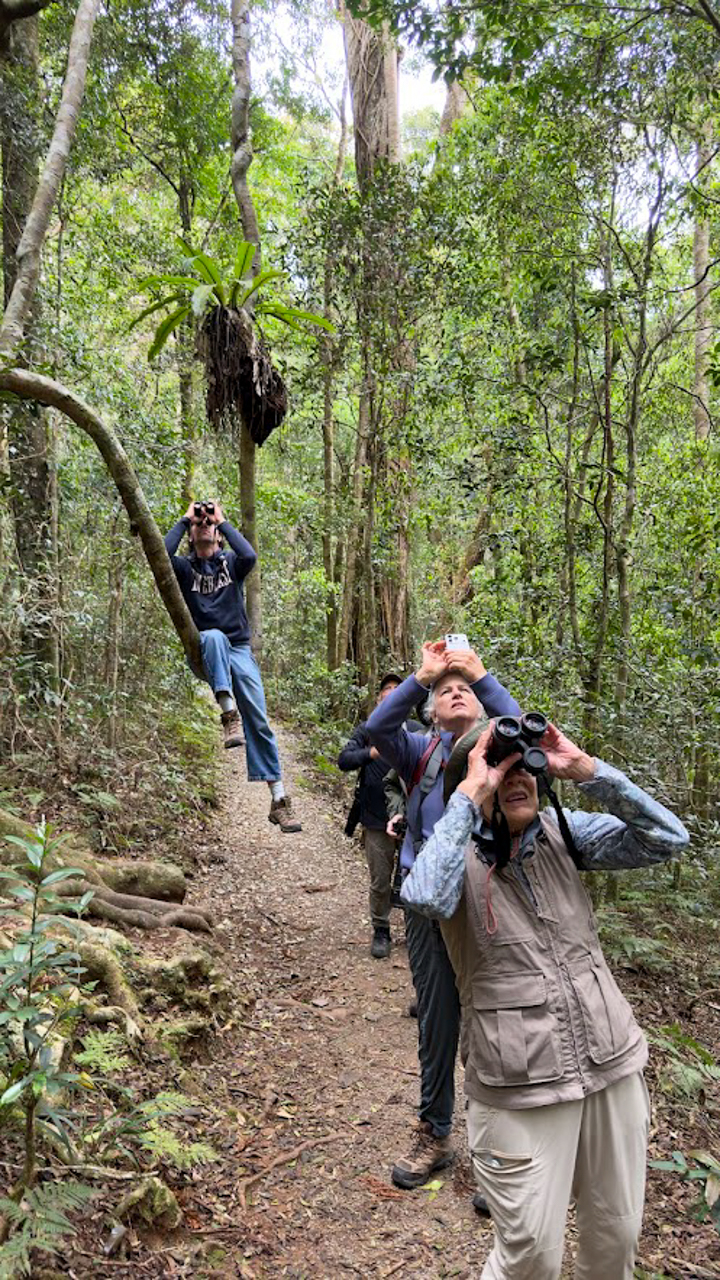
O’Reilly’s birding © Edward Sako
While the whipbirds whip-cracked around us, we stepped off the track to visit a Satin Bowerbird’s bower – a stick avenue with some badges of moss and piles of meticulously arranged blue jewels – bottle caps, rainforest fruit, scrap bits of metal.
We watched as the male came down to his bower and did some re-arranging. Then, Henry deemed it appropriate to steal a shiny blue carabiner from off Ed’s backpack, and caught the bird’s eye with its glint. He tossed it to the ground and the bird hopped right up, collected the carabiner, and put it pride-of-place in his artistic collection! It was such a cool interaction to observe.
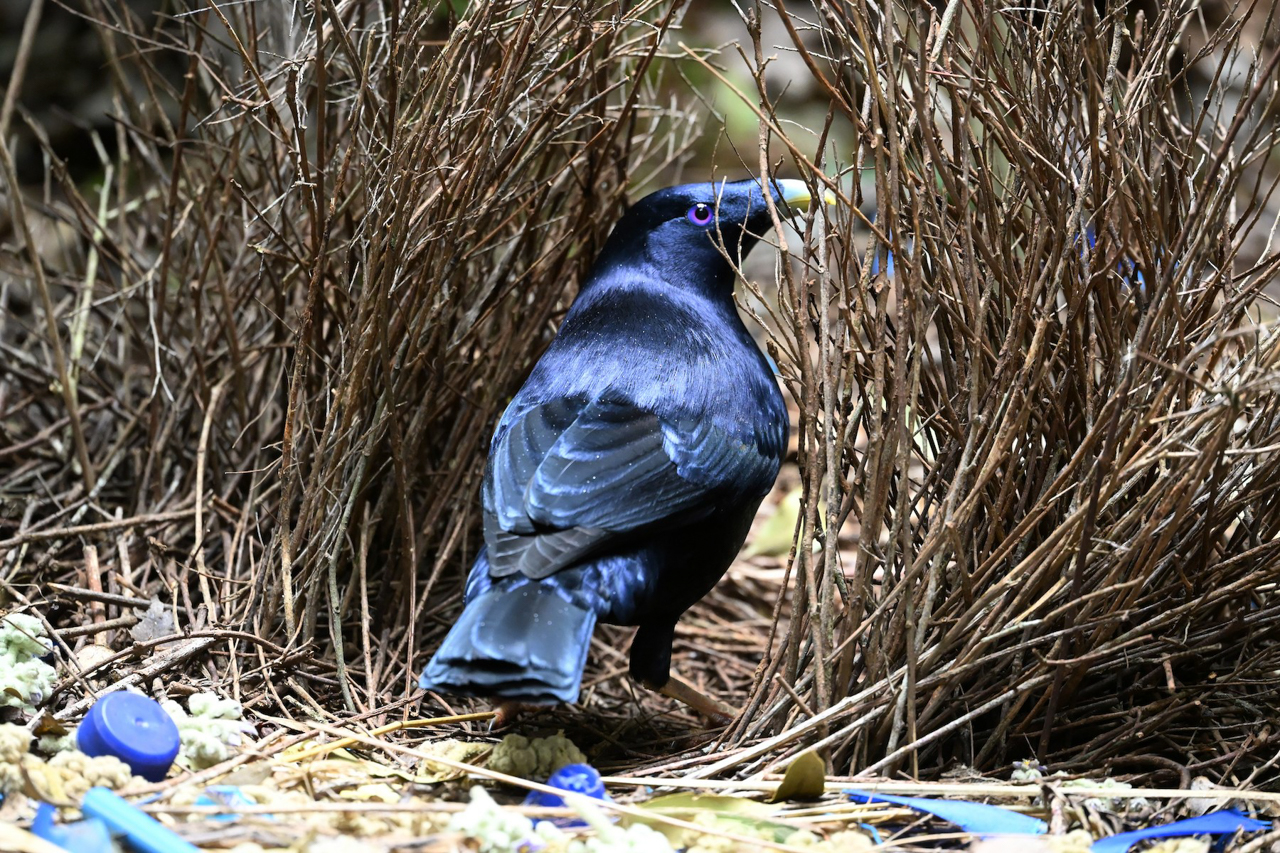
Satin Bowerbird at his bower © Joe Wujcik
We drove to a different area of the park for a picnic lunch and more birding. At Duck Creek Rd, we had a Paradise Riflebird flying over, Gray Fantail, Golden Whistler, Superb Fairywrens hopping about, and Shining Bronze-Cuckoos showing interest in parasitising their nests. Another Rose Robin showed his colours on the walk back.
We stopped and had a look at an interesting spot where the forest type suddenly changes from rainforest to wet sclerophyll, and admired the tall ribbon gums of this patch. Feeding on the gum trees, our target bird Red-browed Treecreeper was easy to find but not easy to see well, and they moved off quickly. The White-throated Treecreepers showed better. Australian Treecreepers are actually a very ancient lineage of songbirds, superficially similar to – but genetically very distant from – the treecreepers of the Northern Hemisphere.
Suddenly, a Paradise Riflebird – the most southerly occurring bird-of-paradise and endemic to this region – flew into a giant gum tree, and spent a long time probing its cracks for invertebrates, offering nice views. Meanwhile, we got some tantalising glimpses of the teeny Spotted Pardalote, and some great views of the giant Wedge-tailed Eagle, Australia’s biggest bird of prey, soaring low overhead, and showing off his namesake – that large, diamond-shaped tail. Yellow-faced and Lewin’s Honeyeaters called, with some White-naped chiming in too.
Then came the real challenge of the day – Albert’s Lyrebird. Albert’s Lyrebird is one of the most range-restricted birds in Australia, renowned for elaborate courtship displays, and for being perhaps the closest living relative to the most ancient passerine. One could almost say the Albert’s Lyrebird was the first bird who ever sang…
We headed out on our mission and glimpsed a female cross the road in front of us but could not relocate her. Then, a call from Jackson – he had found a male. We ran over, and some of us saw him briefly before he scampered off. Finding him again became a whole-team effort, splitting up and scanning different parts of the forest, calling out to one another, then coming back together. It was good exercise – almost too good for some!
But it all paid off. We ended up finding him scratching at the edge of the carpark, digging deep in his quest for worms, minding his own business, and being surprisingly confiding for such a shy bird. We watched him dig for quite a while, and after he’d finished we checked out his impressive excavation.
We walked back to O’Reilly’s and enjoyed a very well-deserved, and very delicious, buffet dinner.
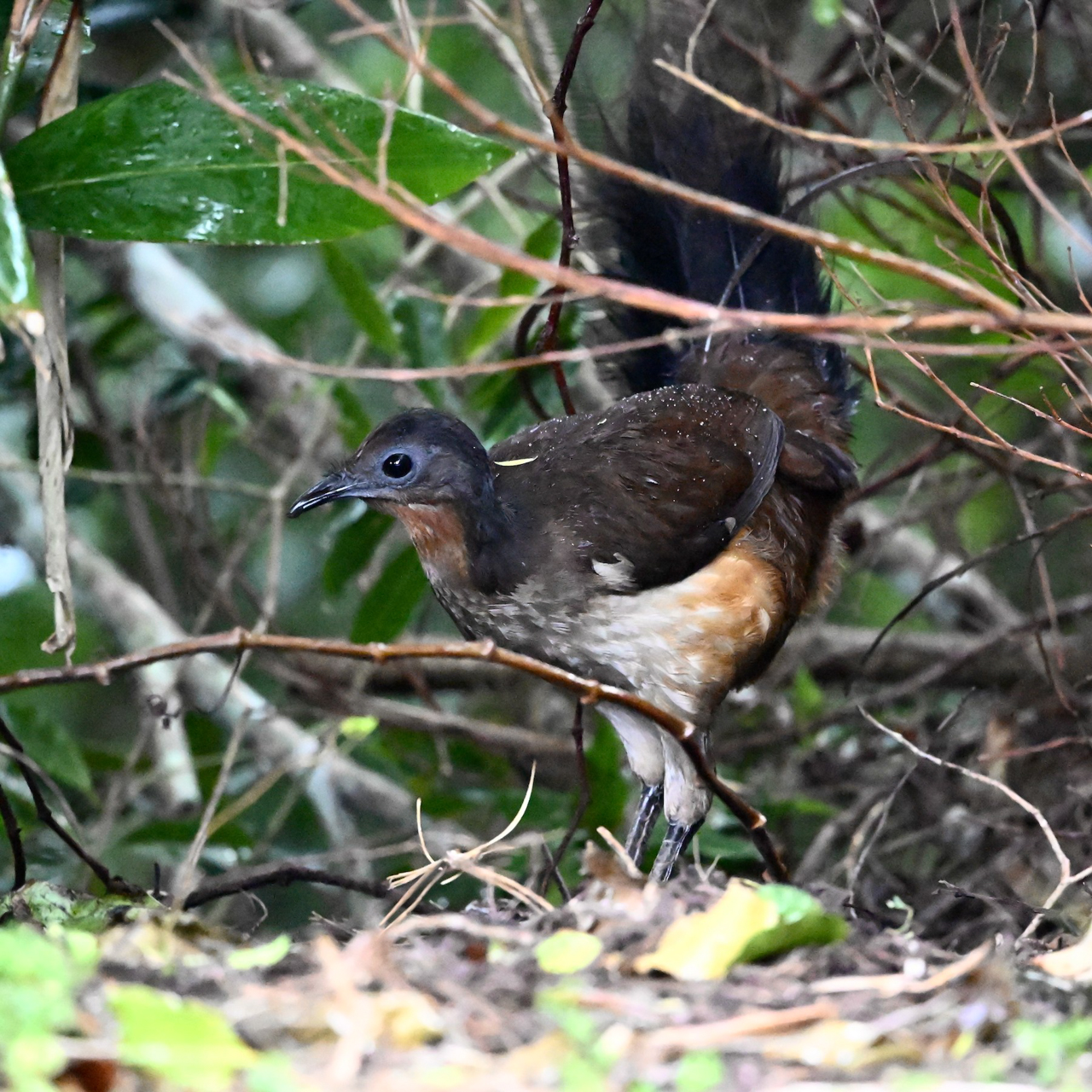
Albert’s Lyrebird © Joe Wujcik
Day 11: Transfer to Sydney
We started on the booyong walk at O’Reilly’s, but had no luck with that morning’s target of Noisy Pitta, though we heard the calls. But we caught up a last time with the Scrubwrens, Whipbirds, Robins, Shrikethrushes and Bowerbirds. The orange fan of a Rufous Fantail glowed bright from the gloomy forest floor.
The Regent Bowerbirds were particularly confiding that morning – and what a bird! With large golden panels in their jet blue-black wings, and a ‘helmet’ of the same gold which ombres to fiery red at the crown, they’ve got to be one of the most striking birds in Australia. Nowhere do these stunning bowerbirds show off better than O’Reilly’s. They are the logo of the resort for good reason. And Shiela was particularly blessed to have one land on her head.
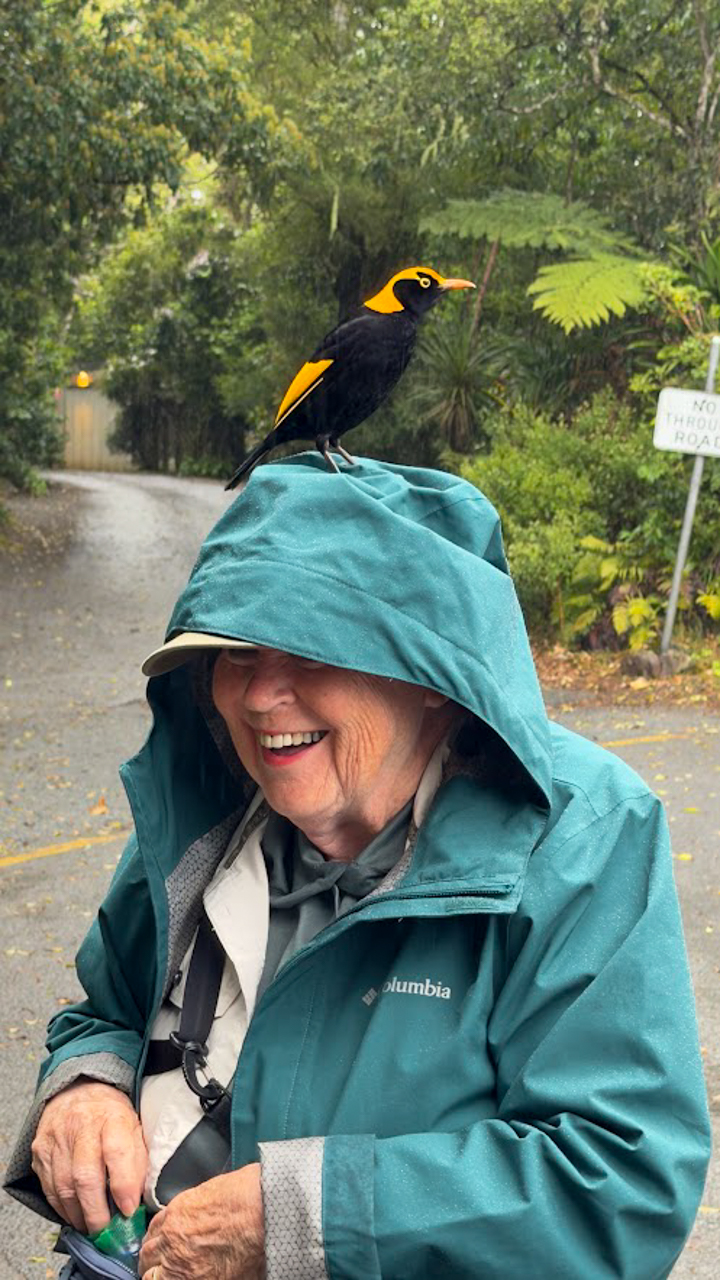
Shiela with Regent Bowerbird © Edward Sako
Later that morning, the Python Rock Track was a beautiful walk through the rainforest in dappled sunlight. We admired formidable buttress roots and strangler figs, thick vines, a Brown Cuckoo-Dove, and a Paradise Riflebird hanging out right at eye level just metres from us.
And then we drove down the mountain, heading back to Brisbane and eventually Sydney, with a stop at a huge Flying-Fox colony on the way. Most were Grey-headed Flying-Fox, but some Black Flying-Fox were picked out too. Some of the group were stunned to see bats so large.
The rest of our day was spent in transit to Sydney. Not a minute of birding time was wasted – as the guides picked up the vans, the group got onto Superb Fairywrens in the parking lot.
Day 12: Pelagic
Our first day in Sydney was not really in Sydney at all, but way out in the Tasman Sea at the continental shelf. But we started in Sydney Harbour, where we saw Chestnut Teal, Silver Gull, Great Crested Tern, Pied Cormorant… oh and the Sydney Harbour Bridge and Opera House are probably worth a mention too.
Leaving the heads, we started to get some of the open-ocean species. Wedge-tailed Shearwater started trickling through. Then an Australasian Gannet. And a few Inshore Bottlenose Dolphin made a welcome appearance. Allan saw a Humpback Whale breach.
Then we started to come upon impressive rafts of Shearwaters – Fluttering and Hutton’s (or simply “Flutton’s”) showed their white bellies and diagnostic flight style. Flesh-footed Shearwaters were picked out from the Wedge-tails by wing shape at a distance, and by colouration when closer. Thank goodness our pelagic guide Greg was on the boat to enlighten us about these identification hacks.
Then, our first Albatrosses came through. Juvenile Shy Albatross, then an adult. Then a fly-by Black-browed Albatross. These awesome birds showed their size and their elegant facial markings – as well as their love for raw chicken. Australasian Gannets also looked impressive flying low over the boat.
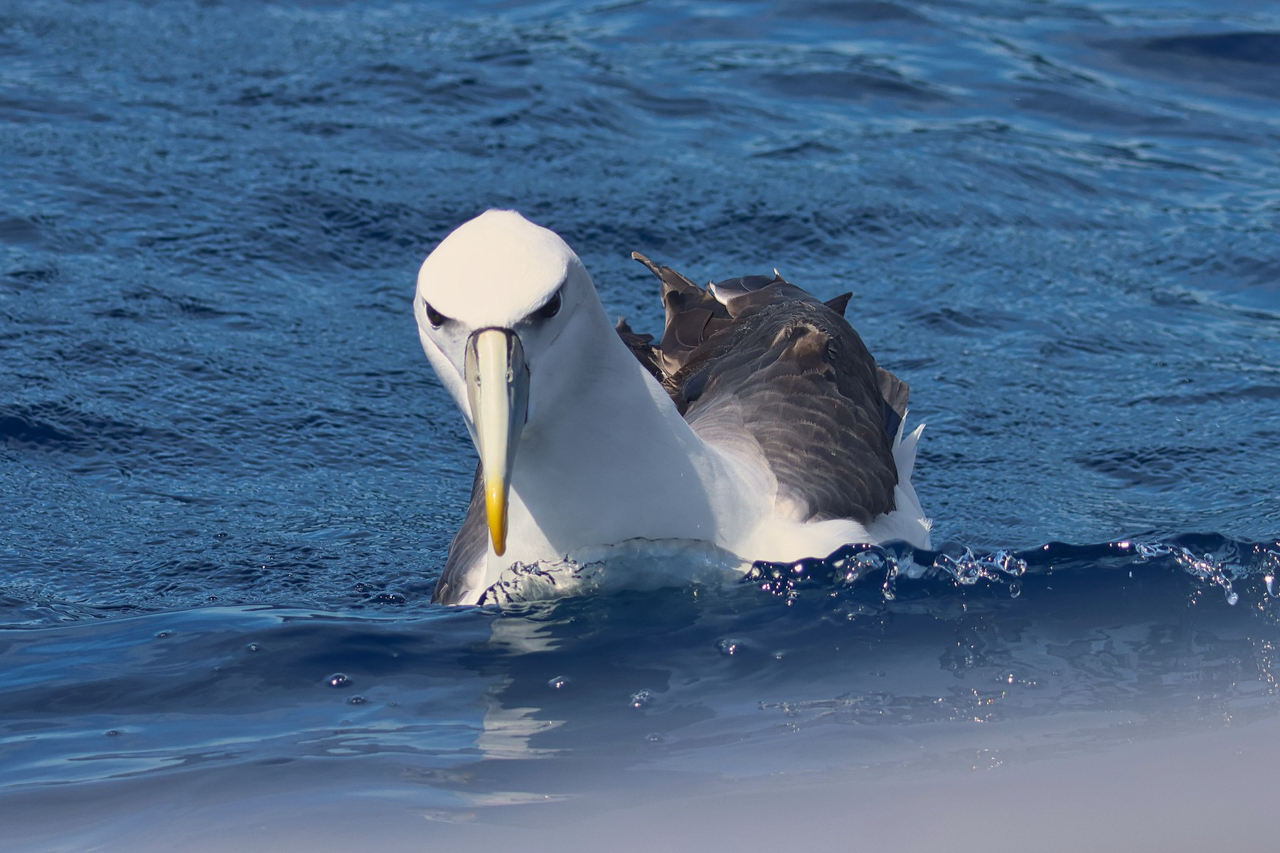
Shy Albatross © Paul Prappas
Then, surely one of the highlights of the day: a large pod of dolphins leaping out and almost gliding in a wave across the surface of the sea, passing right in front of our boat. Some quick ID work by our Greg revealed they were Pantropical Spotted Dolphin – quite an interesting sighting and certainly an animal none of us on board had yet seen.
We stopped and put out a slick, but action was slow. And the waves were big, churning a few stomachs, and making it a real challenge to simply walk around the deck. But as Shy Albatross started coming to the slick, we (mostly) forgot our woes. These giants were joined by some of the very smallest birds of the open sea – Wilson’s Storm-Petrels. These dainty little angels danced across the swell, picking tasty morsels that the albatross had neglected to wolf down.
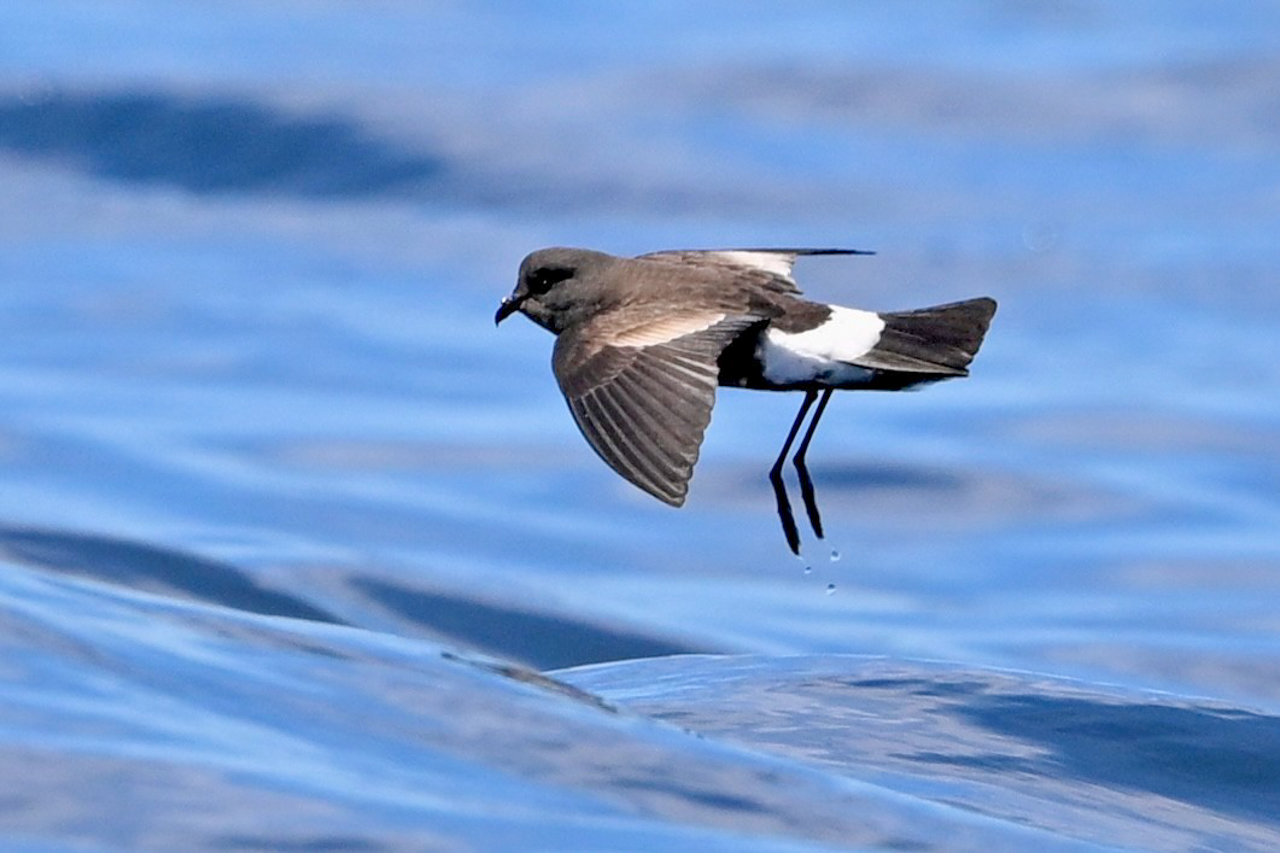
Wilson’s Storm-Petrel © Joe Wujcik
On the way back, we got some great looks at migrating Humpback Whales. And, heralded by Greg’s emphatic cry “Skua! Skua! Skua! Skua!” a Brown Skua landed right behind the boat, and showed off his intimidating size. A very cool bird.
Back at the sandstone cliffs of Sydney, we found a family of New Zealand Fur-Seals lazing about the rock, while another played around in the shallows. A pair of Common Dolphin put in a brief appearance – our fourth cetacean of the day.
We spotted a distant Australian Pelican in the harbour itself, and got good views of Pied Cormorants. We stepped back onto the wharf at Rose Bay with lifers galore and a newfound appreciation of the sweet stability of land.
Day 13: South of Sydney
On a bright and sunny morning we left the big smoke (that’s what Aussies call cities) behind and headed south, first stop Royal National Park, Lady Carrington Drive. We were greeted by Australian Wood Ducks (Maned Ducks) sitting sunlit and picturesque on the Hacking River. We also watched them nibble at the grass with their procession of ducklings. A flash of blue marked an Azure Kingfisher crossing the river.
Overhead came the raucous squawks of the world’s largest cuckoo, the Channel-billed Cuckoo. This mean-looking dinosaur of a bird has a heavy bill and a long, barred tail. They are summer breeding migrants to Australia’s East (much to the dismay of the local Currawongs, who they parasitise).
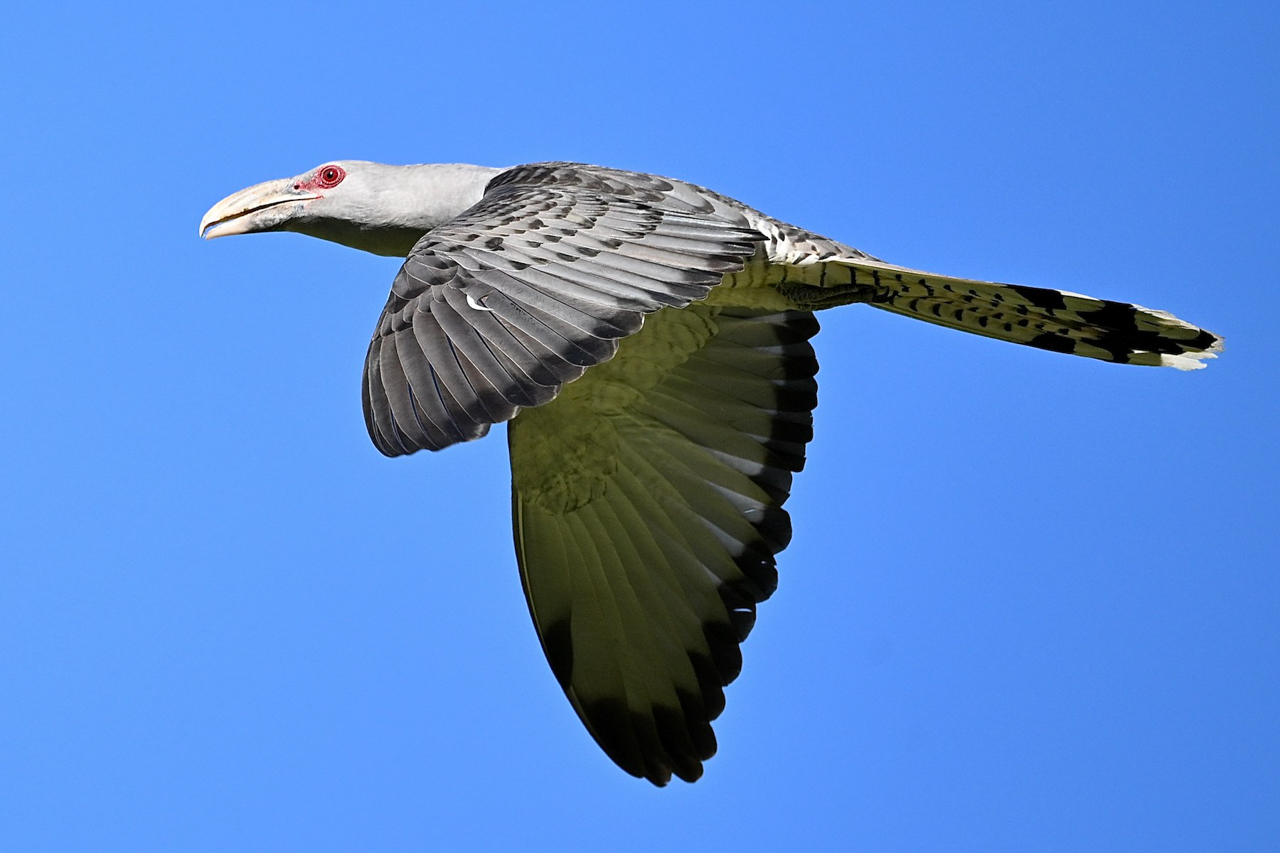
Channel-billed Cuckoo © Joe Wujcik
As we continued, we found Eurasian Coots and Dusky Moorhens on the river, and a Brown Goshawk flying overhead. At the top of the wiggly red Sydney Red Gums, Australian Ravens cawed with their hackled throats. And, flittering between flowers in the understorey, surely one of the most attractive honeyeaters: the Eastern Spinebill, who eventually afforded wonderful views.
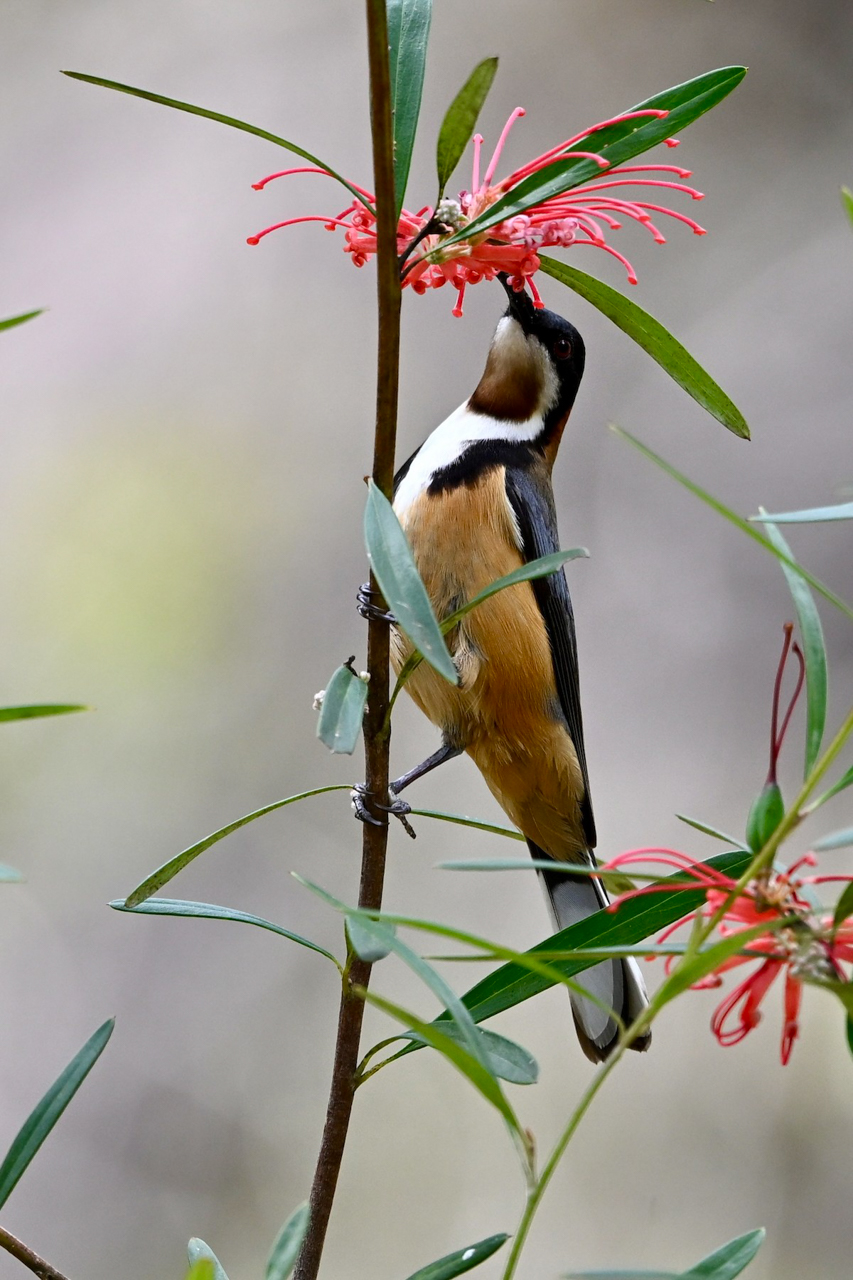
Eastern Spinebill feeding at Red Spider Grevillea © Joe Wujcik
Further into the rainforest, we heard the call of the Bassian Thrush, and Deb’s eagle-eyes managed to spot him on the forest floor, despite his excellent camouflage. Little Wattlebirds crowed higher up, and we scoped them out too. And, just as we turned around, a pair of Green Catbirds – finally, at eye-level! Having been tantalised by this species at O’Reilly’s, it was great to finally all get onto them.
The walk back along the river took us past a kaleidoscope of flowering plants and riddled sandstone rockfaces. Shiela and Henry particularly enjoyed the Epacris longiflora, and we were all impressed by the size and markings of the Eastern Water Dragons, who sat beside the path and dropped, semi-aquatic, into the river. Jenni spotted a Sulphur-crested Cockatoo at a nesting hollow through her scope.
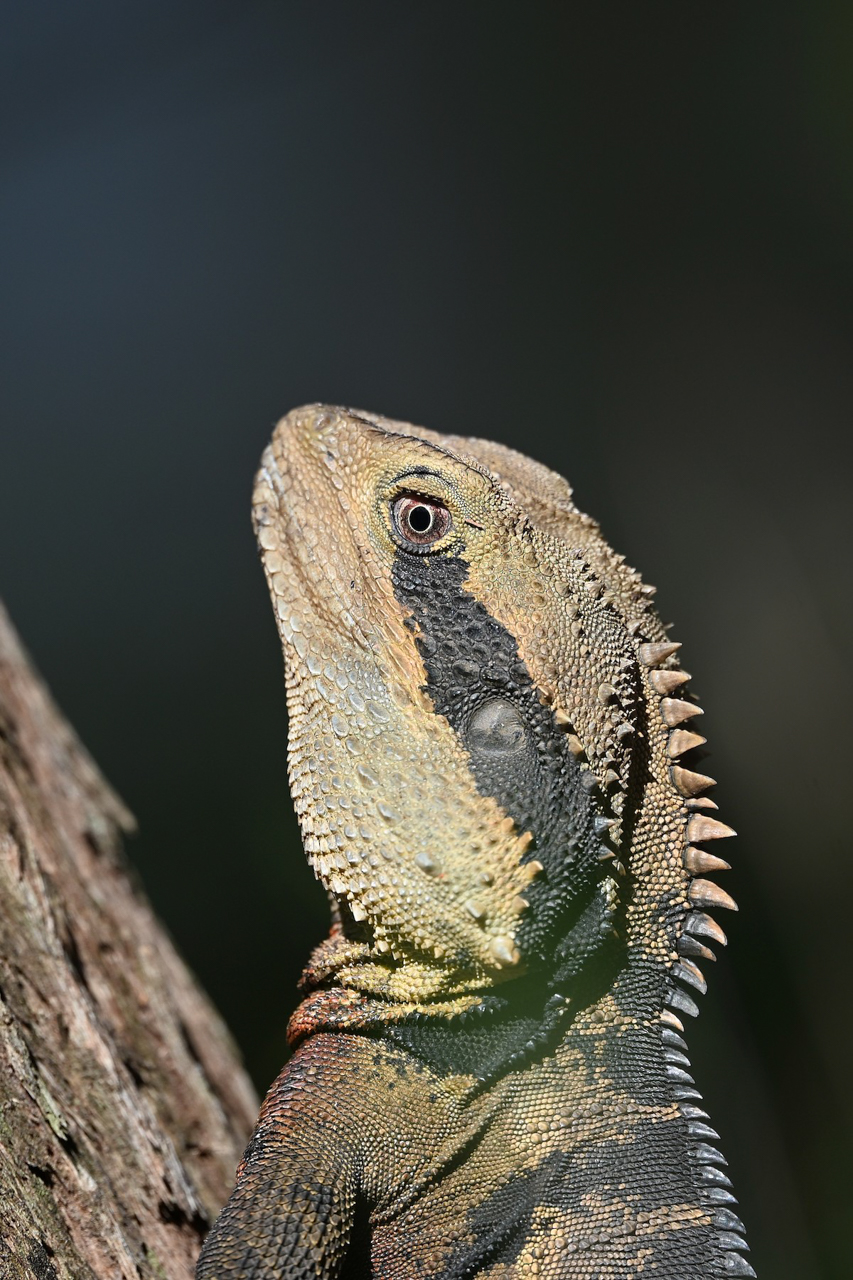
Eastern Water Dragon © Joe Wujcik
Back by the cars, we all saw Superb Fairywren and Brown Thornbill, and then distinguished the higher trills of another Fairywren species – the larger Variegated Fairywren. These birds were hopping around the nearby rocks and shrubs, but didn’t stay still for long. As we followed them with our binoculars and cameras, one of Henry’s earliest birding mentors, Ricki Coughlan, happened upon us, and shared detailed information about the breeding lives of these electric blue little darlings.
We retired to the shade of a picturesque picnic spot, where we lunched in the company of Cockatoos and Ravens and our first Little Corella.
Then, we headed further south, making a quick stop in the heathland to pick up New Holland Honeyeater. We also enjoyed expansive views across the park while a stumpy-tail Rosenberg’s Monitor (Heath Goanna) shuffled across the path.
Another heathland stop at Madden’s Plains was worthwhile indeed. We saw Australian Pipits in their display flights, and then not one but two species of Harrier – first, a Spotted Harrier, and not ten minutes later a Swamp Harrier! Although we wished they came a bit closer, it was awesome to pick up both of Australia’s two Harrier species in quick succession.
But the star of the show here was no bird-of-prey. Rather, a family of Southern Emu-wrens – tiny, delicate, sandy-coloured birds with blue throats and a long fine tail – hopped around the tops of the bushes. A skulker that is never easy to see, we were more than happy with the views we obtained. And back nearer the car, Rufous Whistler and Black-faced Cuckooshrikes put in an appearance, and Paul identified the Swallowtail butterflies.
The other notable presence was the Bogong Moths, whose migration seemed to be in full force. By the time we arrived in our accommodation in Gerringong, the air was thick with them and we struggled to keep them out of the vans. For a species whose population had infamously collapsed a few years prior, it was a good omen to see so many.
Also in Gerringong, we saw Galahs and Corellas feeding on the grass, and Red Wattlebirds (one of the largest honeyeaters) lazing around with bellies full of moths. Meanwhile, we filled our bellies at a local Thai restaurant.
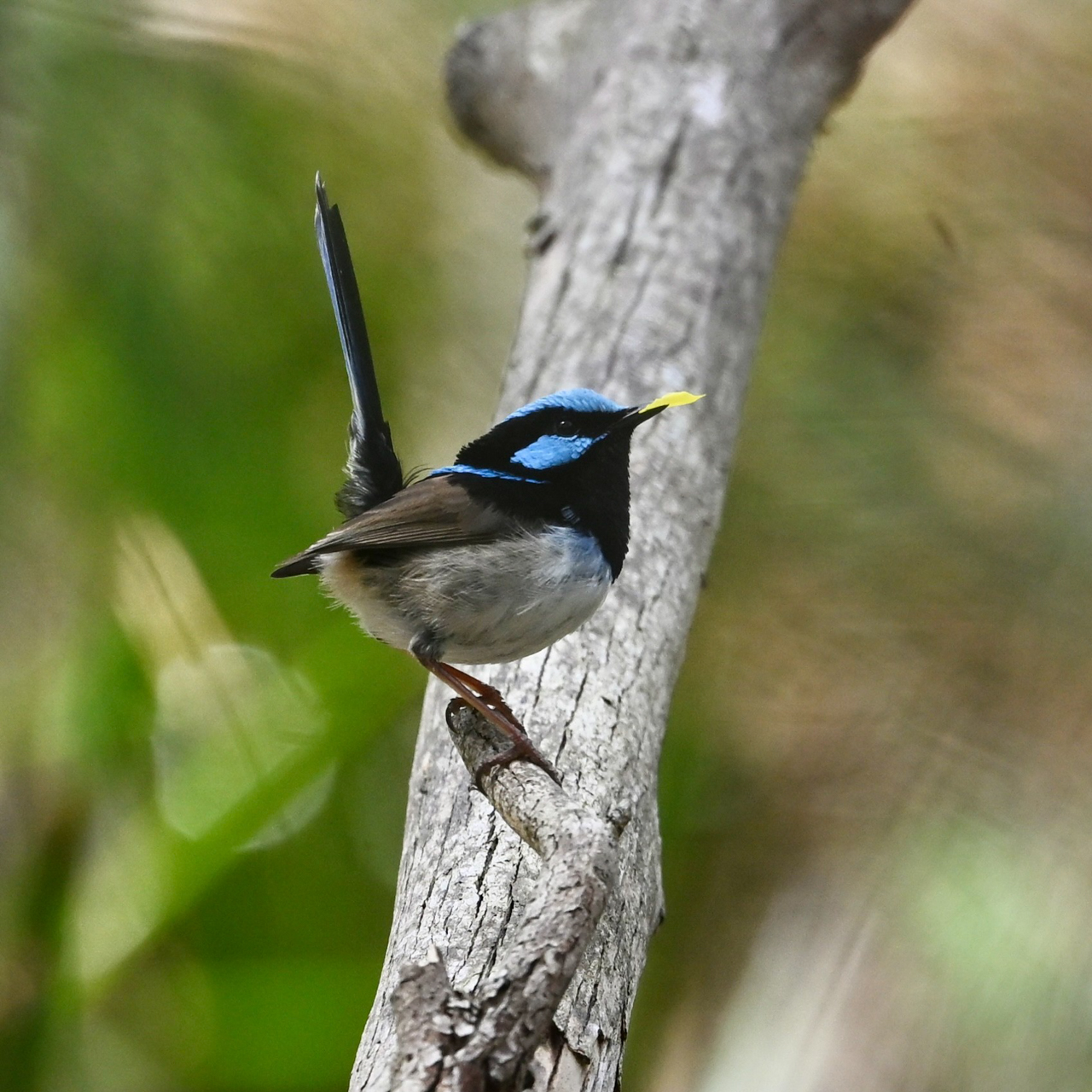
Superb Fairywren carrying courtship petal © Joe Wujcik
Day 14: Crossing the Mountains
We got in the vans and wound up the steep escarpment to Barren Grounds Nature Reserve. We ate a picnic breakfast, and then started along the heathland track. The bush was pretty quiet… until the piercing call of the endangered Eastern Bristlebird sounded loud from a nearby thicket.
We waited, waited, and the calls kept coming, closer and closer. Then, we started catching glimpses of the skulker, piping up from the bottom of a mallee eucalypt, then hopping back to cover. We crept slowly closer, and our patience paid off when one bird, then two, hopped out onto the side of the track, feeding amongst the flowers. Jumping back up to a perch in a low banksia, they kept calling loudly to one another, and we guessed they were a mated pair.
The Bristlebird is a rather plain looking bird, but its subtle beauty was not wasted on Joe, who came away with lovely pictures and a proclamation: “that’s a pretty bird!”
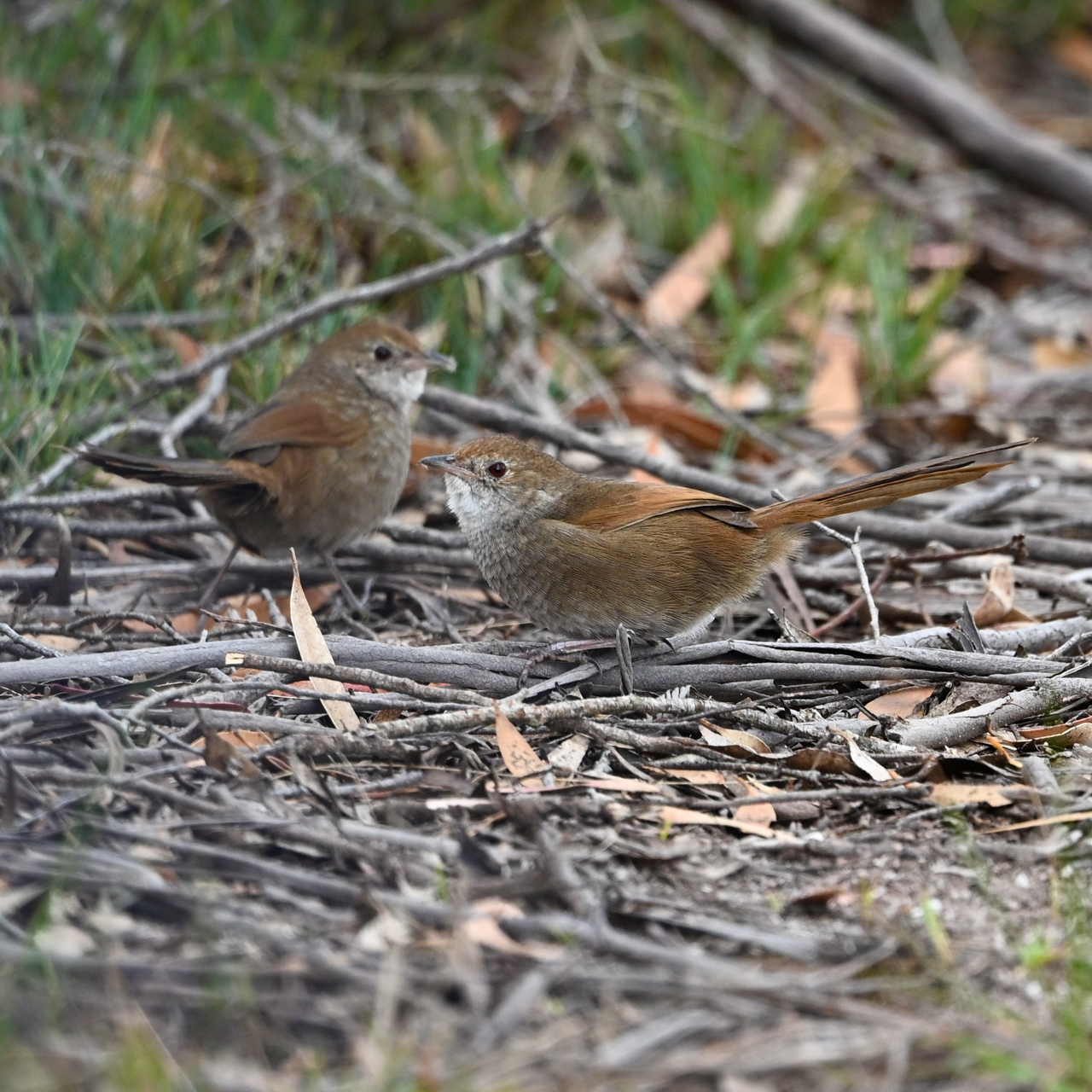
Eastern Bristlebirds © Joe Wujcik
Wandering back, we dropped in on a family of Striated Thornbills, whose greenish and yellowish tinge was just visible in the soft light, and we had a White-throated Treecreeper do his tree-creepy thing right beside us.
All of this was against the backdrop of a gorgeous spring bloom, with the floristic diversity of the rather inappropriately named “Barren” Grounds in its full colourful regalia. We all stopped to admire the majestic Waratah – the floral emblem of New South Wales – in its crimson glory.
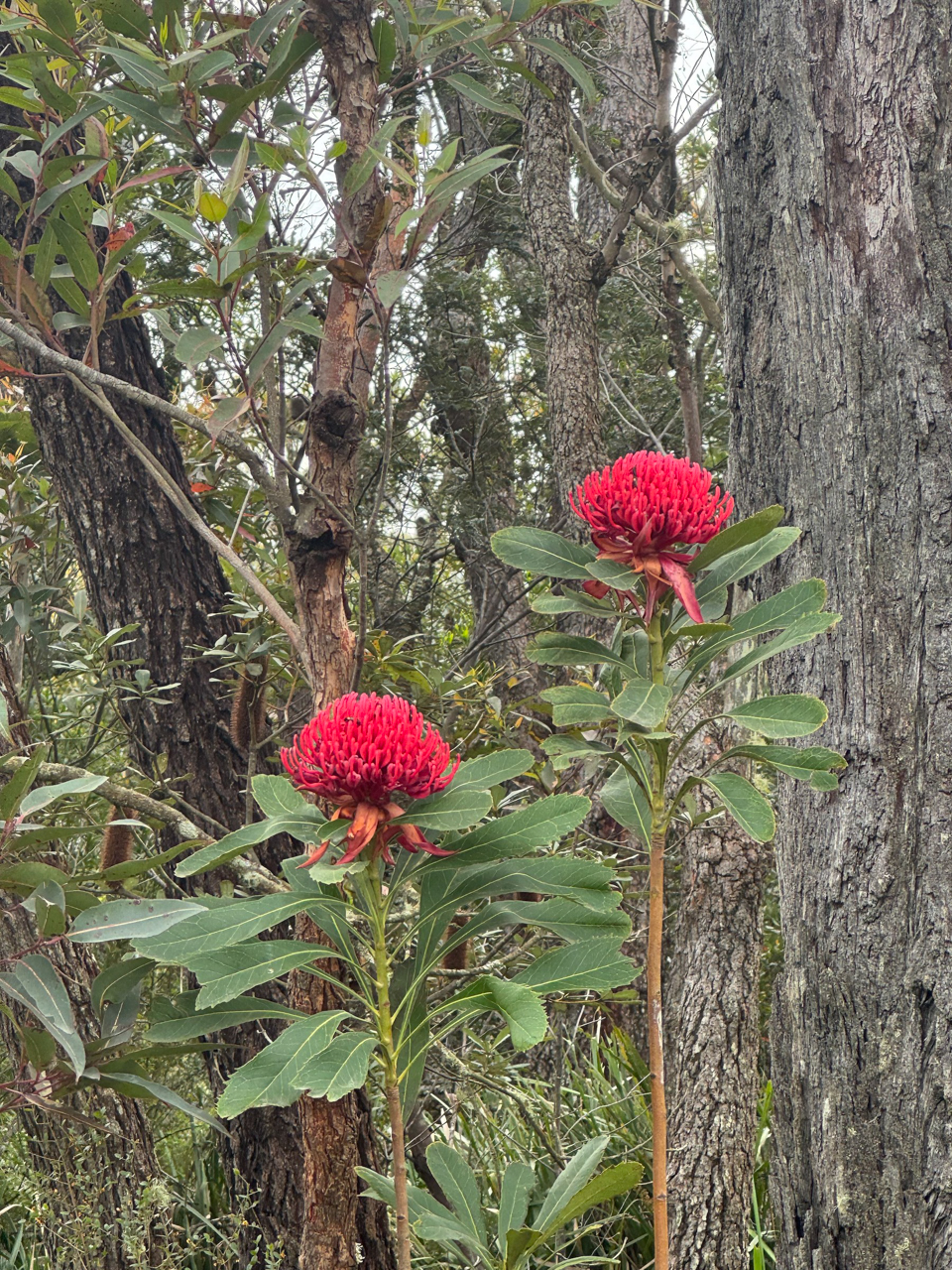
Waratah © Joe Wujcik
From Barren Grounds, we tootled down to the Minnamurra Rainforest, where a major target, the Superb Lyrebird, greeted us. We watched him rummage through a mulch pile before heading off on a circuit through the ancient rainforest. Golden Whistlers, Silvereyes, Eastern Yellow Robins, Scrubwrens and Thornbills abounded. We even found a teeny little baby Brown Thornbill, hardly fledged, sheltering under a leaf.
Then, a female Lyrebird strutted past at close range. Although she lacks the ornate tail feathers of the male, she is very elegant in her own right. She wasn’t bothered by us, and came very close on her forage. While some of the group took their time admiring the giant trees and twisting vines, others of the group got onto another Lyrebird – a young male – further down the track.
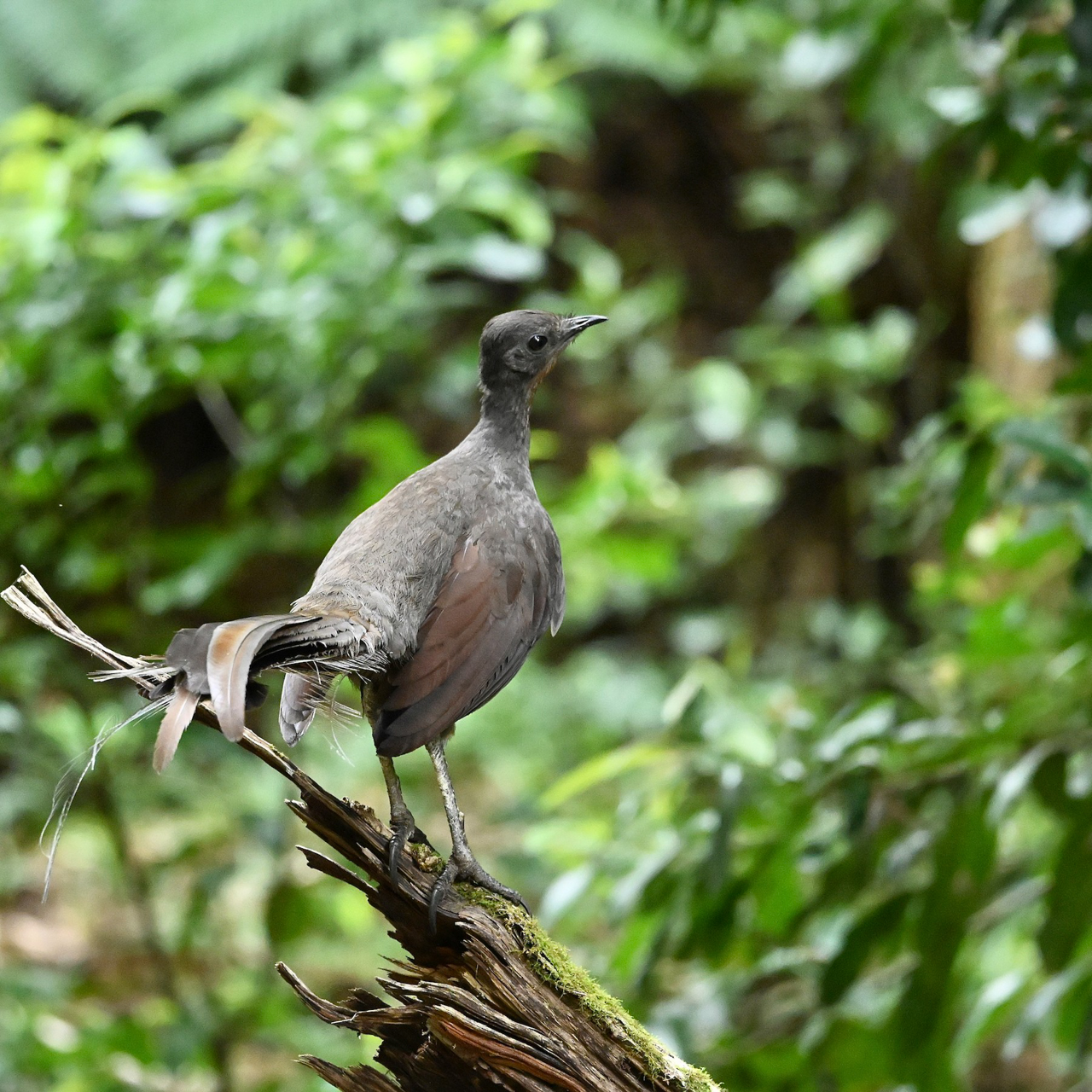
Superb Lyrebird young male © Joe Wujcik
The call of the Lyrebird is extremely special, and although it was after the breeding season, we did tune in to one bird practising his repertoire in the distance.
On our way to the Blue Mountains, we stopped for some sandwiches at a café that were seriously worth writing home about.
In the lower mountains, we called in at the sandstone escarpment to look for New South Wales’s only endemic bird, the Rockwarbler – a cave-dwelling songbird. The scenery was beautiful but the bird was not to be found.
Just as we were about to leave, we heard it. The Rockwarbler was on the edge of a sandstone bluff we were standing on, and we had to endure a tinge of vertigo to see the bird below a cleft just metres from our feet. Thankfully, he ended up flying out and calling from a perch in a tree for a moment, and we all got good looks.
This spot delivered on another little bird as well – the gorgeous and intricately patterned Spotted Pardalote – one of Australia’s smallest and prettiest birds. Being canopy-gleaners, they are often hard to see, and we had only had a glimpse at O’Reilly’s. But now, standing on the cliff, we were at eye-height with the canopy, and a whole family of Pardalotes were right in front of us. This was up there with one of the favourite sightings of the trip.
Onwards we went, crossing the mountains and heading west to Lithgow and the Capertee Valley. We enjoyed some awesome landscape vistas on the way, and arriving in rainy Lithgow, we got our first Kangaroos of the trip! A big male Eastern Grey bounded across the road. We turned a corner and met the whole mob – mums and joeys bounding through the grass. Naturally, everyone was delighted, and Ed braved the rain to get some pictures.
We all braved the rain at the Lithgow Wastewater Treatment plant, just down the road. A diverse collection of endemic waterfowl was to be found on one of the ponds: Hoary-headed Grebes with their funny textured heads, Pacific Black Ducks, Blue-billed Ducks, Hardheads, Pink-eared Ducks with their flabby bills and striking tiger stripes, Australasian Shovelers, and more. This was a great spot for cleaning up on Australia’s unique waterfowl, but the light was not great, so we vowed to come back the next day.
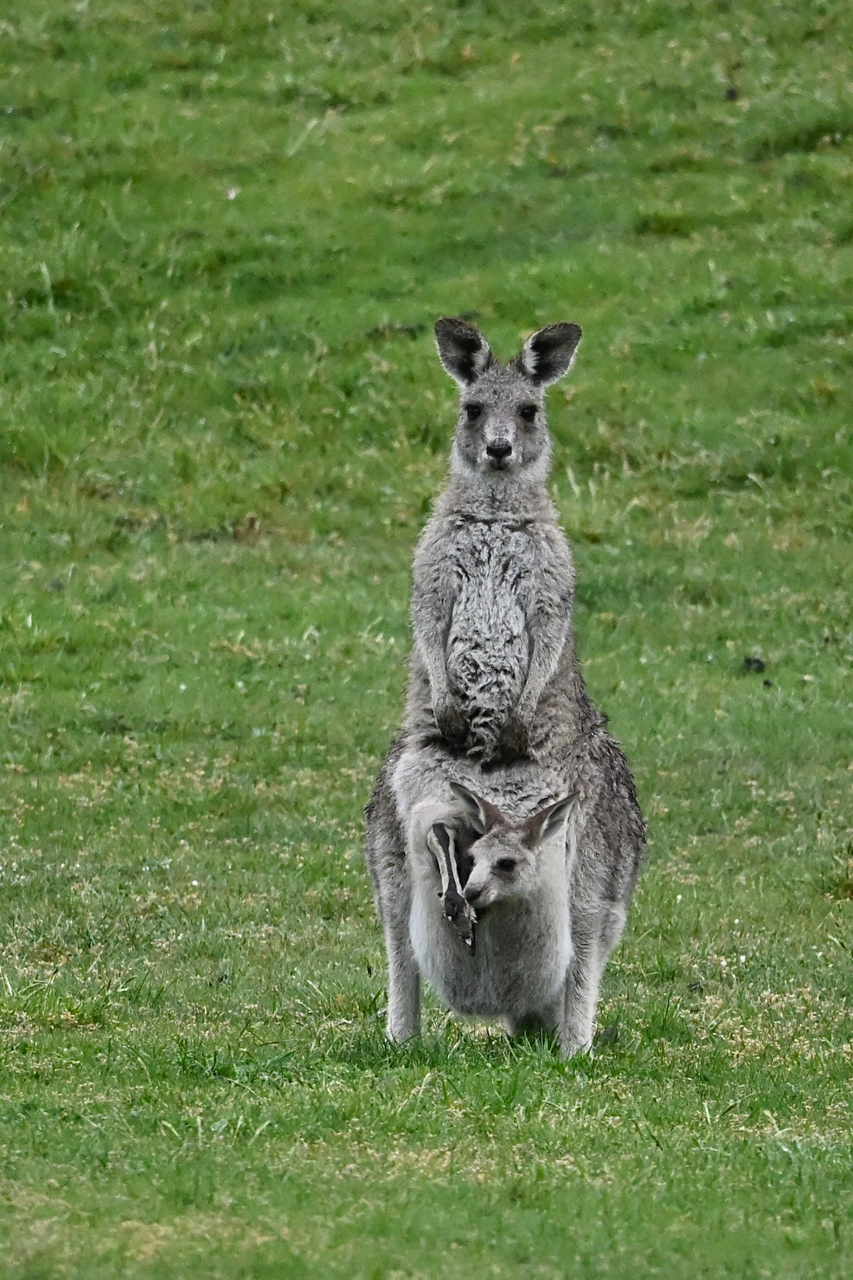
Eastern Grey Kangaroo with joey in pouch © Joe Wujcik
Day 15: Capertee Valley
Today was our day to explore the Capertee Valley – one of Australia’s most renowned birding locations, and a place where, biologically speaking, East meets West. This was one of our best chances to see a lot of the inland species.
The morning was overcast, but as soon as we arrived in the valley and stepped out of the car, we were overwhelmed with birdlife. We added White-plumed Honeyeater, Yellow Thornbill, Jacky Winter, Dusky Woodswallow, and Horsfield’s Bronze-Cuckoo to our list, as well as two rather uncommon dry woodland species: the Speckled Warbler and the Hooded Robin (thanks to Paul’s keen eye for the latter).
We also had a Mistletoebird feeding (on mistletoe, of course) at eye height, and displaying his lovely crimson and navy colouration. Superb Fairywrens were hopping about the whole time. A Channel-billed Cuckoo flew over. And just as we were about to leave, a female Petroica robin perched up high on a bare twig. Even looking back on the photos, we can’t quite figure her out… female Red-capped Robin, perhaps?
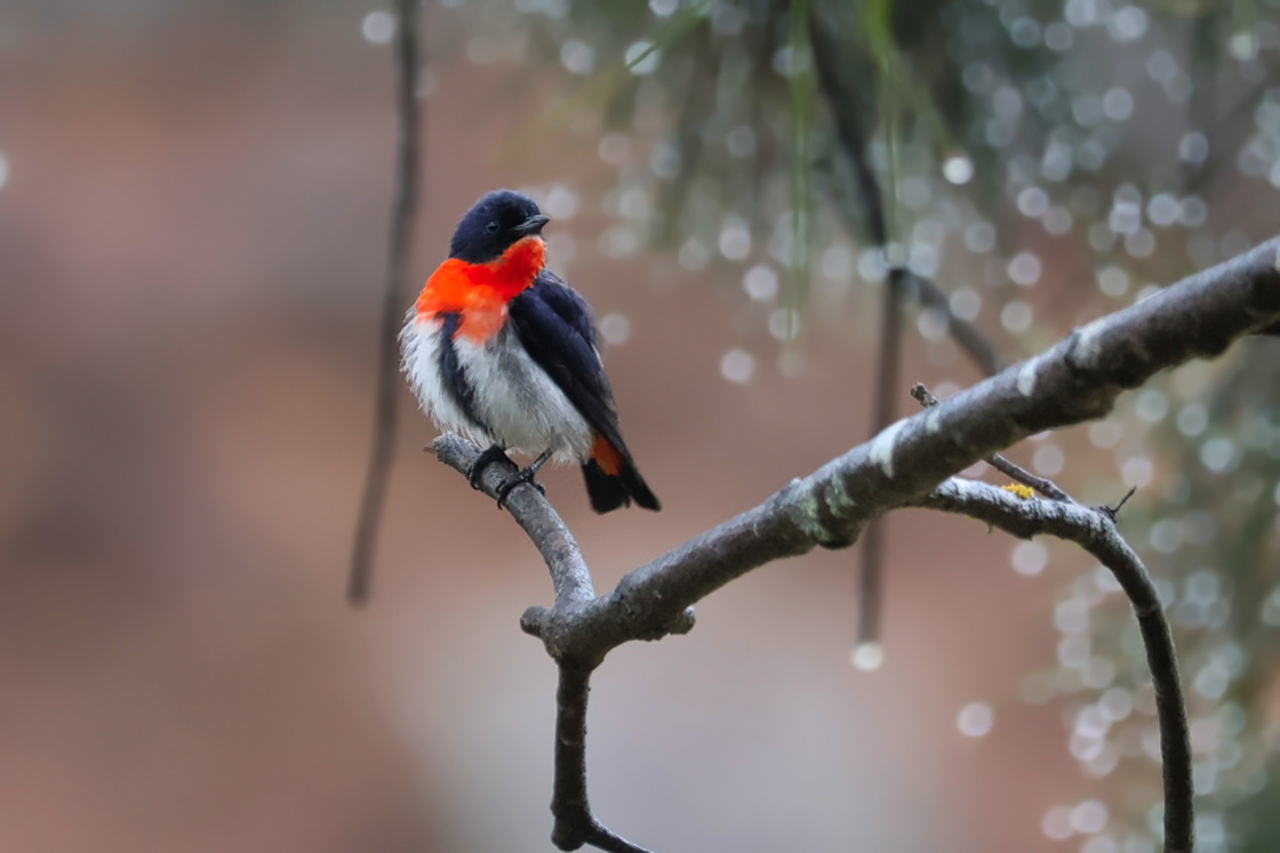
Mistletoebird © Paul Prappas
A kilometre or two further on, we pulled the vans over for Red-rumped Parrots, a Nankeen Kestrel, and the kaleidoscopically beautiful Eastern Rosella. You really can’t get a bird that’s more colourful than an Eastern Rosella, can you?
We stopped at a small farm dam, and found ourselves torn between a family of Brown Treecreepers, a mob of White-winged Choughs, and a flock of Plum-headed Finches. Thankfully, we got to look at them all in good time, and more too: Restless Flycatcher, Musk Lorikeet, more Rosellas… Capertee was shaping up to be quite the birding bonanza.
At the next spot we added Rufous Songlark, but the rarity here was a small fluttery little parrot that flew low overhead and dropped to the ground. His high-pitched call revealed him to be the much sought-after Turquoise Parrot. He was shy, but we all got his bright yellows, blues and deep reds in our binoculars.
We twisted and turned our way down the gravel road that leads into Capertee National Park. Fuscous Honeyeaters filled the roadside trees. At the campground, we were welcomed by some very nice little birds – Striated Pardalotes and Yellow-rumped Thornbills poking around near the ground.
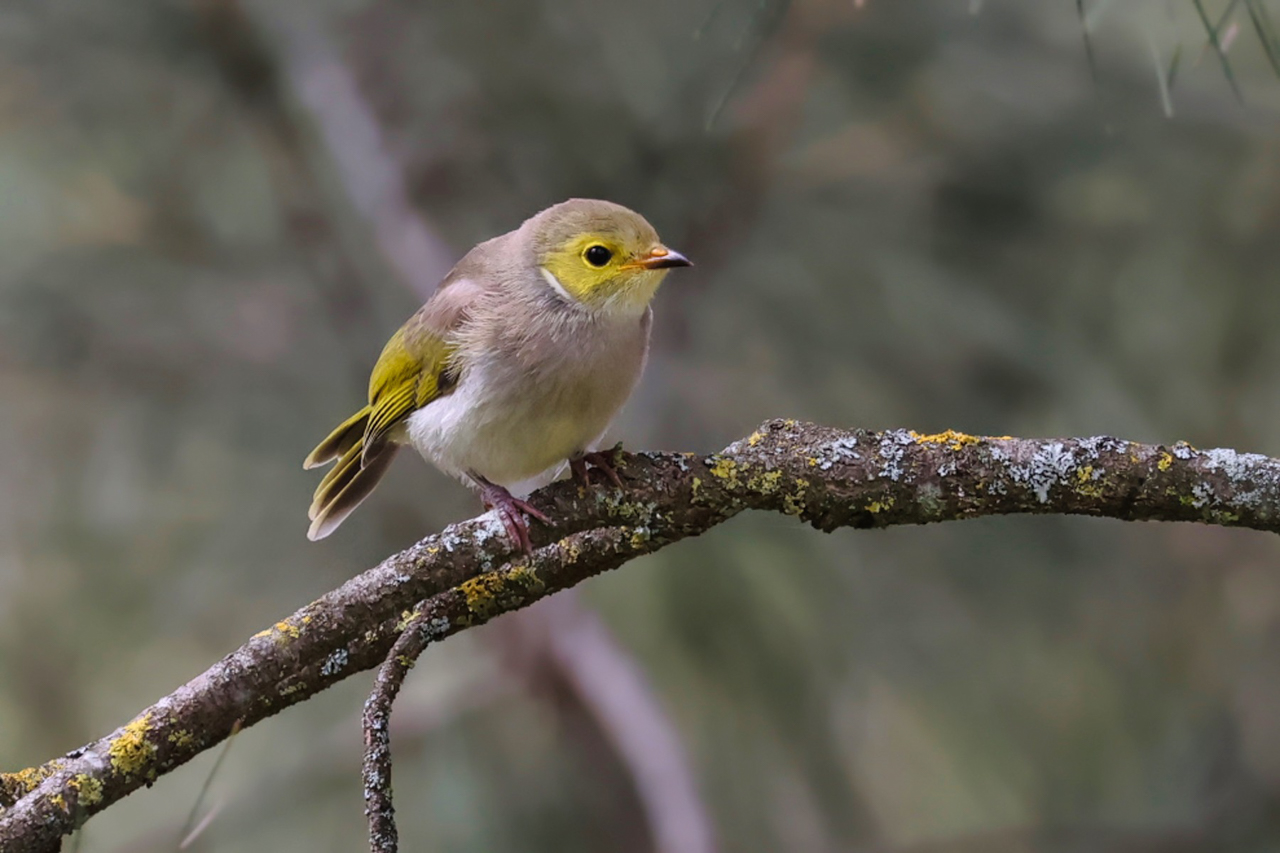
Juvenile White-plumed Honeyeater © Paul Prappas
The real target here, however, was the critically endangered Regent Honeyeater. These striking black-and-yellow birds had had a good breeding season right in this spot. They were quiet, probably feeding young, but we observed a couple of birds flying back and forth from the River Casuarinas to the gum trees. Being one of the rarest birds in Australia, this was not a sighting we were counting on, so we were really lucky to see them.
Alongside the Regents, feeding in the profusely flowering Casuarina mistletoe, were those tiny ruby gems, the Scarlet Myzomelas. We craned our necks and tried to keep up with speedy movements to get a look.
A little easier to observe were the very attractive White-winged Trillers fluttering about on the grass and in the understorey, their bold black-and-white markings making them stand out against the green. We had a picnic in their company. Oriental Dollarbird was a nice addition here too – a breeding migrant recently arrived back from East Asia, swooping and almost swimming through the air overhead.
After lunch, we strolled up the dry river and came across a rather unlikely but very cute Wombat! This burrowing bear-like marsupial is usually quite nocturnal, so we thanked the cooler weather and cloud cover for this sighting.
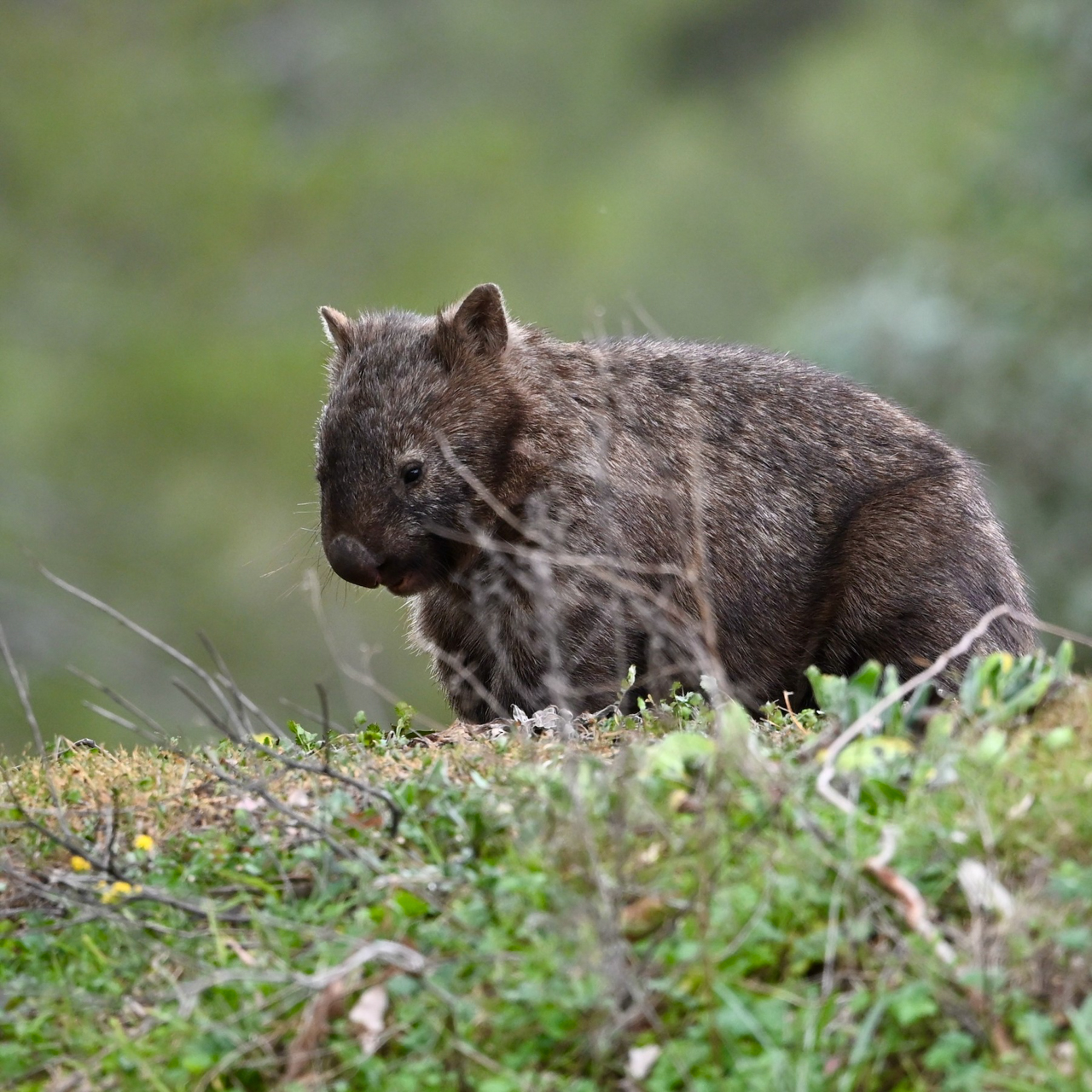
Wombat © Joe Wujcik
And, amongst a mob of Eastern Grey Kangaroos, one animal stood out as noticeably different – thicker set and gruffy: a Wallaroo! Yep, it ain’t just Wallabies and Kangaroos – Wallaroos are a thing too.
On the way out of the campground, we stopped at the edge of the national park where Gray Teal sat on a pond and Lorikeets chattered in the eucalypt blossom overhead. We were lucky to find a nearby flowering tree that drooped down low, so that we could all get good looks of the gorgeous Musk Lorikeets and the diminutive Little Lorikeets lapping up nectar, while Friarbirds and Honeyeaters did their evening rounds.
We left on the scenic, winding road out of the Capertee Valley at sunset, well satisfied with a great day’s birding.
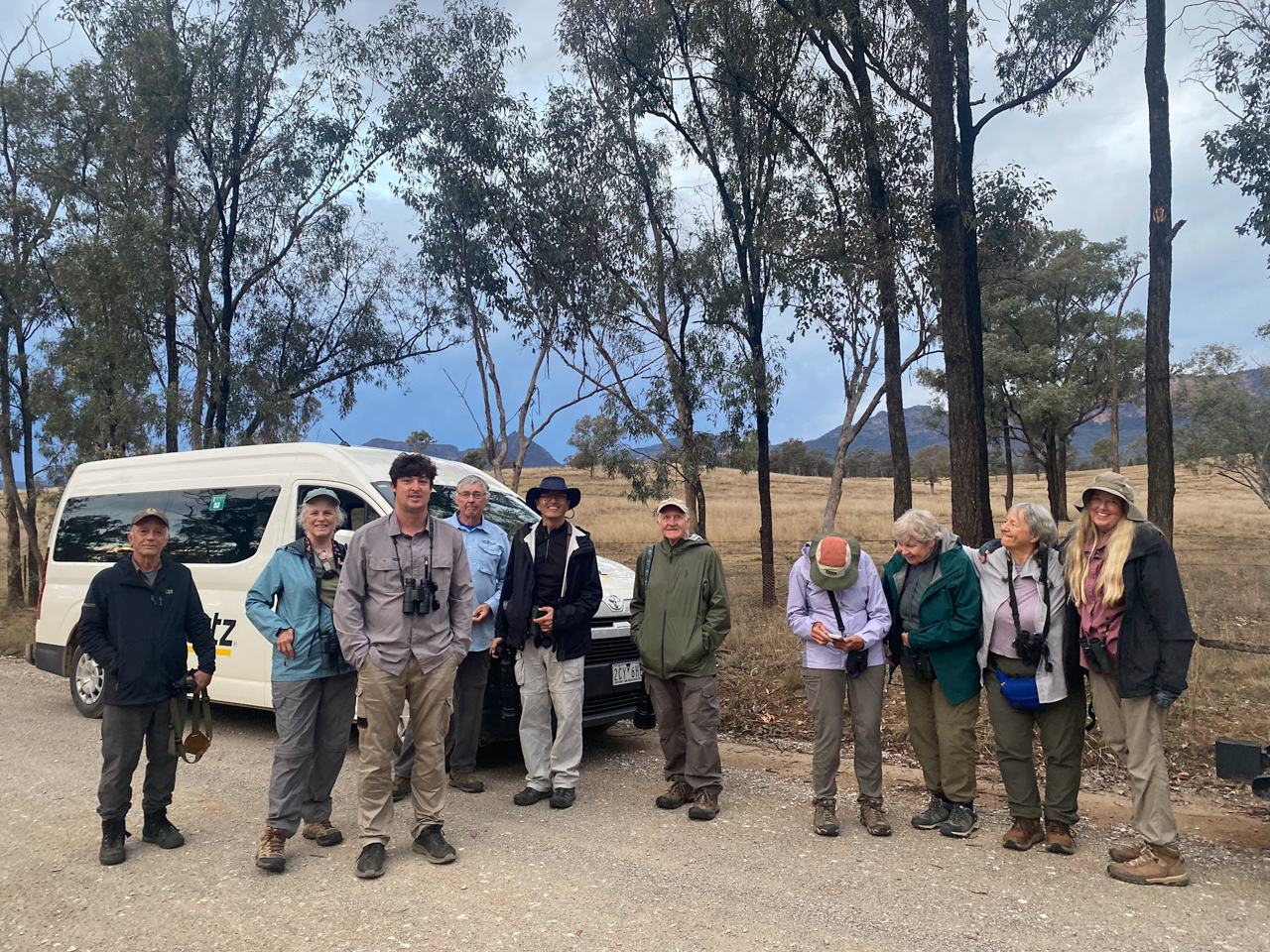
Group shot Capertee © Henry Coleman
Day 16: It’s a Wrap!
Our last day started where many memorable days do – back at the Wastewater Treatment plant. This time, the light was better, and we saw all those wonderful waterbirds again. Plus, we added European Goldfinch and Australian Reed Warbler, with really good views of the latter. We also finally got some abiding looks at the near-ubiquitous Yellow-faced Honeyeaters.
And before journeying back across the Blue Mountains, we made a stop at a historical site in Lithgow – an abandoned early 20th Century steelworks. There, from the cracks in the old brickwork, burst a bright flame – a Flame Robin! We watched a pair of these truly delightful little birds flit from bricks to sticks to ground, then back again. And we watched the male feed the female a caterpillar too! So sweet.
From there began our final winding road, back over the Blue Mountains. We stopped at a lookout to appreciate breath-taking views of the World Heritage wilderness on a sunny morning, and added the attractive White-eared Honeyeater to our list. This was to be our final Honeyeater, taking our Honeyeater (and allies) species tally to no less than 29! Considering you won’t find a single Honeyeater anywhere outside of the Australasian bioregion, this was a nice outcome of the trip.
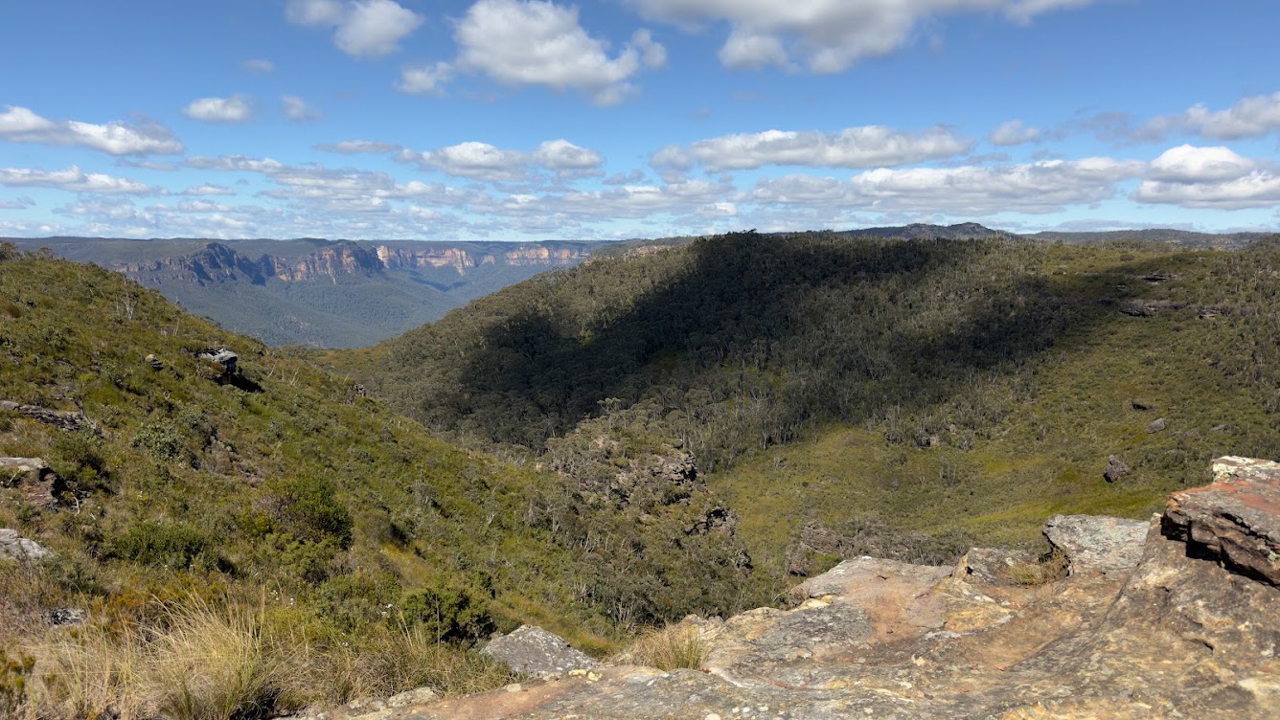
Blue morning Blue Mountains © Edward Sako
Our last lunch was enjoyed with a magnificent vista from Mt Tomah Botanic Gardens before we arrived in the lowlands of Western Sydney – where we searched painstakingly and unsuccessfully for Banded Lapwings. The search might have driven the guides slightly crazy. Nice views of Double-barred Finch were the consolation prize.
At Pitt Town Lagoon, we scoped out some very cool waterbirds, including the enigmatic Black Swan and the Australian Pelican, record-holder for the longest beak in the world. We also got to see Pied Stilt and Royal Spoonbill again – birds we hadn’t caught up with since the very first day of our trip, and a nice way to bookend.
But we still had one last exciting species up our sleeves. Tunnelling through the suburbs, we headed right into the heart of Sydney to the Royal Botanic Gardens. Bin chickens (Australian Ibis) abounded, but we weren’t here for them. We looked up into the bushy leaves of a fig tree and, right there in clear view, sat roosting Australia’s largest nocturnal bird – the Powerful Owl. We got to appreciate closely the intimidating talons and eagle-like bill. She winked a yellow eye open.
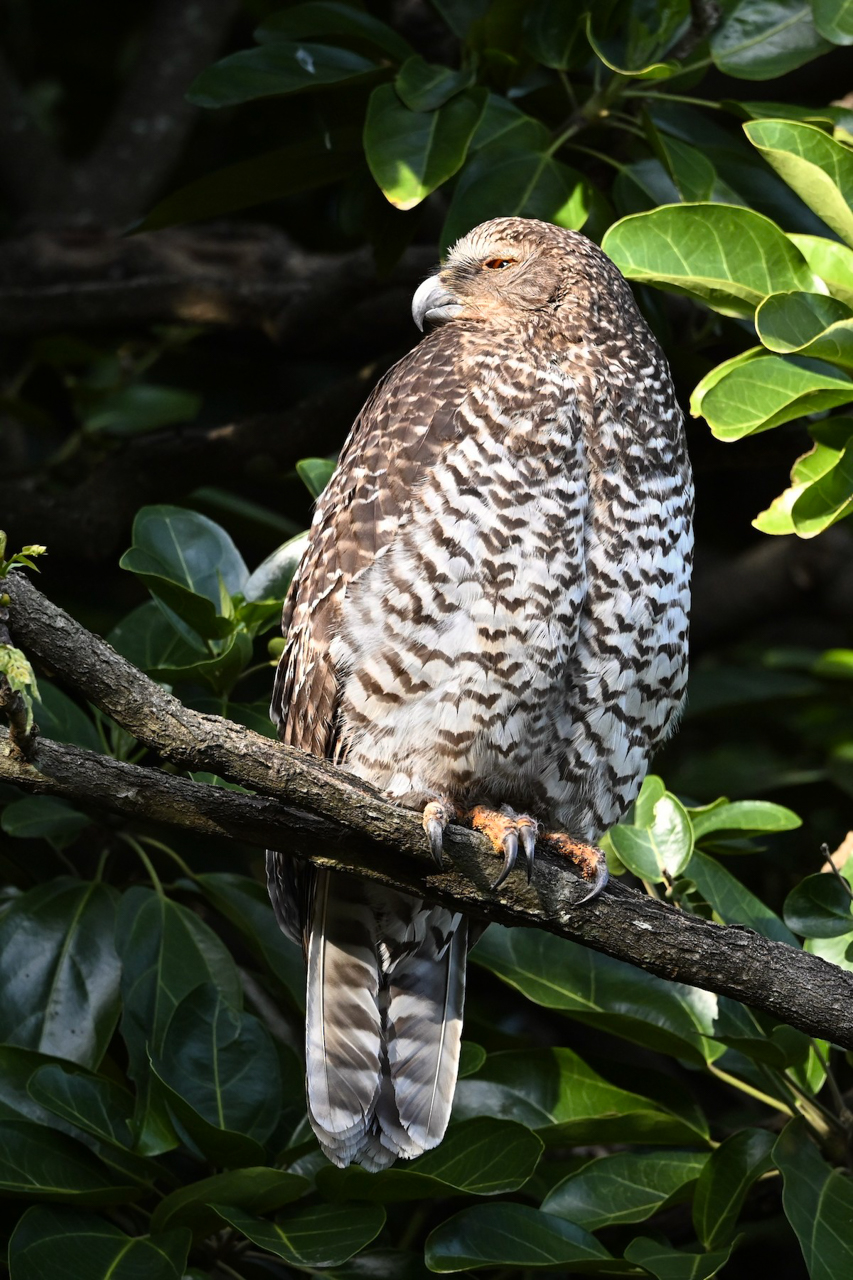
Powerful Owl © Joe Wujcik
Our scopes and cameras all pointed in the same direction managed to catch the attention of the city-slickers roaming the gardens, and they were stunned to see the great bird that many of them probably unwittingly pass by on a daily basis. Under the canopy of the big fig, we tried to be a little more discreet as we looked up to see a great fluffy white ball – the owl’s chick! It was a whole family affair.
We walked back along the Sydney Harbour at sunset. What a great way to wrap up the trip.
And there you have it! Two-and-a-half weeks of full-on birding across three different unique and glorious regions of Australia’s East. What’s more, it turned out that the Powerful Owl ticked us over to a solid 300 bird species – most of them endemic to this far-flung continent down under.
It’s worth noting we also did a pretty good job on Australia’s weird and wonderful mammalian fauna – from Echidna and Platypus to Kangaroos, Koalas, Tree-Kangaroos, various Wallabies and a Wombat too… we ought to have pulled back and left something for the group to come back for!
All in all, it was a truly memorable trip. And, just as importantly, it was such a great group of people to experience it all with.
Big thanks to Allan, Shiela, Jenni, Ed, Paul, Joe, Joanie, Debby, Deb and Barbara. It was a real pleasure to guide you, and we hope you make it back down under some day!
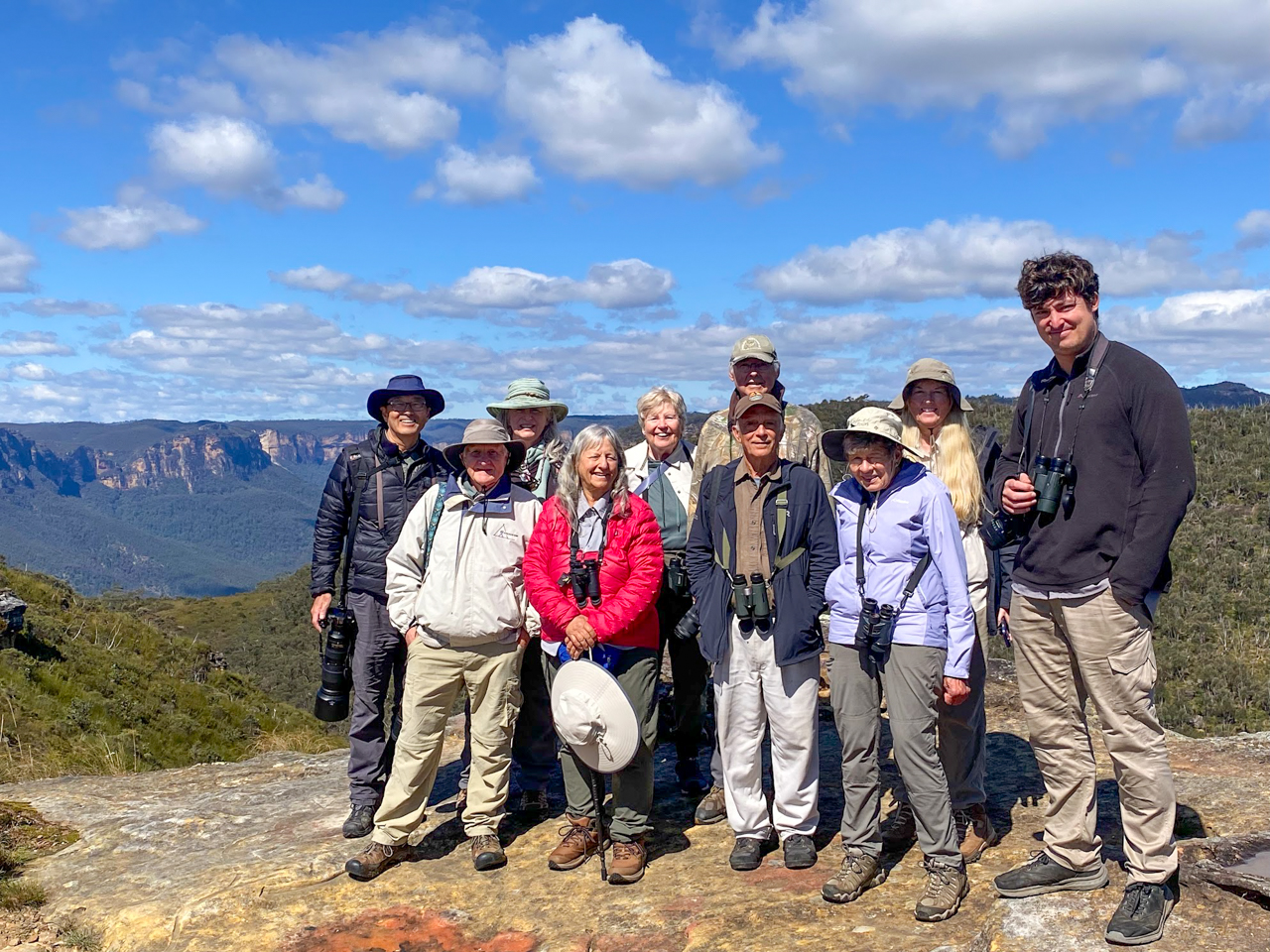
Group shot Blue Mountains © Henry Coleman

Leave a Reply