Tropical Australia Trip Report (Sep 11 – 19, 2026)
The Tropical North Australia trip took us through the rich and varied landscapes of the Northern Territory’s Top End – from lush monsoon vine-forest to golden savannahs. These are places where some of the world’s most beautiful birds can be found between World Heritage rock art galleries, and where the vastness and ancientness of Australia can really be felt. From dawn boat rides on sprawling Kakadu billabongs to pit stops for lunch at quirky outback roadhouses, it was a privilege to get up close and personal with Australia’s colourful characters – avian and otherwise!
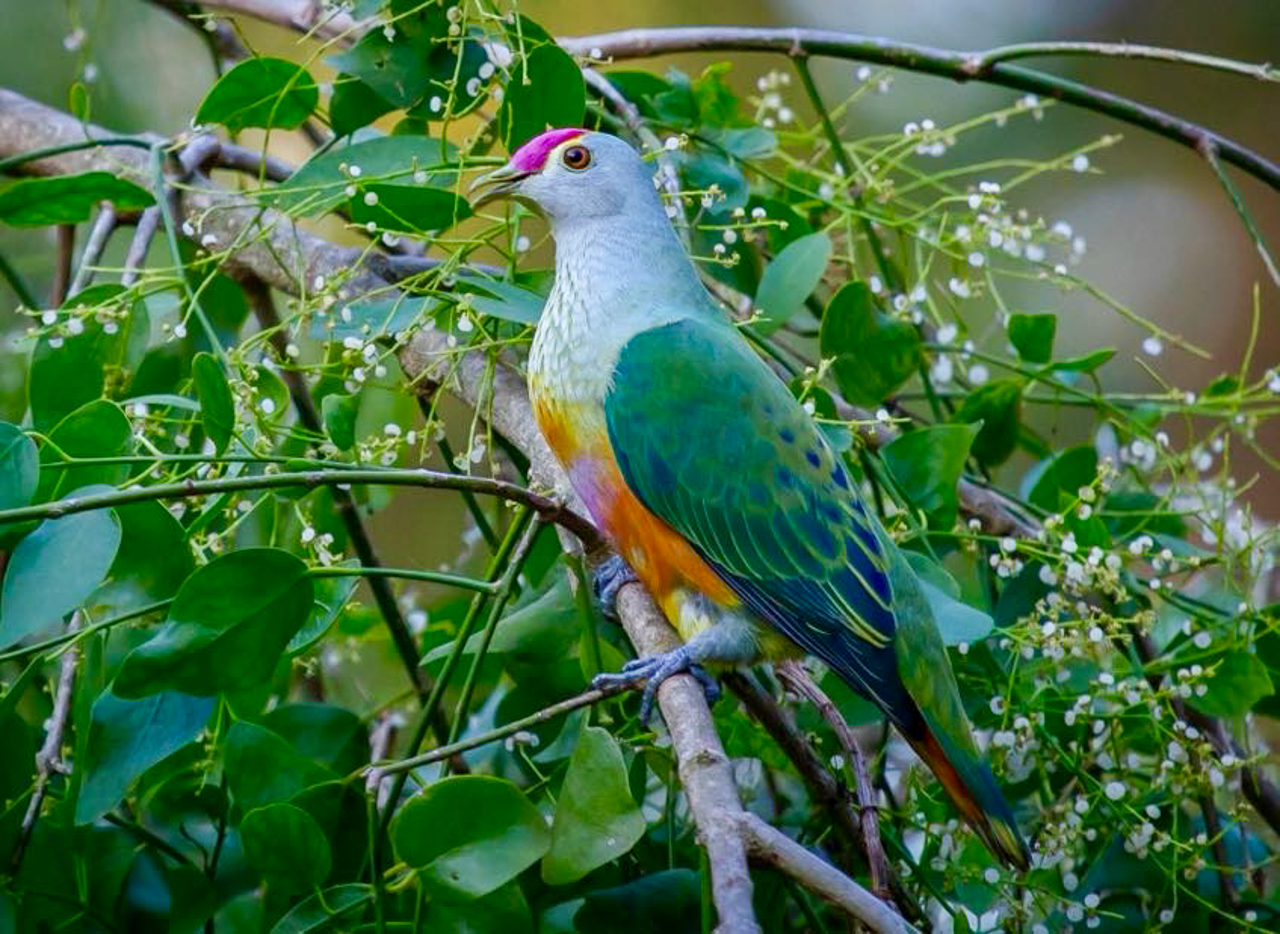
Rose-crowned Fruit-Dove © Maurice Hovens
DAY 1:
We all met at the hotel, in the Northern Territory’s capital of Darwin, to begin our tour of the Top End. Over dinner at the Darwin Sailing Club we shared a bit about ourselves as well as our hopes for the trip, all the while being serenaded (or perhaps haunted) by the wails of the omnipresent Bush Thick-knees.
DAY 2
We headed to Buffalo Creek first thing. Stepping out of the vans, we were greeted by the peacock-like hollers of the Orange-footed Megapode, and it didn’t take long to spot this cartoonish fowl of the undergrowth. We spotted the Red-headed Honeyeater and the striking royal blue of a family of Forest Kingfishers. Northern Fantails flitted around while Rainbow Bee-eaters hawked.
We entered the forest keeping our ears peeled for the call of the Rainbow Pitta, which we heard at close range but did not spot. We did get on to a chorus of other species: Little and Helmeted Friarbirds, Green Orioles, the sunshine-yellow and ruby-red northern subspecies of Australasian Figbird, and smaller North Australia endemics like Australian Yellow White-eye, Arafura Fantail and Green-backed Gerygone. The sighting of the morning was probably a Little Bronze-Cuckoo, who perched in the sunlight to display his strongly barred belly, glossy green wings and distinctive red eye-ring.
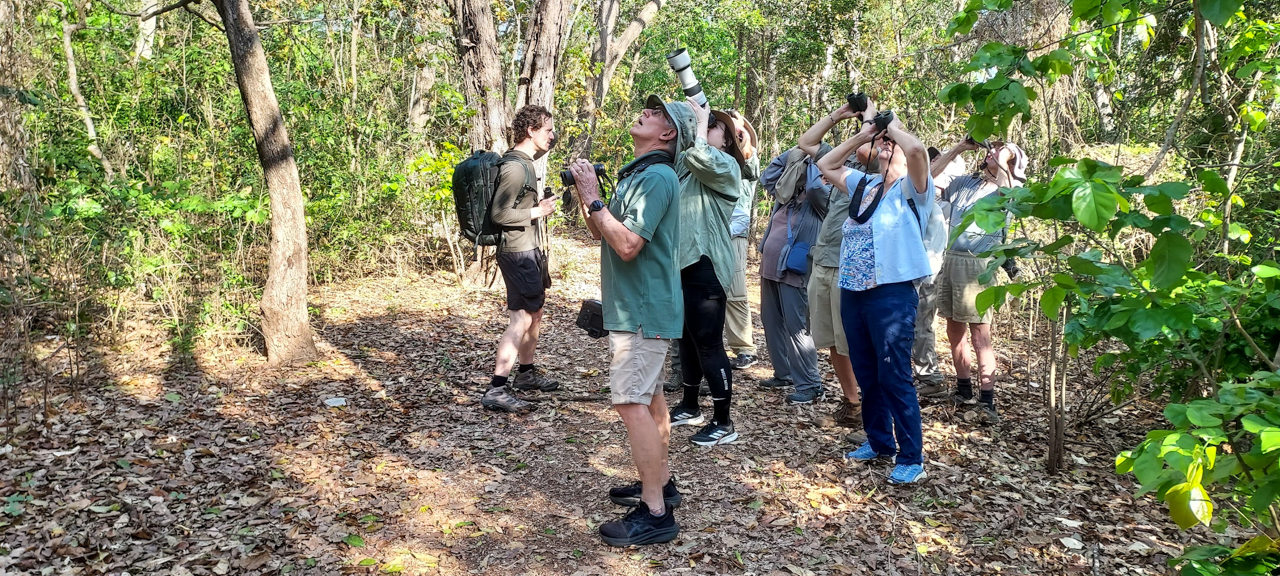
Birding at Buffalo Creek © Magne Bolstad
We went to check out the throngs of shorebirds at Buffalo Creek estuary. The flocks of knots were mostly backlit, but we enjoyed watching an Australasian Darter taking fish in the shallows. A Common Sandpiper bobbed along the shoreline while Australian Terns bombed the plentiful Black and Whistling Kites. A Brahminy Kite flew overhead. A distant Jabiru (Black-necked Stork) was scoped, and, rounding the point, we got onto a very obliging Beach Thick-knee, who made his way closer and closer to the group, affording excellent views. A Pacific Reef-Heron stalked the shallows, his kinked neck poised dagger-like in search of breakfast. A group of roosting Australian Pelicans were scoped out before they glided majestically overhead. We also managed to scope shorebirds like Bar-tailed Godwit, Black-bellied (Gray) Plover, and the Far Eastern Curlew, whose ibis-like bill is the longest of any shorebird’s.
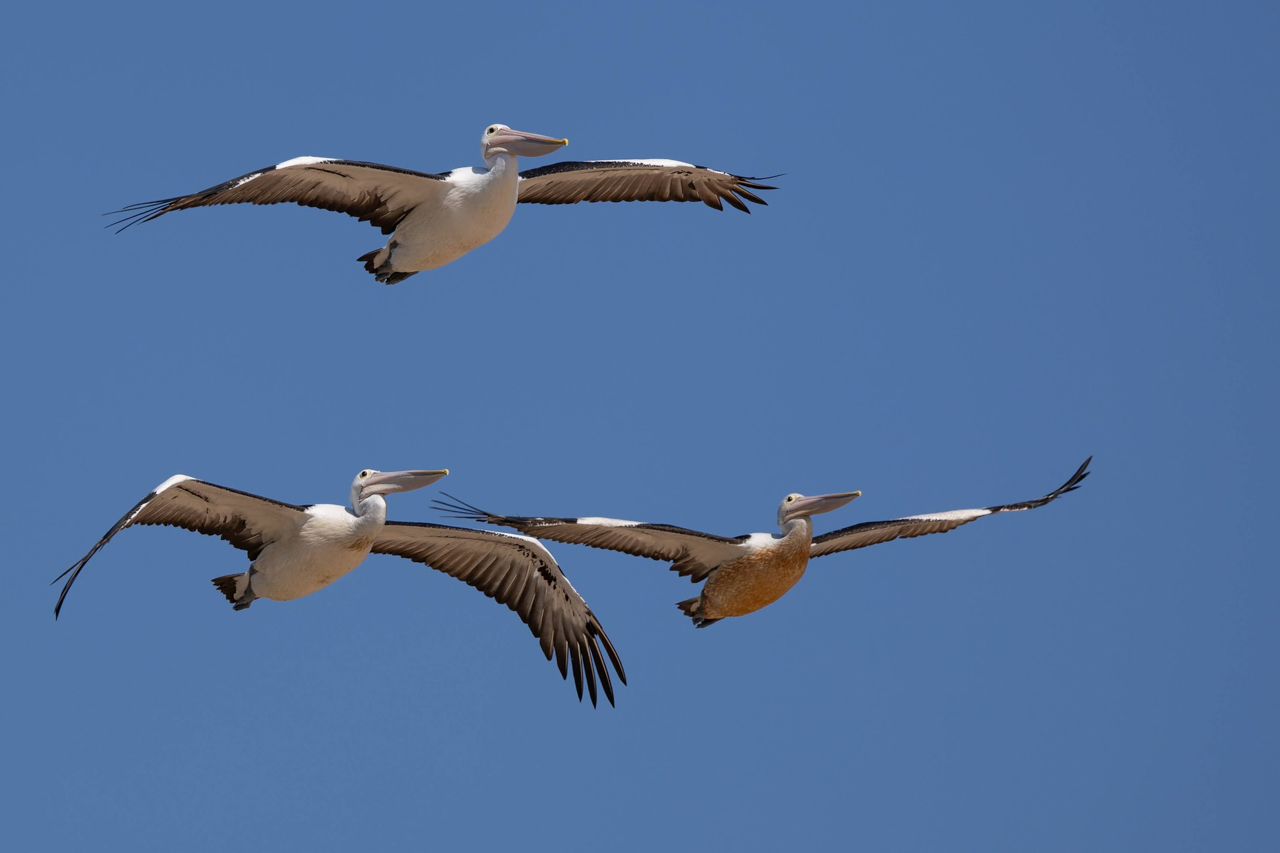
Australian Pelicans © Bruce Staples
The tide rushed out, taking the shorebirds with it, and we went off to Lee Point for more bush birding. A large group of Red-tailed Black-Cockatoos squabbled in the charred eucalypts, displaying not only the gorgeous crimson in their tails but also the star-spangled cheeks of the females. We also picked up Sulphur-crested Cockatoo at a nest hollow, more Forest Kingfishers, Varied Triller, Gray Whistler, Blue-faced Honeyeater, and plenty more.
After lunching in the company of Red-collared Lorikeets and White-gaped Honeyeaters in the shade of the great fig trees of the Darwin Botanic Gardens, we headed out for our afternoon birding session to the mangroves of East Point. The long mangrove stretches of the northern Australian coastline have the highest rate of avian endemism of any mangroves in the world.
On the way, we pulled over to watch two Dollarbirds on the wire. These birds had recently arrived back from their wintering grounds in East Asia; Australia’s only representative of the rollers of the Old World. Everyone enjoyed the Dollarbirds’ interesting dark turquoise colouration, bright orange bills and white wing patches which show only in flight. Their distinctive acrobatic flight-style makes it look almost like they swim rather than fly through the air.
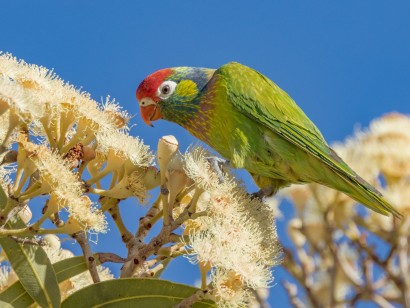
Arriving at East Point, a Little Heron stalked the lakeside – a funny little character. The mangrove forest was relatively still and quiet, until the tide rushed into the tangle of roots, bringing with it a flurry of sought-after endemics: Mangrove Gerygone, a pair of energetic Broad-billed Flycatchers, a Torresian Kingfisher with its dark emerald wings and bulky bill, and a delightful pair of Mangrove Robins. A sweet little Lemon-bellied Flyrobin became our best friend, hanging out on the boardwalk right by our feet.
On the walk back, we all heard the deep voice of the Black Butcherbird, but didn’t catch more than the briefest of glimpses. Spectacular views of the multicoloured Rose-crowned Fruit-Dove were more than adequate in consolation. We ended the day watching fruit-doves and Torresian Imperial-Pigeon feeding on berries at eye-height in the Botanic Gardens. It doesn’t get better than that!
DAY 3
Our first stop this morning was the waders of Buffalo Creek – we wanted better views than the previous day, and we got them! We arrived at the perfect tide, and watched the waders fly in in their hundreds, hungry after their recent long migration from Siberia. Some of them still sported patchy breeding plumage: Great Knot, Red Knot, Bar- and Black-tailed Godwits, Ruddy Turnstone, Greater Sand-Plover, Red-necked Stint. They were joined by Pied Oystercatcher, Common and Little Tern. Some of us were able to pick out the odd Terek Sandpiper and Gray-tailed Tattler from the hordes of knots. A White-bellied Sea-Eagle soared overhead.
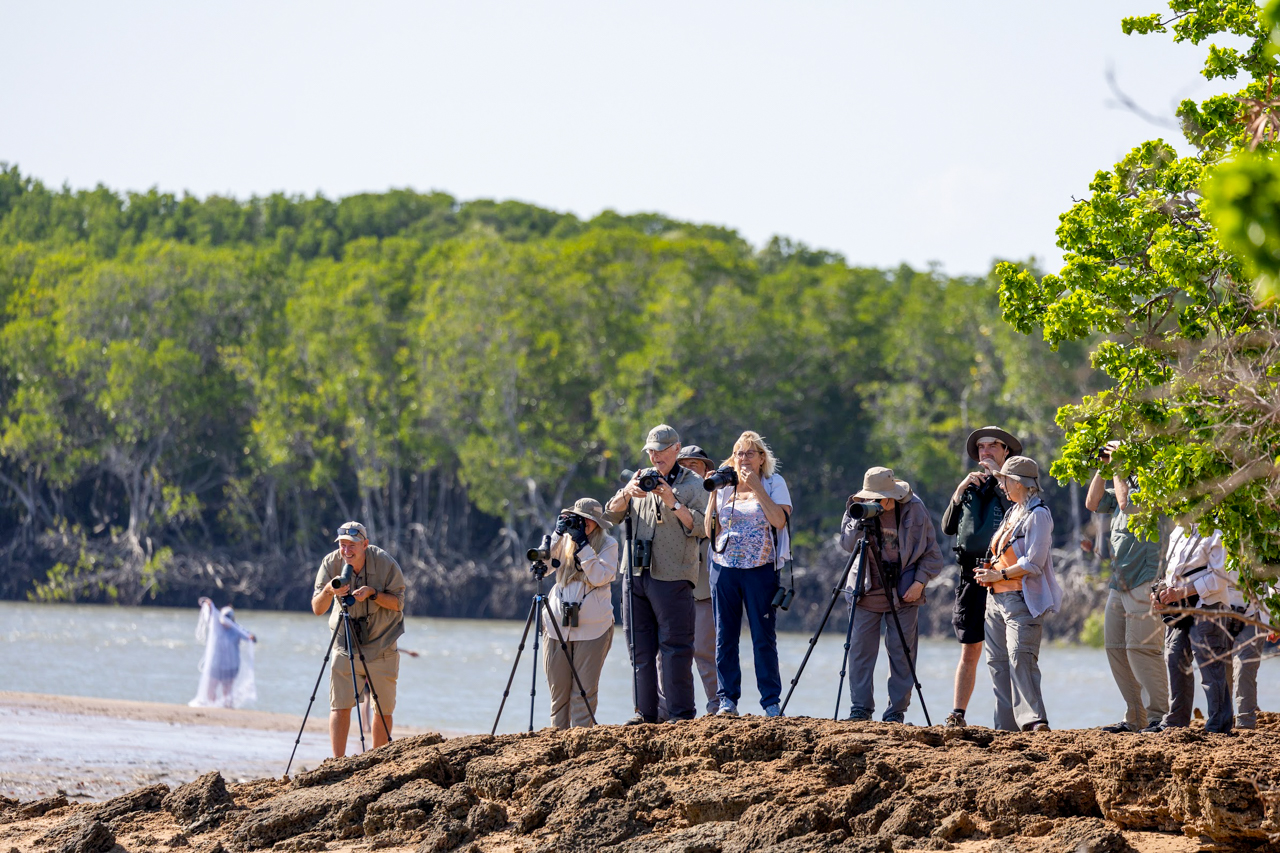
Shorebirding at Buffalo Creek © Bruce Staples
Before heading on to Fogg Dam, we tried again for Rainbow Pitta. We immediately heard three calling at close range, but we had no luck! We saw the leaf-litter move, saw shadows between the vines, caught a glimpse of the leg and the wing – but were left unsatisfied! That’s birding for you!
Off to Fogg Dam. A long walk through the monsoon vine-forest meandered between the large mounds that are the engineering feat of the Orange-footed Megapode. And we dodged the impressive silks of the golden orb spiders. The long walk ended in a platform set among beautiful paperbark trees overlooking an expansive floodplain, which was thick with Magpie Geese, Pied Heron, three species of egret, and Australian and Straw-necked Ibises. While seven Brolga graced us with their elegance, the muddiest Radjah Shelduck and Little Pied Cormarants any of us had ever seen fed in the shallows, their smart white plumage dyed a ruddy brown.
After a thirsty walk back, we hopped in the air-conditioning of the vans and cruised along the dam wall, picking up Wandering Whistling-Ducks, Glossy Ibis, more egrets and herons, exquisite Green Pygmy-Geese, and a family of Comb-crested Jacana – the four gangly chicks running around the lily pads right in front of us. We also spotted our first Willie-wagtail and Paperbark Flycatcher dancing above the lily pads and stopping to pose picture-perfect atop the pink blooms of the lotus.
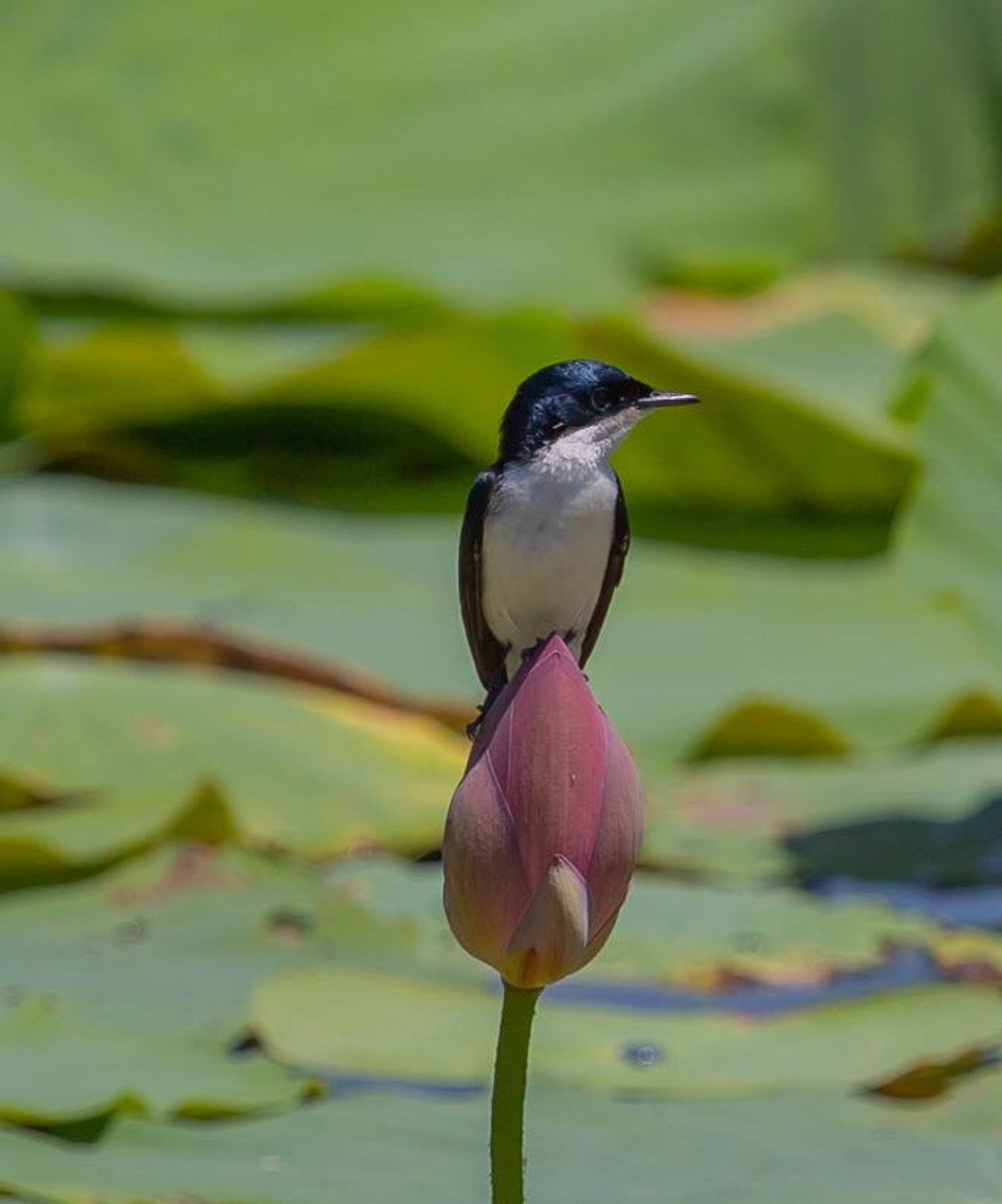
Paperbark Flycatcher © Maurice Hovens
Onwards to Kakadu, we lunched in the company of Crimson Finches, Blue-faced, Brown and White-throated Honeyeaters coming to drink at the Buffalo pond. And when we arrived at our accommodation, we were greeted by Blue-winged Kookaburra and Bush Thick-knee, both of which would become a consistent and – with their glaring eyes and unnerving calls – a somewhat haunting presence for the rest of the trip.
DAY 4
We were up early and on the road to Cooinda/Yellow Water for the sunrise cruise. As we walked down the jetty, Bruce expertly picked up our first highlight of the day – a family of four Barking Owls coming down to drink at the water’s edge!
The boat cruise itself was awesome. In the morning light on the wide open billabong, our skipper Dennis (with two Ns) regaled us with stories, information and Indigenous knowledge, wrapped up in plentiful jokes and theatrics. What a character. Dennis with two Ns got us up close and personal with numerous crocs (estuarine crocodiles), some of which he was on first-name terms with.
The avian highlights came thick and fast: Plumed and Wandering Whistling-Duck, Green Pygmy-Geese circling the boat on emerald wings, stoic White-bellied Sea-Eagles poised in the trees, rafts of the prehistoric-looking Magpie Geese, Nankeen Night Herons and Australasian Darter photogenic in the morning light, jacanas walking on water, Whiskered Tern working the billabong from above, Brolga feeding and calling in the distance…
And, of course, some of the best things come in small packages: Paperbark and Shining Flycatchers and Rufous-banded and Bar-breasted Honeyeaters flitted out from the melaleuca trees overhanging the billabong. Azure Kingfishers dived for fish, and sat still as we floated just a couple of metres from their perches. And Sacred Kingfishers too, glowing turquoise with an orange-tinged breast and an attractive black eye-line. I stand by my claim that the first one we saw was the very prettiest Sacred Kingfisher I’ve ever seen!
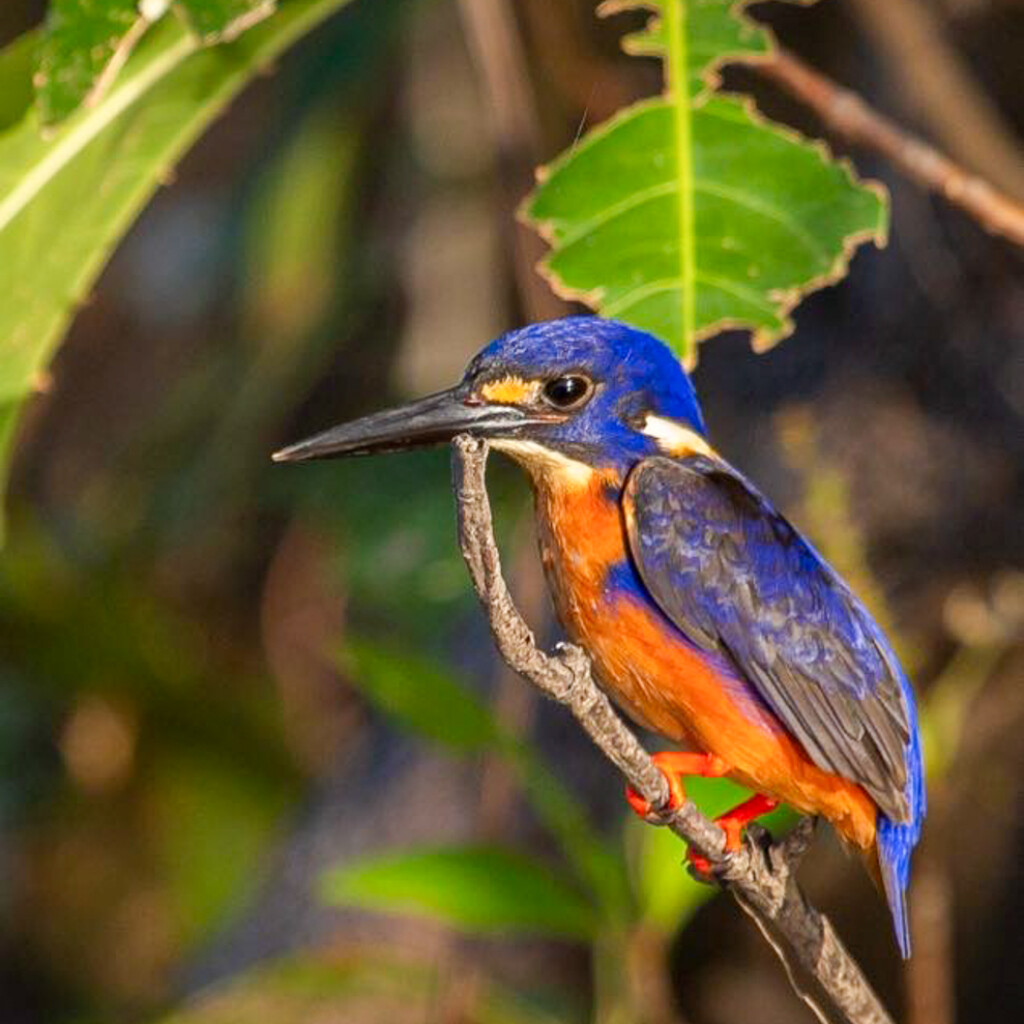
Azure Kingfisher © Maurice Hovens
The wonders on the boat kept coming – Australasian Swamphen on the bank, Pacific Heron dwarfing the Pied Heron next to it, Royal Spoonbill swinging its head from side to side, and a ridiculously cute family of Black-fronted Dotterel running along the shore not metres from our boat. Henry embarrassed himself by calling out ‘Jabiru!’ when a stray Magpie Goose flew over the horizon, but redeemed himself by spotting a pair of Sharp-tailed Sandpiper or ‘Sharpies’. Deb somehow managed to scope out a distant Australian Hobby, which then gave us a speedy flyover. We even saw a crocodile catch and chomp on a big catfish for breakfast.
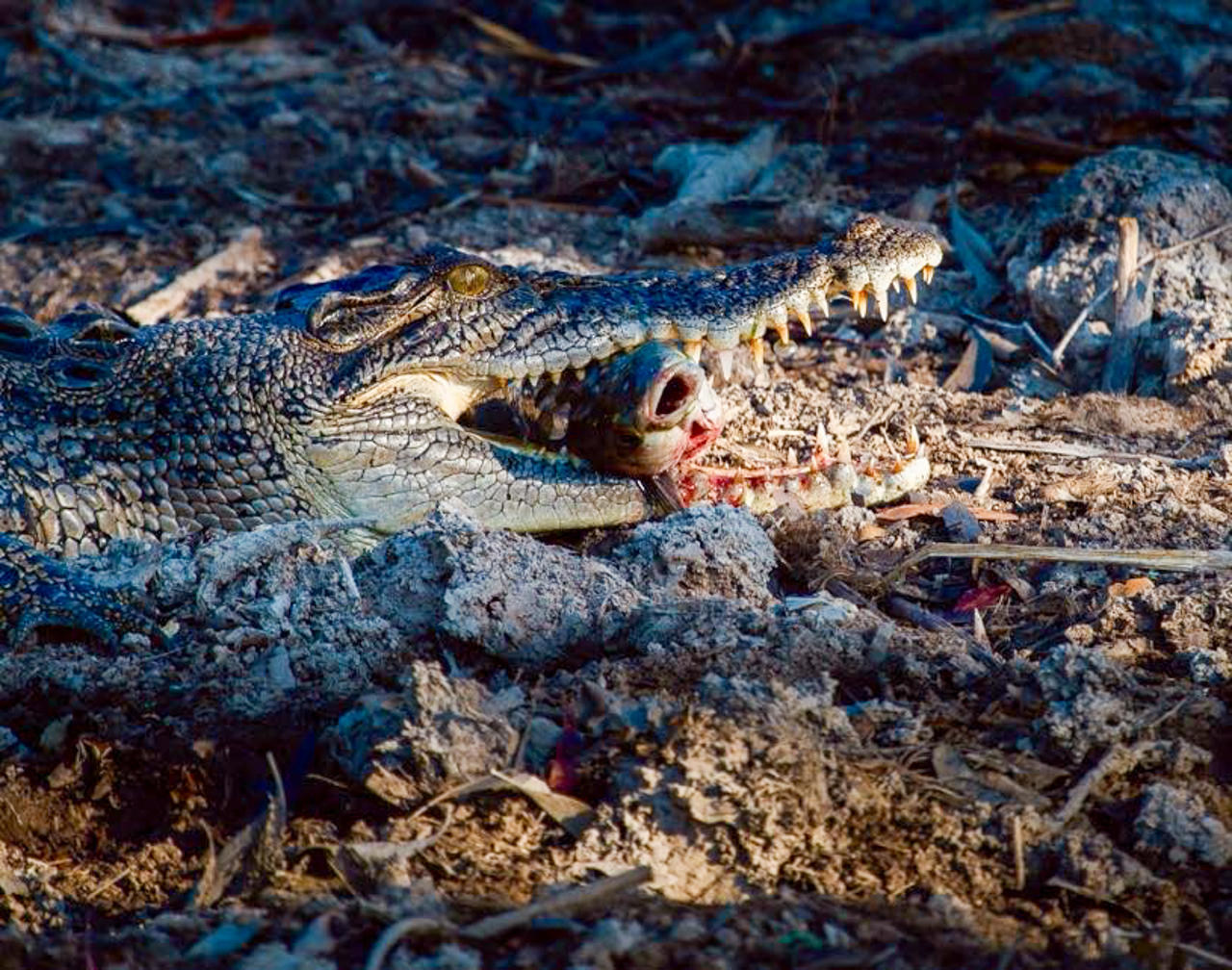
Estuarine Crocoadile with Catfish breakfast © Maurice Hovens
Well satisfied with the cruise, we enjoyed a buffet breakfast at Cooinda. Another walk through the melaleuca wetland yielded nice views of both male and female Shining Flycatchers (very different looking birds), Leaden Flycatchers, and an old married couple of Black-necked Stork (Jabiru) being sweet with each other in the shade.
We then headed to learn about the riches of local culture at the Warradjan Cultural Centre, and all came away with a growing appreciation of the unique anthropological riches of Kakadu. Eagle-eyed Emma soon found us all a pair of one of Australia’s prettiest birds of prey – the Pacific Baza, which ended up being extremely obliging. We watched as these gorgeous hawks worked the eucalypt branches, one of them catching a praying mantis for a snack. The image of the mantis praying for dear life in the merciless yellow eyes of the baza will probably turn out to be photo-of-the-trip. Incredible!
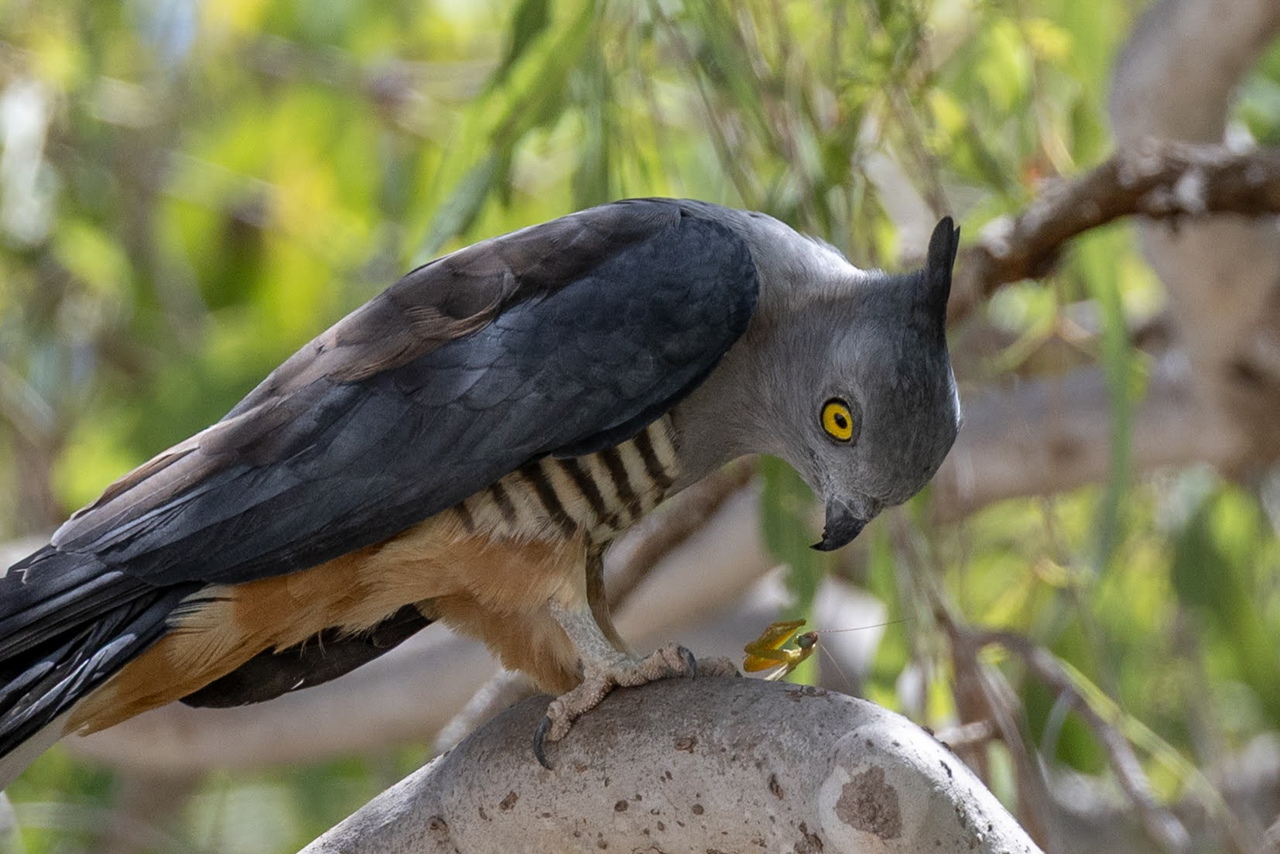
‘Praying for Mercy,’ Pacific Baza with Mantis © Bruce Staples
An afternoon birding session around the Bowali Visitor Centre failed to yield our target of Partridge Pigeon. Instead, we watched White-throated, Rufous-throated, Dusky and Brown Honeyeaters join Double-barred Finches and Great Bowerbirds for an evening drink at a leaky tap.
At night, we watched the spectacle of Little Corellas gathering in their hundreds to roost. And as we slept, we were serenaded by the soft hoots of the Barking Owl, and haunted by the yodels of Anbinik’s resident thick-knees.
DAY 5
Today was the day for Stone Country. Stone Country refers to the Arnhem Plateau, which rises, ancient, eroded and golden, above the sprawling wetlands of Kakadu. The meeting of these two landscapes is dramatically beautiful – riddled with Indigenous history and artwork, and home to a number of endemic species.
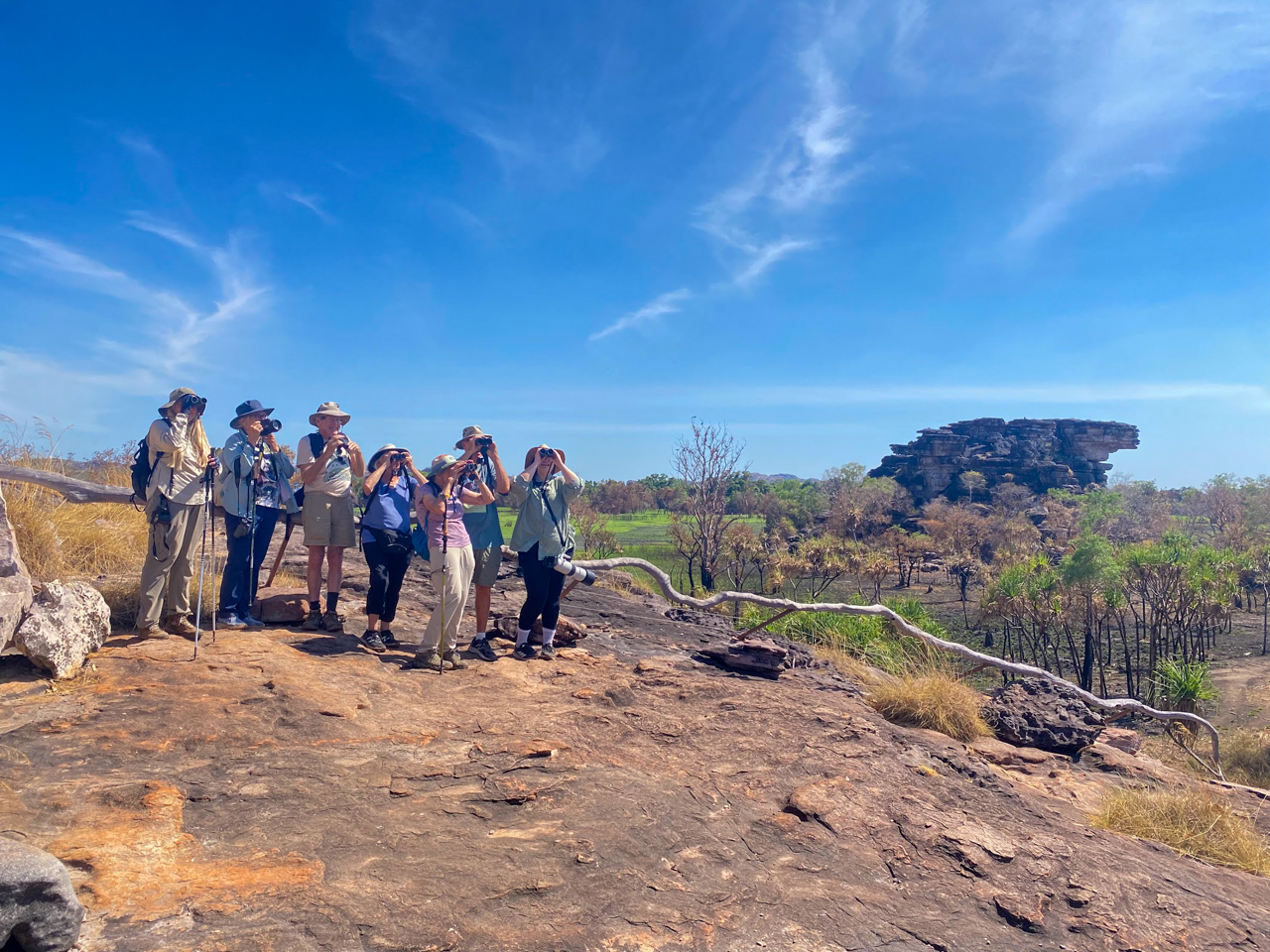
Sandstone Country © Henry Coleman
Soon after sunrise, the Bardedjilidji Sandstone Walk was quick to yield Red-backed Fairywren, Crimson Finches and our first target species, the Sandstone Shrikethrush. The shrikethrush is the largest representative of a uniquely Australian songbird family which are neither shrikes nor thrushes. They are large, intelligent songbirds with beautiful voices, and the Sandstone Shrikethrush is the largest and most terrestrial of these. Watching the Sandstone Shrikethrushes sit atop those ancient rock formations and sing their rich, loud, melodious tunes felt really special.
Maurice shared his detailed knowledge of culture and history as we admired the world-renowned artworks of the Bininj people on the sandstone canvas. Em sat in the shade of a tree and scanned the sandstone until she picked up another of our endemic targets – the Chestnut-quilled Rock-Pigeon. We all ended up getting great views through the scope, and glimpsed the chestnut in the wing as they glided between outcrops.
On to Ubirr we travelled, admiring some of the most renowned rock art in the whole world, including the Namarrkkanj sisters, the Mimih spirits, and great examples of contact art. Maurice regaled us with their stories. A pair of Channel-billed Cuckoo were detected overhead, being uncharacteristically quiet, feeding in the fruiting fig right next to the rock art site.
Later on, a delightful group of Double-barred Finches and even Chestnut-quilled Rock-Pigeon joined us at our Ubirr picnic lunch site, and we stopped at a roadside stand of flowering Melaleuca (paperbark) to watch the endemic Bar-breasted and Rufous-throated Honeyeaters going about their important pollination work (Melaleuca forests are one of Australia’s numerous forest types that are predominantly bird-pollinated).
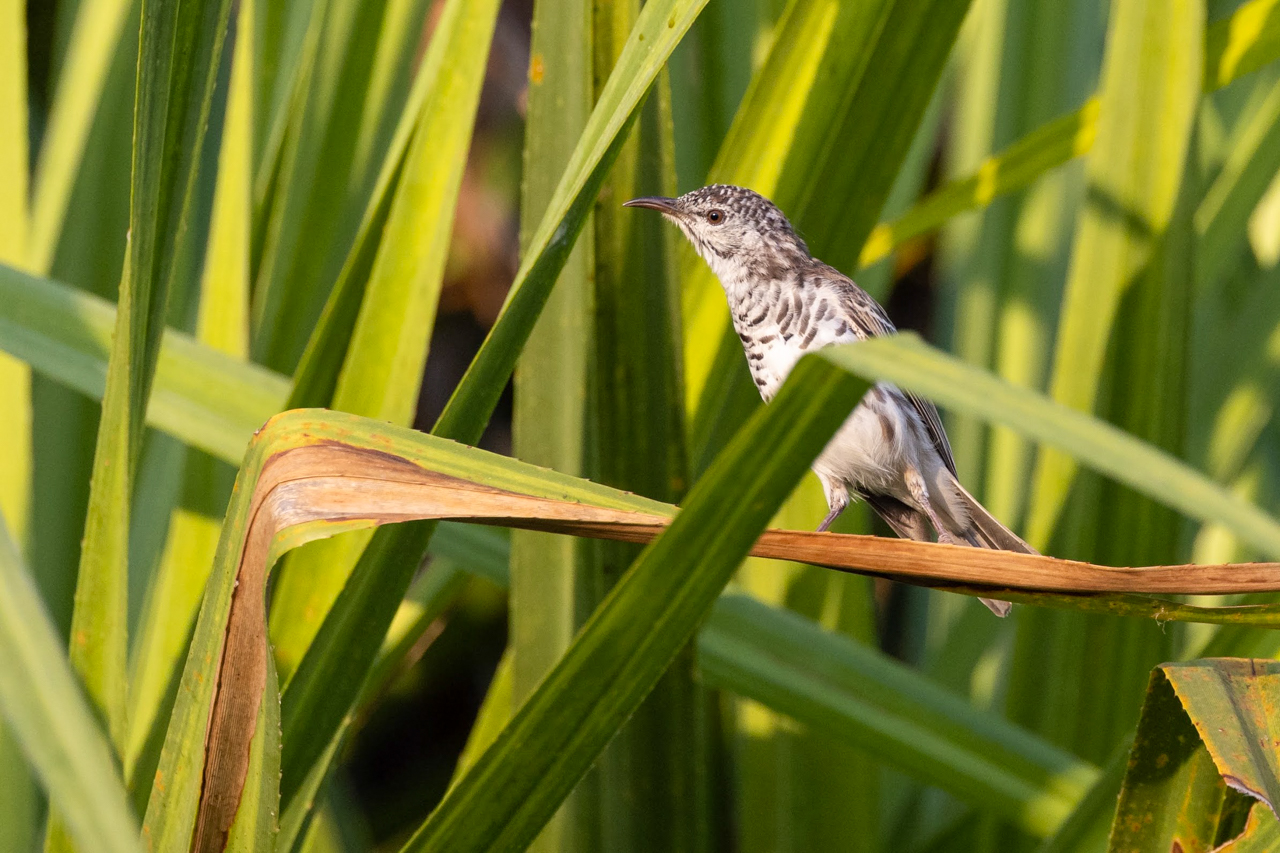
Bar-breasted Honeyeater © Bruce Staples
After an afternoon rest, some of us walked around the Jabiru lake and went spotlighting. We saw thick-knees, a fly-by Barking Owl, and a surprising number of kookaburras out and about in the dark! We also spotted a mother Dingo by the roadside, who seemed almost as curious about us as we were about her. Black Flying-Fox swooped large and silvery through the torchlight.
DAY 6
The next morning, we headed to Nourlangie Rock – another of Kakadu’s dramatic sandstone outliers. A roadside stop for Red-winged Parrot was almost a flop, until Em’s eagle eyes picked out a large brown shape moving among the sticks and foliage… Emu! Emus are fairly rare in Kakadu, so this was one of our most unexpected sightings. The large shaggy ratite ambled out of the trees, nibbling the new growth from the bushes, giving everyone great views. As Bruce and Chris stalked the Emu for a photo, a small flock of Partridge Pigeon exploded out from underfoot on whirring wings and disappeared into the bush. We all wished we had got better views.
Upon arriving at Nourlangie, the escarpment itself wowed everybody. We watched a family of Silver-crowned Friarbirds lerping (picking sugary insect exudates off eucalypt leaves), and we all noted the diagnostic identification features that separate Silver-crowned from the Helmeted and Little Friarbirds.
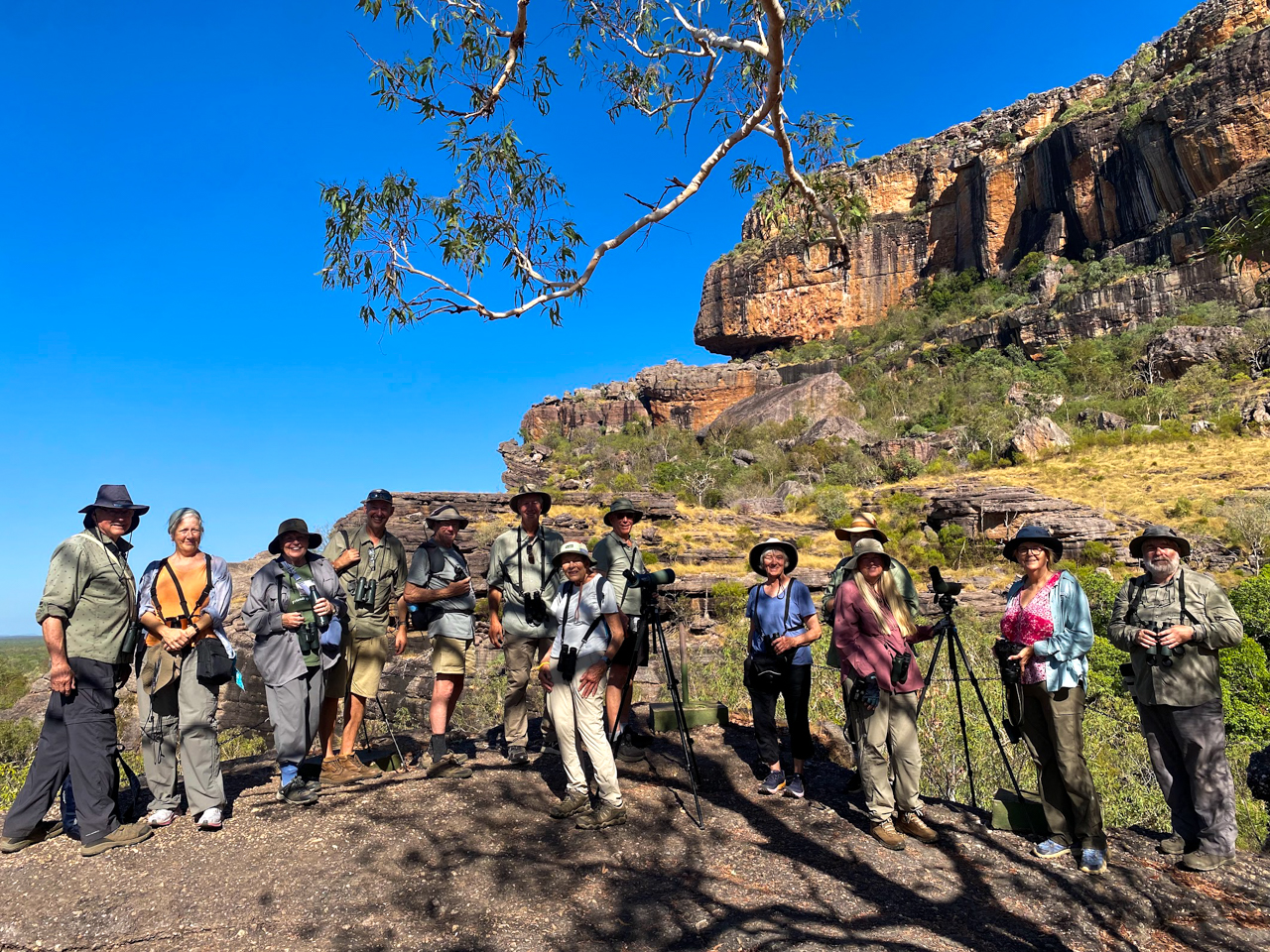
Our group at Nourlangie Rock © Henry Coleman
Beyond the landscape and the artwork, the avian highlight of Nourlangie was the gorgeous and highly endemic Black-banded Fruit-Dove. We watched two of them feeding and moving fast around the canopy. Being quick fliers and evidently hungry for fruit, they weren’t the easiest birds to track, but most of us managed great if fleeting views. From the lookout, we heard the distinctive whistles of the other endemic – the White-lined Honeyeater – but didn’t lay eyes on it. We descended into the rainforested gully – a dramatic shift in forest type – where a pair of Spangled Drongos seemed to have much to say in their metallic voices.
Wandering among the extraordinary artwork of Nourlangie was a real treat. The depictions of Namarrgon (lightning man) and Namondjok are exquisite and world-renowned. There are also artworks here that are not allowed to be photographed, and thus remain a gift reserved for the eyes of those who venture to this unique place.
On the walk back, a male Mistletoebird blessed us with what are surely the best views one can possibly get of this teeny tiny and immaculately colourful species. We watched at close range as he not only swallowed the mistletoe fruit, but proceeded to excrete the seed, placing it precisely on the branch, thus demonstrating the close ecological tie between Australia’s only flowerpecker and our abundant and diverse mistletoes. What joy!
We picnicked by the Anbangbang Billabong – our final lunch-date with Kakadu’s wondrous waterbirds.
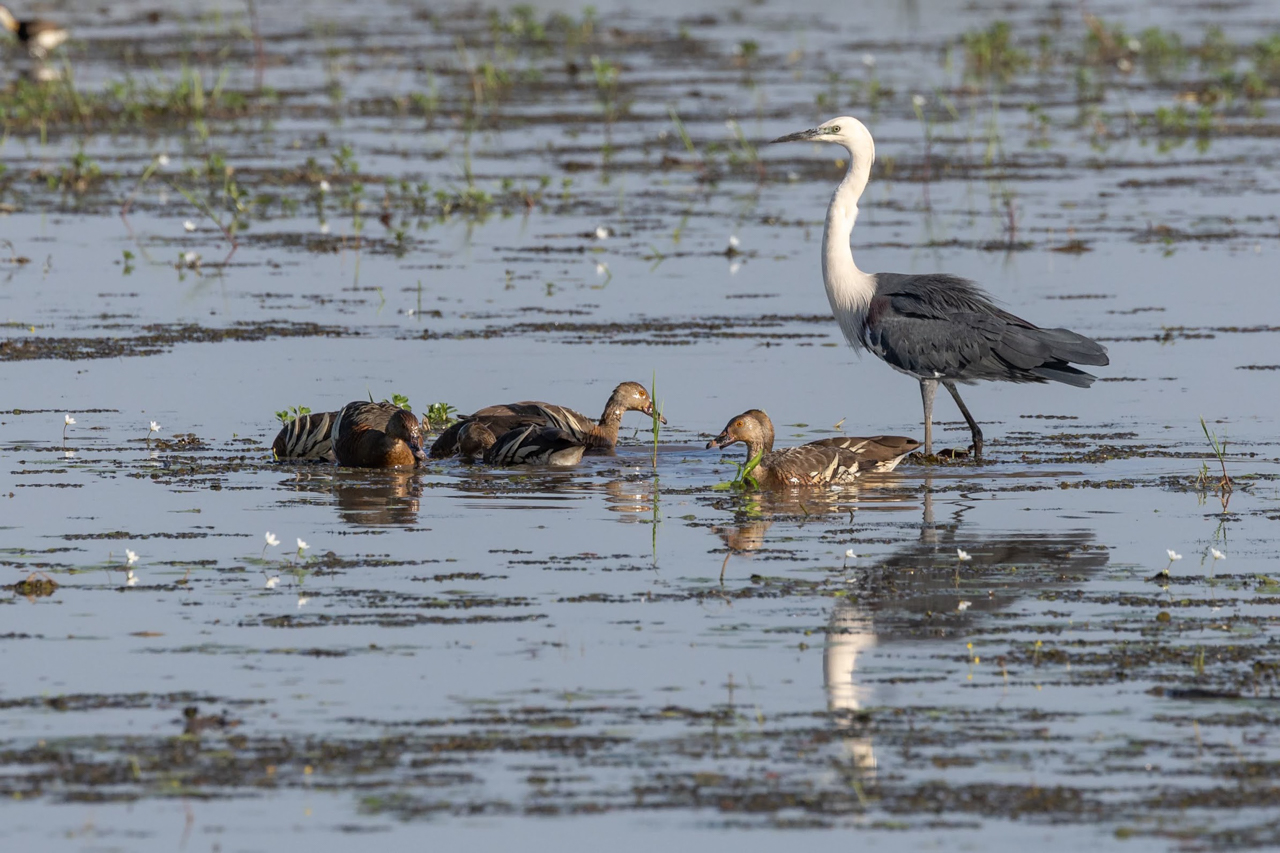
Pacific Heron and Plumed Whistling Ducks © Bruce Staples
Travelling through the vast southern reaches of Kakadu towards Pine Creek, we saw wild stallions galloping through the red dust and stopped at a lookout, where the Red-winged Parrots were clearly not as used to the presence of humans as their cousins in town. Upon arriving in Pine Creek, however, we finally all got really nice views of these large parrots. With their lime plumage and charcoal black wings with a bright crimson shoulder patch, they are surely one of Australia’s most beautiful psittacines.
We wandered through the cute little township of Pine Creek, picking up Gray-crowned Babblers, which were an unexpected highlight for some. The antics of Australian babblers – representatives of another endemic songbird family – are always fun to watch. We also chanced upon a Tawny Frogmouth roosting at eye-level, but nevertheless expertly camouflaged. While Allen awarded the frogmouth his ‘bird of the trip’, Debby exclaimed that she’d never seen such an ugly bird. “Not his fault,” apparently!
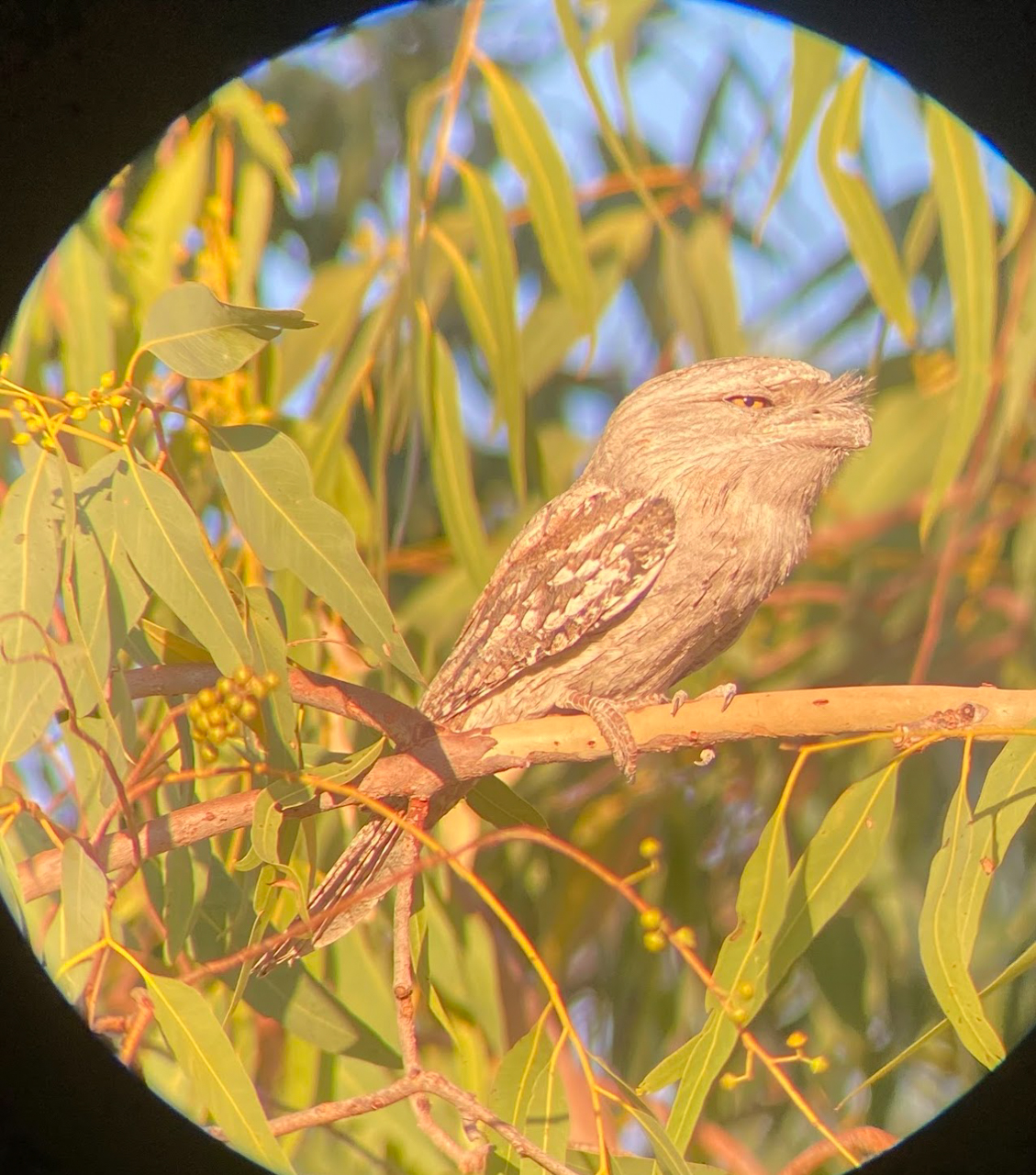
Tawny Frogmouth (digiscoped) © Henry Coleman
Then, right as the sun was setting, our star of the show descended – at least thirty Hooded Parrots! These highly range-restricted grass parrots look gorgeous with their long tails, red vents, turquoise cheeks and breasts, golden shoulder patches and smart black caps. We followed the flock through town – almost right to the doorstep of where, conveniently, we had our dinner reservation!
DAY 7
Today started with a focus on those little darlings of Australia’s tropical savannahs, the grass finches. We were up early and on the road south to a very special little waterhole. A nest of Collared Sparrowhawks was quickly detected. We set up camp by the waterhole, where we would sit in silence and wait with bated breath for the birds to come and take their morning drink.
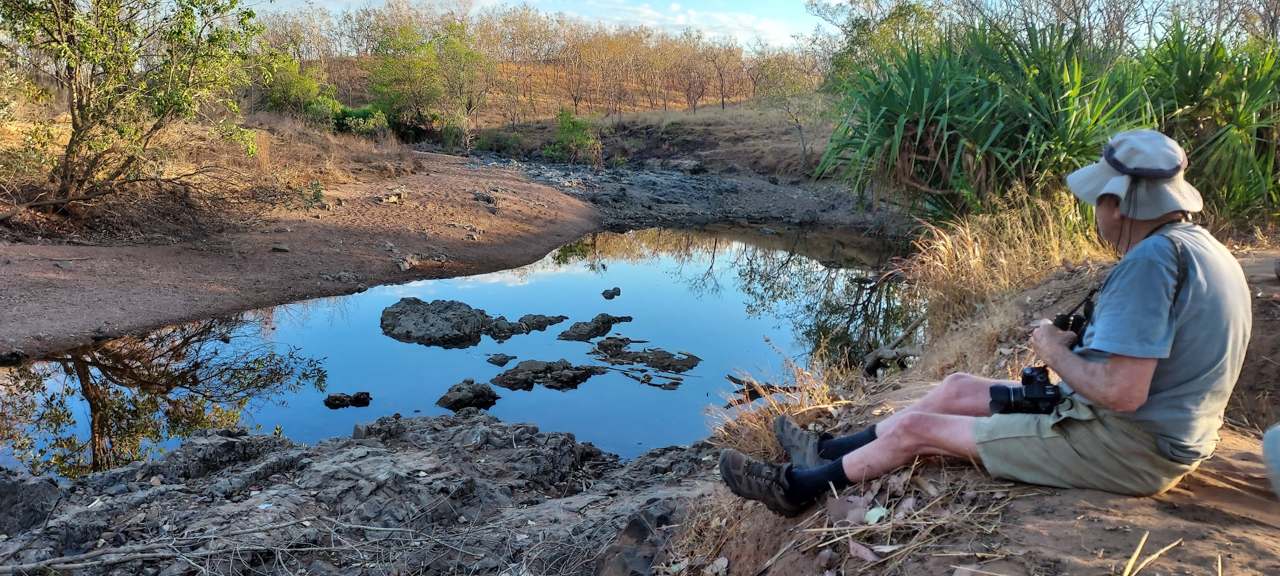
Staking out the waterhole © Magne Bolstad
First came the Peaceful Doves, looking gorgeous in the morning sun. Then, the Double-barred Finches, also known as the Owl-faced Finch for their heart-shaped facial disks. Then came a large group of Masked Finches, a quintessential savannah bird with a bright yellow bill. Soon enough, Long-tailed Finches were added to the mix – a stunning grass finch with a black throat-patch and pin-tail and bright red and yellow bills. We watched these mixed flocks fly in, drop to the water’s edge, drink, scare, and then swirl back again.
This was all getting us very excited, and it was hard to stay still and quiet. But our patience paid off when a group of ten Gouldians was detected high in a tree on the other side of the creek. Distant at first, the flock soon flew over our heads and into the tree behind. And they too dropped to the creek below in perfect light. Wow. Coloured like lollipops, the adult birds sport gaudy yellow and purple fronts and grass-green wings. Turquoise neck rings match their turquoise tails. Their heads are mostly jet black, but one bird in our flock was of the red-headed variety. Gouldians, which were long trapped for the cagebird trade, have been well-studied, and it turns out that red-headed males are dominant in their social hierarchy, though surprisingly immunologically weaker and shorter-lived.
We were all in heaven watching the finches, flycatchers and doves at the waterhole, and the whole scene crescendoed with the fly-through of one of the resident Collared Sparrowhawks, clearly on the prowl. Now we saw how the finches’ skittishness was justified – it’s a scary world out there for a finch! A Blue-faced Honeyeater came to the rescue, driving the sparrowhawk away.
As the day warmed up, we headed south, witnessing a great big Wedge-tailed Eagle at a roadside carcass en route. We stopped in Katherine for some delicious toasties and coffee, and managed quite the bird-list at the café, adding drier-country species like White-winged Triller and Apostlebird.
We then headed further south and spent time birding in the woodland at Dry River Road. Just as we stepped out of the car, Bruce spotted another of our bird-of-prey highlights – a Black-breasted Buzzard cruising overhead.
The woodland was initially quiet, but soon enough we detected Rufous Whistler and Silver-crowned Friarbird. Following the songbirds haphazardly into the bush, we chanced upon a tree where a flock of Varied Lorikeets was at rest and preening. Our sightings of this pretty little lorikeet had so far been limited to flyovers at high speed, and we’d not yet decided to count them on our list, so it was a relief and a great joy to finally be able to observe them well.
While watching the lorikeets, the zitting calls of Banded Honeyeaters were detected. The birds flitted around, proving difficult to observe, until one bird decided to sit still and chill out for a moment, giving us all great scope views! These are birds that rarely pause. Perhaps birding in the heat of the day wasn’t too bad a decision after all. A Striated Pardalote soon joined the honeyeater, but proved much less cooperative.
We headed back to Katherine for lunch and a rest at the hotel. A brief afternoon outing to the Katherine Water Treatment Plant yielded Wood Sandpiper, Pied Stilt and dotterels, but the air was smoky with bushfires and the sun was harsh. We retreated for a riverside walk among majestic melaleucas and Blue-winged Kookaburras, and wrapped up the day with a fancy dinner.
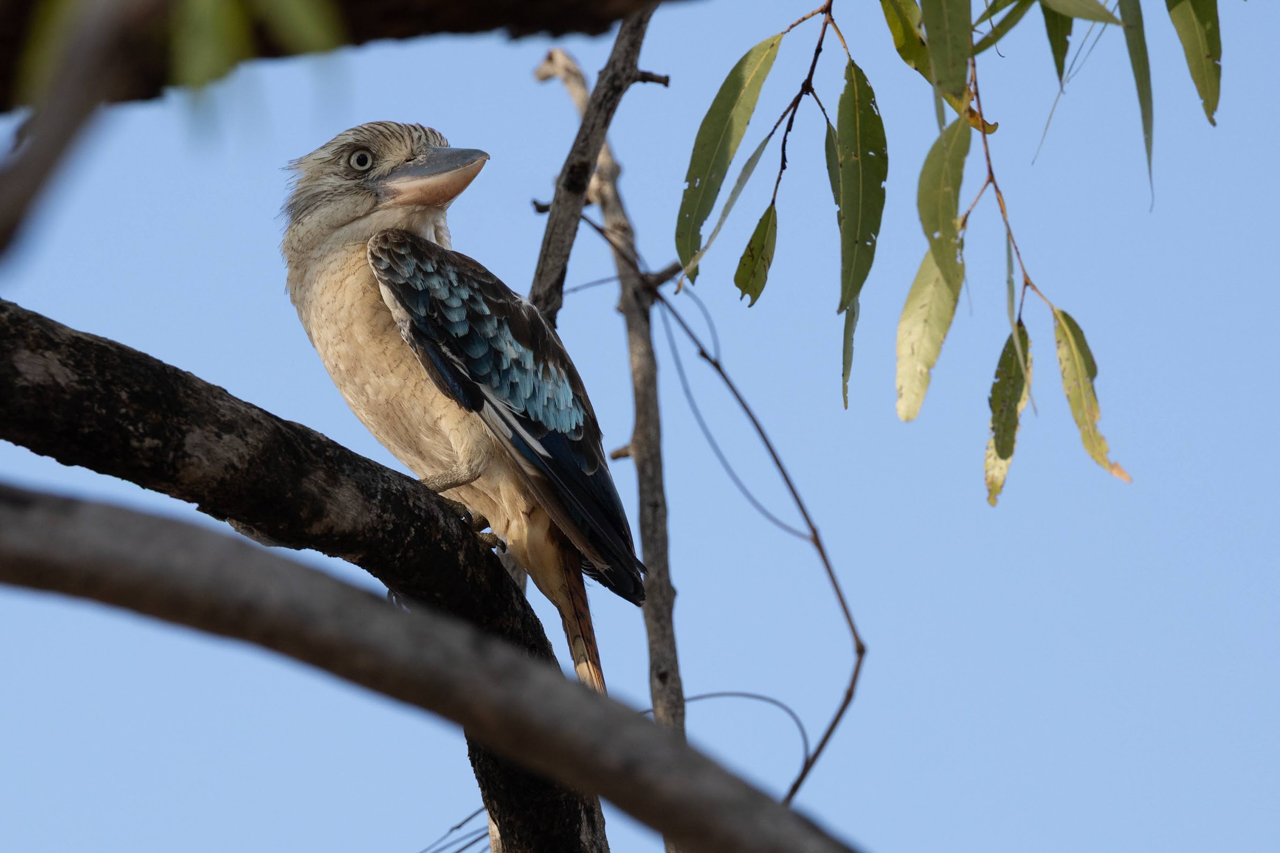
Blue-winged Kookaburra © Bruce Staples
DAY 8
On our last full day, we were birding around the hotel even before our breakfast, picking up numerous Yellow-tinted Honeyeaters feeding among the more common Browns and Duskies in the Callistemon flowers. Sheila drew our attention to a woodswallow perched atop a palm tree, which turned out not to be the White-breasted (with which we were now all well familiar) but rather a Black-faced Woodswallow – a bird more typical of drier climes. Pied Butcherbirds and Crested Pigeons were also enjoyed by all.
Before the long drive back to Darwin, we all agreed it was worth spending another morning at our favourite finchy waterhole. On the way in, a mob of sandy-red Antilopine Wallaroos bounded across the road.
We arrived to find two other birders who’d been staking out the waterhole since dawn. They had had no luck with Gouldians. We all enjoyed great views of Leaden Flycatcher as well as the more common finches (Double-barred, Masked, Long-tailed, Crimson), but still no Gouldians. We realized what a blessing it was to have seen them the day before.
Exploring the pandanus along the creek edge, some of us got great if brief views of an awesome rarity – the Black Bittern, who flew out of the thick vegetation and perched momentarily on a dead stick above the water, displaying a long, thick, dark brown neck with yellowish striations. But it dropped back into the pandanus thicket, cryptic as ever. Nankeen Night Herons and White-faced Herons were also observed working this stretch of water in an otherwise parched environment.
We spotted Golden-headed Cisticolas among the flocks of Crimson Finch. Their long tails had us initially questioning their ID, thinking perhaps they were grassbirds. But Chris’s awesome knowledge of Australian birds set us straight, and we learned that cisticolas actually have longer tails in their non-breeding plumage.
A Northern Fantail showed well in the eucalypts while Red-backed Fairywrens flitted lower down. A few loud melodious notes betrayed the presence of a Gray Shrikethrush, which was seen by some. A couple of flyover Cockatiels were not seen well, spurring us to travel further down the road and search more of the woodland.
And it was a good thing we did. Although the Cockatiels gave nothing more than flyovers, a Partridge Pigeon was detected running around in the grasses. We all crept around the bird, most of us getting good views. Finally, the bird flushed on whirring wings, partridge-like, quite high into a eucalypt tree. There the bird stayed, and we scoped it out from multiple angles, getting everyone good views of its cartoonish bright red face. After trying multiple times for this endemic bird with limited success, this sighting was appreciated by all. And before heading back to the car and to Darwin, we all enjoyed great views of a flock of Galahs and a pair of Brown Falcons.
Back in Darwin, we had a picnic at Marlow Lagoon. We added Yellow-throated Miner as well as the endemic Silver-backed Butcherbird, and we even located the nests of both species! A juvenile Brown Goshawk also showed nicely. A walk through Holmes Jungle Nature Reserve gave us an opportunity to farewell some of Darwin’s colourful characters, including kingfishers, orioles, figbirds, fantails, finches and fairywrens!
We wrapped up the trip in the place we began it – over dinner in the Darwin Sailing Club, overlooking the shallow sea at sunset. It was a greatly rewarding – if, at times, demanding – adventure through the Top End, in the company of a bunch of great people. We celebrated with a drink, a feed, and much laughter.
Thank you, everyone, for an awesome trip and great birding memories! We hope to see you again, somewhere in the world ☺
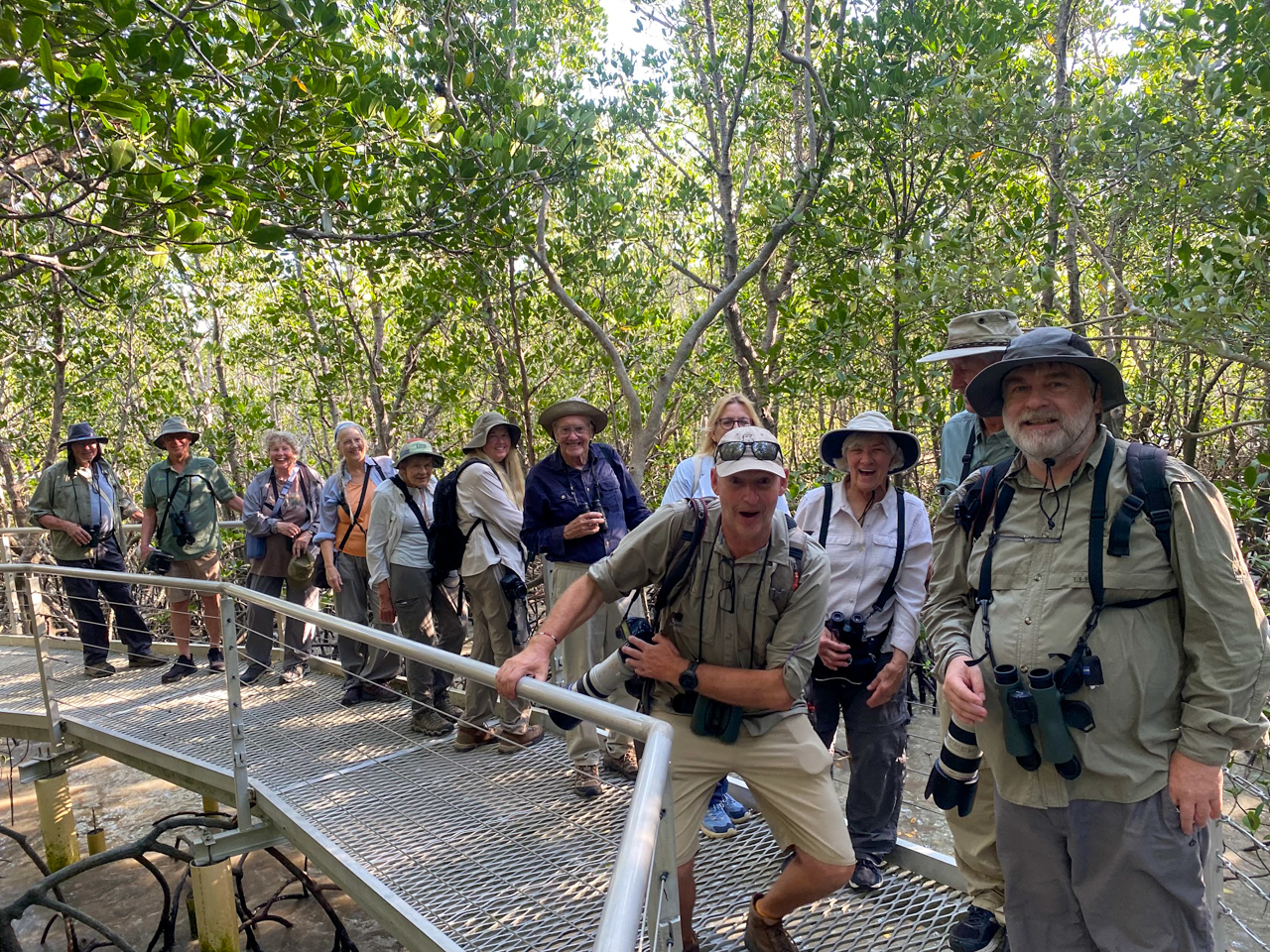
Our group


Leave a Reply