Tanzania Trip Report (Mar 29 – Apr 13, 2025)
Our Eagle-Eye Tanzania tours provide an opportunity to explore seven distinct ecological landscapes across what is for any ecologist undeniably one of the richest and most wondrous regions in this world. We entered this patchwork in a mix of woodlands and glades that lie between Mount Kilimanjaro and Mount Meru. Then after three nights in these cool submontane forests we descended into the great rift valley and traveled amongst the Elephant maintained granny Baobab Savanna of Tarangire National Park. After three full days in the intoxicating warmth of the Great River Valley, we wound our way westwards up the wall of the rift and into the refreshing coolness of the Crater Highlands.
Here we visited the one and only Ngorongoro Crater, one of those few experiences nowadays whose genuine profundity our words cannot begin to describe. After a night in a luxurious hotel at Ngorongoro where the rooms perch on the rim of this fantastic, quite simply awe-inspiring location, we descended toward the vastness of the Serengeti.
Here, more than one thousand five hundred metres below the Crater rim, we visited the “Cradle of Mankind” and its museum at Oldupai or Olduvai Gorge. Now we were at the edge of the volcanic ash nurtured short-grass plains. Our base for exploring this world famous (eastern) Serengeti ecosystem since these unspoilt “African Prairies” completely surround the woodlands of Ndutu Safari Lodge.
This area is “THE Africa” that so many travelling naturalists dream about: a land teeming with herds of wildebeest, zebra, eland and gazelles, flat-topped acacia trees, flocks of colourful birds, breath-taking sunrises and sunsets, clean air and unscathed blue skies. All of this, observer and observed, silently wrapped in a tranquil vastness. Undoubtedly this is the “Nature Experience” which so many of us, in our oh! so industrial lives yearn for, almost each and every day.
From the glory of Ndutu we once again trekked westwards, traversing the endless plain of Serengeti to a delightful tented camp set amongst the shallow valleys, low hills and the giant boulder kopjes of the western Serengeti.
And then, finally, we pushed our way along narrow rutted roads through what is nowadays the seldom visited Western Corridor of the Serengeti to reach our final destination, and eco-region, to stay at Speke Bay Lodge on the papyrus-fringed shores of the vast Lake Nyanza-Victoria.
From Mwanza, the second city of Tanzania in terms of human population, we flew back to Kilimanjaro International AirPort and to KIA Lodge, where only two weeks previously, seven hungry nature participants had first convened, yet now with minds replete with accumulated wonder.

Kilimanjaro (snowy peaks) from Arusha National Park © James Wolstencroft
We departed early on our first field morning in cloudy conditions from KIA Lodge, nestled beside the international airport, the quaint hotel where the group had gathered for our briefing on the previous evening of the 29th of March.
This proved to be a very good group. Essentially easy-going with a good sense of humour and collective spirit. We ‘gelled’ well and we were soon helping each other from the safari vehicle to spot an incredible, oft times bewildering, variety of birds, mammals, lizards, frogs, butterflies, and flowers.
Before we had left the perimeter of the international airport, one participant, a master of eBird and a good spotter, found “our first good bird”, a male European Golden Oriole outside Jambo Café when Moses, our driver-guide was paying for the airport parking.
Better still we got our first views of a range-restricted, but thankfully increasing bird, the Pangani Longclaw. This is a meadowlark look-alike, and a perfect example of convergent evolution.
Alongside the airport road we saw half a dozen individuals of a rapidly decreasing infra-African migrant bird, the Abdim’s Stork. And soon after that the first of a rapidly increasing, introduced species, the (Indian) House Crow.
We entered Arusha National Park after only an hour’s drive to find our first barbet, which happens to be the rarest one we saw, the Brown-breasted. Incidentally, we were to see all four of the closely related, widely distributed East African woodpeckers and we saw all of them well on this tour.
Soon we were watching our first “big game” at a beautiful and verdant forest glade called Serengeti Ndogo – Little Serengeti.
After an hour or two inside the park we were exploring seldom driven tracks in the evergreen forests of the higher elevations and most of us caught glimpses of a skulking forest ground-feeder, the White-starred Robin.
After a shower of rain we were lucky to find at least two very different looking species of tree frog sitting out on leafy foliage beside the track.
The next morning around our lovely hotel, (which is not far from the park), is a small secluded lake. Much of it nowadays is blanketed with duckweed. Sure enough we soon found a resident pair of the rather sombre African Black Ducks tending their four ducklings, all the while dabbling at the weed.
Here we saw the delicate looking Mountain Wagtails along the babbling outflow from the lake. We also saw a striking make Black-throated Wattle-eye, in the company of the not quite so striking Grey-Olive Greenbul. We saw most of the expected species in Arusha National Park and were lucky to spot an Osprey, a relatively rare visitor.
Of particular note was a total of perhaps one hundred Maasai Giraffes. This park has the highest density of giraffes in the world, or so it is said.
The next day in Tarangire National Park we encountered our large flocks of Helmeted Guineafowl soon after entering.Such a common species in Tanzania and yet somehow far more striking and exotic in this their native environment than as hapless domesticates abroad.
On each of our two days in Tarangire we saw at least 20 Knob-billed Ducks. Some of the drakes of this dramatic-looking waterfowl were displaying. Meanwhile, a few females were watching nest prospecting at holes in the immense baobab trees. Both sexes were observed feeding delicately on the nodding heads of seeding waterside grasses.
On our first afternoon in Tarangire, we were very lucky to see males of four species of Whydah more or less together, around a rainwater puddle in a sandy track: the Village Indigobird being the least remarkable and the male Eastern Paradise Whydah easily the most spectacular.
We got exceptional views of the somewhat skulking Emerald-spotted Wood-dove one time when we drove out of the lodge. Much later in the tour, at Speke Bay Lodge, we were fortunate on foot to find both this species and Blue-spotted.
We got fantastic views, right beside the track, of three Buff-crested Bustards on the Lemiyoni circuit in the dry north-eastern corner of the park where, ironically, we also found our first “wetland-adjacent” Black Coucals, no doubt thanks to the recent rains. Another rain-related bird that we saw in Tarangire was the very scarce Rufous-bellied Heron. Days were hot in Tarangire and it was no doubt such conditions that brought down a small flock of five migrant Lesser Spotted Eagles to drink, at noon, at the Tarangire river.
We did very well for Saddle-billed Stork on this safari. We saw six birds in total, on four days, including an adult male (dark iris) who was flushed whilst lifting a dried stick from the surface of the main track through Manyara National Park. It was very pleasing indeed to see an African Woolly-necked Stork at a fresh water pool beside the main track that crosses the central plains of the Serengeti.
Above the town of Karatu we got good views of Schalow’s Turaco both inside the Endoro forest and at Gibb’s Farmhouse where we had our delicious lunch. Perhaps everybody’s favourite bird on this day was the gorgeous Black-fronted Bush-shrike in the evergreen canopy of the trees overhanging the stone steps which have been cut out of the escarpment.

Endoro Forest Walk © James Wolstencroft
We enjoyed the roosting Slender-tailed Nightjar at KIA Lodge, after sunset we could listen to their chuffing electrical song and liquid flight calls. KIA Lodge is a good choice of location for our owl list, as we saw both Barn Owl and Spotted Eagle-Owl here. We also saw a Barn Owl very well, asleep beside the track, in the Serengeti.
As usual, the African Scops Owls “performed well in their sleep” at the lodge in Tarangire and we could hear them after dark from our spacious permanent tents overlooking the river. There was male African Lion here too, huffing and puffing at night, as they do! Despite the tall and wavy grasses of this season’s tour we saw 22 lions in total. And saw them very well.
It is once you leave Karatu with its bustling markets, and climb over the watershed of the Ngorongoro Conservation Area’s eastern scarp, that for many participants, the pure majesty of this Tanzania safari begins in earnest.
I think it is the vast sky and the thousand shades of greens and browns and yellow of the route, from Ngorongoro past Oldupai and into the Serengeti, that perhaps best capture one’s attention and release one’s sense of awe.
Our day in Ngorongoro Crater is always, without doubt for me, the almost uncontested highpoint of our safari. It provides highlights and becomes a hingepoint. And I am sure the majority of our guests would concur. Not only does it provide the greatest bird list for any day of the tour (typically 135-140 species seen or heard) but it never fails to create an experience that is deeply moving.

Ngorongoro Crater from rim © James Wolstencroft
On this safari, for myself, the highpoint was perhaps the ferocious rainstorm which coincided with our picnic lunch in the Crater, inside the van on the shore of Lake Magadi. This is a spot which lies directly below the lodge where we would stay at night.
As the rain began and visibility dropped to less than two hundred metres, it was intriguing to watch the Great White Pelicans as they huddled together on the lawn-like shore, their bills pointed upwards at 45 degrees into the slanting shining rods of rain. There were about thirty of these great birds in the flock and they were close on our left-hand side.
Meanwhile out in front of us over the lake an almost momentary passage of about one thousand White-winged (Black) Terns appeared to feed upon an emergence of chironomid midges whose life cycles were being resurrected by the rain storm. Only a short while later the rain shower has completely cleared westwards.
So we returned to the lake and continued our search for the beautiful and range-restricted Chesnut-banded Plover. A beautiful little Snowy Plover replacement, resident here amongst a wealth of other shorebirds both resident and especially migrant. One might say that whilst here we conducted a little fieldwork seminar on Old World shorebird identification. An experience that I hope was of some interest to everybody on the tour.
Moses, our excellent “Driver-Guide” then spotted a distant jackal along the shoreline of Lake Magadi. A Black-backed Jackal, so we drove over to get a better look.
Suddenly we realised that the jackal was “finishing off” a very young Thompson’s Gazelle. And we saw that the mother, evidently distraught, was running in circles, belatedly trying to fend-off another similarly-sized jackal. This dog jackal, who was evidently the other jackal’s mate, was harrying the mother gazelle, enabling the other jackal to overwhelm the hapless kid. Typically these jackals are to be found in family groups of two to five including here, down in the fabled Crater.
After the rain storm, when we were making a short stop at the restrooms, a mixed feeding flock of swifts passed over us. The flock contained two Mottled Swifts, a bird that is getting hard to find nowadays, together with 15 Nyanza Swifts, two Common Swifts and unusually at this location three Scarce Swifts.
On this first tour we saw five Browse (aka Black) Rhinoceros in the Crater. They are typically dark battleship grey in colour and can prove hard to find. But we had several keen observers within our rank.
A particularly sharp-eyed member of our team spotted an African Rail, our only sighting of the safari, in the typha swamps (also known as cattails) near to hippo pools. The old and the newly created wetlands of the Crater floor attract a huge variety of birds. For any birder, in the unique East African equatorial light of late afternoon and “highland sunshine”, these myriad water birds in such a setting weave an unforgettable tapestry of life across one’s memory.
What makes this place so incredibly special, unique even? After well over one hundred visits I think it is in essence the natural majesty of the setting; and then the sheer scale and variety of the wildlife experiences that seem to flow out of the landscape and embrace you. And to embrace you repeatedly. Such a phenomenon is extremely rare and cannot be easily replicated!
From the concentrated wonders of Ngorongoro we descended to the vastness of the Serengeti. At Ndutu Safari Lodge, perhaps the most beautiful accommodation of the tour, sporting “old rewilded gardens” lovingly crafted out of the bush, one is treated also to a pageant of colourful birds who outshine the flowers not only in their pigmentation, but also in their amazing iridescence.
Firstly there’s the ubiquitous Superb Starling and the equally delightful Hildebrandt’s and the long-tailed grackle-esque Ruppell’s Starling, and of course the Sunbirds. Here we have “only” six species: Eastern Violet-backed, Gorgeous, Scarlet-chested, Marico, Variable and Bronze.
Always, at this “spring” season, the colourful masses of flowers of April demand our attention. The fact that so many of them are “accidental alien exotic introductions” notwithstanding, this experience is a pure delight.
But most folk come to the eastern Serengeti for “cats, BIG cats”! As is the norm nowadays we eventually found a Cheetah at Ndutu after some effort. Two brothers as is often the case. Unusually though, for us, we had to share this sighting with four other vehicles.
Thankfully, for primarily we were birders, there were birds galore. Among the birds, for me the incredible and uniquely adorned Secretary Birds must take pride of place. We were well provided for and must have seen at least a dozen different individual birds on one day in the easternmost Serengeti, including a pair at the nest.
We got great views of the largely crepuscular Spotted Thick-knee on this tour, the first was near Oldupai and the second at Speke Bay Lodge. Another nocturnal bird that we did well to find was Three-banded Courser at both Ndutu and Speke Bay Lodge.
Falcons however were to be in short supply on this tour, nevertheless we did see a hulking female Lanner and we did very well for Pygmy Falcon seeing them on four days and each time nice and close.
So what was the avian highlight for this guide, now an “old Africa hand”? Well, strangely enough, for me, the “best bird” might well have been the migrant Isabelline Wheatear (a bird from Central Asia or even “Outer Mongolia”) that fluttered down onto thd dusty track right in front of the Toyota as we were beginning our search for the cheetahs on our full day (very full day) at Ndutu. Such is the magic evoked by bird migration!
Apart from birds … What were the butterfly highlights (as an example of the “little things”) on our tour? It was very pleasing to see that there has been a return to form, this year, for several species of widespread open country Nymphalidae such as the Yellow Pansy, Blue Pansy and Peacock Pansy. Since we were mostly in open habitats, we saw relatively few of the scarce and localised species that one might find in this region. However the evergreen forests of Arusha National Park were exceptional in this regard and we saw some lovely swallowtails (‘Papilios’) and tiger-monarchs (Danaidae).
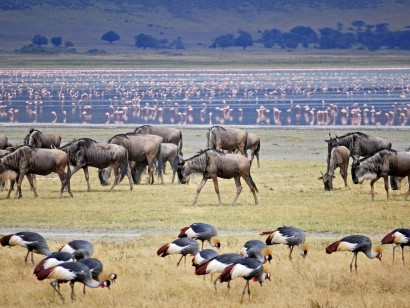
What was an exceptional mammal experience for the guests? I think, as in so many cases, it likely was the sense of immersion in Wild Nature, as if one were in the Garden of Eden. Especially the unique feelings one experiences when surrounded by the surging migration of zebra and wildebeest.
What was the best mammal of the tour for me? Undoubtedly the female tawny-coloured Caracal, hunting little Arvicanthis grass rats close to our vehicle, one evening near to the lodge at Lake Ndutu. For this is a seldom seen cat, which we were very fortunate to find and to be able to watch well at close range. Such are the joys for those lucky finders of our unique safaris into the surviving wonderland of Northern Tanzania.
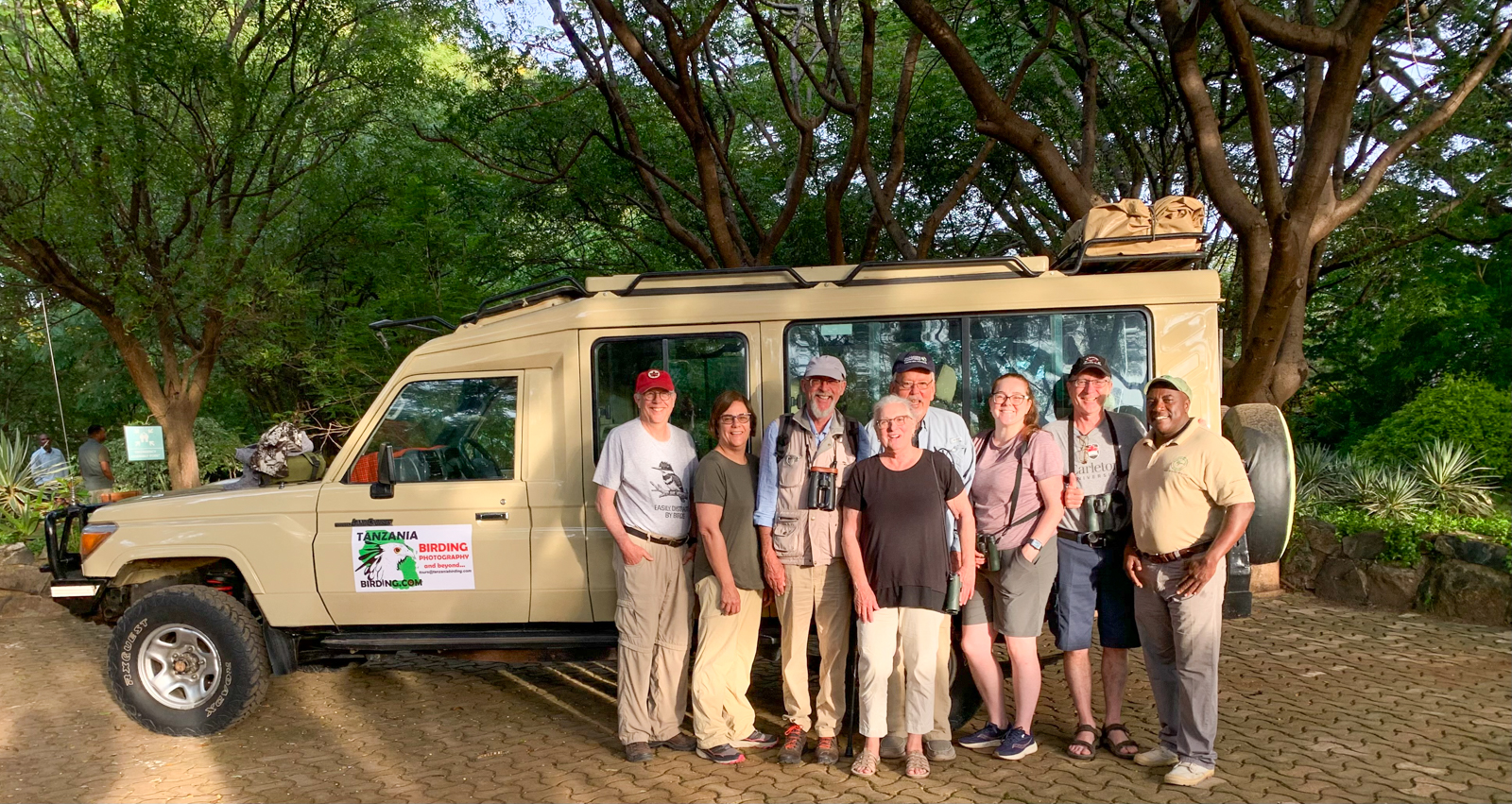
Our group