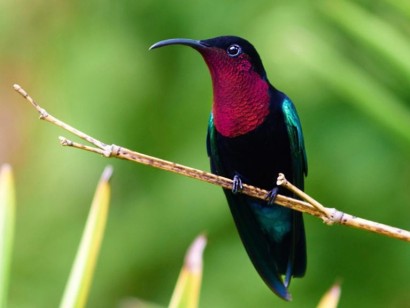
Best of the Lesser Antilles Trip Report (Feb 22 – Mar 2, 2026)

Des Cartiers Rainforest lookout © Paul Prior
Eagle-Eye’s previous tour to this part of the eastern Caribbean was in 2022 and there have been some fairly major changes in the intervening years. Bird-wise one of the big changes has been in avian taxonomy which has increased the number of island endemic species -specifically the three wrens – teasing visiting birders. But no doubt the taxonomists will have more to say over the next few years. Other big changes have occurred more naturally but rather more catastrophically, with Hurricane Beryl impacting the St. Vincent forest in 2024, and a volcanic eruption on the same island in 2021. All this to say, no matter what, this was going to be a very interesting trip and all three of our island guides proved to be well up to the task of providing wonderful insights into not just the changing fauna, but also island life in general.
Day 1
Our small group convened at supper in our St. Vincent hotel planning a very leisurely 8am start for the following day.
Day 2
Our local guide, Lystra, arrived in good time and straight away we were off in search of our first island endemic: the St. Vincent Wren. We drove to the town of Prospect and very soon we were getting great looks at our target. I had not expected much from these recent splits from Southern House Wren, but I confess that in the end these three new species were a real highlight. This first of the trio was a remarkably different bird, both visually and audially, and we were treated to a prolonged performance complete with encore. Meanwhile, one of the resident Broad-winged Hawks (subsp. antillarum) circled close overhead.

St.Vincent Wren © Paul Prior
From this suburban stop it was just a short drive to Prospect Mangrove where we were in search of the regionally endemic Lesser Antillean Tanager, Grenada Flycatcher, Caribbean Elaenia, and Lesser Antillean Bullfinch, paying special attention to the first two on this list since neither would be found on either St. Lucia or Dominica. Fortunately, all four species were easily found, together with Antillean Crested Hummingbird, Gray Kingbird and Mangrove Cuckoo.

Lesser Antillean Tanager © Paul Prior
Lystra then whisked us away to our first highland hotspot in the hills above Kingstown, where we were to search for Whistling Warbler, a species that has become somewhat more difficult to find since the Soufriere eruption in 2021. The drive up set the tone for much of the rest of the trip, passing fabulous vistas down to the ocean and sea, deeper into lush green, rainforest. Lystra led us along the trail through taro fields to the edge of the foothill forest where, despite the rather blustery conditions, we were able to find plenty of the completely black (over-ripe?) Bananaquit (subsp. atrata) together with both Purple-throated and Green-throated Caribs, Scaly-breasted Thrasher, Spectacled Thrush, but sadly not a peep from the Whistling Warbler.

Bananaquit (Dark Morph)
We made our way back down to Arnos Vale for lunch and then drove north along the Atlantic coast to the mid-region of the island where we cut west inland to reach Jemmings in plenty of time to set ourselves up for the late afternoon flyby of St. Vincent‘s Amazon. We managed a couple of closer birds in flight, and some rather more distant scope views of perched birds across the valleys. Evening light presented excellent photo opportunities for the serious photographers in our group despite the distance and we left in good time for the long drive back to Kingstown. All too soon it was time to say thank-you and farewell to our wonderful local guide.

St. Vincent Amazons © Paul Prior
Day 3
Inter-island flights here in the Lesser Antilles are not the most straightforward of processes, and in both of our transfers we had to deal with short layovers in Barbados. Our second island on this tour was St. Lucia, flying into Castries, where our new guide, Willow, waited for us. Our three guides had their own unique styles, but they were all technically brilliant field-birders, each with their own treasure-trove of local lore and island information.
After lunch at the beachside airport restaurant, we drove to our hotel in Rodney Bay where we stored our luggage and then headed straight out for our first taste of St. Lucia birding near the upland region of Babonneau. Here we soon made the acquaintance of the delightful St. Lucia Warbler, scoped a Green-throated Carib incubating on her tiny nest, and were provided with wonderful first looks at Lesser Antillean Pewee (a potential island endemic), Lesser Antillean Flycatcher (as opposed to the other regional Myiarchus flycatcher: Grenada Flycatcher, which we had seen on St. Vincent).

St. Lucia Warbler © Paul Prior
Also hereabouts our guide picked up the quiet calls of two important island endemics: the Oriole and the Black Finch, but both species stayed obstinately hidden in deep vegetation. However, we were well compensated with excellent looks at a Gray Trembler trembling to itself in the low canopy while a St. Lucia Wren bounced about nearby. This latter was not quite as dramatically different from our more familiar Southern House Wren, particularly vocally, but certainly more obvious than I had expected.

Gray Trembler
Day 4
We departed from our hotel at 6am to beat the traffic (St. Lucia’s traffic proved the busiest of the three islands) en route to the dry forest at Micoud on the east side of the island. Here we started our search for St. Lucia Thrasher.

Searching for the Thrasher © Paul Prior
Willow was onto one after about a half hour of patiently waiting, but the bird stayed well hidden, quietly “thrashing” about in the deep shadow just 10m from the trail. The rest of us had to make do with tantalizing glimpses of small portions of the bird through tiny windows in the trail side vegetation. We continued a little further up the trail, but after further looks at St. Lucia Warbler and Caribbean Elaenia, we about-turned and made our way slowly back to the main road. And then suddenly, there, perched right out in the open at eye level in the sunlight, a splendid St. Lucia Thrasher!

St. Lucia Thrasher © Paul Prior
Further tiny audio clues then alerted us to the presence of another crucial endemic, but this young male St. Lucia Oriole proved rather flighty, allowing repeated, but very brief views.
From here we moved higher into the mountains, arriving at the Des Cartier rainforest trail with a couple of specific targets in mind. The trail was relatively flat, but recent rain had made the cobble-stone surface slick and so progress was rather slow. We could hear both targets – Rufous-throated Solitaire and St. Lucia Amazon – singing and calling well off the trail, but Willow urged us on up to the lookout.

Des Cartiers lookout © Paul Prior
Things were not looking good when heavy rain started, but we pressed on in the hopes that the end of such a downpour might motivate birds to sit out in the open to dry-off. Sure, enough shortly after we arrived at the lookout, the rain ceased, the sunshine and the birds presented themselves: first the St. Lucia Amazon flew in and perched close by on an exposed snag, and then a beautiful Rufous-throated Solitaire sat even closer, curious as to why these crazy humans were lingering at such an altitude in the rain.

St. Lucia Amazon © Paul Prior

Rufous-throated Solitaire © Paul Prior
Elated, we headed back down the slick trail, Willow now taking more time to point out various intriguing forest plants, and their uses such as the highly flammable sap of the Gommier used for tarring boat holes and as long-burning incense candles. We drove back down to the coast where we enjoyed a late and leisurely lunch at a cosy little seaside restaurant, followed by the long drive back to our fancy accommodation north of Castries.
Day 5
Today we headed way south again, through Castries and along the coast towards the Pitons, stopping to do some very productive roadside birding above Canaries. Here we were unexpectedly treated to what appeared to be a family party of St. Lucia Black Finches, and an assortment of species we were now somewhat familiar with: Scaly-naped Pigeons, Antillean Crested Hummingbird, Caribbean Elaenia, and Lesser Antillean Flycatcher.

St. Lucia Black Finch © Paul Prior
Continuing with the roadside birding we left the van and hiked down the much less travelled Bouton Road where a disappearing Lesser Antillean Euphonia teased us with a single observer sighting. Other species were much more forthcoming with great looks at Purple-throated Carib, St. Lucia Warbler, Scaly-breasted Thrasher, and at last proper looks at an adult male St. Lucia Oriole. A hike back uphill to the van produced Lesser Antillean Saltator, Brown Trembler, Lesser Antillean Pewee, and some fly by Lesser Antillean Swifts.
From here, we headed down to a large restaurant, offering a buffet lunch and a wonderful vista of the island’s two main volcanic spires: Gros and Petit Piton.

The Pitons © Paul Prior
Taking in a stroll along the beach in Soufriere in the hopes of some shorebirds we could only muster a few dozen Laughing Gulls, a Brown Pelican and a vicious yellow spider. We now had to contend, or at least Willow had to contend with heavy traffic as we headed back north, but Willow‘s new-found Spidey senses helped considerably.
Day 6
Sadly, again, time to change Islands this time to Dominica. When we arrived, we were taken our hotel where we were introduced to “Dr. Birdy”, our guide to the avian treasures of Dominica. Birdy was keen for us to make the most of the fine weather and to follow up on the sighting of the much sought Imperial Amazon reported that morning up at Syndicate. First, however before heading into the rainforest proper, we stopped at a fruiting magnolia tree where several of the not-at-all-endangered Red-necked Amazon were feeding on the strange looking fruits. The Amazons were joined by Brown Tremblers and Scaly-breasted Thrashers all making the most of the plentiful crop. A short drive later we reached the Syndicate forest information centre and commenced the several hundred metre hike to the lookout. Here we waited for the big guy to show but had to make do with further looks at Red-necked Amazon, Broad-winged Hawk and scope views of a large Lesser Antillean Iguana lying on its log on the far side of the valley.

Lesser Antillean Iguana © Paul Prior
Day 7
Early this morning, our driver drove us back up the winding lane to Syndicate. Birdy was adamant that we needed to see the biggest and rarest Amazon in the world. The weather was definitely against us, but then in a lull in the rain and drizzle we heard the bird’s distinctive call. Gradually we managed to orient on the calls from the canopy and finally found a pair of Imperial Amazons sitting high on an open canopy snag.

Imperial Amazon © Paul Prior
They stayed put for everyone to get a look, and then moved to another part of the canopy where they continued their game of hide-and-seek. Eventually, it was decided that our best bet for additional looks would be to hang out at the lookout. We’d already had some pretty good looks, but for a bird this scarce it was worth trying for more … unfortunately the weather had other ideas: Dominica‘s dry season continued to send torrents of rain our way, and we decided to retreat to our hotel for lunch, but not before standing under umbrellas to view a most-tolerant Blue-headed Hummingbird and staring up close into a fruiting ficus tree for Lesser Antillean Euphonia and Brown Trembler gorging on the abundant tiny fruits.
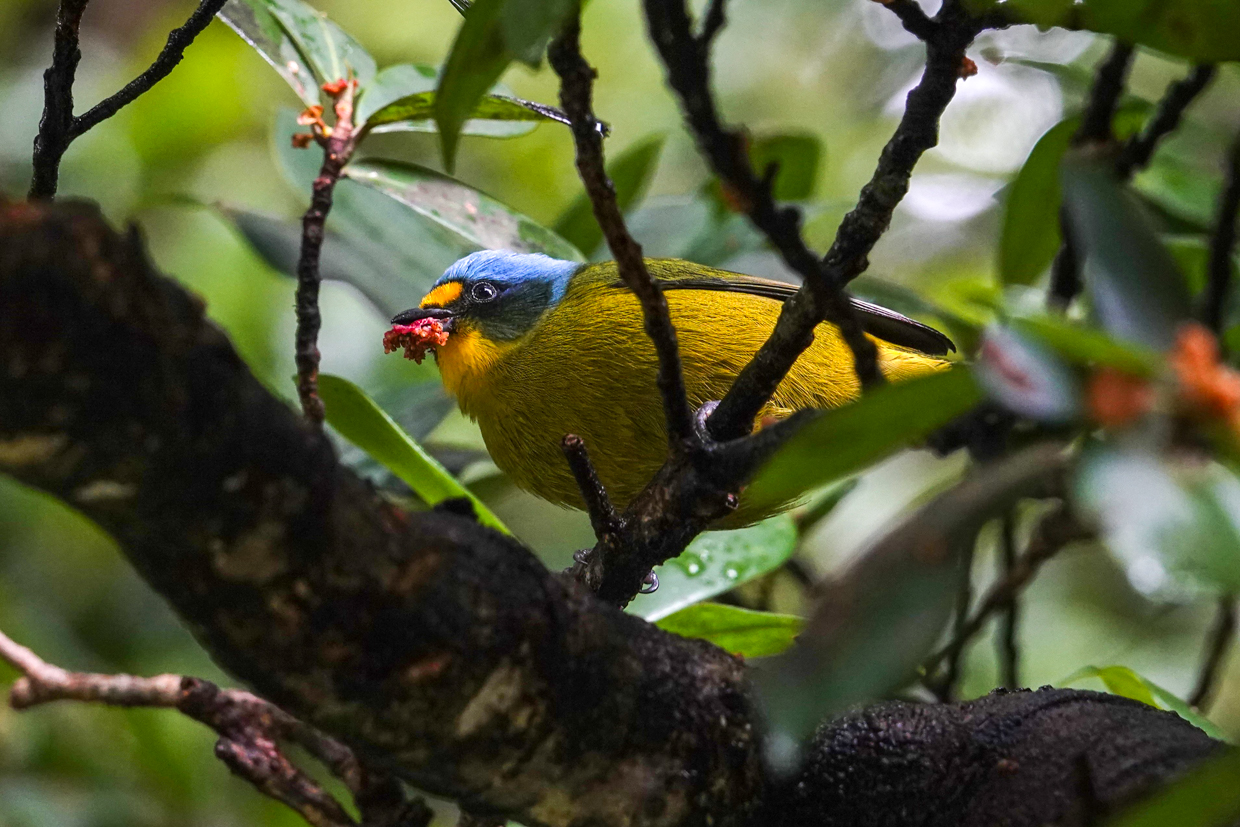
Lesser Antillean Euphonia © Paul Prior
After lunch, Judy drove us to the Lower Colihaut where we walked a gravel road for our remaining endemic targets. The first of these – Plumbeous Warbler – showed very quickly and repeatedly.

Plumbeous Warbler © Paul Prior
But our third and last wren – the Kalinago Wren – proved much more tricky with only a couple of people getting half-looks at a bird that just wasn’t interested in our broadcasts. A little further along the road we flushed a Red-legged Thrush a species which, given how approachable they can be elsewhere in their Caribbean range, proved quite flighty and easily spooked. Fortunately, this individual circled back around us and started feeding out on the open road affording us excellent views. The Dominica version of the Lesser Antillean Pewee rounded the visit off and we drove back to our hotel.
Day 8
Our last birding day and since we had pretty much exhausted the new bird possibilities It was decided that we would drive back up towards Syndicate in search of better looks at the Euphonia, the Wren, and the Blue-headed Hummer (for those who had missed out on the previous day). I think Birdy was hoping the group might have the energy to try for more looks at his parrot, but to be honest, everyone had been very happy with their previous views.
So, we concentrated first on Kalinago Wren, which gave excellent looks, and then returned to the Blue-headed hummer‘s favourite perch, where he obliged with unbeatable views.

Blue-headed Hummingbird © Paul Prior
And then back to the roadside ficus tree, still alive with birds, including even better looks at the Kalinago Wren, and a splendid Lesser Antillean Euphonia.

Kalinago Wren © Paul Prior
We could now change tack completely; Birdy rerouted us down to the town of Portsmouth, where one of the church barns held a day roosting American Barn Owl, subsp. nigrescens (the speciation of these Tyto owls in the Lesser Antilles is still up for debate). The visit required a small contribution paid to the director for all the trouble he goes to, cleaning up all the poop, pellets, and prey remains.

American Barn Owl © Paul Prior
From here we headed to the far side of town and had a picnic lunch watched by hungry goats. A post-picnic perambulation along the adjacent trail took us alongside a mangrove edged creek where we were treated to our first ducks and non-spotty shorebirds: Blue-winged Teal, Wilson’s Snipe, and Greater Yellowlegs. It was also here that we encountered our only lingering neotropical migrants in the form of Northern Waterthrush and a lovely adult male American Redstart. We were nearing the end of our birding adventure, but Birdy had one more goodie to share with us – this one was not even an island bird. At the south end of Portsmouth, we pulled in close to the beach and there on a wrecked barge was a collection of Royal Terns with just one lost-looking Black-headed Gull, a second-year bird, and quite a rarity in this part of the world.

Black-headed Gull © Paul Prior
Back at our hotel, having said our farewells to Birdy we headed out for a rather tardy attempt to find photographable Black-whiskered Vireos, and while doing this, we happened upon a rather skittish pair of Spectacled Thrushes.

Black-whiskered Vireo © Paul Prior
Day 9
Thank goodness this was to be a travel day with neither need nor expectation to do any birding – the dry season continued to hammer us with even more rain! The drive from the hotel back over to the airport took us past cascading torrents of muddy waters, but our driver Judy remained completely unfazed by the lashing rain, assuring us that once we would start our descent to the far end of the island the rain would abate, and of course he was quite right.
Despite being dogged by all this unseasonable weather – the wind on St. Vincent, the rain on St. Lucia, and both wind and rain on Dominica – we had caught up with almost all of the island endemics. Our star photographers had amassed an enormous collection of wonderful images to sort through. Many thanks to our three island guides each of whom worked so hard – relentlessly even – to ensure that everybody got the best of views of every species. And many thanks also to the wonderful participants who shared not just their love and enthusiasm for birds and the natural world, but all manner of tales from their ongoing travels. I’d like to think that parts of our eight days in these gorgeous islands will feature in future storytelling as they continue to bird all corners of the globe.

Our group