Tropical Australia Trip Report (Oct 25 – Nov 2, 2025)
Day 1
We met at the Palms City Resort in Darwin to start the trip, heading to the Darwin Sailing Club for a hearty and delicious dinner where Red-collared Lorikeets screeched overhead and Little Terns fished offshore.
Day 2
After an early breakfast, we made our way to Buffalo Creek in northeast Darwin. We started in the coastal forest, where almost immediately we heard the distinctive double whistling call of the Rainbow Pitta from near the path. Sadly, despite our best efforts, we could not locate the bird in foliage that had become significantly denser after recent rains. Thankfully, there was a great supporting cast of songbirds in the trees, including White-gaped, Red-headed and Rufous-banded Honeyeaters, Varied Trillers, Australasian Figbirds and Green Orioles. Overhead, a Brahminy Kite joined multiple Black Kites. We headed towards the boat ramp, where we found a number of waders on the estuary shore, including Far Eastern Curlews, Great Knot, Greenshank, Red-capped Plover, Pied Oystercatcher and Common Sandpiper. It was exciting to see a Striated Heron emerge from the dense mangroves and an Australasian Darter perched above the water. The mangroves were alive with songbirds, mostly Australian Yellow White-eyes, while a Northern Fantail put on a great show and a Broad-billed Flycatcher flitted about the carpark. Two Gull-billed Terns flying low over the beach were a great bonus.

Brahminy Kite © Hugh Scarth
We decided to move on to nearby Lee Point. We quickly found more waders on the beach, this time including a Grey Plover, Greater Sandplover, Sanderlings, Ruddy Turnstones and Grey-tailed Tattlers. Both Australian and Gull-billed Terns flew over the beach, allowing for great comparison of these two recently split species. As the heat began to increase, we took a rest in the adjacent parkland and had a moment of epic excitement as a darting silhouette passing through the trees revealed itself to be an Oriental Cuckoo. A Blue-winged Kookaburra raucously chuckled, while countless Red-collared Lorikeets joined Torresian Imperial Pigeons and White-bellied Cuckooshrikes overhead. We decided to watch a small puddle adjacent to the carpark and had a great treat as honeyeaters began to come down to drink, including our first Dusky Myzomela of the trip and a beautiful pair of Double-barred Finches. As we made our way back to the cars, an Australian Hobby zoomed low over head and landed delightfully close in a nearby tree.
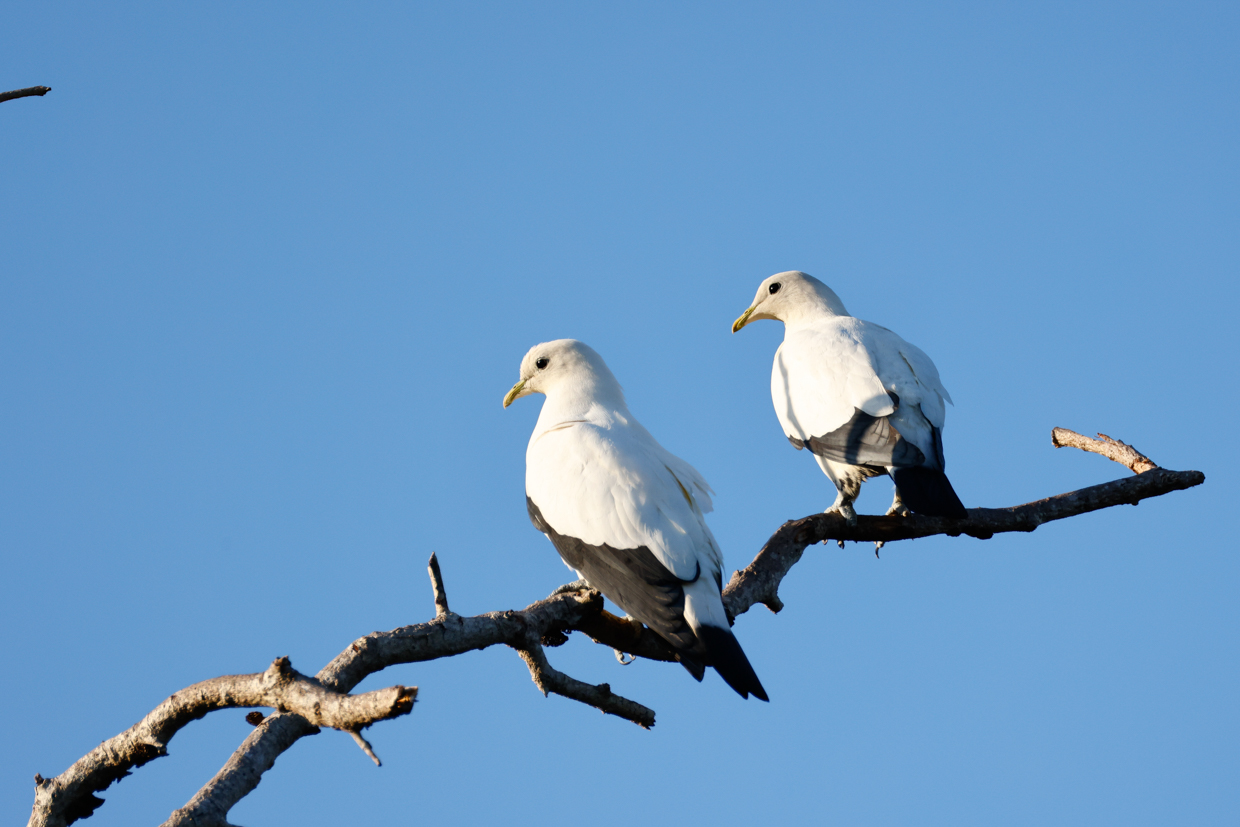
Torresian Imperial Pigeon © Hugh Scarth
With the afternoon becoming very warm, we made our way to the George Brown Darwin Botanic Gardens for a delicious lunch. Guests enjoyed great views of Orange-footed Megapodes and Helmeted Friarbirds as we ate. Making our way further into the gardens, it was a great surprise to come across four striking Radjah Shelducks while White-breasted Woodswallows flew overhead, with resplendent Northern Water Dragons showing well around the ponds. We soon found our main target with stunning views of two roosting Rufous Owls, providing outstanding photographic opportunities. Heading back to the car, we had one more treat – a stunning Pacific Baza perched high in the canopy above us.
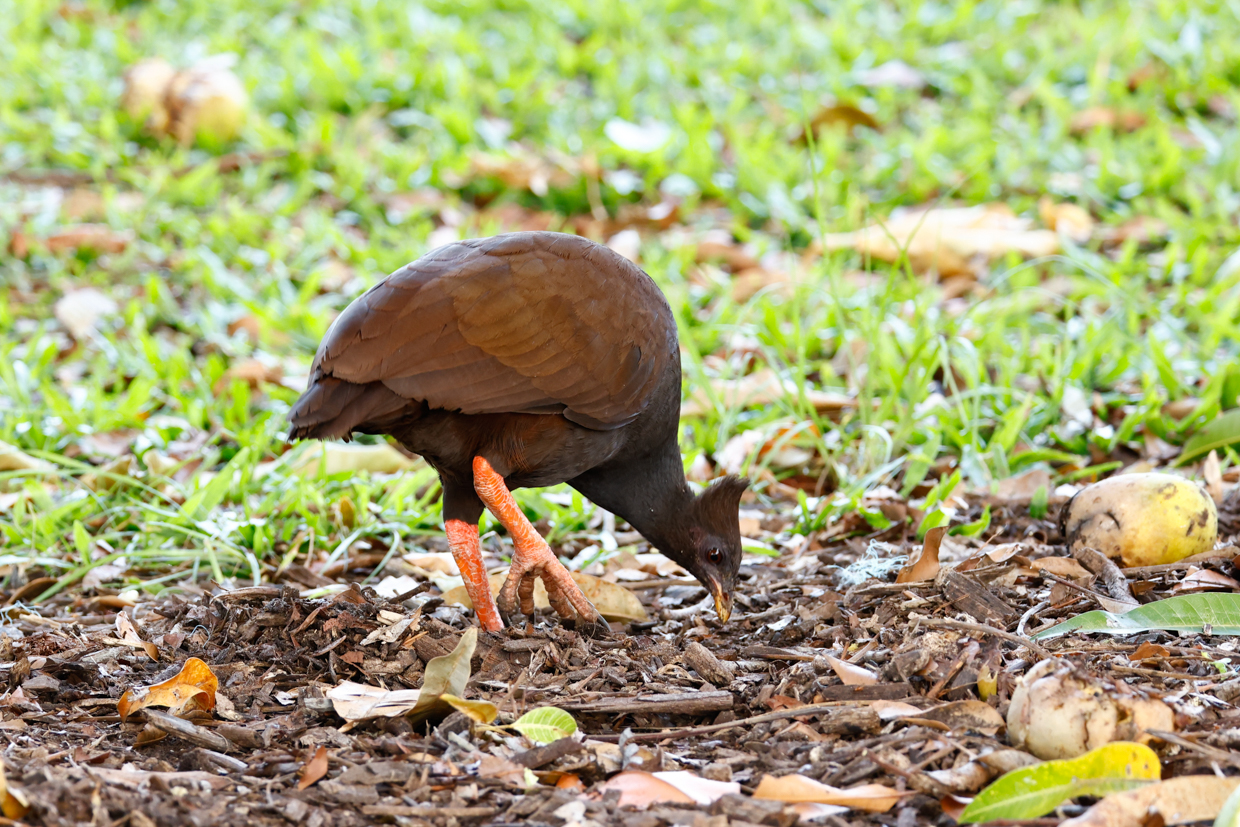
Orange-footed Megapode © Hugh Scarth
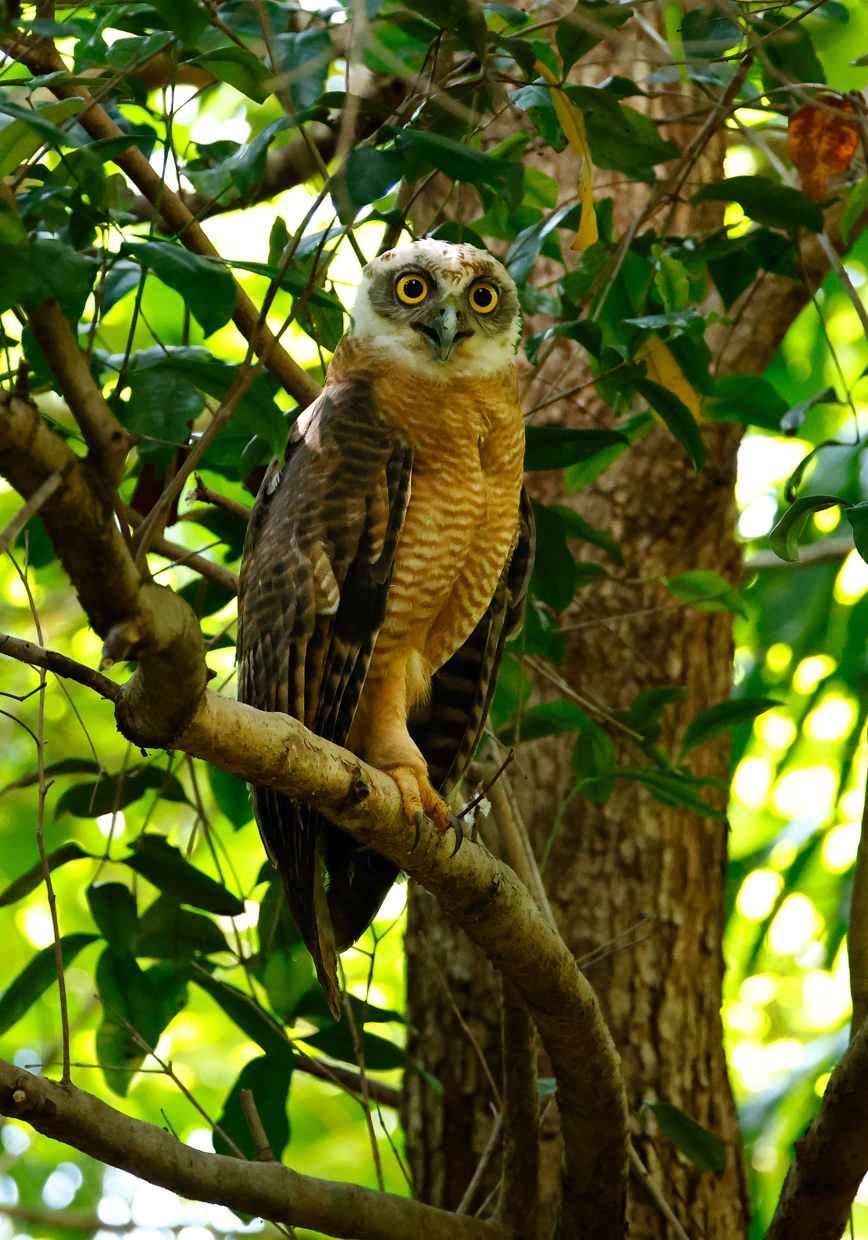
Rufous Owl © Hugh Scarth
After a break from the heat in our hotel rooms, we spent the early evening at East Point on the Mangrove Boardwalk. Guest enjoyed their first of many Magpie Geese and Agile Wallabies by the carpark, where a beautiful pair of Rose-crowned Fruit-Doves showed wonderfully. In the mangroves, a noisy pair of Torresian Kingfishers duetted alongside numerous Honeyeaters and Spangled Drongos. A Black Butcherbird showing well from the path was great surprise, while a group of Red-tailed Black Cockatoos drifted languidly overhead to mark the end of a great day of birding.

Rose-crowned Fruit-Dove © Hugh Scarth
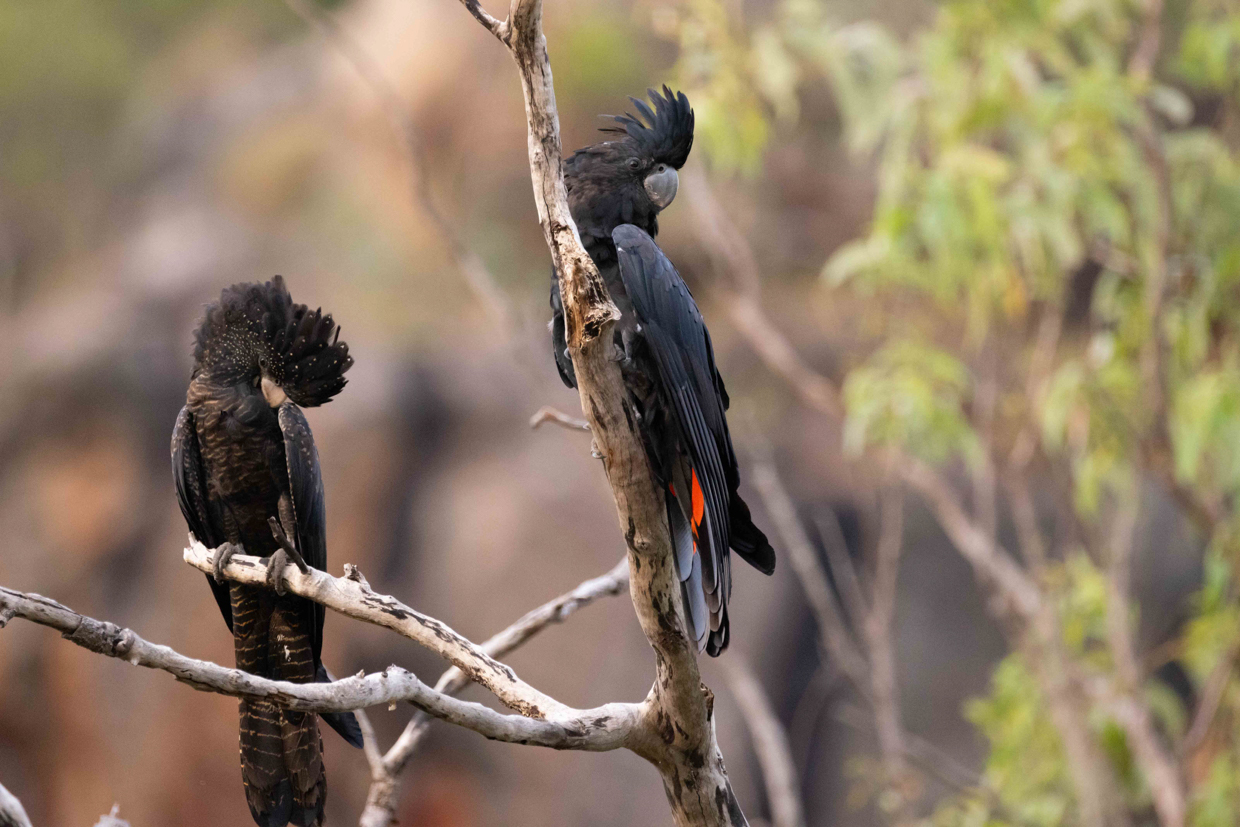
Red-tailed Black-Cockatoo © Hugh Scarth
After dinner, several guests joined for spotlighting around the Botanic Gardens. We enjoyed seeing a large number of Northern Brushtail Possums and Black Flying-Foxes, and we were in a fantastic treat when a small rodent just next to the path revealed itself to be a Grassland Melomys.
Day 3
We started the day with an early trip back to Buffalo Point in search of waders roosting at high tide. We decided to briefly try for the Rainbow Pitta, but were instead rewarded with wonderful views of a Pacific Emerald Dove just ahead of us on the path. Wader numbers on the beach were exceptional, and it was great to pick out some new species for the tour in the form of Siberian Sandplover, Black-tailed Godwit, Terek Sandpiper and Sharp-tailed Sandpiper. We had a moment of great excitement when a Beach Stone-Curlew flew right past us. Terns were abundant, particularly White-winged, sadly now in their non-breeding plumage, along with Little, Gull-billed, Caspian, Common and Great Crested. An Australian Pelican joined the shorebirds on the beach. It was sadly soon time to head back to the hotel for breakfast and to check out.
We then headed back to East Point, this time to the Monsoon Forest. We again heard the distinctive call of a Rainbow Pitta and all guests soon enjoyed superb views of this strikingly colourful species scraping away at the leaf litter on the forest floor. Absolutely delighted by such fantastic views of this wonderful bird, we made the journey east from Darwin to Fogg Dam.
Though recent rainfall has dispersed some of the waterbirds from the dam, it remained a wonderful spectacle of colour with Glossy Ibises, Plumed Egrets, Comb-crested Jacanas, Green Pygmy Geese and Radjah Shelducks wandering between the muddy shores and beautiful abundant flowering lilies that covered much of the dam – from one of which a Golden-headed Cisticola buzzed loudly. A neighbouring tree was home to a Paperbark Flycatcher nest, with a small chick inside. In a muddy field adjacent to the dam with seven elegant Brolgas, while a small patch of nearby woodland revealed two beautiful Rose-crowned Fruit Doves, Lemon-bellied Flyrobin, Grey Whistlers and Mistletoebird.
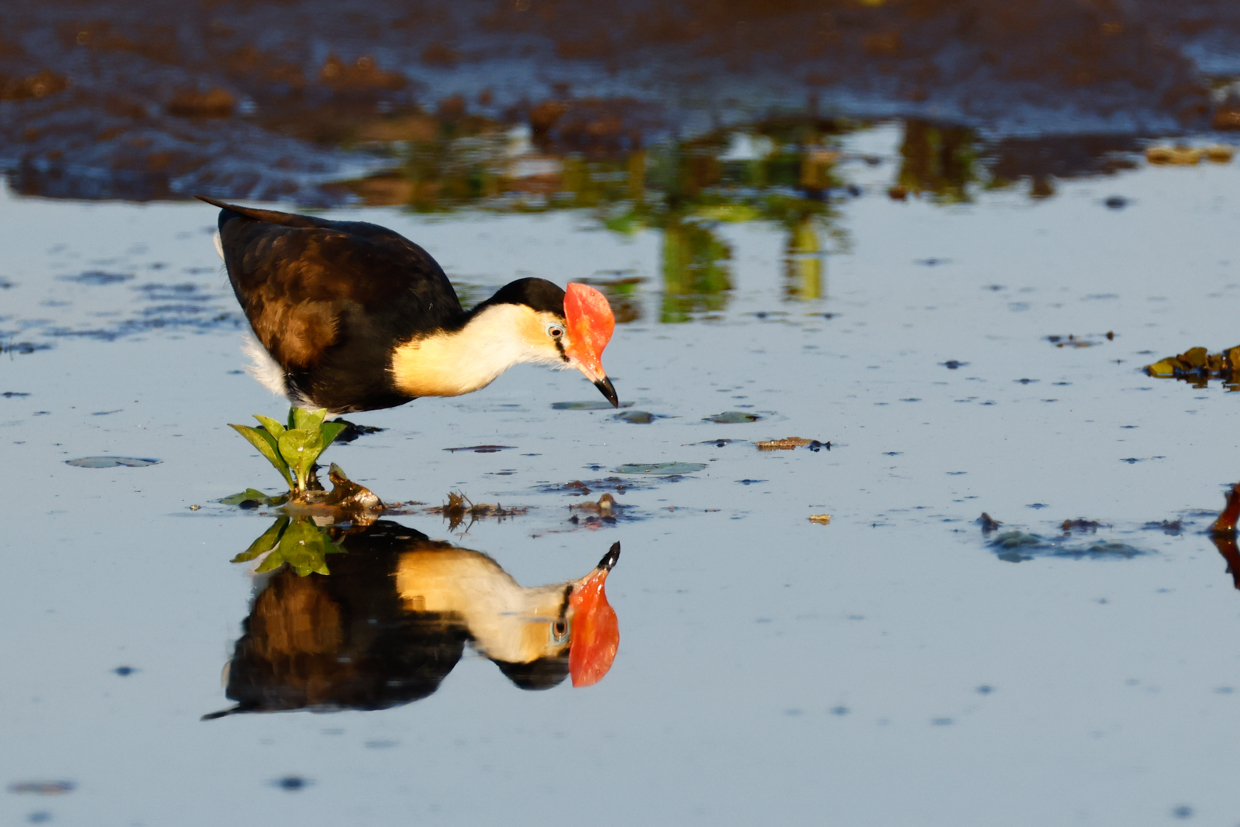
Comb-crested Jacana © Hugh Scarth
We had lunch at Bark Hut Inn, where guests had a wonderful treat in the form of three Partridge Pigeon, a threatened Northern Australian endemic, strolling past our parked car, revealing their striking bare-skinned red face. Nearby was a group of equally stunning Crimson Finches.
We continued our journey, reaching Anbinik Kakadu Resort in the mid-afternoon. A guest soon spotted a roosting Barking Owl in the tree next to their room. Barking Owls were to become a constant feature of our stay at Anbinik, spending their days resting in the large trees surrounding our rooms and appearing every morning in the trees by our cars, watching us as we packed up in the early hours of each day.
Before dinner, we enjoyed a short exploration of Jabiru Town Lake. It was a Cuckoo extravaganza, with the deep whistling of a Pacific Koel and forebodingly mournful ringing of a Sahul Brush Cuckoo interrupted by a raucous shrieking beast of a bird flying low overhead – a magnificent Channel-billed Cuckoo, which landed in a nearby tree and gave excellent views. We soon had great views of the male Koel and of the Sahul Brush Cuckoo, while Green Pygmy Geese, Wandering Whistling Ducks, Australasian Grebes, Australasian Darters and Little Black Cormorants entertained guests on the lake. We soon headed to Mercure Kakadu Crocodile Hotel for an excellent dinner, with some guests opting for the delicious Kangaroo steak and others the Crocodile spring rolls. The trees outside the restaurant were alive with abundant roosting Little Corellas.
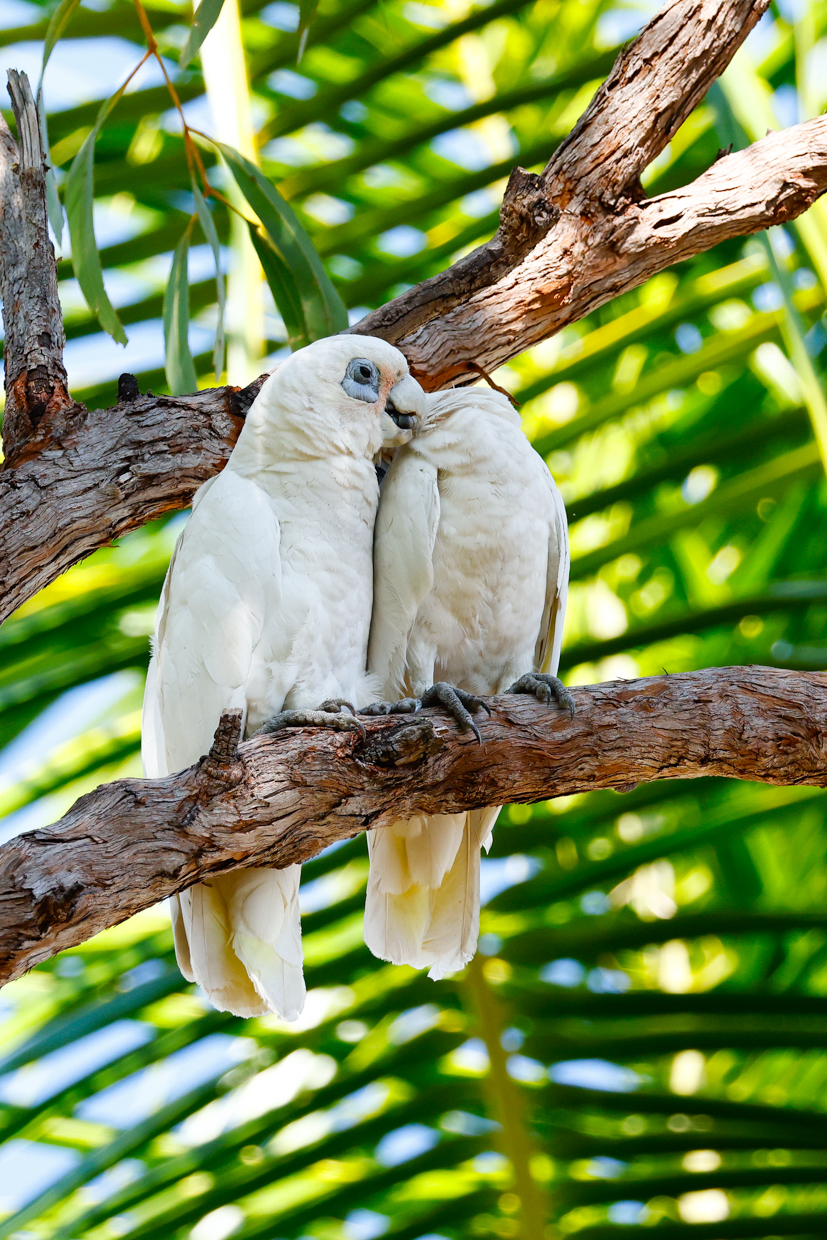
Corella © Hugh Scarth
While some opted for an early night after a long day, others ventured back out for an evening of spotlighting. After great views of a Giant Burrowing Frog, we had a moment of incredible excitement as Kye spotted the distinctive shape of a Buttonquail on the road. After pulling the car over and getting closer, we had an unforgettable experience of close-up views of a tiny Red-backed Buttonquail, a tiny terrestrial ancient species of wader. It was truly one of the highlights of the trip, but the evening only got better as we came across numerous Eastern Short-eared Rock Wallabies in a nearby rocky area – and even better as two powerfully reflective sets of eyes on a rocky escarpment transformed into exceptional views of a pair of Rock-haunting Ringtail Possums. It was incredible end to what had been a truly wonderful day of wildlife.
Day 4
We were up early to make our way to Cooinda Lodge, where we met our brilliant skipper Dennis for a boat trip on Yellow Water. Almost immediately, we came upon a large Estuarine Crocodile, with the species becoming a familiar sight as we made our way up and down the river. Waterfowl were abundant, particularly Magpie Geese and both Wandering and beautiful Plumed Whistling Ducks, while a Pacific Black Duck was a surprise. Dennis entertained us all with hilarious stories from his life, while Australasian Swamphens, Nankeen Night Herons, Pied and Pacific Herons, stunningly elegant Black-necked Storks, Royal Spoonbills, three species of Ibis and beautiful Black-fronted Dotterels patrolled the muddy shorelines.
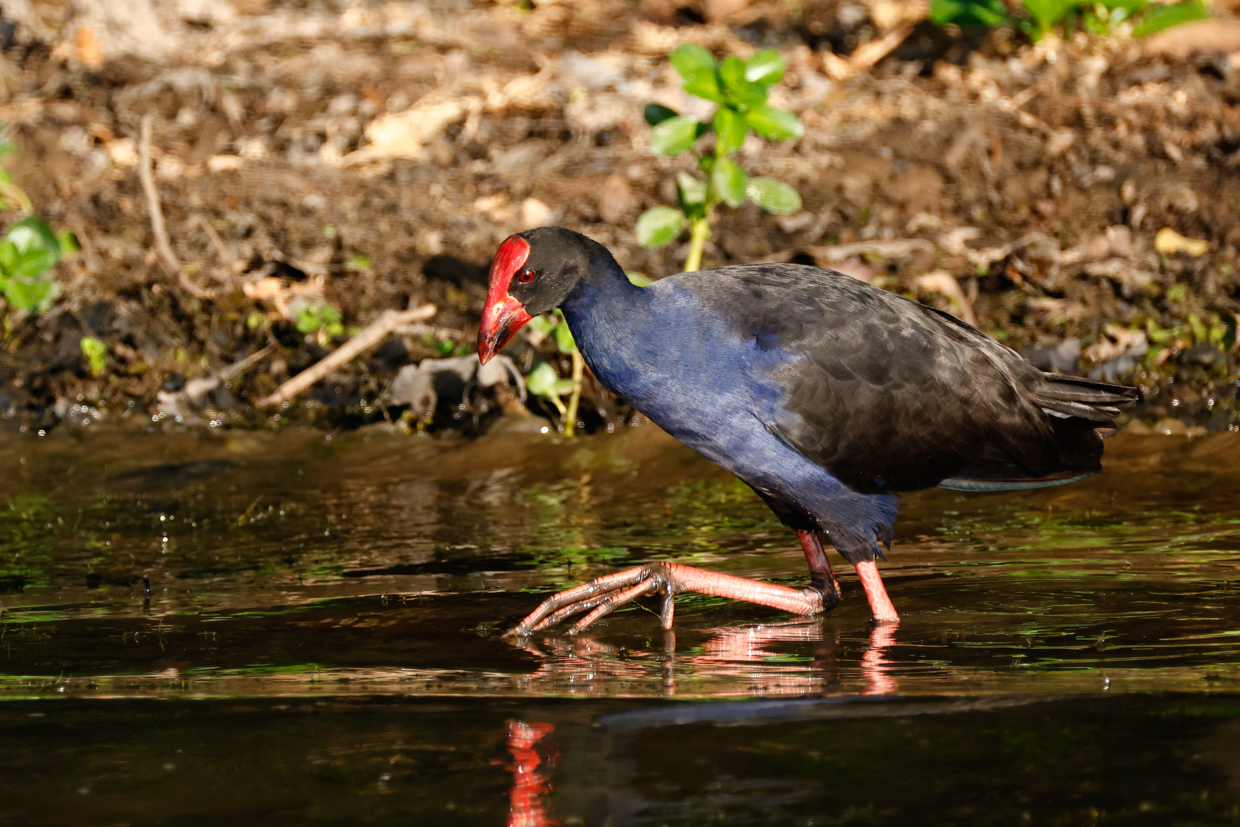
Australasian Swamphen © Hugh Scarth
We had wonderful views of abundant Comb-crested Jacanas showing why they earned their alternative name, the Lillytrotter, as they actively made their way across the lillypads. Feral Horses, Feral Pigs and Dingos showed well in the neighbouring muddy fields and Whiskered Terns hunted low over the river. We had wonderful views of a pair of White-bellied Sea Eagles perched side-by-side in a dead tree next to the river, along with bright flashes of blue and orange in the form of Azure Kingfishers taking a brief break from fishing to perch low in the vegetation just next to the boat. Northern and Arafura Fantails fluttered in the riverside vegetation alongside numerous Flycatchers – Broad-billed, Paperbark, Lemon-bellied and striking Shining.
Sadly, with the day heating up, it was time for the cruise to end. After a hearty breakfast at Cooinda Lodge, we made our way to Warradjan Aboriginal Cultural Centre. Here, guests enjoyed a fascinating exhibit on Aboriginal culture within the Kakadu region and an excellent gift shop. Some brilliant birds around the centre were a nice bonus. Beautiful and noisy Bar-breasted Honeyeaters were the highlight, while White-throated Honeyeater and Sacred Kingfisher were nice new birds for the trip and a Brown Goshawk flew high overhead.
After lunch in Jabiru, we rested in our hotel rooms through the heat of the mid-afternoon. With inclement weather setting in, we made the short journey to Bowali Visitors Centre in the late afternoon, enjoying incredible views of a Partridge Pigeon just ahead of us on the path and a brief sighting of a group of Rufous-throated Honeyeaters in the carpark. Sadly, thunder and heavy showers were rapidly approaching and we had to beat a hasty retreat to the cars and back towards the hotel.
With clearer skies in the early evening, we decided to do some more local birding. After enjoying great views of Dollarbirds and various Honeyeaters in the hotel grounds, we made our way towards Jabiru Wastewater Treatment Plant. We made a sudden stop as a group of Dingo appeared, patrolling bushland on the outskirts of town. This was a fortuitous stop, as we soon spotted a Grey-crowned Babbler, followed by a small group of Finches including both Long-tailed and Masked. A rich mixed flock of small birds made their way through the bushland, as we delighted in picking out Weebill, Striated Pardalote and Red-backed Fairywren, while a Brown Falcon zoomed overhead. The treatment plant itself was comparatively quiet, though guests enjoyed great close-up views of numerous Pied Herons, along with a Common Sandpiper and Australasian Grebe around the ponds.
We enjoyed another dinner at Mercure Kakadu Crocodile Hotel, before another lovely evening of spotlighting during which guests enjoyed fantastic views of Little Red Flying-Foxes and a wonderful moment as Kye somehow spotted a Tawny Frogmouth in roadside vegetation from the passenger seat.
Day 5
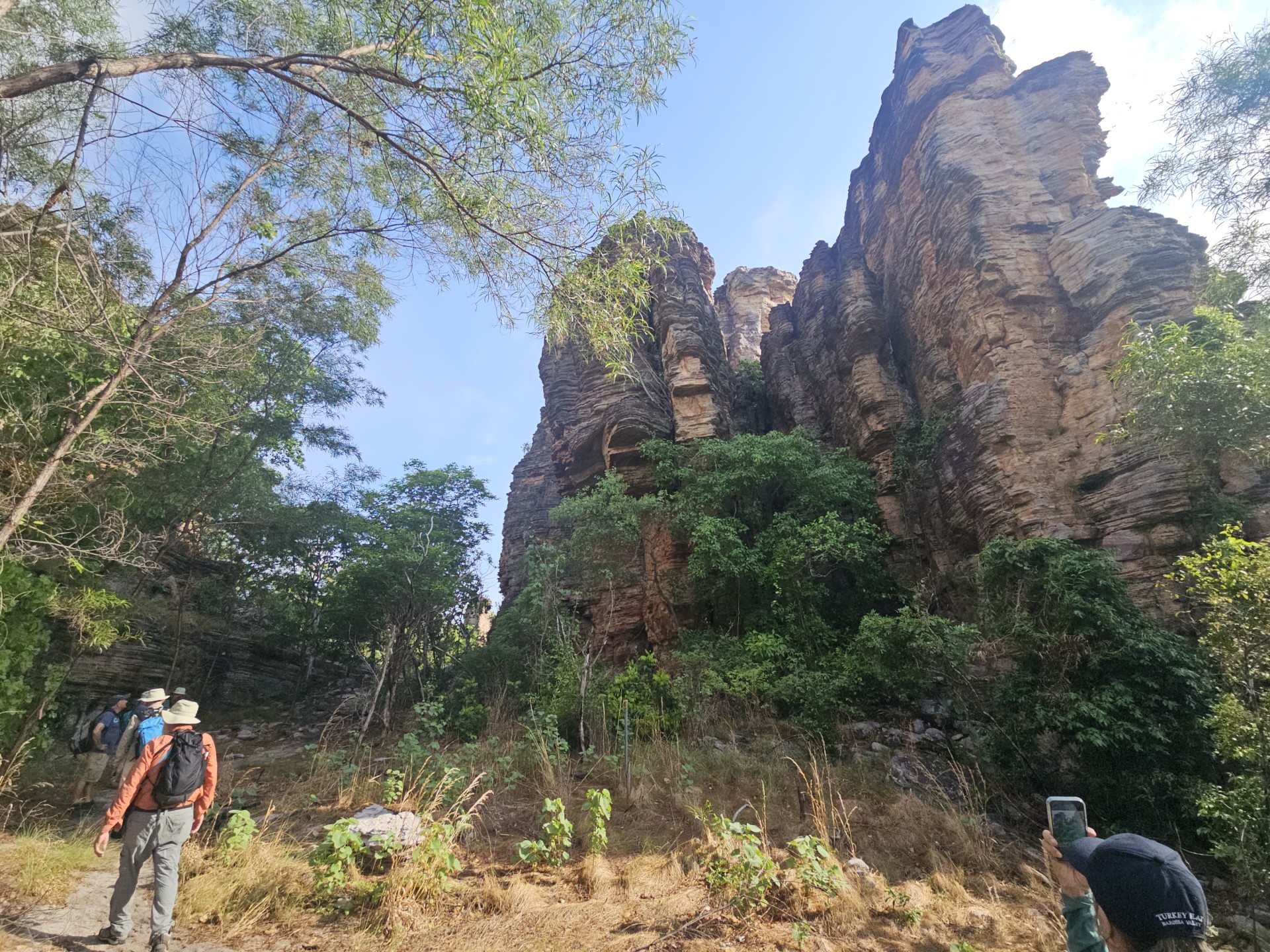
We made our way to the magnificent Bardedjilidji for first light. A short way down the path, we could scarcely believe our luck as a Sandstone Shrikethrush appeared right next to us. The bird appeared fascinated by our presence, coming closer and closer to the point of being just a few metres away. With one of our two key targets found, we focused our efforts on the other. After the enjoying the stunning landscape while the sun rose, we finally found a Chestnut-quilled Rock Pigeon showing well atop a striking sandstone outcrop. A Great Bowerbird made several appearances overhead, alongside with a good number of Red-tailed Black Cockatoos drifting by. Delighted with the success in finding these two northern sandstone escarpment endemics, we enjoyed a great diversity of birds near the car, with beautiful large Pheasant Coucals showing especially well alongside various Honeyeaters, a lovely male Rufous Whistler, Forest Kingfishers, Mistletoebirds, Northern Fantails and a Leaden Flycatcher.
© Kye Turnbull
Our next stop was Ubirr, where we had a wonderful experience of the incredible Aboriginal rock art – notably including a Thylacine, believed to have been painted before their extinction on mainland Australia 4000 years ago, shortly after the arrival of Dingos on the continent. In a poignant moment, we watched an Eastern Short-eared Rock Wallaby clamber past the rocks bearing ancient paintings of the species – a near-endemic to the National Park, alongside another wonderfully showy Sandstone Shrikethrush. A Spotted Harrier joined a Brown Goshawk overhead to provide another wonderful bonus in this stunning location.
We then popped into Cahills Crossing for fantastic close-up views of Estuarine Crocodiles, along with Nankeen Night Heron, Little Egret and Common Sandpiper braving the water’s edge with an array of Mudskippers against the backdrop of a Rainbow Pitta calling loudly. Two bright Red-winged Parrots flew past to provide another addition to the tour total before we returned to Jabiru for lunch – with some guests enjoying great views of a roadside Wedge-tailed Eagle on the journey.
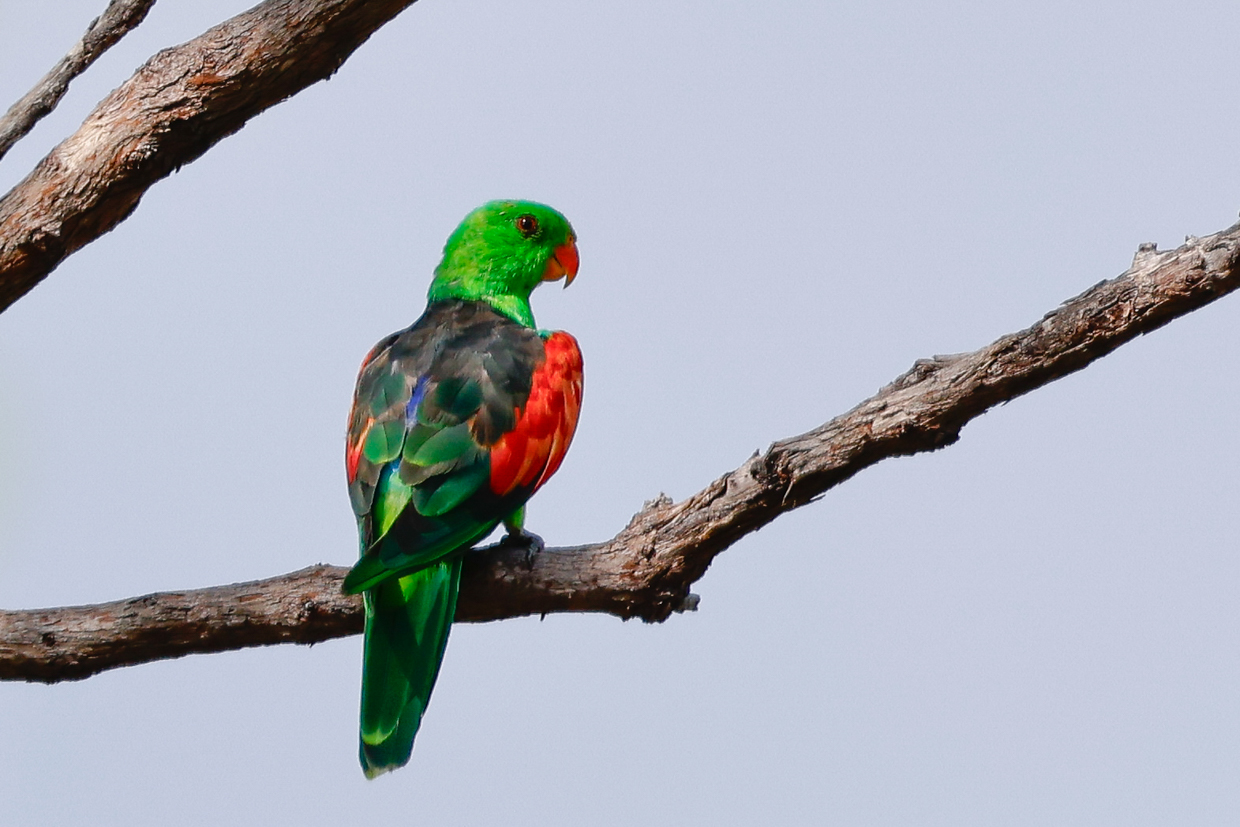
Red-winged Parrot © Hugh Scarth
After lunch, we returned to Bowali Visitors Centre for improved views of Rufous-throated Honeyeaters among a great array of other Honeyeater species. Sadly, inclement weather again set in and we had to return to the hotel. With skies surprisingly clearing in the early evening, we decided to venture to the stunning Nourlangie Rock. Alongside enjoying more extraordinary Aboriginal rock art, we also came upon several Sahul Cicadabirds, Helmeted Friarbirds of the unique Arnhemland race, Silver-crowned Friarbird, Olive-backed Oriole, Great Bowerbird and Horsfield’s Bronze Cuckoo. Guests had a fantastic view of another perched Channel-billed Cuckoo, and a vast Water Buffalo, thankfully seen from the car as we made our way back towards Mercure Kakadu Crocodile Hotel for dinner.
Day 6
We returned to Nourlangie Rock for a more extensive exploration – with two key targets in mind, alongside further enjoyment of the Aboriginal rock art. Climbing up a rocky outcrop, Kye spotted a white dot distantly on the escarpment. Getting our scopes onto it, we were over-the-moon to see that it was a Black-banded Fruit Dove, an astonishingly beautiful large black-and-white dove endemic to the western edge of Arnhemland, and a major target for the tour. After climbing down from the outcrop, a group of Honeyeaters appeared, moving quickly through the trees. Brief moments of excitement quickly became minor disappointment as most turned out to be Dusky Myzomelas – before one bird landed close, revealing a subtle green to its wing and a distinct and striking white gape and arc extending past its eye. It was a White-lined Honeyeater, another near-endemic to Kakadu and our final key target for the region. It had been a truly wonderful start to the day in a powerful and moving location. Further down the road, we made a stop for another special Northern Australia endemic. The striking ashy darkness of a Black-tailed Treecreeper appeared a short distance from us, contrasting strongly with the light grey dead tree in which it appeared to be nesting.
We then headed to the wonderful Anbangbang Billabong, which was covered in abundant waterfowl. Magpie Geese, Plumed and Wandering Whistling Ducks, Radjah Shelduck and Green Pygmy Geese waded through the shallows alongside three species of Ibis, Royal Spoonbills, Pied and Pacific Herons and plentiful Egrets. We could quite happily have spent the day delighting in the incredible spectacle of hundreds of birds against the striking backdrop of the Arnhemland Escarpment, but we sadly had to continue our journey on towards Pine Creek. We made one final stop before lunch at Cooinda Lodge. In remote bushland near Nourlangie, we found a large number of extraordinary Leichardt’s Grasshoppers/Alyurr. An astonishingly colourful, deep orange and blue large grasshopper, it was not seen by scientists for over a hundred years shortly after being recorded in Arnhemland by the German explorer Ludwig Leichardt. The species is of great cultural importance to the Bininj/Mungguy people of Kakadu, to whom alyurr are the grandchildren of Namarrkon, the lightning man – appearing just before the monsoon season begins. Reflecting on their cultural significance in this magnificent landscape was one of the most moving moments of the trip.
On the way to Pine Creek, we came across a beautiful family group of Feral Horses and a Brolga nearby.
Before we had even checked in, we came upon a group of another Northern endemic – magnificent Hooded Parrots, feeding on the lawn in front of our hotel, the Lazy Lizard, with the males displaying their striking yellow shoulder patch contrasting against their light green and grey bodies. Within the hotel grounds was an immaculate Great Bowerbird bower, the bird showing well to all guests at some point during the stay, while beautiful Red-winged Parrots and raucous Black Flying-Foxes added to the fantastic array of nature near the rooms.
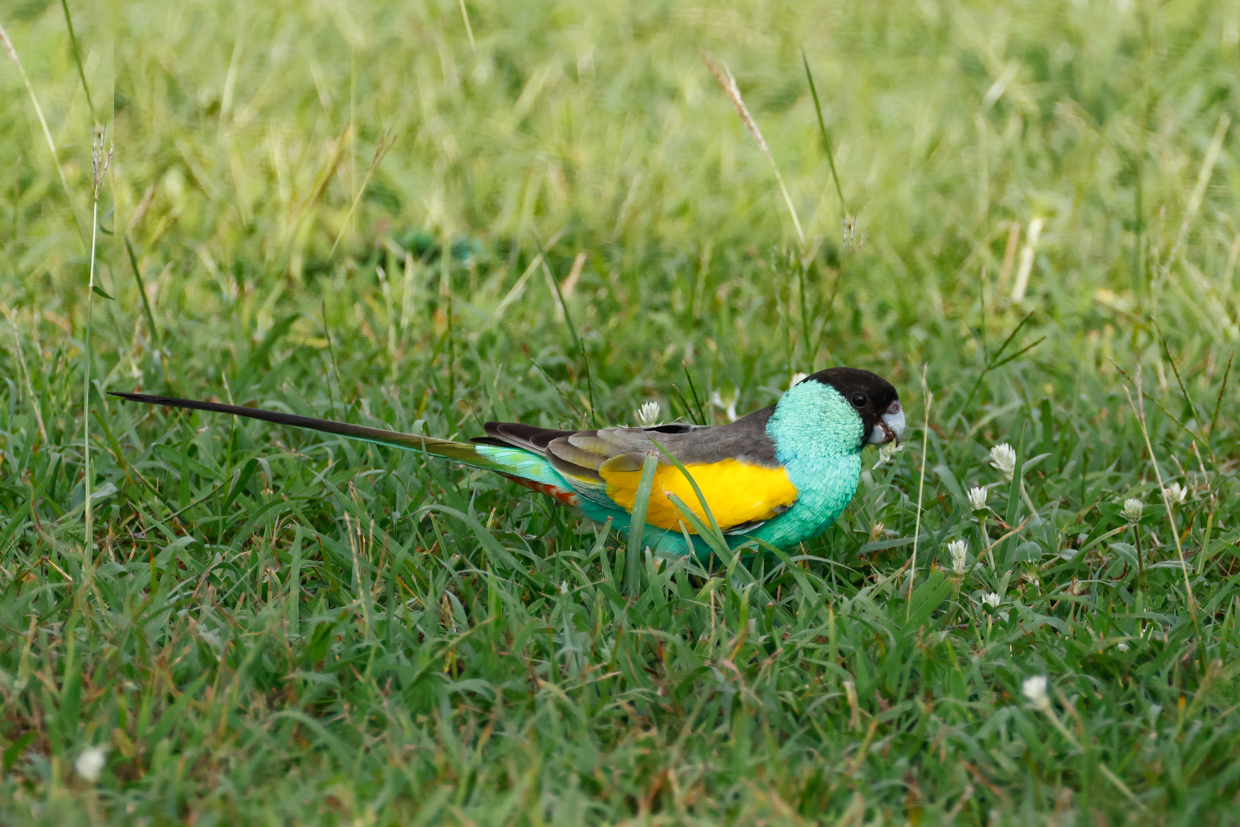
Hoooded Parrot © Hugh Scarth
Sadly a thunderstorm suddenly struck and we had to escape to our rooms until a nice dinner in town.
Day 7
We were up very early, making our way to a beautiful stream running by Edith Falls Road. We had one clear target in mind here – the Gouldian Finch. Despite waiting from sunrise for a significant time, the birds never appeared, likely a result of recent rainfall reducing their dependence on the stream for water. Regardless, we had another magnificent morning, delighting in the beauty and tranquility of the stunning savannah landscape. Honeyeaters were abundant, including wonderful Banded Honeyeaters appearing by the dozen, as were Finches – Double-barred, Masked and Crimson. Two Brolgas passing low overhead were a wonderful treat, while a passing White-faced Heron was new for the trip. Possibly the highlight of the morning for many of the guests was a resplendent Azure Kingfisher fishing just in front of us – catching and devouring a small Sooty Grunter just metres from the group.
Some of us fantasised about spending the day in this beautiful location, sitting in a deckchair and delighting in the abundant colour and noise of the numerous birds coming to drink or feed by the river. But we had more birds to find, and made our way south to Katherine for a delicious breakfast at the Black Russian Caravan Bar. This proved an excellent birding location, with a large number of Pacific Swifts zooming overhead, alongside our first Fairy Martins of the trip. Yellow-tinted Honeyeaters and a Yellow-throated Miner appeared alongside countless Honeyeaters, while Apostlebirds bounded purposefully through the carpark.
We continued south to Gorrie River, deep into the savannah. A Common Bronzewing flushed up from the road, while Brown Goshawk, Brown Falcon and Wedge-tailed Eagle were seen overhead. We parked near an area of Salmon Gums and headed into the bush. White-winged Trillers shot between the trees around plentiful Honeyeaters – including striking Golden-backed, the northern race of Black-chinned Honeyeater. Jacky-winters called from all around, hawking for insects from low perches. Both Masked and Long-tailed Finch were seen, along with brief views of Varied Sittellas moving quickly through the trees and a wonderful of more Black-tailed Treecreepers whose dark plumage starkly contrasted with the subtle pink of the Salmon Gums. Suddenly, our hearts were set racing as we heard a Northern Shrike Tit call from reasonably nearby. We started moving quickly towards the bird, when two small birds abruptly flew up from near our feet. We strongly suspected they were something very special – a potential lifer for both guides, but we wanted better views. We had an enviable decision to make – to keep searching for the incredibly rare Northern Shriketit that was still calling nearby (one of only two pairs that have been seen this year) or to find these special birds that were somewhere nearby in the grassland. We decided on the latter, soon unable to believe our luck as all the guests enjoyed incredible views of two Chestnut-backed Buttonquails creeping above the short grassland. It was a truly magical moment watching these bizarre and little-known ancient members of the wader family hurry about this wild savannah bushland. Sadly the Northern Shriketit went quiet, but we had had an incredible morning.
We returned to Katherine for a delicious Vietnamese bakery lunch, followed by a brief stop at Katherine Wastewater Treatment Plant, where we found our first Pied Stilts and Wood Sandpipers of the trip, alongside numerous Radjah Shelducks, Black-fronted Dotterels, Common Sandpiper and Whiskered Terns.
We made the journey back to Pine Creek, stopping by the Pine Creek Wastewater Treatment Plant which held a similar abundance of Radjah Shelducks, Pied Stilts and Black-fronted Dotterels, along with Australasian Grebes and numerous Egrets and Herons. We again had to stop birding early as a thunderstorm set in, before we dined in the tavern adjoining our hotel.
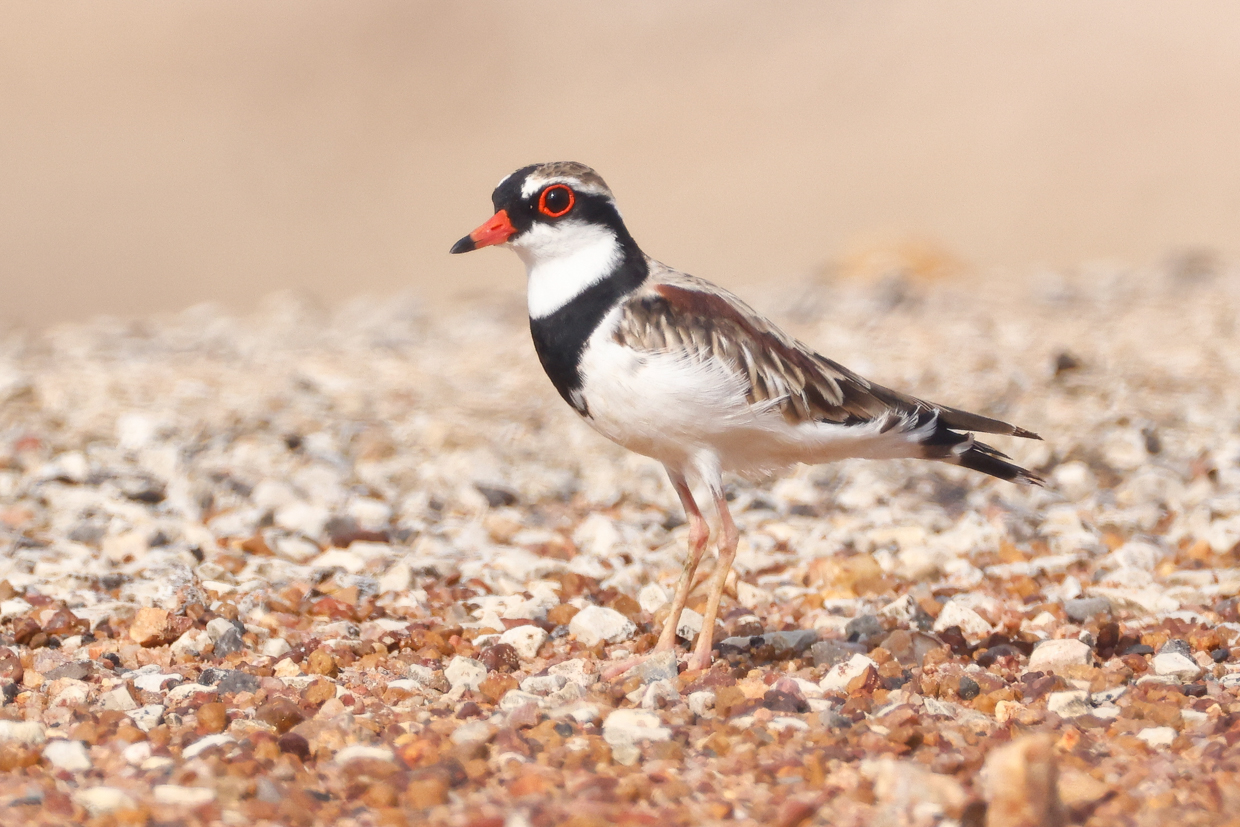
Black-fronted Dotterel © Hugh Scarth
Day 8
We started early again, heading back to Edith Falls Road, to search again for Gouldian Finches. On the way, we found a group of Cockatiel near the roadside, with guests enjoying good views of the world’s smallest Cockatoo species. A short distance down Edith Falls Road, Kye made yet another extraordinary spot, with a group of Finches flitting about by the roadside. Double-barred, Masked, Long-tailed and… Gouldian! We were treated to unbelievable views of up to 30 of this iconic, absurdly colourful and characterful Northern Australian endemic feeding alongside the other Finches on abundant seed in the area. It was a truly humbling moment to step back and appreciate our privilege in witnessing this endangered and beautiful bird in its stunning savannah habitat. Rather overshadowed by the Gouldians was another lovely new bird for the trip – numerous Black-faced Cuckooshrikes joining White-winged Trillers in feeding from the short trees surrounding the Finches. We visited another spot further down the road, where the highlight was coming upon a group of Brown Quail moving quickly through the dry grassland.
It was sadly soon time to head back north, stopping briefly at Pine Creek for breakfast and to check out of the hotel, continuing on to Lake Bennett. We had one key target here – and we quickly found it in a dense, lush roadside gully. A noisy Buff-sided Robin shaking its tail and calling loudly, another striking Northern Australian endemic.
We continued our journey towards Darwin, with our next stop being Marlow Lagoon on the southwest of town. We spent an idyllic half-hour there, enjoying our first Silver-backed Butcherbirds and Chestnut-breasted Mannikins of the trip, along with great views of Dollarbird, Forest Kingfisher, Yellow-throated Miner, Bar-breasted Honeyeater, Little Friarbird and Paperbark Flycatcher, flitting about the beautiful lilly-covered lagoon. We took lunch in nearby Palmerston, and ventured further into Darwin.
We reached the wonderful Knuckey Lagoon in the south of the city, birding from three separate spots around the reserve. Magpie Geese were present in incredible numbers, along with plentiful other waterfowl seen earlier in the trip. Three Brolga showed brilliantly, giving our best views of the species of the tour, while Pied Stilts, Sharp-tailed, Marsh and Wood Sandpipers and Common Greenshanks fed on the muddy shorelines. Herons were abundant, particularly Pied, with a particular highlight being a rare, striking rufous morph of the species. Alongside them were Glossy and Straw-necked Ibises, Pacific Herons, Royal Spoonbills and three species of Egret. A stop at Snipe Swamp within the reserve revealed a wonderful small mixed flock of shorebirds, including Pacific Golden Plovers, Red-necked Stints and fantastically, three Little Curlews – a key target for one our guests. An Australian Hobby put them up into flight, while some guests who had stayed by the car enjoyed great views of a Swamp Harrier.
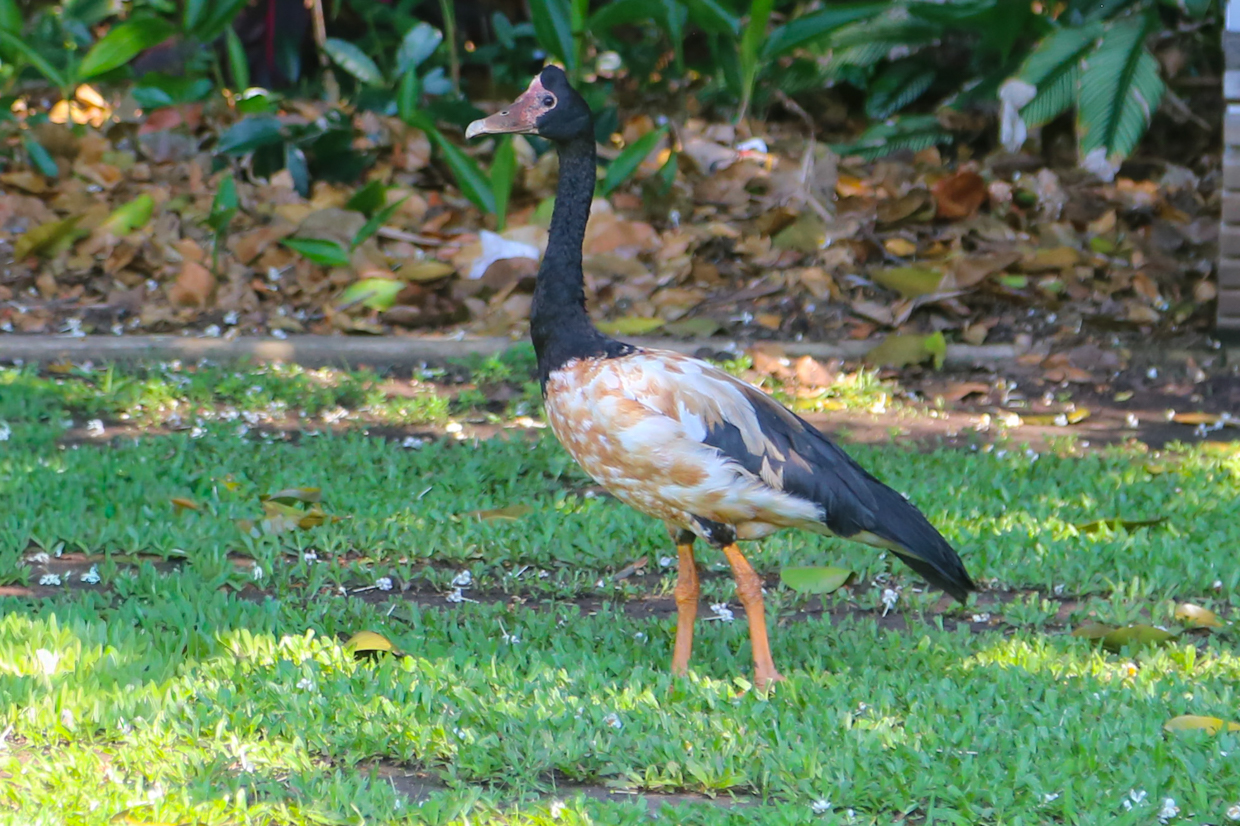
Magpie Goose © Hugh Scarth
We continued onto the Palms City Resort, where we had started the tour. Some made a rapid pre-dinner excursion to the glamorous location of Bunnings in Palmerston – home to a bird whose arrival in Australia has been a source of conjecture. Did the Eurasian Tree Sparrow arrive by its own accord from its expanding native range in Indonesia after a cyclone, or did they come by ship? Regardless, there now exists a small population around Darwin and it represented another addition to the tour total.
After a wonderful final dinner at the Sailing Club, some guests joined for another evening of spotlighting. Heading to Buffalo Creek, we started to hear numerous calling Large-tailed Nightjars. Kye spotted one briefly perched in roadside vegetation, before the guests enjoyed better views as one flew low over the road, while an Australian Owlet-Nightjar called from nearby. Gregor had a hunch that it would be worth looking out into the estuary from the boat ramp – and so it proved. First, two Nankeen Night Herons were found feeding in the shallows, before a larger bird was spotted in the distance. We could not believe our luck when raising our binoculars to see a Great-billed Heron casually feeding out in the open. To make the spectacle even better, next to the Heron was a Beach Stone Curlew, also providing excellent views as it fed along the sandbank. It was soon time to head to sleep, and what a day it had been.
Day 9
Guests departed at various times through the morning. Some took a boat trip at Buffalo Creek, where they enjoyed great sightings of Chestnut Rails, while others ventured to the airport where scanning eventually revealed an Oriental Plover. An intrepid venture through the mangroves near Orchard Street in Darwin proved amazingly fruitful. Alongside a great array of shorebirds (including another stunning Beach Stone Curlew), various beautiful whistling calls from the dense vegetation eventually revealed themselves in the form of the huge, rare White-breasted Whistler and stunningly bright plumage of the Mangrove Golden Whistler.
It marked the end of a truly wonderful trip around the northern part of the Northern Territory, with 193 species of bird recorded, along with 11 mammals, 7 reptiles, 18 butterflies including some wonderful northern endemics, 5 species of frog and 7 fish species.
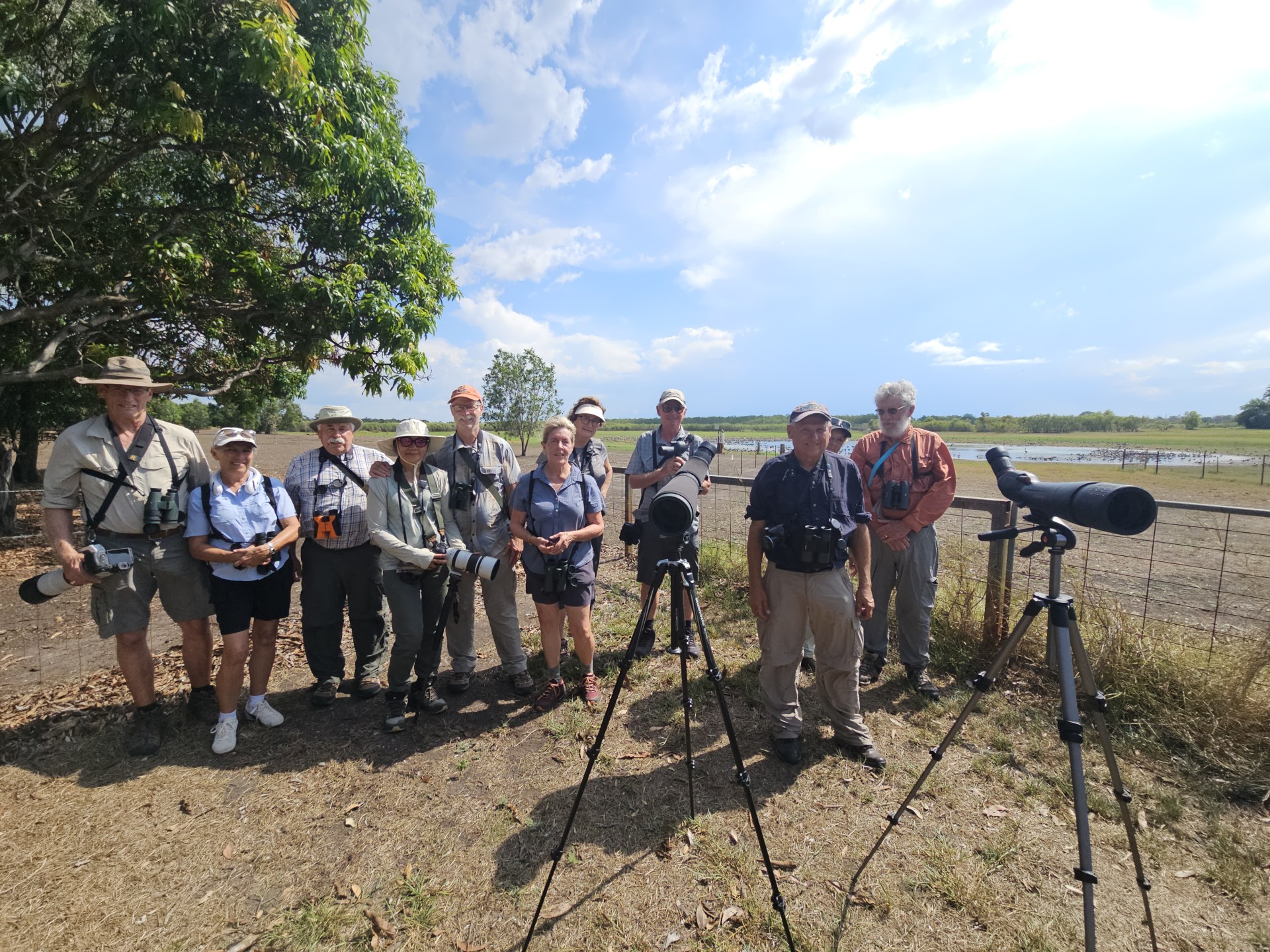
Our group
Tropical Australia birding tour (Oct 25 – Nov 2, 2025) eBird list