Canadian Rockies: Waterton Trip Report (Jun 6 – 11, 2026)
This trip was a great showcase of prairie, foothill, and mountain birds and mammals. Though the weather was not ideal all the time, we certainly made the most of it, and finished the trip with a number of great sightings and lots of very fine memories. Numerous life birds were seen by all participants, and the splendour of Alberta’s landscapes did not disappoint.
Day 1 – June 6 – Arrive in Calgary
Our group enjoyed a delightful dinner at our hotel. Two participants and one guide had joined from the Birds and Dinosaurs tour that wrapped up this same day. The 11 guests came from Canada, the US, and Australia.
Day 2 – June 7 – Calgary, the foothills, and Kananaskis Country
Sometimes it is nice to start a tour by easing into things, but the Canadian Rockies: Waterton tour features anything but an easy start. We covered a lot of ground on our first day, and began it all with an incredible rarity, at an unassuming pond on the edge of Calgary. Our first stop of the trip was at Rocky Pond, only 15 minutes from the hotel in the city’s northeast. We found the long-staying Sabine’s Gull and had excellent scope views of its remarkable breeding plumage. The gull even flew for a short distance, displaying its diagnostic wing pattern. This gull was found by a previous Eagle-Eye Tours, almost a week previously.
Sabine’s Gull is a most remarkable seabird. They breed on tundra wetlands across the far north before undertaking what must be the longest migration of any gull species, to nutrient-rich waters off western North and South America and southern Africa. One migration route passes over Alberta, with birds moving from the Pacific to the arctic in late spring and early summer. Though they pass over Alberta, presumably a very high altitude, they tend to be seen mainly only after or during periods of inclement weather. Perhaps the extreme wind and rain that took place about one week before this trip brough our Sabine’s Gull to Rocky Pond.
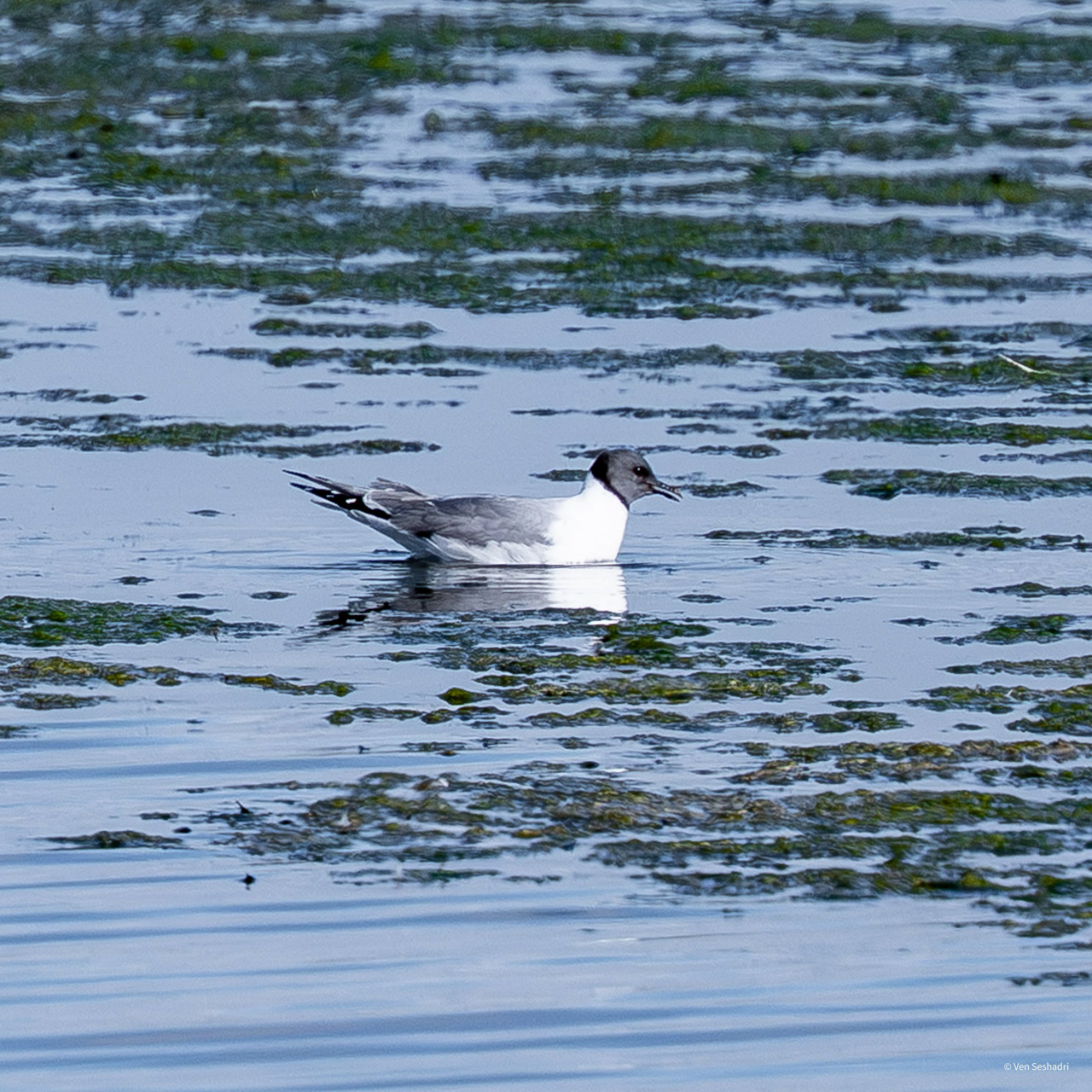
Sabine’s Gull © Ven Seshadri
The Sabine’s Gull was not the only bird at Rocky Pond. We found a good selection of other waterbirds, including 10 duck species. There was an unexpected male Barrow’s Goldeneye, male Ruddy Ducks preforming their bubble “blowing” displays for only vaguely impressed females, and a brilliant Cinnamon Teal also fully in the throes of courtship. A handful of shorebird species were also at Rocky Pond, including the real stars of the prairie shorebird scene, American Avocets and Black-necked Stilts, both of which paraded along the shoreline foraging and chasing one another.
We did not linger long with the waterfowl or the shorebirds, knowing the following morning at Frank Lake would be utterly devoted to them and other wetlands birds. With the still snowy mountains partly obscured by storm clouds, we pushed our way through Calgary traffic, spotting Swainson’s Hawks perched on lampposts beside the highway and slowly growing weary of counting Black-billed Magpies, certainly Calgary’s most ubiquitous bird.
Westward along the Trans-Canada Highway, we enjoyed the green rolling foothills and their ever-present retinue of cattle. We looked in vain for Elk, but found Mule Deer instead; our Elk sighting would have to wait until later in the trip.
Turning south off the highway we stopped at a small pond which marked the start of the Sibbald Creek Trail. Here, a Sora called from its hidden enclave among the cattails and a Black Tern winged its way over a variety of ducks, including some particularly handsome Ring-necked Ducks and Blue-winged Teal.
Proceeding south along the Sibbald Creek Trail (many a road has the appellation of “trail” in Alberta, a charming bit of western culture), the group was overjoyed to have a close encounter with a pair of Mountain Bluebirds. The male in particular offered us stunning views as he perched at close range.
The striking sky-blue colour of the male Mountain Bluebird is not produced by blue pigment, instead, it comes from microscopic structures within the bird’s feathers that scatter blue wavelengths of sunlight while absorbing other colours. This phenomenon, known as structural coloration, is similar to the process that makes the daytime sky appear blue. Layers of dark pigment beneath the feather surface enhance the effect, making the blue appear especially vivid and luminous. Depending on the angle of the light, a mountain bluebird can seem to glow with shades ranging from soft powder blue to brilliant turquoise, giving it one of the most distinctive and beautiful plumages among Alberta’s birds. Our group certainly thought so.
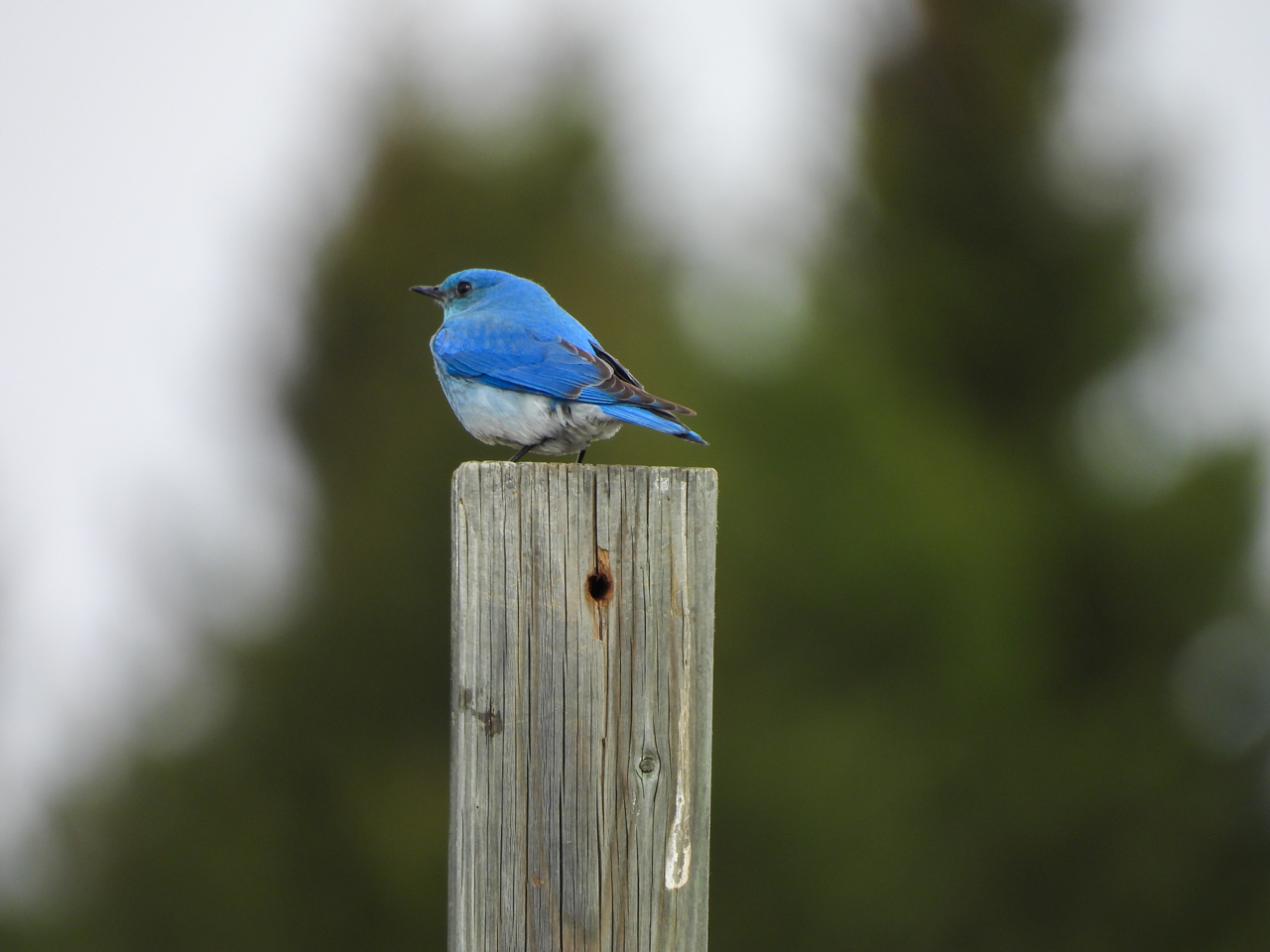
Mountain Bluebird © Nick Bartok
Cliff Swallows and a perched Red-tailed Hawk formed the background to our bluebird appreciation event. But after that the birding became slower while the weekend traffic picked up on this normally quiet forest road. We made a few stops for birds at wetlands, but the breeze, the dust from passing vehicles, the seemingly uncooperative nature of the birds compelled us to leave the Sibbald Creek Trail behind, but not before picking up a few new species for the trip. Perhaps the highlight was watching a female Tennessee Warbler gathering nesting material and scold us away from the vicinity of her nest site. It was a treat to watch this tiny warbler, knowing that she had only recently migrated at least 3,500 km (and possibly much further), to nest right there, virtually at our feet.
Another great sighting along the way was at Sibbald Meadow Ponds where we watched two beautiful Violet-green Swallows foraging low over the water. Our view from the roadside above gave us excellent looks at the swallows’ iridescent backs and distinctive white “saddlebags”.
Leaving the Sibbald Creek Trail at its terminus, we turned south into the Kananaskis Valley. The still snow-streaked peaks of Heart Mountain and Mount Baldy loomed over Barrier Lake – a fitting mountain welcome. It was not long until we encountered our first group of Bighorn Sheep, right in the middle of Highway 40. This herd of youngsters paid little attention to the traffic as they treated the asphalt like an artificial mineral lick, no doubt harvesting whatever residue of salt and sand might remain from winter snow clearing activities. The sheep eventually climbed a small cliff to exit the road and we continued our drive south.
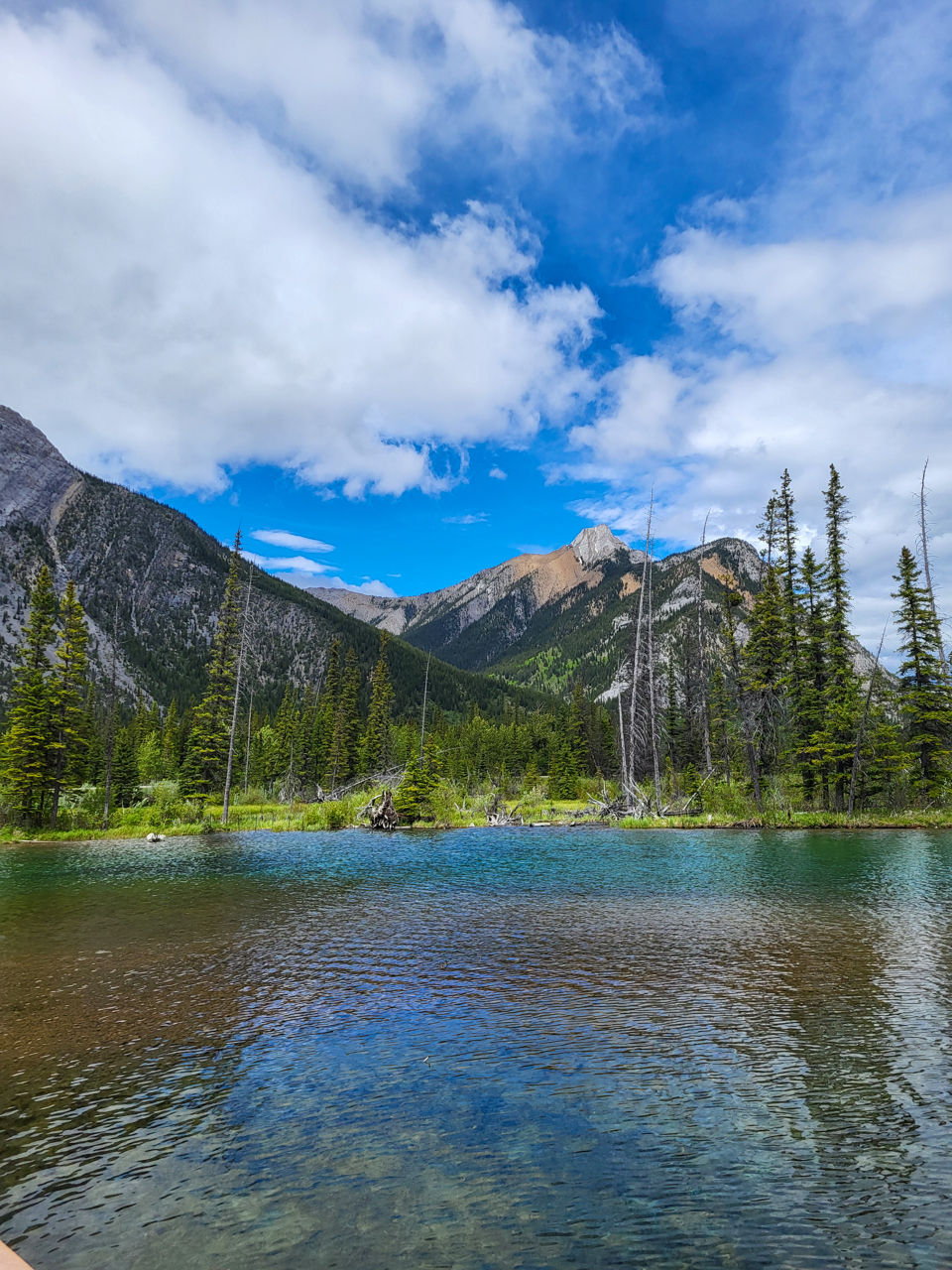
Mount Lorette Ponds © Mark Conboy
Lunchtime found us at Mount Lorette Ponds. The eponymous Mount Lorette towered over us to the north and Wasootch Peak loomed large to the south. We dove into a picnic lunch with gusto, and although rain threatened, it held off throughout lunch and long enough for us to take a walk afterwards. It was none too warm however, but despite this there was some bird activity. Our lunch was serenaded by a particularly boisterous Northern Waterthrush, Tennessee Warblers, Northern Yellow Warblers, and a flock of dapper Cedar Waxwings.
After lunch we headed out on the short trail among the ponds. Just as we left our picnic table a family group of Canada Jays descended to look for scraps. Among the light grey adults was a lead grey juvenile, learning the subtle art of picnic robbery from its parents. Further along the trail, as it wound its way past tranquil blue ponds, we heard the distinctive song of a Townsend’s Warbler from high in the spruces. It would not show itself, so we had to content ourselves with its sweet, high-pitched song. A few members of the group came across a Mountain Chickadee, surprisingly the only one for the entire trip.
No sooner had we competed our walk than rain really set in. Combined with poor visibility and rather cold temperatures we left the mountains and headed for the foothills once more. Driving north out of the valley we returned to the Trans-Canada Highway before turning south and following the whimsically named Cowboy Trail south to Bragg Creek.
By the time we reached Bragg Creek the rain had cleared and the sun had emerged from overcast once again. We found our way to Elbow Falls, on the thundering Elbow River just west of Bragg Creek. From the pathway just below the falls we watched, what was a favourite bird of the day for many: an American Dipper foraging in the tumultuous water below the mighty falls. The Elbow River was practically overflowing with water and the Falls were thundering, but that did not bother the dipper. It foraged in the shallow protected water below the falls as only dippers can, bobbing, swimming, and diving, disappearing completely below the surface in search of prey. Upon bobbing to the surface, the dipper would take to the wing, flying in a straight line to its messy nest, which hung in a crevice only a few metres from the rushing falls. Our group watched the dipper with delight, while in turn other sightseers at the falls watched us perplexedly, wondering just how it is such a little gray bird can elicit so much joy in a group.
After our visit with the dipper, we headed to Bragg Creek for a nice dinner (Rockies Tavern & Grill). Our day was not yet over though; we still had some ground to cover and species to search for in the foothills east of Bragg Creek. Off we struck into the evening, in search of the most spectacular of Alberta’s owls, the Great Grey Owl. Sure enough we found one, just where we thought we might, along Plummers Road. The owl obliged us with perfect photographic opportunities as it sat seemingly unconcerned upon a roadside fencepost. After a long while it took flight, and much to our delight, landed only a few metres further away, on the impossibly thin tip of a spruce tree. After another barrage of pictures had been taken, the owl glided away into the darkening forest, vanishing as they do, with grace and elegance like no other Alberta bird.
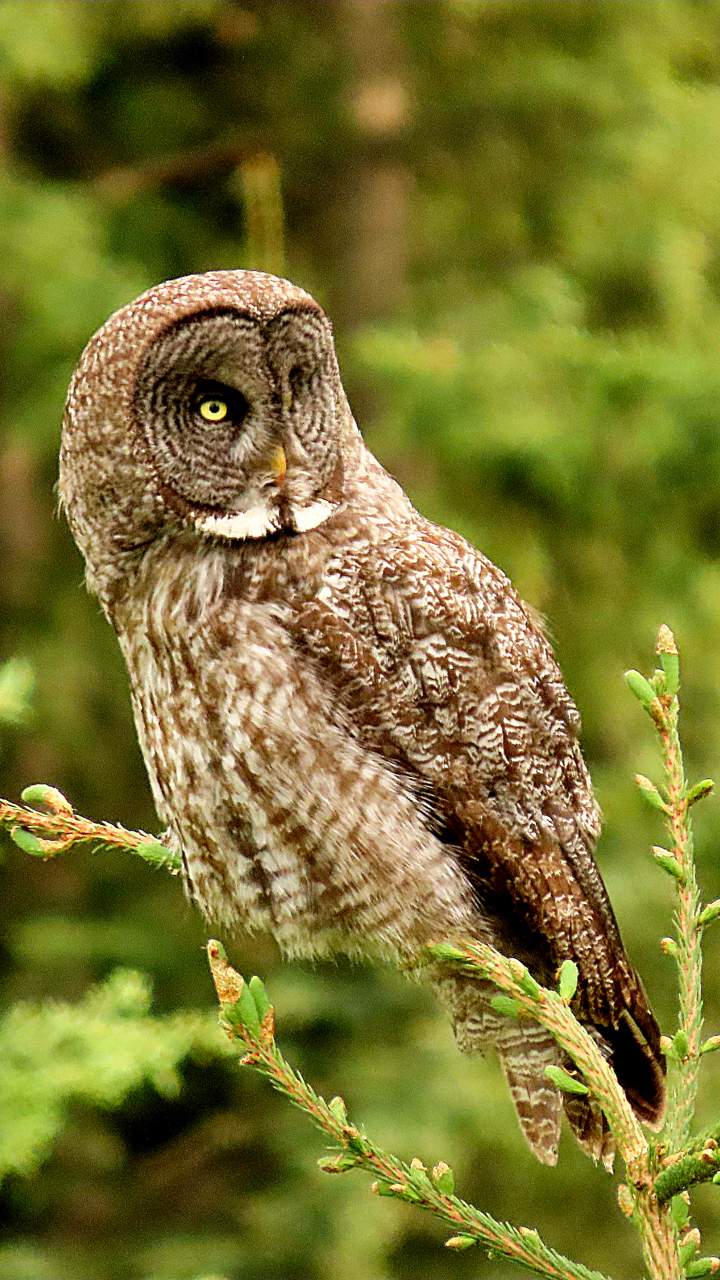
Great Gray Owl © Mark Conboy
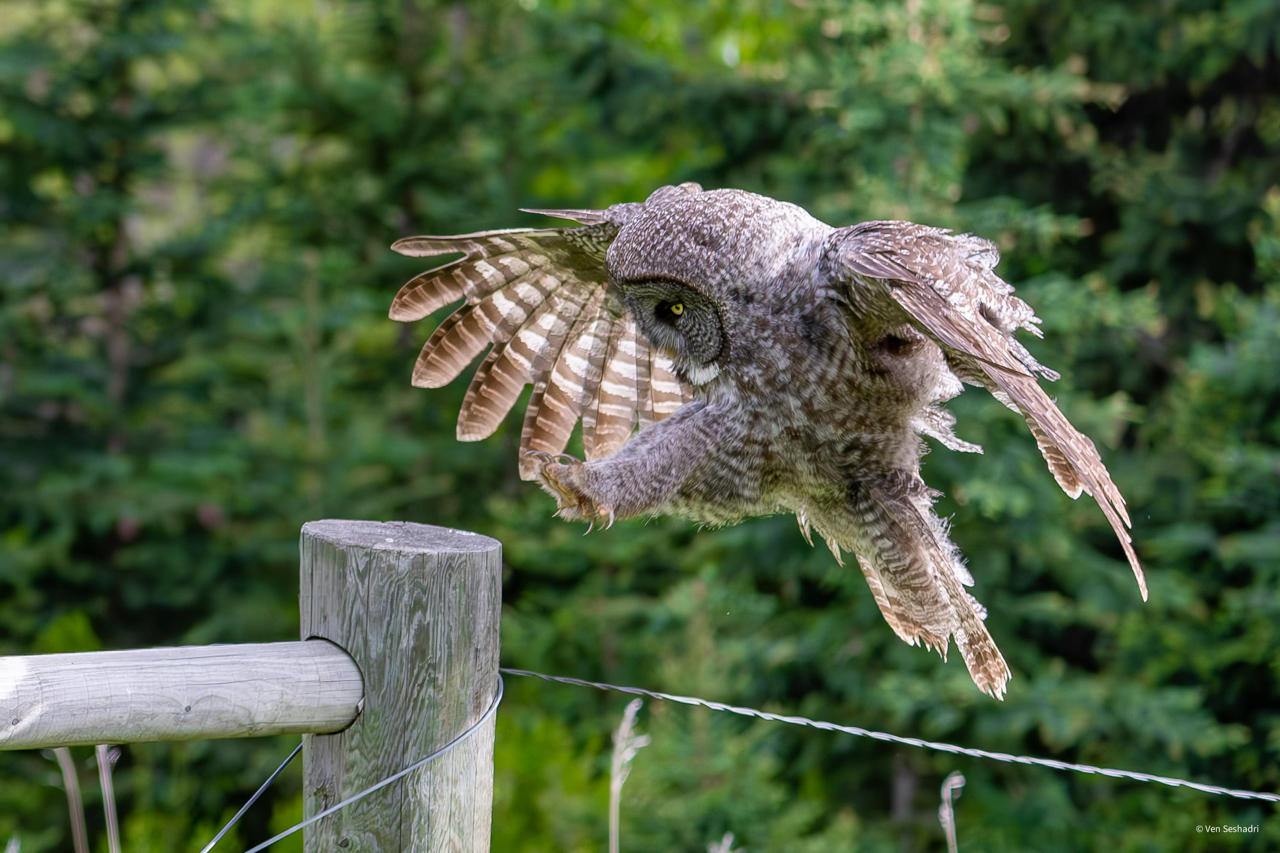
Great Gray Owl © Ven Seshadri
Plummers Road was not done providing treats though. Our next birding stop of the day was at a wetland that was humming with bird life beside a field that contained a handful of singing male Bobolinks. In the wetland we enjoyed excellent views of Wilson’s Snipe and Yellow-headed Blackbird, and heard Common Yellowthroat and Sora. Our final stop featured two Yellow Rails in a wet sedge meadow.
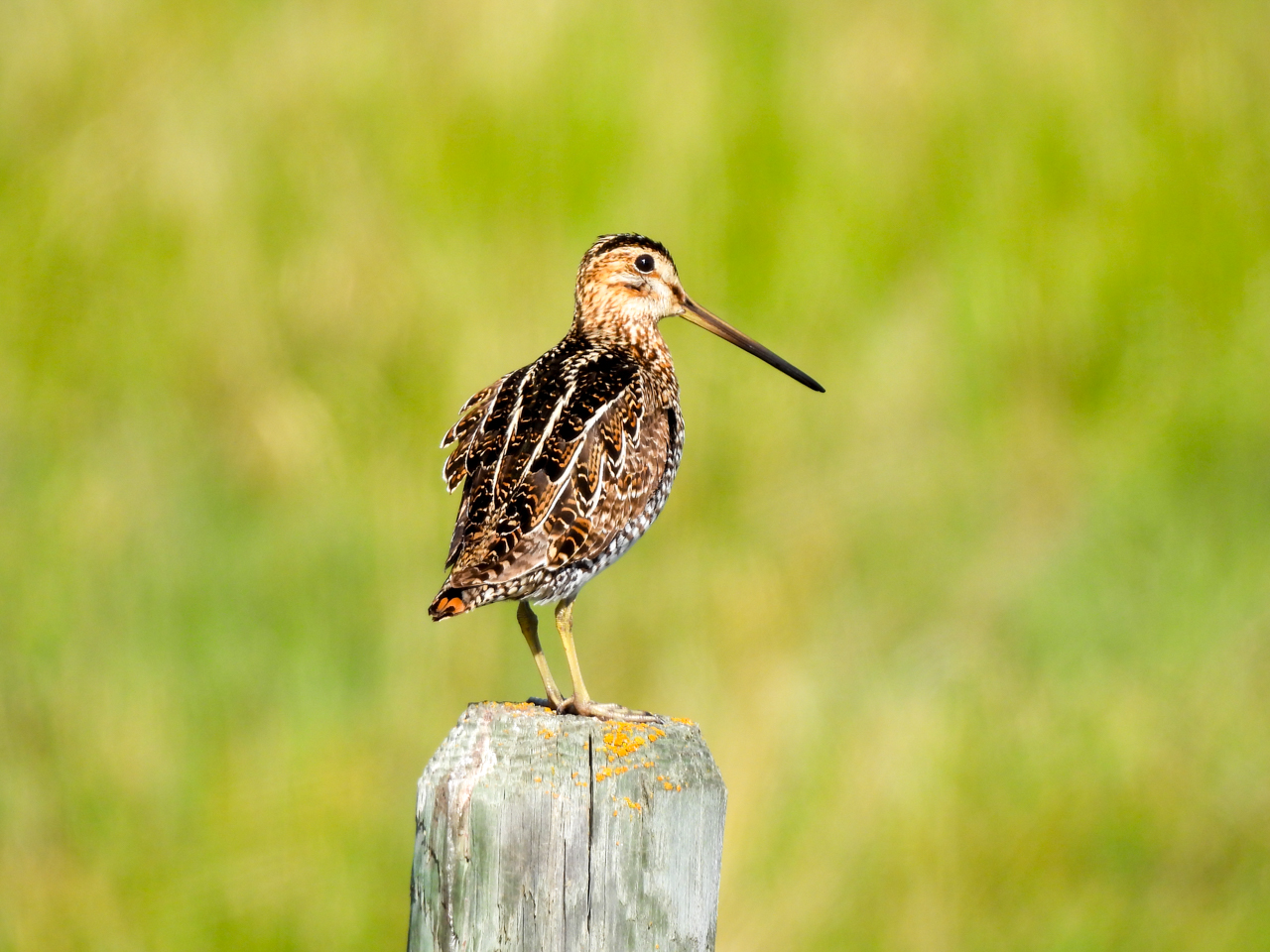
Wilson’s Snipe © Nick Bartok
Finally, well into the evening we arrived in High River and our hotel for the night. It was a long day, but a rewarding one. The slow parts of the day and the mixed weather conditions were more than made up for by some of the fantastic birds we enjoyed.
Day 3 – June 8 – Frank Lake to Waterton
After breakfast we were back on the road. Our first stop was the famous Frank Lake, only minutes east of High River. Frank Lake often provides great viewing for a wealth of water and wetland birds. Our visit was no exception. Fourteen species of waterfowl graced the lake, including some dapper Canvasbacks. Some rather confiding Wilson’s Phalarope and American Coots greeted us at the blind. It was a breezy morning and the open basin of the lake had rather few birds on it, but prominent around the blind were Eared Grebes, Ruddy Ducks and a considerable number of Western Grebes, some of which were displaying.
Franklin’s Gulls, Forester’s Terns, and Double-crested Cormorants streamed overhead, along with a couple hundred American White Pelicans. The pelicans preformed nicely for the group, be it on air or land. We watched flock after flocks circling high overhead, wheeling in the sunlight, their white bodies and black wingtips shinning as they turned to catch the morning rays. On the small island near the sewage treatment outflow, we were able to examine pelicans at close range, admiring their peculiar nuptial horns and wondering at the awkwardness of such long bills when it came to preening.
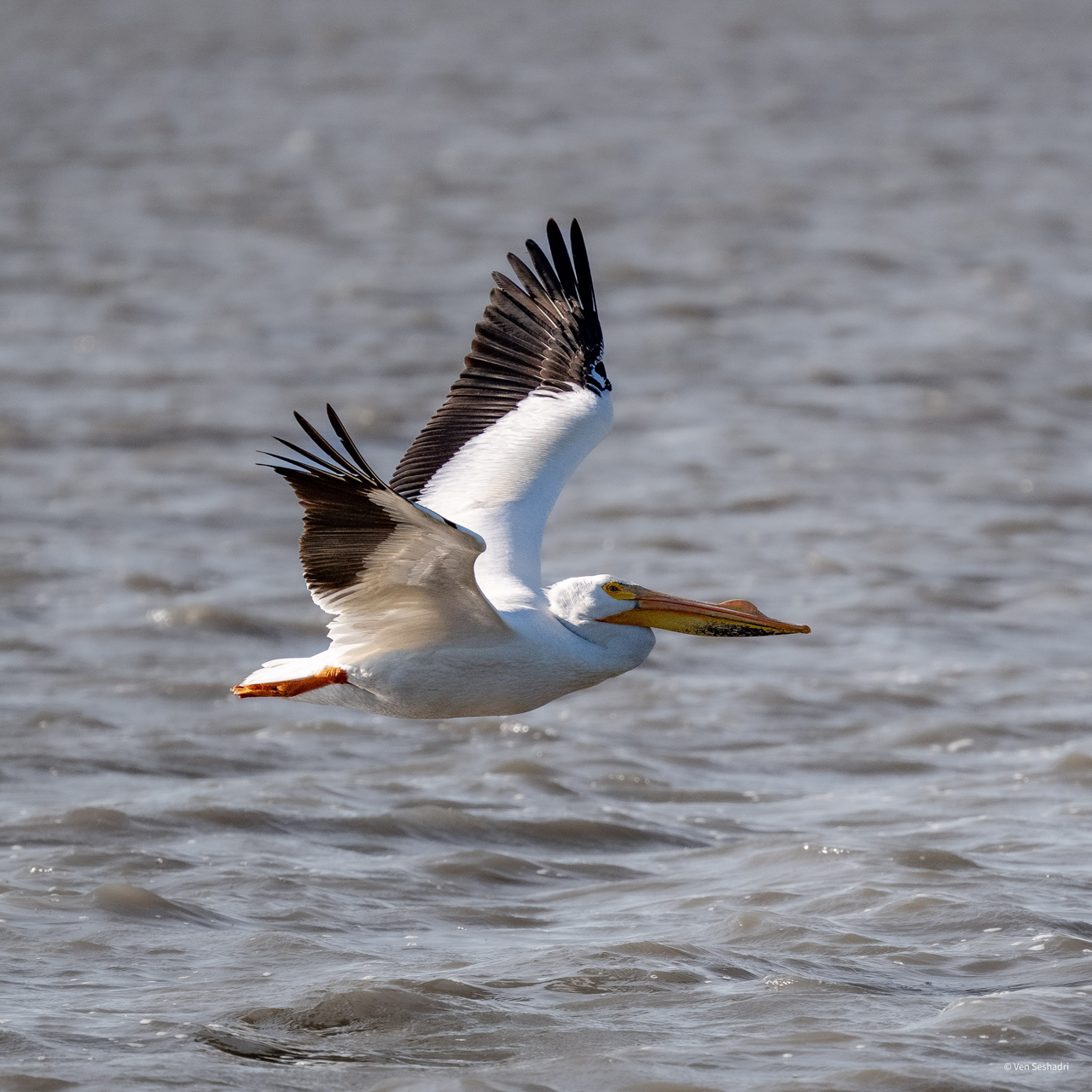
American White Pelican © Ven Seshadri
Among the other favourites at Frank Lake were several small flocks of White-face Ibises, Black-crowned Night-Heron, and the boisterous Marsh Wrens.
After a productive morning at Frank Lake we headed west again. Following a lunch stop in Nanton, we toured the remarkable Williams Coulee Road. Williams Coulee Road is a scenic gravel road that runs through foothill ranch lands, along the eastern flank of the Porcupine Hills. We would revisit the Porcupine Hills later in the trip as well. The road is known locally for sweeping views of rolling grasslands, sandstone outcrops, and great birds.
The birds definitely did not disappoint! A Eurasian Collared-Dove got us off to a good start. In no time at all we had spotted the first of three Prairie Falcons that we would see along the sandstone outcrop of the coulee’s north rim. The falcon took a half-hearted flight after a passing Turkey Vulture before returning to perch and afford excellent views to the group. Our first Western Kingbird appeared and the scrubby woods on the south side of the coulee rang with birdsong: Least Flycatcher, Clay-colored Sparrow, Spotted Towhee, Baltimore Oriole, and Northern House Wren, to name a few. Further along we came across two more Prairie Falcons, including one engaged in a protracted aerial battle with a female Northern Harrier.
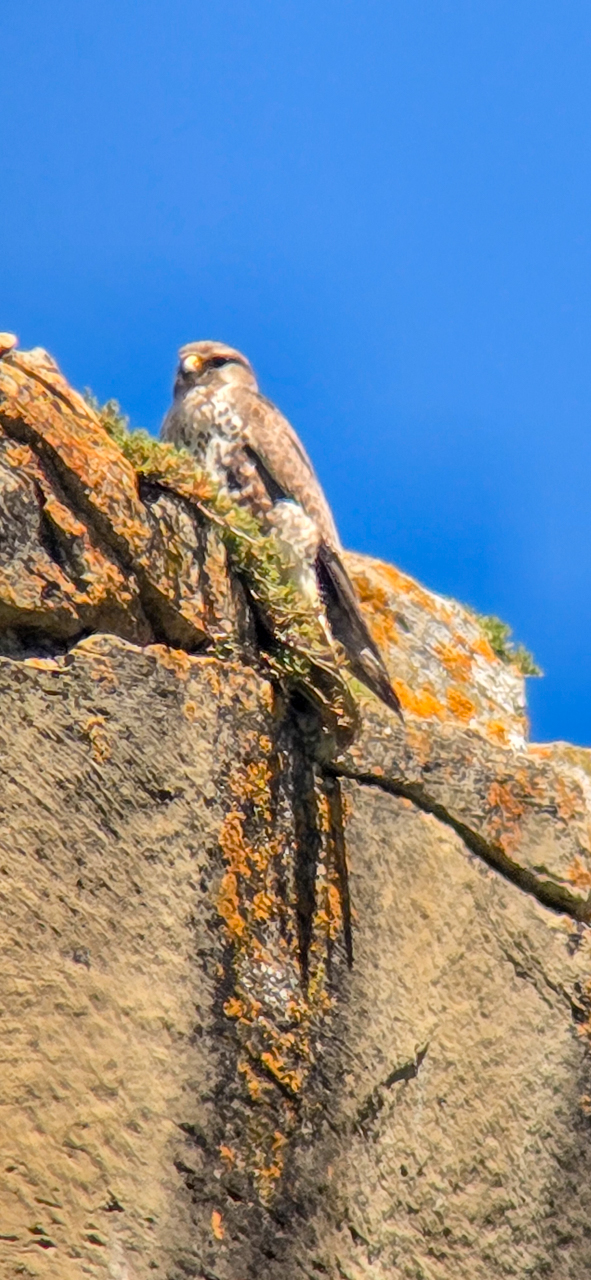
Prairie Falcon © Nick Bartok
After passing out of the coulee we saw grassland and farmland stretch before us in a bucolic splendour. Our next exciting birds were soon in sight. One, then two adult Ferruginous Hawks circled to the north, while at least two downy white nestlings could be seen in their nest just to the south of the road. A Loggerhead Shrike was spotted and another was heard singing its strange song very near the road; we knew a nest was close by. With that, we moved on down Willams Coulee Road, enjoying the view and spotting a Belted Kingfisher, among other species.
We headed south on Cowboy Trail through beautiful rolling countryside and made a brief bathroom break at Chain Lakes Provincial Park where we spotted our first Columbia Ground Squirrels of the trip. Up until that point all the ground squirrels we had seen were Richardson’s.
After a positively gorgeous drive through some of southern Alberta’s most scenic ranch country, we arrived at one of the Canadian Rockies’ crown jewels: Waterton Lakes National Park. Now in our new birding destination some of the group embarked on an evening drive up the Akamina Parkway to Cameron Lake in search of bears and birds. The venture did not disappoint. Those who came along were treated to roadside views of a young Grizzly Bear munching dandelions. This was followed by an extraordinary few minutes watching a cinnamon-coloured female American Black Bear with her adorable charcoal-coloured cub walking nonchalantly down the parkway. Two Bighorn Sheep were also seen. At Cameron Lake we sampled the bird life only briefly, knowing that we would return in the morning.
Day 4 – June 9 – Waterton Lakes National Park
The hotel in Waterton (Waterton Glacier Suites) was the trip favourite. After check-in we sampled a variety of meals at the Lakeside Chophouse. The hotel only served as a place to sleep, since we kept very busy during our one full day in the park. After breakfast we headed back up the Akamina Parkway hoping to find more bears for those who missed them the previous night. Drizzly and chilly weather conditions prevailed. Periodic stops along the road turned up Olive-sided Flycatcher, Willow Flycatcher, Townsend’s Solitaire, Swainson’s Thrush, and numerous White-crowned Sparrows. The songs of White-crowned Sparrows were a near-constant background sound during our stay in the park.
At Cameron Lake the rain made birding a little more challenging and a little more uncomfortable than we were hoping, but we did manage good looks at the slate-coloured form of Fox Sparrow and Northern Waterthrush, after some effort. A Wilson’s Warbler gave excellent close views for the few that were lucky enough to see it before it disappeared into the shrubs. A Pacific Wren serenaded us constantly, but would not emerge into view amid the tangle fresh growth and fallen trees, the aftermath of the incredibly devastating Kenow forest fire of 2017.
Evidence of the fire was seen throughout the park. In fact, virtually every forested place at which we stopped inside the park showed signs of severe fire impacts. Nearly 40% of the park burned, totalling some 35,000 hectares. Luckily the townsite was saved though the heroic efforts of firefighters, but almost all of the forest along the Akamina and Red Rock Parkways, where we spent a significant amount of time, were burned. The destruction was obvious, but so was the renewal of plant life. Wildflowers were in bloom, even in the cold rain. The most notable of the wildflowers on display was Common Bear-Grass. This otherworldly-looking member of the corn lily family could be mistaken for a gigantic white mushroom, when seen at a distance.
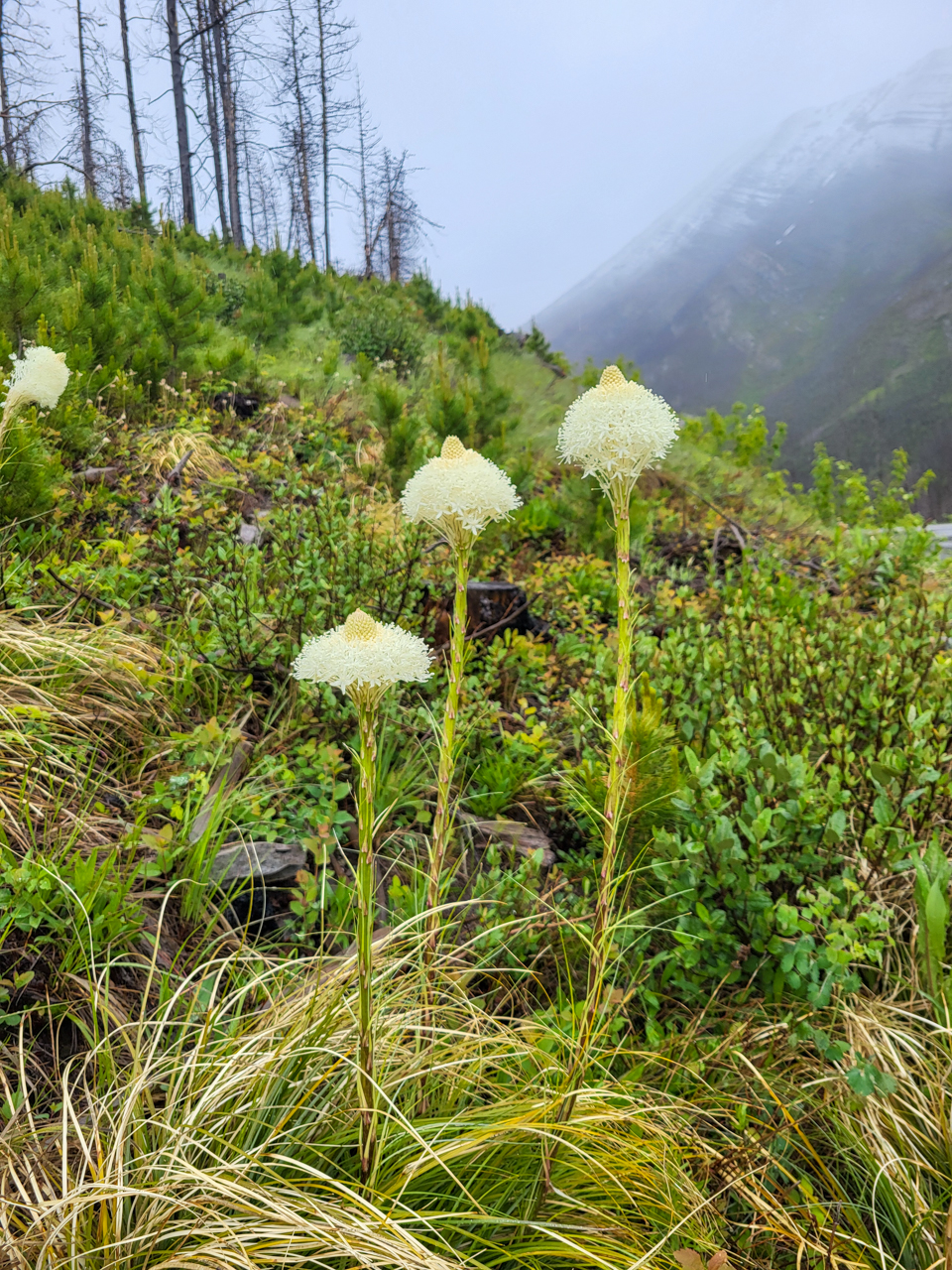
Common Bear Grass © Mark Conboy
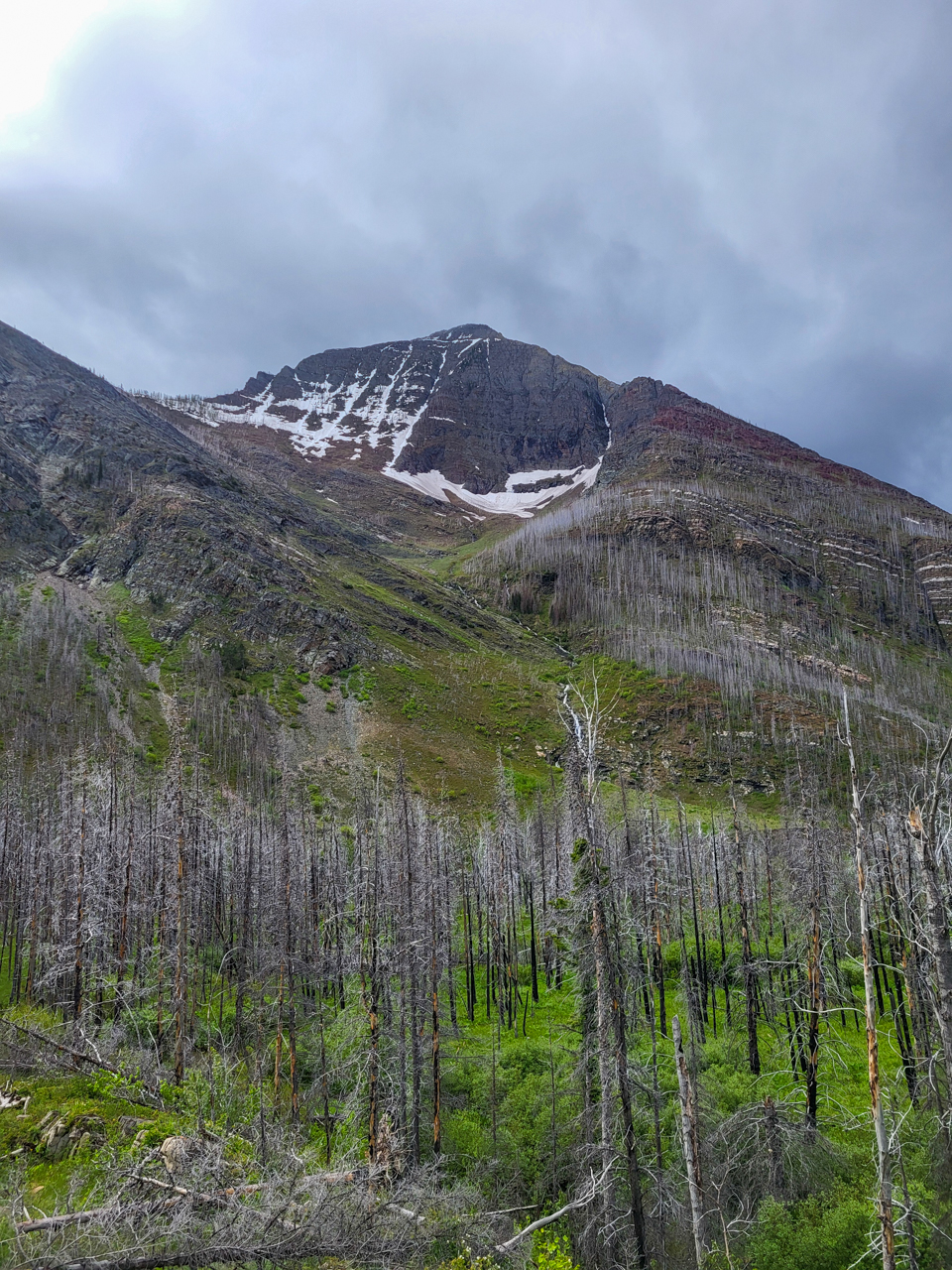
Burned forest in Waterton Lakes NP © Mark Conboy
As we descended back down the Akamina Parkway we made several stops including one at the Little Prairie Day Use area which produced a good assortment of birds in the willows along a Cameron Creek. There were of course Willow Flycatchers, but also an uncharacteristically cooperative MacGillivray’s Warbler, and another brilliant male Wilson’s Warbler. A flock of Cassin’s Finches, including some adult males, showed nicely, as did the first Golden-mantled Ground-Squirrel of the trip.
Another random stop along the parkway gave an aerial view of a pretty little rapids in Cameron Creek, and an accompanying American Dipper. One final stop along the parkway, at McNally Picnic Area, produced a singing American Redstart and a White-crowned Sparrow nest with four beautiful eggs.
A visit to Cameron Falls at the Waterton townsite gave interesting views of a pair of Red-breasted Nuthatches and a Yellow-rumped Warbler foraging on the cliff face flanking the falls.
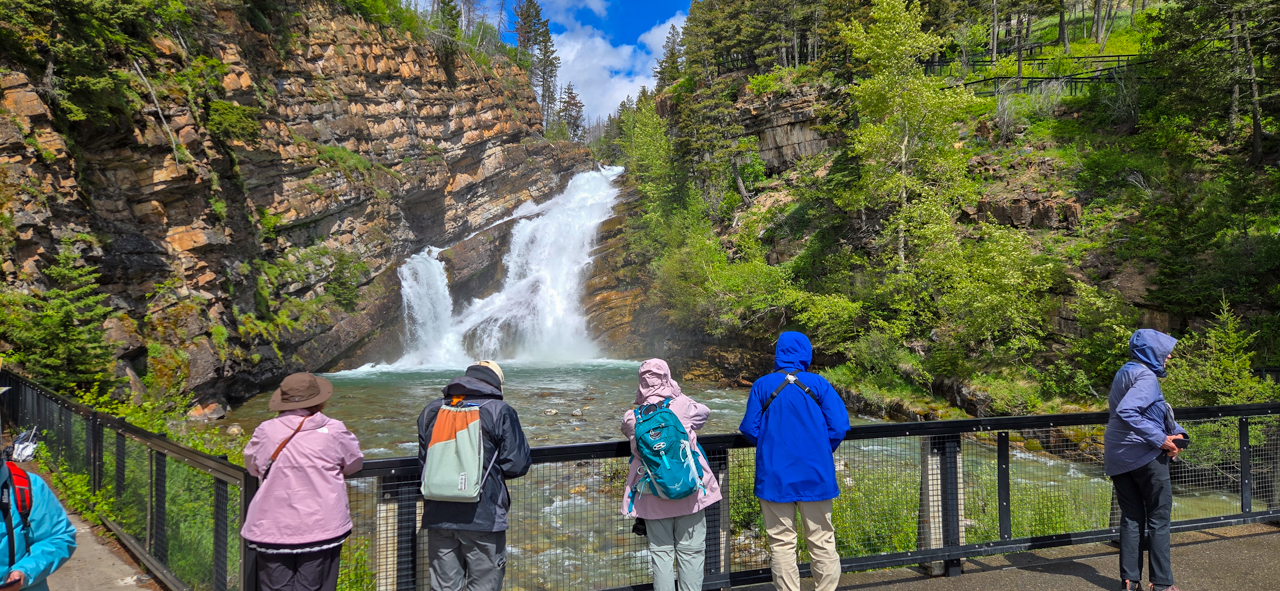
Cameron Falls in Waterton Lakes National Park © Nick Bartock
A delicious lunch in town energized us for afternoon adventures, which began with a visit to the Buffalo Paddock. The paddock contains a herd of about 20 Plains Bison. Parks Canada has maintained a herd in the park since 1952; we had excellent views of this semi-wild herd. Birds were few and far between in the fescue grassland; thus, we relocated to the ponds at the park gate where we found three Barrow’s Goldeneyes.
Next visited Hay Barn Road in the valley bottom. This was actually our second visit to this site of the day, but we were quickly rained out during our first stop, but not before spotting a male and female Black-headed Grosbeak. The male grosbeak was seen again upon our return to Hay Barn Road, along with a gorgeous male Baltimore Oriole; both of these orange and black beauties even found their way into the same tree at one point. Among the other 17 species of birds we found along Hay Barn Road were Orange-crowned Warbler, Gray Catbird, and the smallest bird in Canada, the Calliope Hummingbird (weighing only about as much as a nickel). It was a male Calliope, and he gave fantastic views sitting atop a willow. His starburst magenta gorget was clearly visible.
After communing with the Calliope Hummingbird, we took a short break before what proved to be our best dinner of the trip at the Royal Stewart Dining Room, within the historic and decadent Prince William Hotel. Once dinner was done, we headed out again for another evening bear search, this time up the Red Rock Parkway. Rain and wind kept us in the vehicles for most of the evening. But that changed near the end of our drive when a very special bird was found. At the Crandel Lake Campground Bridge we found a gorgeous male Harlequin Duck sitting on the rocky shore of Blakiston Creek. He sat in perfect field guide posture long enough for everyone to have a look. After a time, he slid into the river and we watched him slowly boob on the current and around a distant corner and out of sight. What an excellent end to a great, if wet, day of exploring Waterton Lakes National Park.
Day 5 – June 10 – Waterton and Head-Smashed-In
Our second morning in Waterton was a rainy, windy and cold one. We determined that our best bet for seeing any birds would be to return to Cameron Lake. Unfortunately, the rain and wind blowing across the lake made for challenging and rather unpleasant birding. A stunning adult Bald Eagle was seen along the Akamina Parkway along with two cinnamon-coloured American Black Bears. As our time in the park came to an end we took one more look for the Harlequin Duck along Blakiston Creek, but he was not there.
Shortly after leaving the park the rain cleared, though the wind persisted as we drove through Pincher Creek and beneath ranks of turning wind turbines. We made our way towards Head-Smashed-In Buffalo Jump across the rolling and verdant Porcupine Hills where we added Red Fox, Elk, and American Badger to our trip mammal list. The badger in particular offered up spectacular views as it ambled (as only a badger can amble) across a short grass field, stopping occasionally to dig at ground squirrel burrows.
Head-Smashed-In Buffalo Jump (HSIBJ) was our final destination before heading back to Calgary. The cliffs at HSIBJ were used by Indigenous peoples as a highly sophisticated communal hunting site for millennia. Hunters used carefully constructed drive lanes marked by stone cairns to funnel bison toward a 10-metre cliff, where the animals were driven over the edge and then processed at camps below. Deep archaeological deposits of bone and artifacts preserve evidence of thousands of years of continuous use, making HSIBJ the oldest, largest, and best-preserved buffalo jumps in North America. The site was recognized as a National Historic Site of Canada in 1968, designated a Provincial Historic Site by Alberta in 1979, and inscribed as a UNESCO World Heritage Site in 1981 because of its exceptional testimony to Plains Indigenous culture and subsistence practices. The remarkable visitor centre, which blends into the landscape, was opened in 1987.
We enjoyed a guided introduction to the site and some time to the explore the visitor centre exhibits on our own. We also walked the short trail to the cliff tops that overlook the actual buffalo jump site. Despite the wind, cool temperatures and overcast, two Yellow-bellied Marmots were out on the cliff face. A Long-tailed Weasel also made a brief appearance, emerging from a crack in the cliffs momentarily, only to disappear seconds later. The final new species for the trip was Rock Wren, two of which were seen, also on the cliffs.
Extremely windy conditions practically pushed us back to Calgary where we enjoyed the theatrics of a teppanyaki restaurant before officially wrapping up the trip.
Day 6 – June 11 – Depart from Calgary
Our final bird species tally for the trip was 123. All in all a great trip with lots of fantastic birds, wonderful people, and incredible scenery.
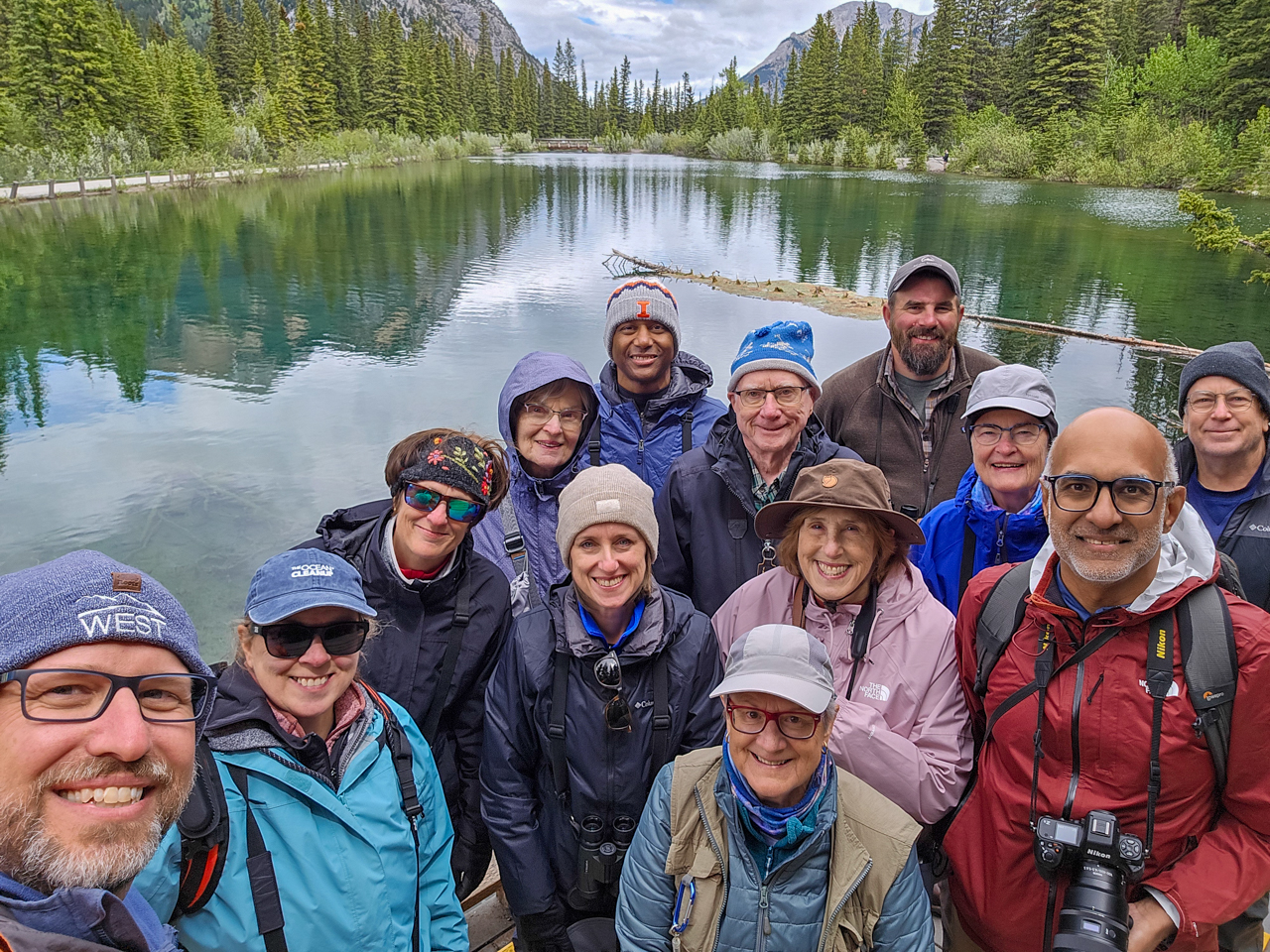
Our group