Bhutan Trip Report ( April 1 -18, 2026)
This was a wonderful journey right across the Himalayan Kingdom of Bhutan, known in the local Dzongkha tongue as Druk Yul – the Land of the Thunder Dragon. By starting in the Assamese plains in northeastern India, and entering Bhutan in the southeast we were able to experience the full range of altitudes and as a result, almost all habitats in this country where two-thirds of the ecosystem remains intact.
From pristine forests to the more human-influenced landscapes around Paro, we experienced some of the best birds of the east Himalaya. 351 species of bird, and 19 mammals, were seen on our travels, an impressive total for a country comparable in size to Belgium (or, alternatively, the state of Maryland). Among the many highlights mentioned by our group of travellers in personal end-of-tour Top Threes were classic east Himalayan specials like Rufous-necked Hornbill, the critically endangered White-bellied Heron Tawny Fish Owl, Satyr Tragopan, Ward’s Trogon, Beautiful Nuthatch, and Fire-tailed Myzornis, alongside more widespread (but no less stunning) birds like Ibisbill, Slaty-backed Forktail, and Long-tailed Broadbill.
Among the mammals, highlights included the beautiful and range-restricted Golden Langur, Bhutan Giant Flying Squirrel, and Siberian Weasel. As if that wildlife wasn’t enough, it was invariably encountered among spectacular scenery, often with a backdrop of blooming magnolias and rhododendrons; the latter in particular was putting on a real show of flowers in shades of red during this year’s tour.
This tour is made even more special, though, by the human element of Bhutan. The ever-friendly people, the culture – including the temples we are lucky enough to visit, and the food of a unique country cannot be overlooked, as great as the birding is. Our brilliant and seemingly tireless crew – guide Tshering, driver Nima, and camp crew Lambu, Karmala, Karma Tobgay, Chuma and Yeshila – deserve special thanks for making our travels through the Himalaya so memorable.
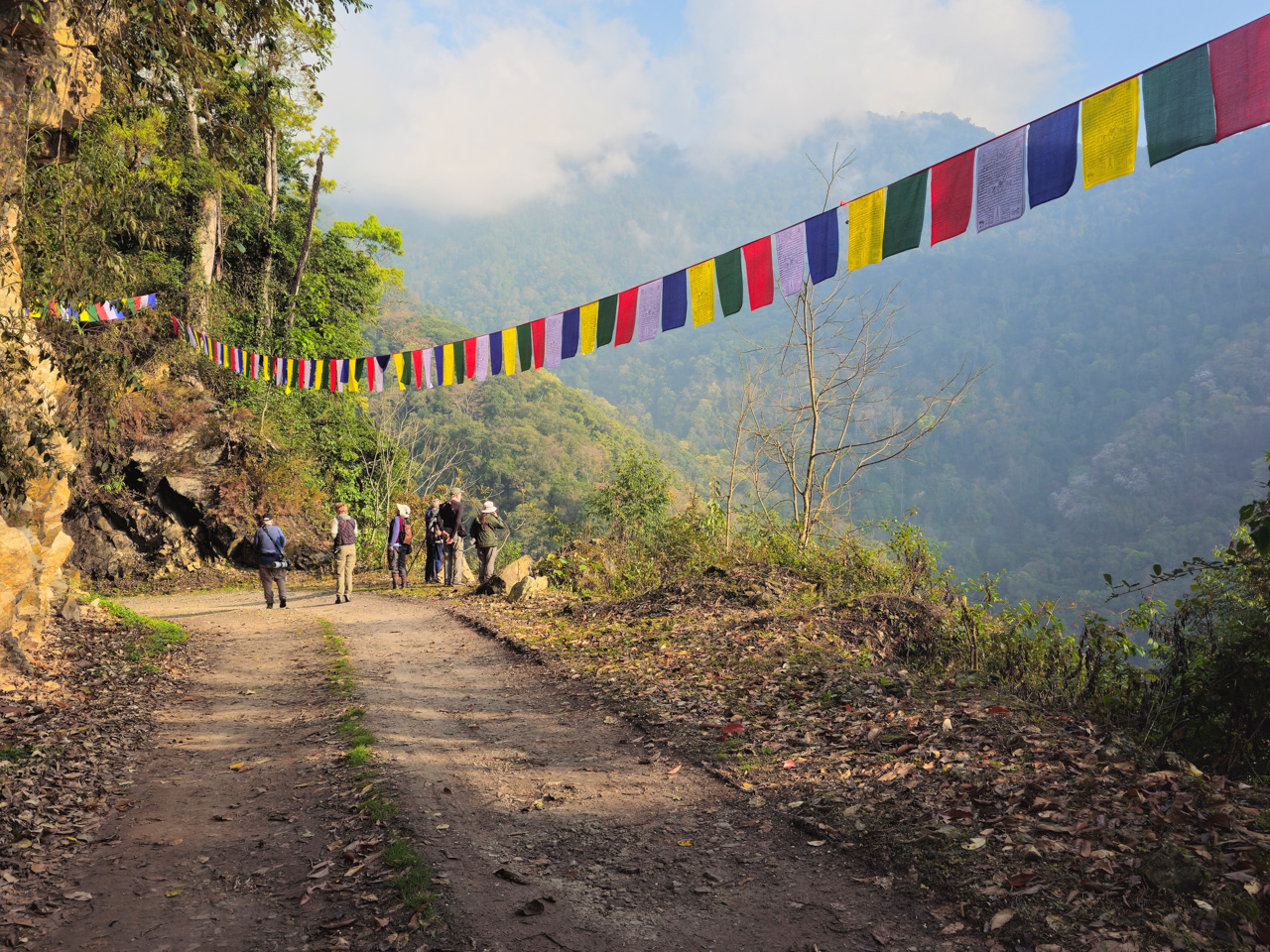
Birding prayer flags Yongkola © Mike Hoit
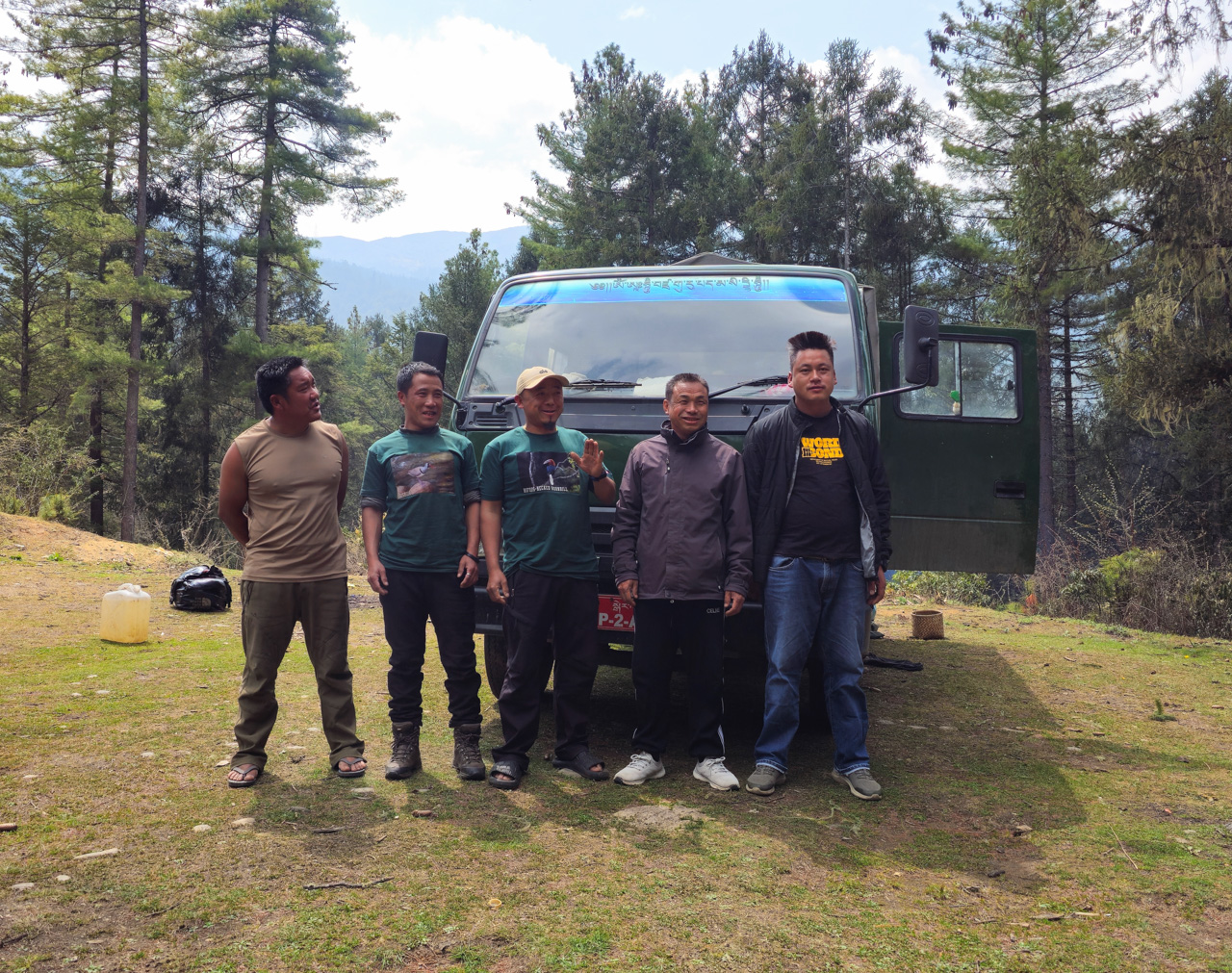
Camp crew © Mike Hoit
Day 1: Delhi
Rather than Bhutan, our adventure started in neighbouring India! And by the time the group convened for dinner in our hotel close to Delhi airport, many had already started seeing new birds. Despite rapidly-progressing urbanisation, this is still a great area for seeing Alexandrine Parakeet, as well as the more common Jungle Babbler, Purple Sunbird and Common Tailorbird. Introductions made, plans laid out and an extensive buffet consumed, we retired in advance of the first of many early starts
Day 2: From Delhi to Bhutan.
After trials and tribulations of Delhi airport with its various foibles, we had a smooth flight to Guwahati in the northeast Indian state of Assam. The brand new airport terminal was quite the sight to behold as was our first birding location. Meeting up with Bhutanese guide Tshering, a team of local drivers whisked the group to Guwahati waste disposal.
Here, the critically endangered Greater Adjutant soared overhead and fed on the mountain of refuse in numbers looming over the cattle sharing the garbage feast.
After this we had an appetite ourselves, so after a thali tray lunch we proceeded to the border crossing. During the formalities we had time to see some lowland species such as Black-hooded Oriole, Yellow-footed Green-pigeon and Jungle Babbler (the last two being subcontinent endemics).
After the lengthy process of leaving India, we were finally in Bhutan, and received a warm welcome at our guesthouse for a home-cooked meal, more than ready to rest up after days of travelling.
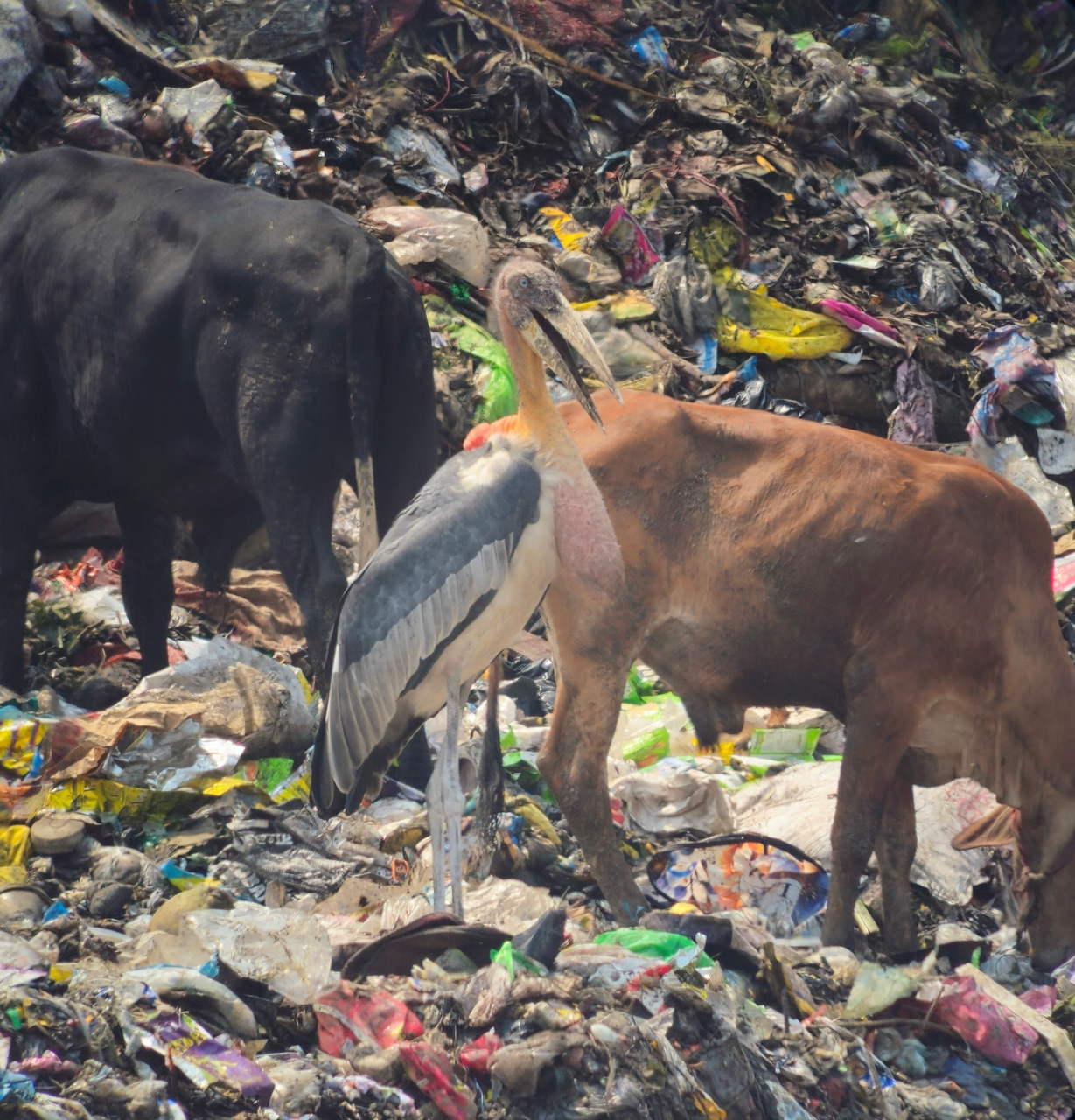
Greater Adjutant © Mike Hoit
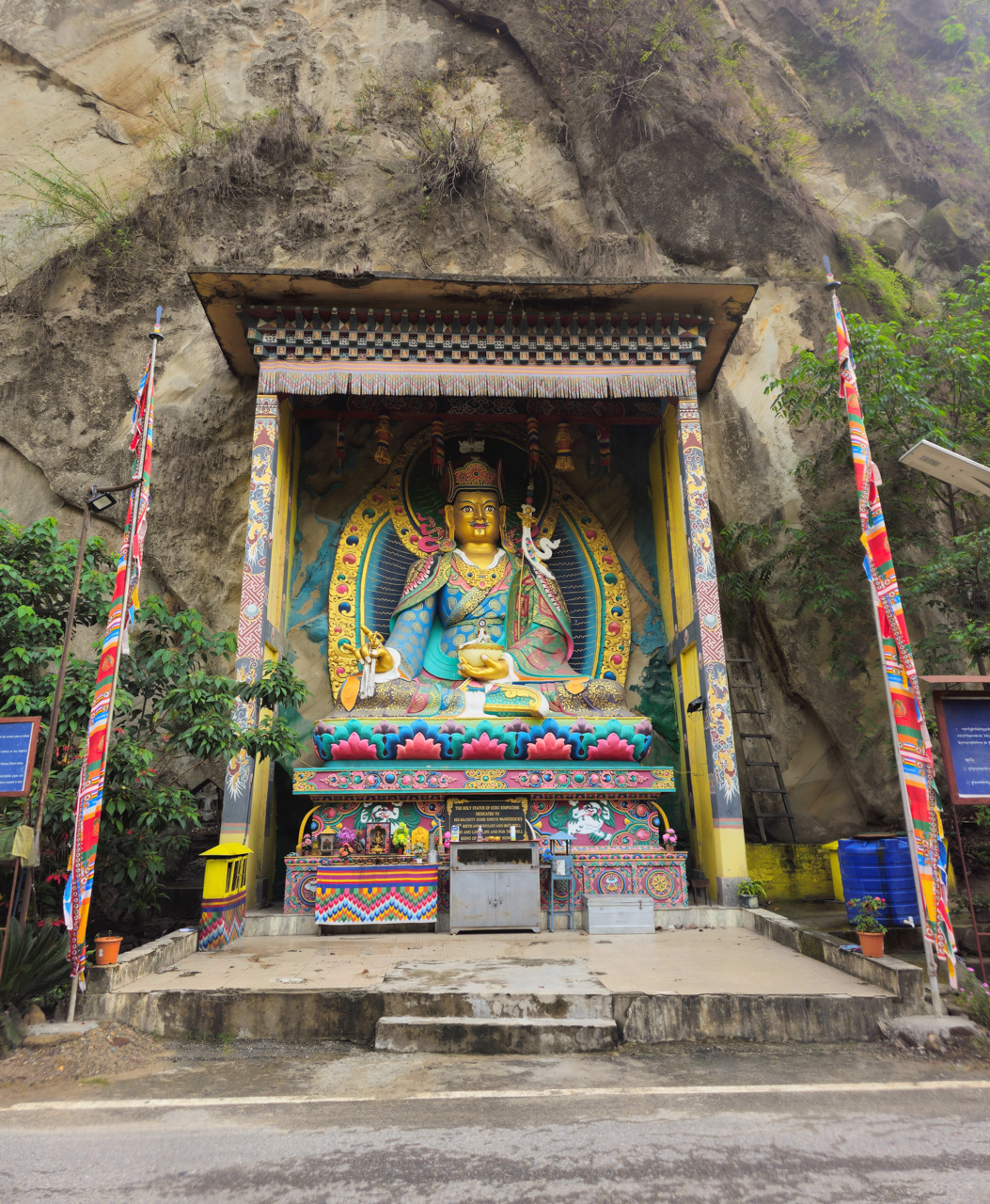
Shrine SJ © Mike Hoit
Day 3: Samdrup Jongkhar to Morong
Our birding in Bhutan started in earnest before we had even left the lowland border town of Samdrup Jongkhar, with a showy Asian Barred Owlet. A wide variety of species during the morning included widespread Asian birds with a distribution that only just extends into Bhutan (Yellow-footed Green-pigeon, Gold-fronted Leafbird, and Asian Palm Swift), and those which would become familiar over the tour (Scarlet Minivet and Verditer Flycatcher). On top of that, we gained exceptional views of classic regional stunners like Crested Kingfisher and Long-billed Broadbill, and two very rare and sought-after species: Dark-rumped Swift and Blyth’s Kingfisher.
Soon it was time to head for the hills, and a first delicious field lunch prepared by our camp crew; marvelling at the quality and diversity of the spread they lay out with minimal gear in remote locations became a regular feeling!
A short drive further, we rolled into the tented camp they had prepared – although ongoing roadworks rendered it more like a building site than was ideal! In the afternoon we headed out birding in the cool climes of 1700 metres above sea level.
This was a first chance to get to grips with species topical of Himalayan mid-elevation forests, such as Golden-throated Barbet and leaf-warblers (including the uncommon Green-crowned), plus some lovely Capped Langurs and impressive Black Giant Squirrels. Real excitement was provided by our first glimpses of Rufous-necked Hornbills, whetting the appetite for tomorrow.
Day 4: Morong to Trashigang
Further explorations of the forests around Morong turned up striking Sultan Tits, the sweet-singing, skulking Spotted Elachura (a unique bird, basal to other passerines) gave good views, and our first sightings of one of the quintessential birds of habitat: Himalayan Cutia. Around camp, the construction work didn’t deter the near-endemic Bhutan Laughingthrushes from hopping around almost underfoot.
Much of the day was spent travelling to Trashigang. The first try for Ward’s Trogon in beautiful, moss-draped forests drew a blank, but dazzling Green-tailed Sunbirds showed well. Further along, we made a walk and quickly found Brown-throated Fulvettas which flitted around us – a delightful dweller of high elevations in the east Himalaya that has a tiny range in Bhutan. Dropping down to slightly lower altitudes, we were glad to arrive into a comfortable hotel in the early evening.
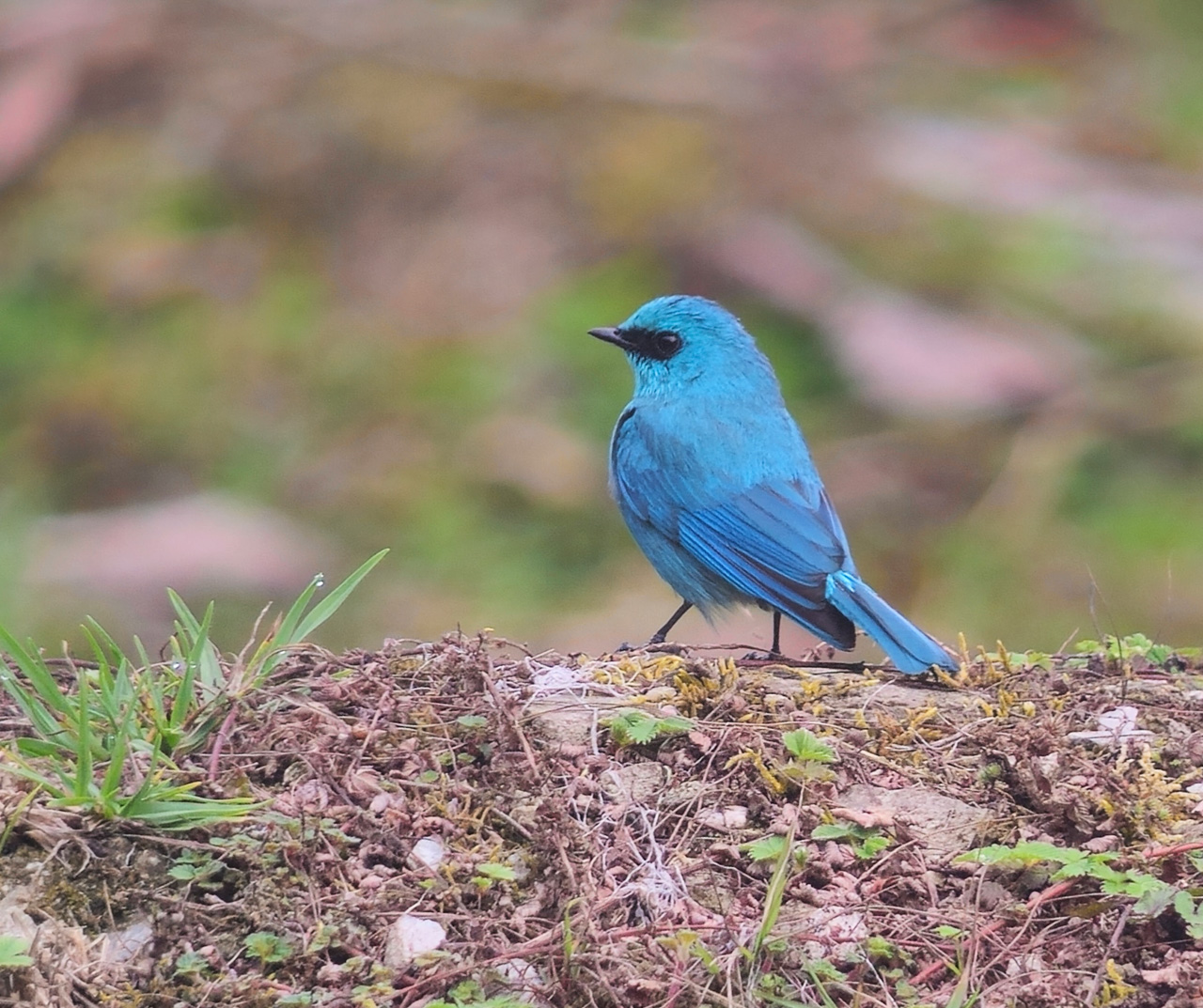
Verditer Flycatcher ©Mike Hoit
Day 5: Trashigang to Yongkola, via Kori La
Venturing out just as dawn was breaking, we could hear Grey Nightjars calling and see the Trashigang Dzong illuminated in the valley below our first time seeing one of Bhutan’s spectacular fortress-monasteries.
Travelling west through one of the dry, rain-shadow valleys, we made a few stops for species typical of these habitats, such as White-crested Laughingthrushes and Himalayan Bulbul.
The main destination for the morning was the Kori La: a forested high pass, at an elevation of 2450m. The first Kalij Pheasants of the trip strolled at the roadside, while we also found Blue-bearded Bee-eaters, Rufous-bellied and Bay Woodpeckers, Slaty-bellied Tesia, Red-billed Leiothrix, and Mrs Gould’s Sunbird. A Ward’s Trogon called and seemed to fly in, only to evaporate one that would have to wait…
After lunch, we had to wait a while for the road to Yongkola to be clear of roadworks, and so took the opportunity to stroll the streets of Mongar and take in a little slice of life in a Bhutanese town. And of course, we saw some birds. Rusty-cheeked Scimitar-babblers gave incredible views – quite incongruous in a semi-urban setting – and on the outskirts a singing Himalayan Prinia posed.
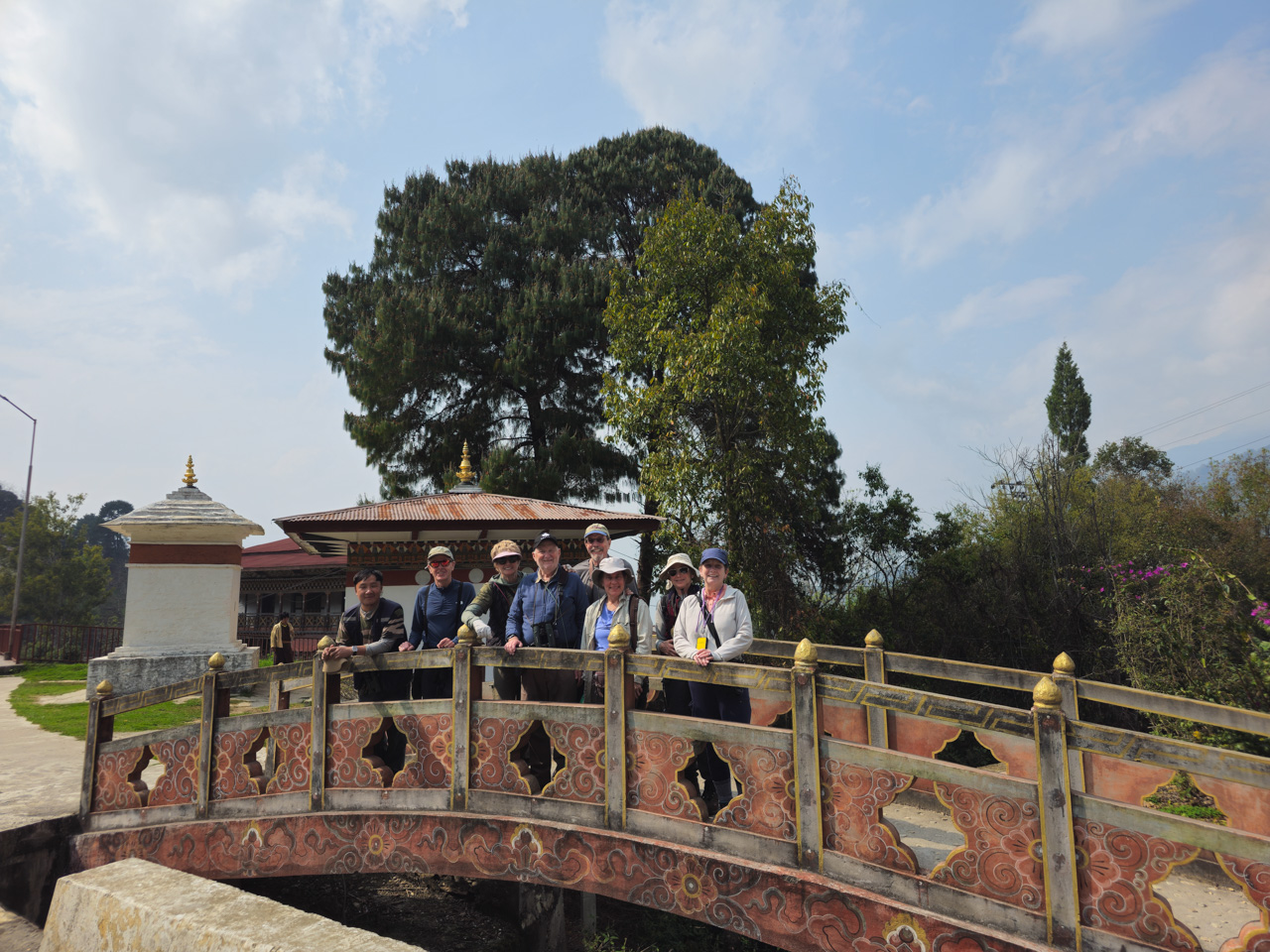
Group in Morong © Mike Hoit
With the road open, it was a relatively short journey – slowed a little by stops for a beautiful male Blue-capped Rock-thrush and Long-tailed Shrikes – to our lodge for the next few nights, the birder-centric Trogon Villa.
Days 6-8: The Lingmethang Road
The forested mountains in the area of Yongkola, Namling and Sengor have quite the reputation among aficionados of Asian birding, and we were soon to realise that it is well deserved. The fifty-five kilometres known as the Lingmethang Road pass through unbroken forest while traversing elevations from 600 to over 3000 metres above sea level – much of it in Phrumsengla National Park.
The weather was atypically chilly here, due to a late blast of wintry weather, and the birding was a little slow at times – but of course all things are relative, and slow in Bhutan is still pretty spectacular!
For much of the time here, we birded the mid-elevation, mixed broadleaved forests between 1450 and 2300m. On the first morning, we made an effort to find the aptly-named Beautiful Nuthatch, with great success. Two separate pairs showed well in the end, and while searching we found many other birds: a superb male Sapphire Flycatcher was a standout, and skulkers such as Red-faced Liocichla, Rufous-chinned Laughingthrushes and Rufous-throated Wren-babblers were seen in the open.
Later, we gained even better views of Beautiful Nuthatch in one scope, while the other was trained on perched Rufous-necked Hornbills, as a Golden-throated Barbet sang from a snag mere metres away and a Crimson-naped Woodpecker showed well a classic Bhutan moment.
A close view of a remarkably-hued Ward’s Trogon added a splash of colour, the weird and wonderful Yellow-rumped Honeyguide perched out over the road, and in the dense bamboo were sneaky Black-crowned Scimitar-babblers and Scaly Laughingthrushes, and gangs of White-breasted and Black-throated Parrotbills. And of course, we had several brilliant encounters with the characterful Himalayan Cutia, a classic dweller of epiphyte-clad hill forests.
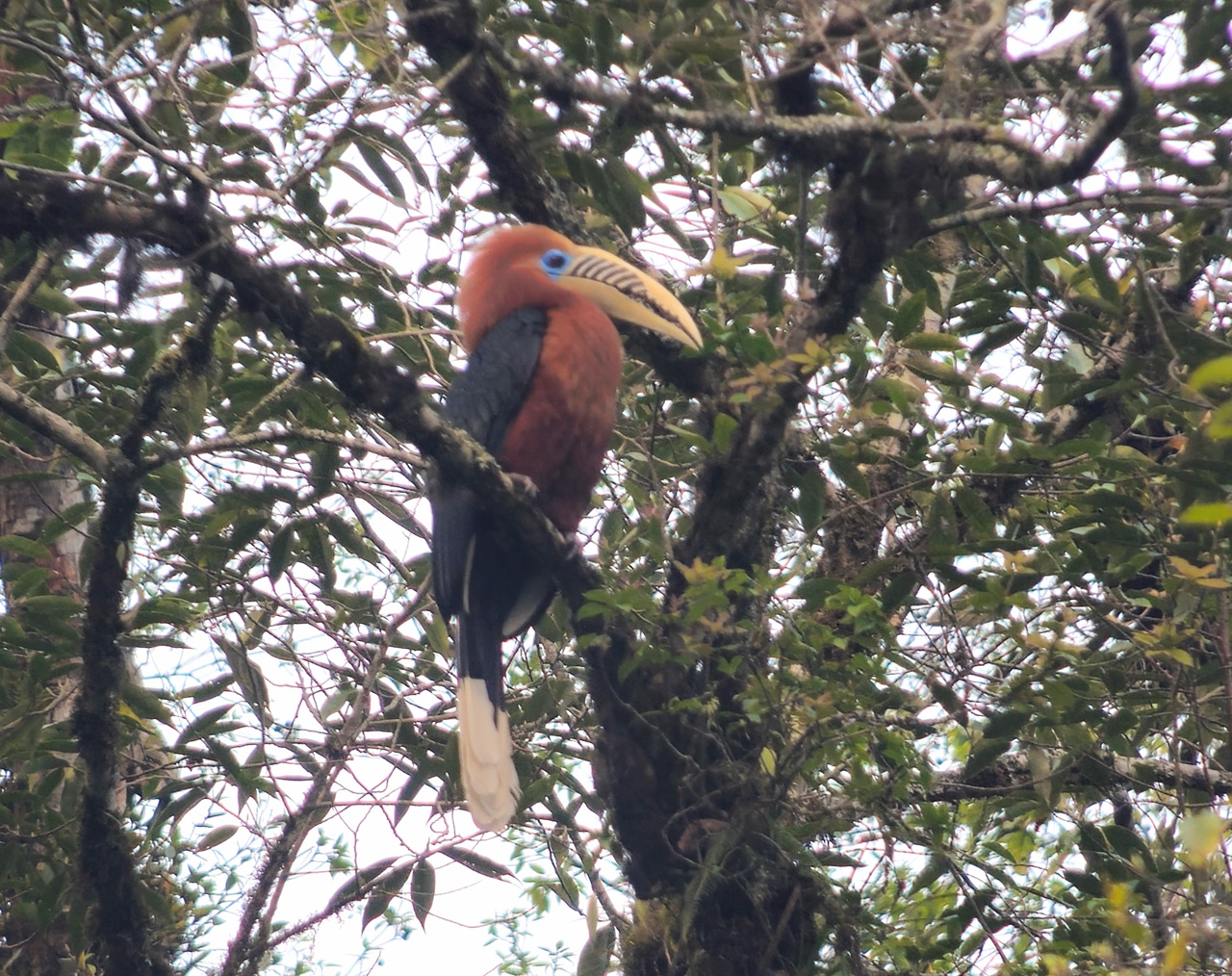
Rufous-necked Hornbill © Mike Hoit
The supporting cast to these main players was no less appreciated. Red-tailed and Blue-winged Minlas, Whiskered and White-naped Yuhinas and Rufous Sibias are typical flock species, vocal White-browed and Black-eared Shrike-babblers (actually related to vireos!) showed well, and Darjeeling Woodpecker, Yellow-bellied Fairy-Fantail, and nesting Sikkim Treecreepers entertained, while even close to the lodge Rufous-necked Laughingthrushes hopped around fields.
All, of course, with hot breakfasts and lunches out in the forest – and, on one occasion, the crew gave us a chance to try playing khuru. This is the Bhutanese pastime of outdoor darts, which are hurled with spin at a target around twenty-five metres away. Needless to say, our attempts were less adept than those of the crew.
A night walk one evening failed to turn up the difficult Hodgson’s Frogmouth, unsurprisingly, but we had a great look at Grey Nightjar, and located two species of nocturnal flying-squirrels: the awesome Bhutan Giant, and the smaller Hairy-footed.
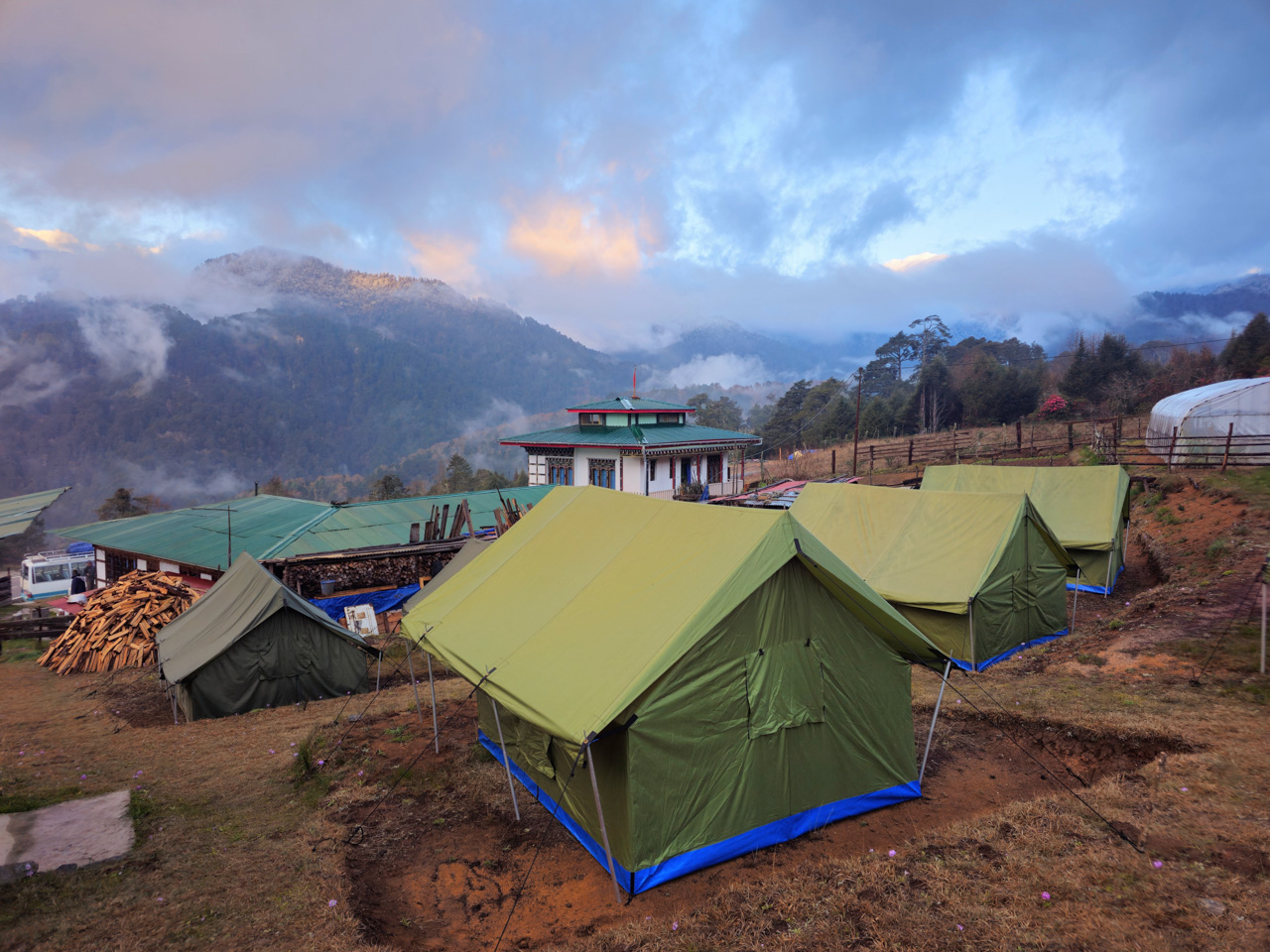
Morning at Sengor campsite © Mike Hoit
On day eight, we moved higher, birding through chestnut and rhododendron forest before entering the conifers as we neared 3000 metres above sea level.
Here, we found Little Forktails around a spectacular waterfall, the Namling Brrak, got some nice views of Chestnut-headed Tesia, and, during a very fortunately-timed photo stop, an extremely close and dazzling Fire-tailed Myzornis.
A profusely-flowering patch of rhododendron close to our camp, in alpine pasture, had attracted a frenzy of nectar-feeding birds, including several spectacular Fire-tailed Sunbirds. As the evening drew in, Satyr Tragopans began calling from the forests, and Himalayan Owls were hooting: what an experience.
Day 9: Sengor to Trongsa.
After a rainy night, we woke to see forest on the higher ridges dusted with snow. Down here in Sengor the fields were clear, and we enjoyed good views of Red-billed Chough, and both Speckled and Snow Pigeons. Climbing higher towards Thrumshing La, the deposits of snow lay ever more thickly, coating the moss-draped hemlock forest. A beautiful setting, but for birds it was extremely quiet, and as further snow fell we cut our losses and moved on to avoid the risk of travel disruption.
This sadly curtailed our search for Red Panda, but at the pass itself we found fresh prints of two animals and tracked them a way down the road before the trail disappeared into the forest. A near-miss! Blood Pheasants, however, did not disappoint and we had multiple sightings close to the road, the colours looking stunning against the pristine snow. Moving lower, we started to pick up montane birds such as Rosy Pipits, Grey-crested Tit, Goldcrest and a superb male White-throated Redstart.
Condition were a little more pleasant down in the Ura Valley, and as well as a warming lunch we found a large flock of Plain Mountain Finches (pushed down from high altitudes by the weather), as well as Hodgson’s Redstart, Rufous-breasted Accentors and Black-rumped Magpies.
Cutting back to the main highway, we happened upon a key species for the tour: a spectacular male Satyr Tragopan, out and about mid afternoon! This highlight was more or less it for birding for today: with continuing poor weather on the higher passes, we headed for Trongsa to enjoy our lovely hotel for a touch longer than usual.
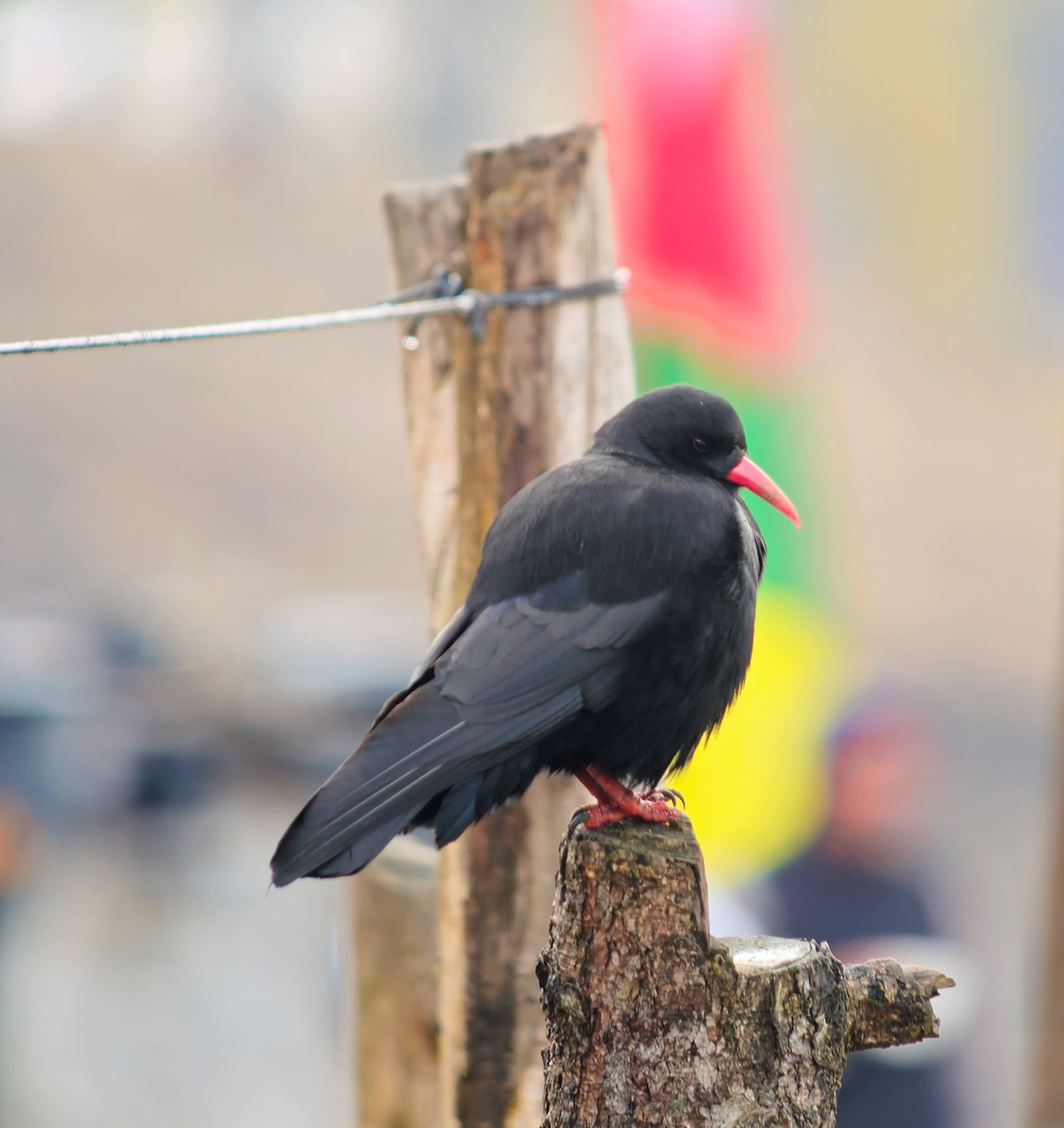
Red-billed Chough © Mike Hoit
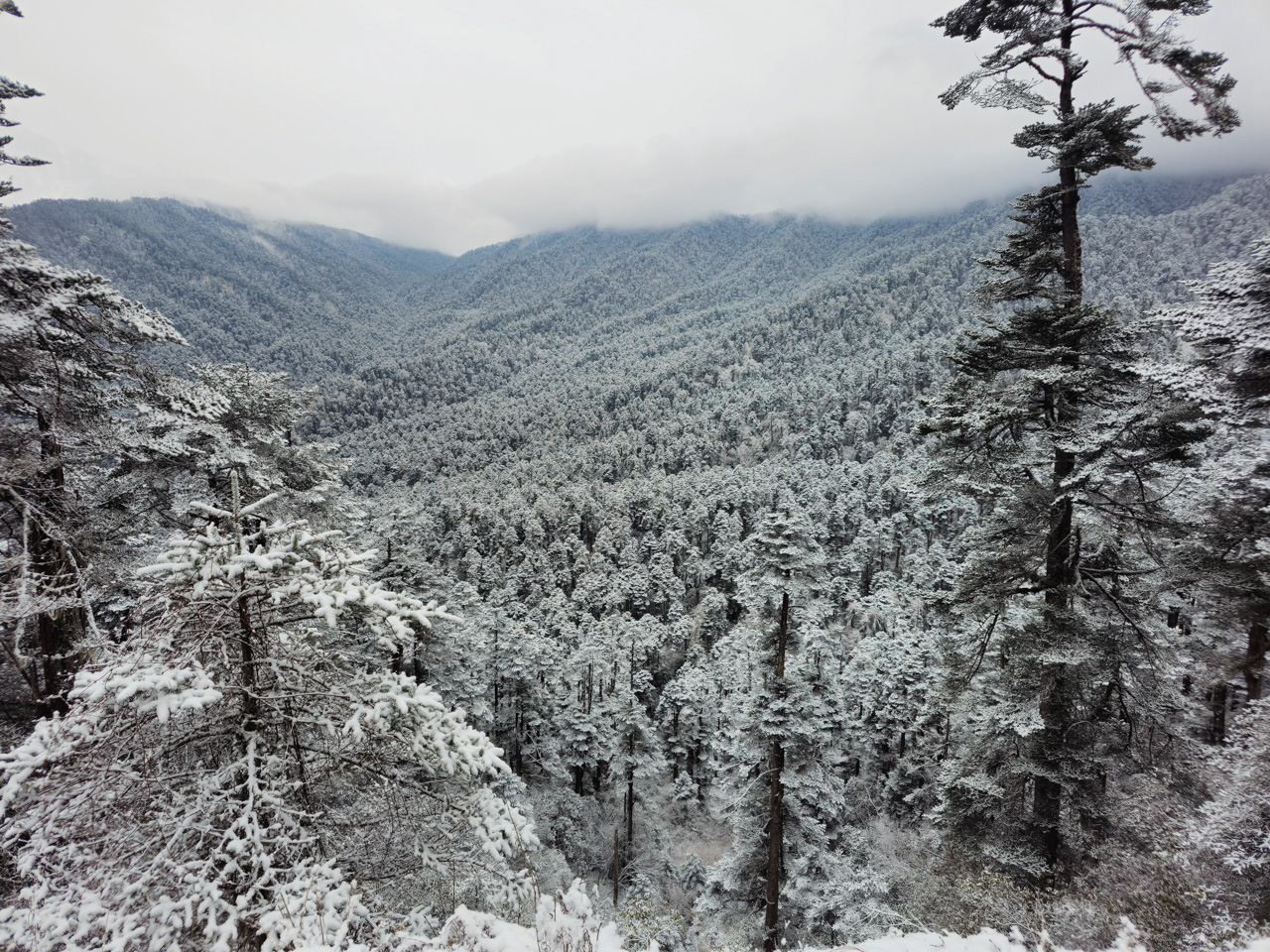
Thrumshing La © Mike Hoit
Day 10: Trongsa to Tingtibi
It was still chilly and damp at dawn, but birding close to the hotel was productive, with Common Cuckoos (cuckoo-ing in full view) and Tickell’s Leaf Warblers both being new. More surprising was a singing Russet Bush-warbler, normally a difficult to see high altitude species, which proved very responsive and hopped around in the open!
The only aim for today was to reach Tingtibi at a reasonable hour, allowing for a leisurely travel day with a number of birding stops. Early sightings included Grey-winged Blackbird and Crested Bunting, while at the well-chosen breakfast stop were Blue-throated Flycatcher, Rufescent Prinia and a pair of Yellow-throated Martens. Slaty-backed Forktail, Large-billed Leaf Warbler, and very close looks of Black and Rufous-bellied Eagles and three species of barbet entertained through the morning, only to be trumped by a Great Hornbill waiting to greet us at lunch. Along the way, we also had some great encounters with the beautiful and range-restricted Golden Langur.
Before reaching camp, we decided to make a quick check of the Mangde Chhu for one of the prize birds of the area, despite it not being the best time of day. And lo and behold, there it was: a huge, elegant White-bellied Heron! We all had good scope views before it flew off downstream sadly now an incredibly rare bird in serious trouble, but what a privilege to see such a magnificent creature in a pristine forested river valley.
After this early success, we settled into an idyllic campsite for two nights, rounding out the day with Striated Yuhinas and two showy cuckoos: Square-tailed Drongo and Plaintive.
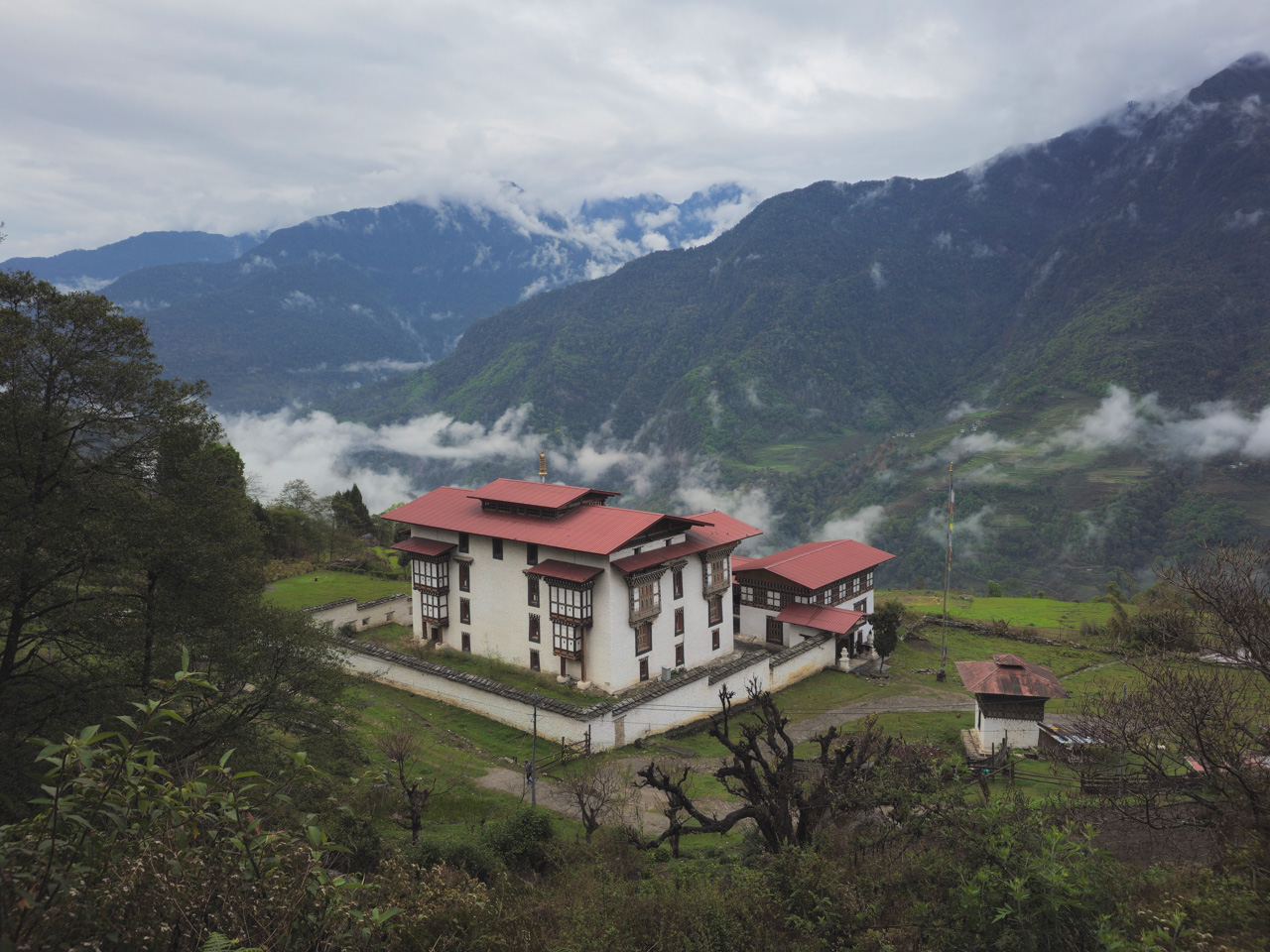
Kuenga Rabten Shedra winter palace © Mike Hoit
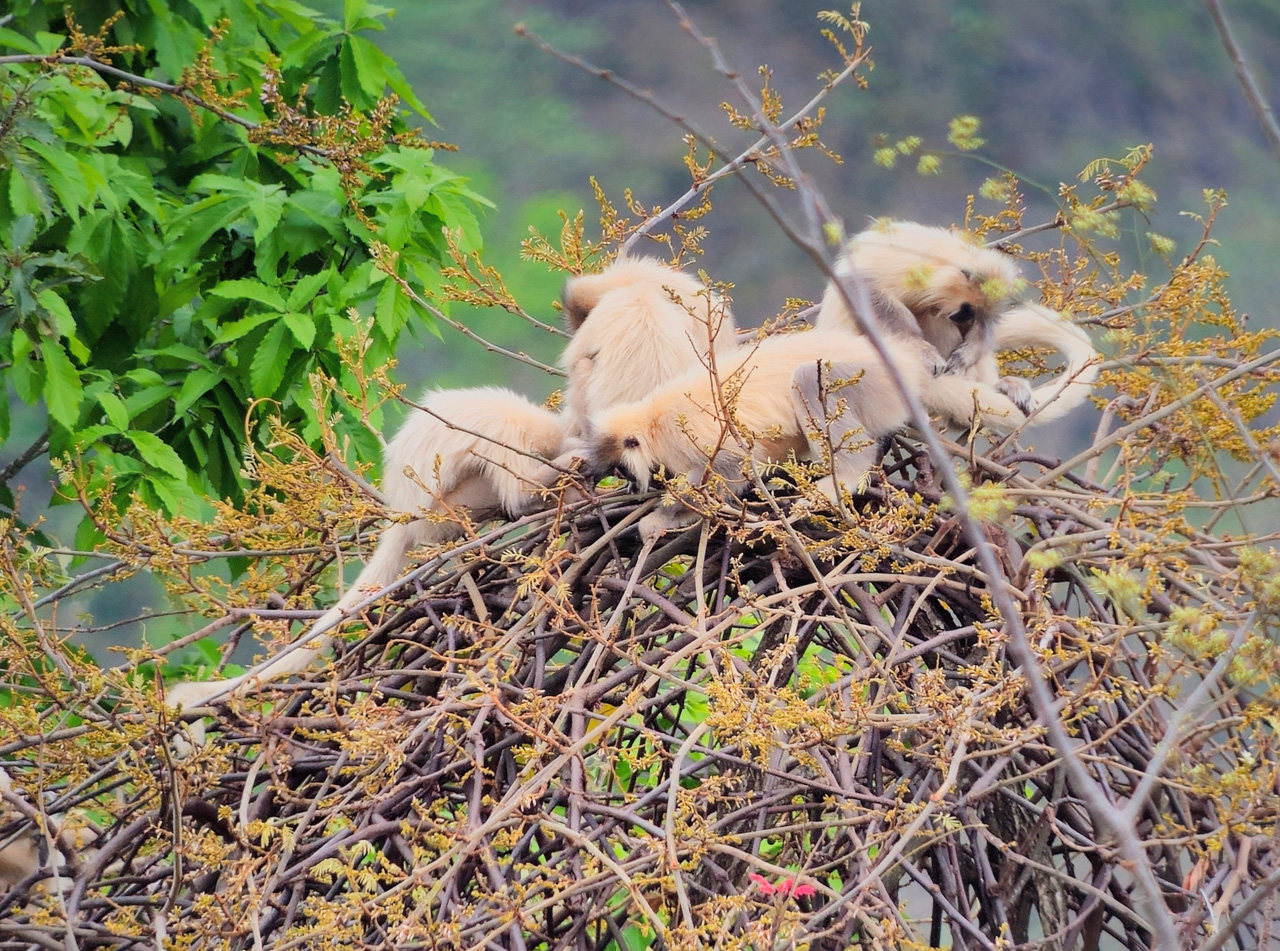
Golden Langurs © Mike Hoit
Day 11: Tingtibi
Tingtibi camp is nestled within the vast and beautiful Royal Manas National Park, at lower altitudes than we had become accustomed to. We had a full day exploring the forests between 500 and 700 metres above sea level, while of course being catered for by the camp crew.
Close to the campsite, we found bamboo specialists such as Pale-billed Parrotbill, White-hooded Babbler and Yellow-bellied Warbler, had good views of the scarce Pale Blue Flycatcher, watched an Asian Barred Owlet being bullied by Rufous Sibias, and enjoyed a majestic flypast from a pair of Great Hornbills.
In hillier sections were Rufous-necked Hornbills in equally-impressive flight action, sneaky Common Green-Magpies, and more Golden Langurs. A very enjoyable day, in lovely habitat with a minimum of travelling.
Day 12: Tingtibi to Phobjikha
After a final night under canvas, there was time for a little more birding around Tingtibi. We found a new bird in the shape of Fulvous-breasted Woodpecker, and Grey-throated Babbler finally showed well, but the birding was a little slow in grey conditions.
Like yesterday, a search for White-bellied Heron drew a blank – the birds have become less reliable here in recent weeks, highlighting just how lucky we were.
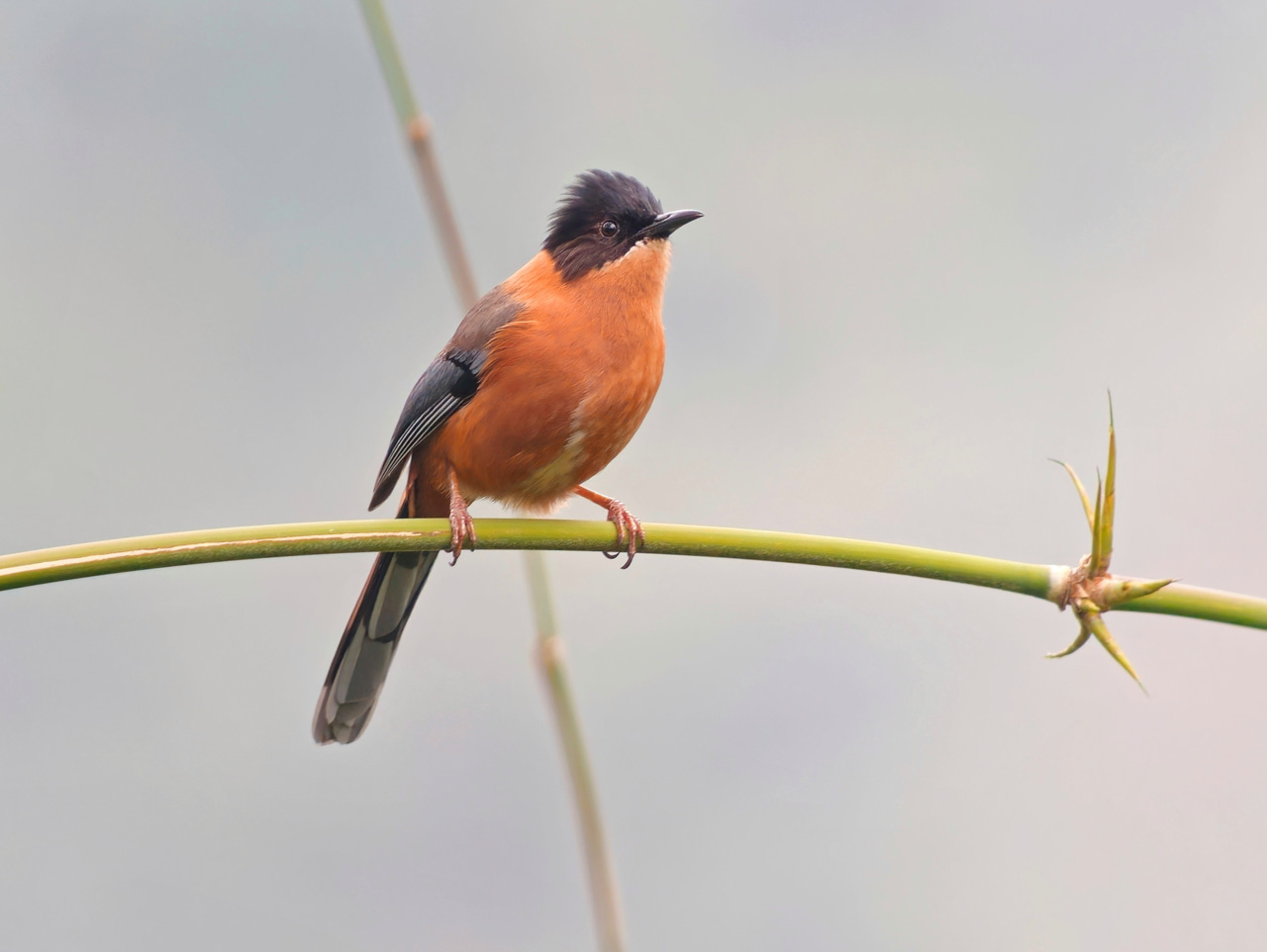
Rufous Sibia © Mike Hoit
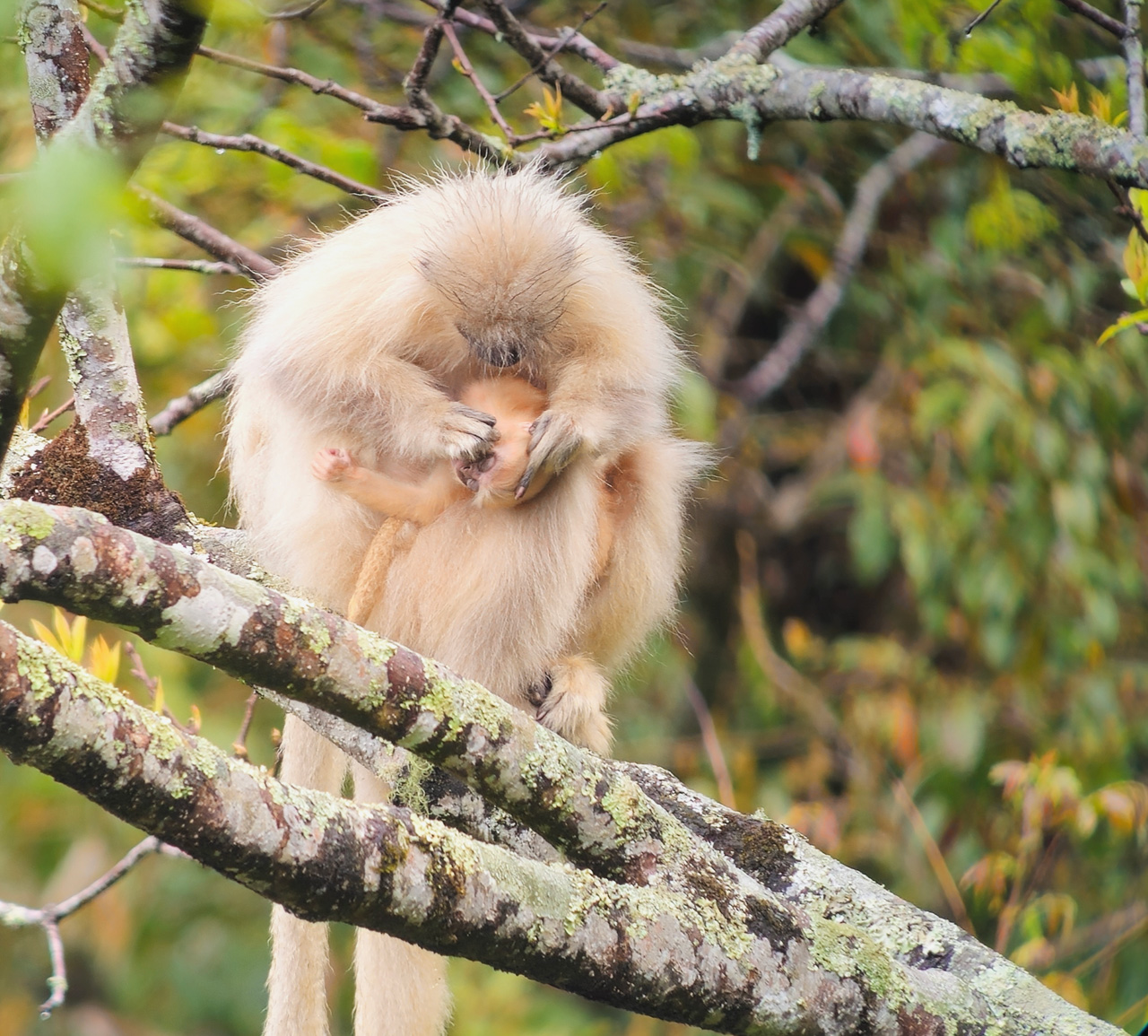
Golden Langur © Mike Hoit
The rest of the day was largely on the road: we hustled along towards Trongsa without too many stops (well, aside from cakes at Zhemgang Junction, naturally) so as to avoid a road closure. Prior to lunch a birding walk turned up a very showy roadside White-tailed Robin, plus a large and most enjoyable mixed flock, where Yellow-bellied Fairy-Fantails, White-tailed Nuthatches and Lemon-rumped Warblers showed, among others.
The now-expected delicious field lunch and stop to view the impressive Trongsa Dzong looming over a precipitous valley followed, before we continued up, up, up. With reports that a couple of Black-necked Cranes had lingered in their wintering grounds far later than usual, no time was wasted in pushing on over the Pele La.
As soon as we reached the agricultural area of the Phobjhika Valley, two statuesque birds were spotted! Surprisingly, the duo comprised an adult and one of its offspring from last year, presumably delayed from making their spring migration by recent cold and wet weather. With this big (both literally and figuratively) bonus in the bag, we enjoyed the scenery of this beautiful montane valley en route to the latest cosy hotel.
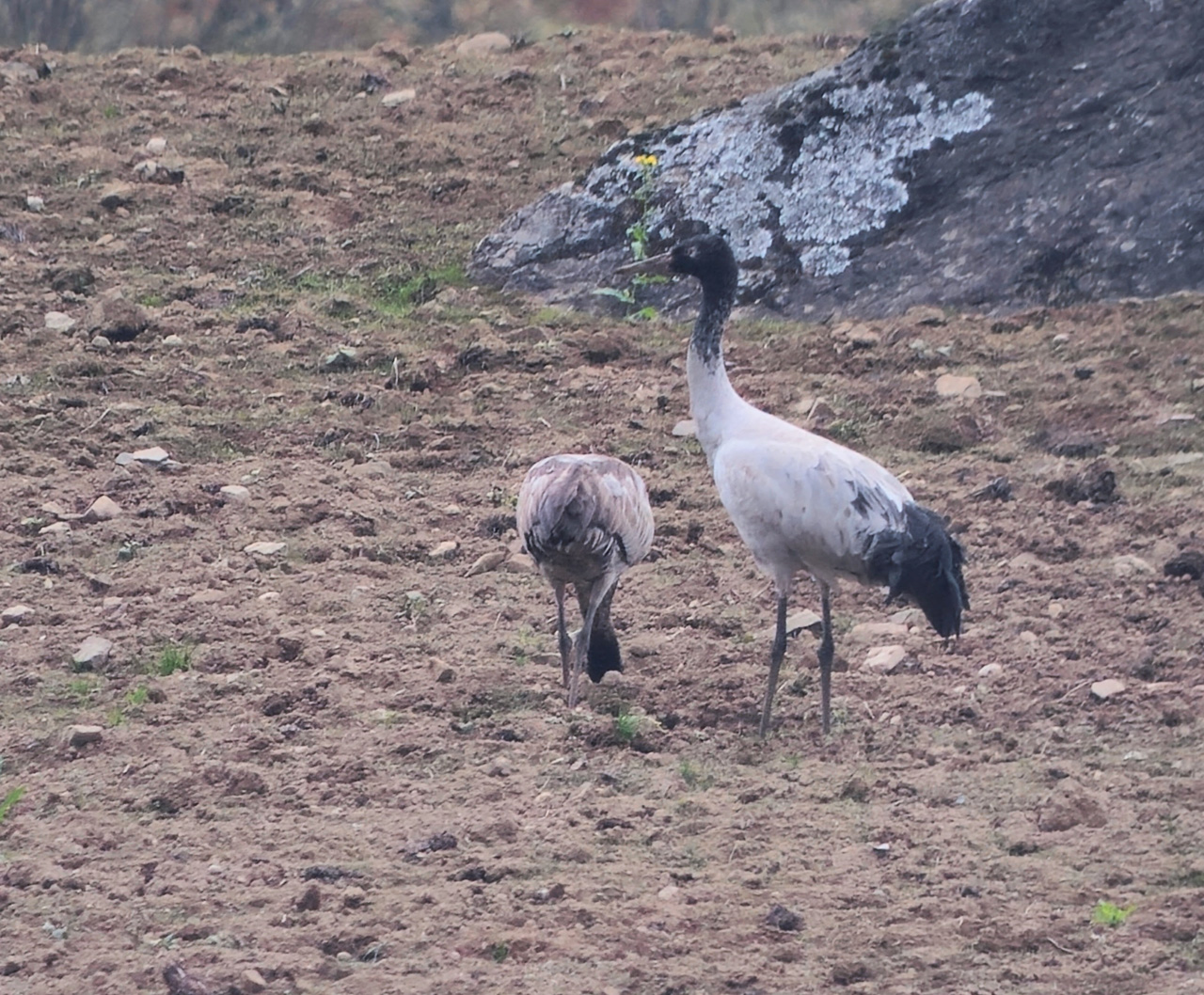
Black-necked Cranes © Mike Hoit
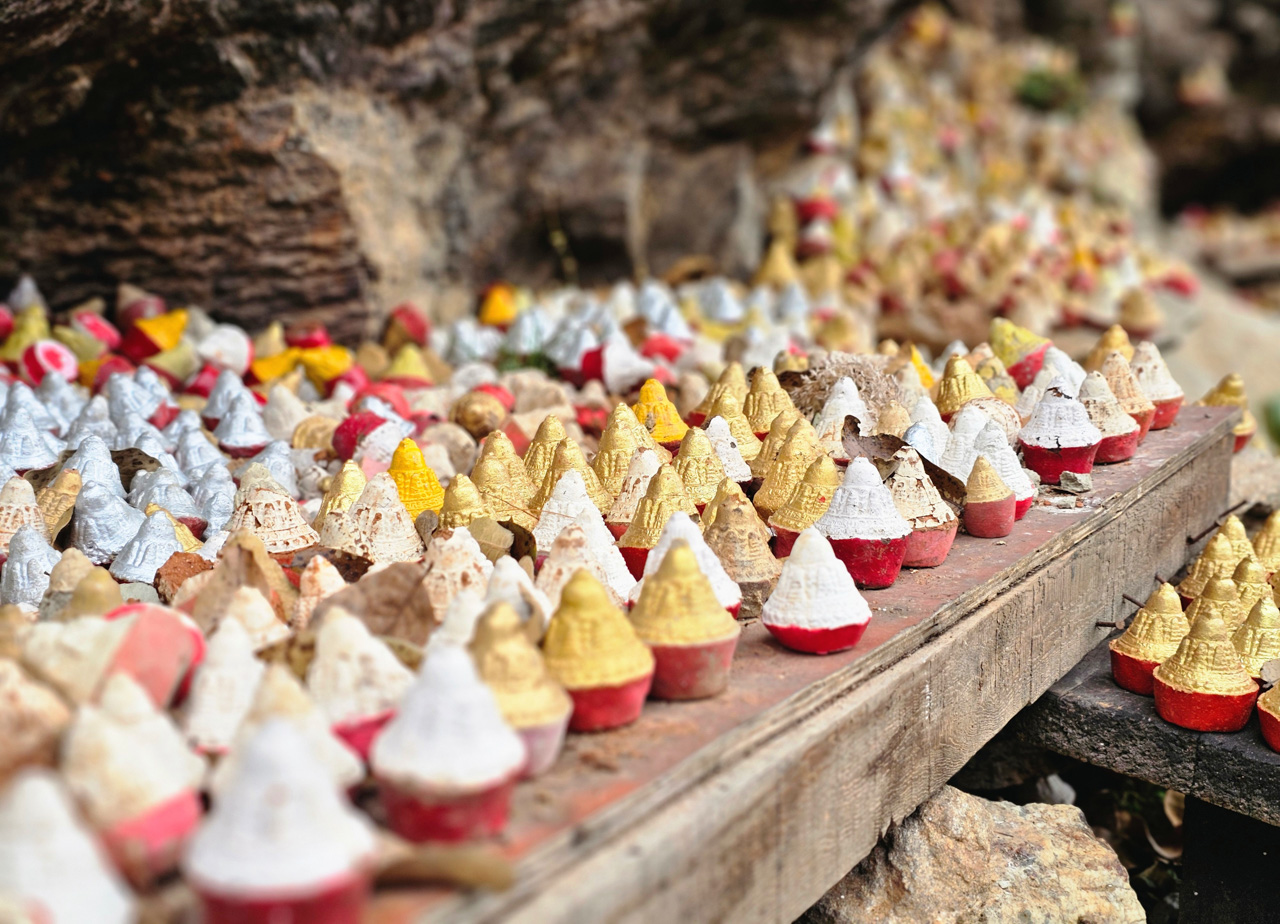
Mini chortens © Mike Hoit
Day 13: Pele La to Punakha.
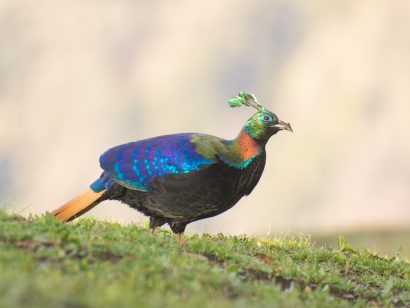
A full morning was spent around the Pele La (3250-3440m above sea level), with mostly clear skies for a change, and some really excellent birds. Males of Himalayan Monal and Satyr Tragopan, started us off well, followed quickly by nest-building Fire-tailed Myzornis.
A hot field breakfast was much needed up at these chilly altitudes, giving some energy for further explorations. Some Crimson-browed Finches feeding quietly at close range were perhaps the highlight, though we also turned up Spotted and Black-faced Laughingthrushes, Alpine Accentor, Grey-sided Bush-warbler, Dark-rumped and Himalayan White-browed Rosefinches, and Hoary-throated Barwing, amongst others. As the valley below warmed up, Himalayan Griffon Vultures took to the air and gave a spectacular display.
Dropping downhill a little, the birds kept coming at lunch – often the case in this part of the world. Some nice mixed flocks performed well, everyone caught up with Whistler’s Warbler and Golden-breasted Fulvetta, and we got some good views of Scaly-breasted Cupwing and Pygmy Flycatcher.
In the afternoon, it was time for something completely different! The Puna Tsang Chhu is one of the few rivers that acts as a migration flyway, giving the potential for both a boost to the trip list and an unpredictable combination of birds. Today, the birding was exceptional: we found an outstanding selection of rare and scarce passage migrants, likely held up by the weather.
The best find was a Desert Wheatear – perhaps only the fourth record for Bhutan – but also present were Tibetan Sandplover, Kentish Plover, a flock of gulls comprising, Black-headed, Brown-headed, and the awesome Pallas’s Gulls, Ruddy Shelducks accompanied by a few Bar-headed Geese,a Falcated Duck, Garganey, and Common Pochards among commoner ducks, and Siberian Stonechat.
Tonight’s hotel featured views across Punakha, with the dzong illuminated at the confluence of the rivers.
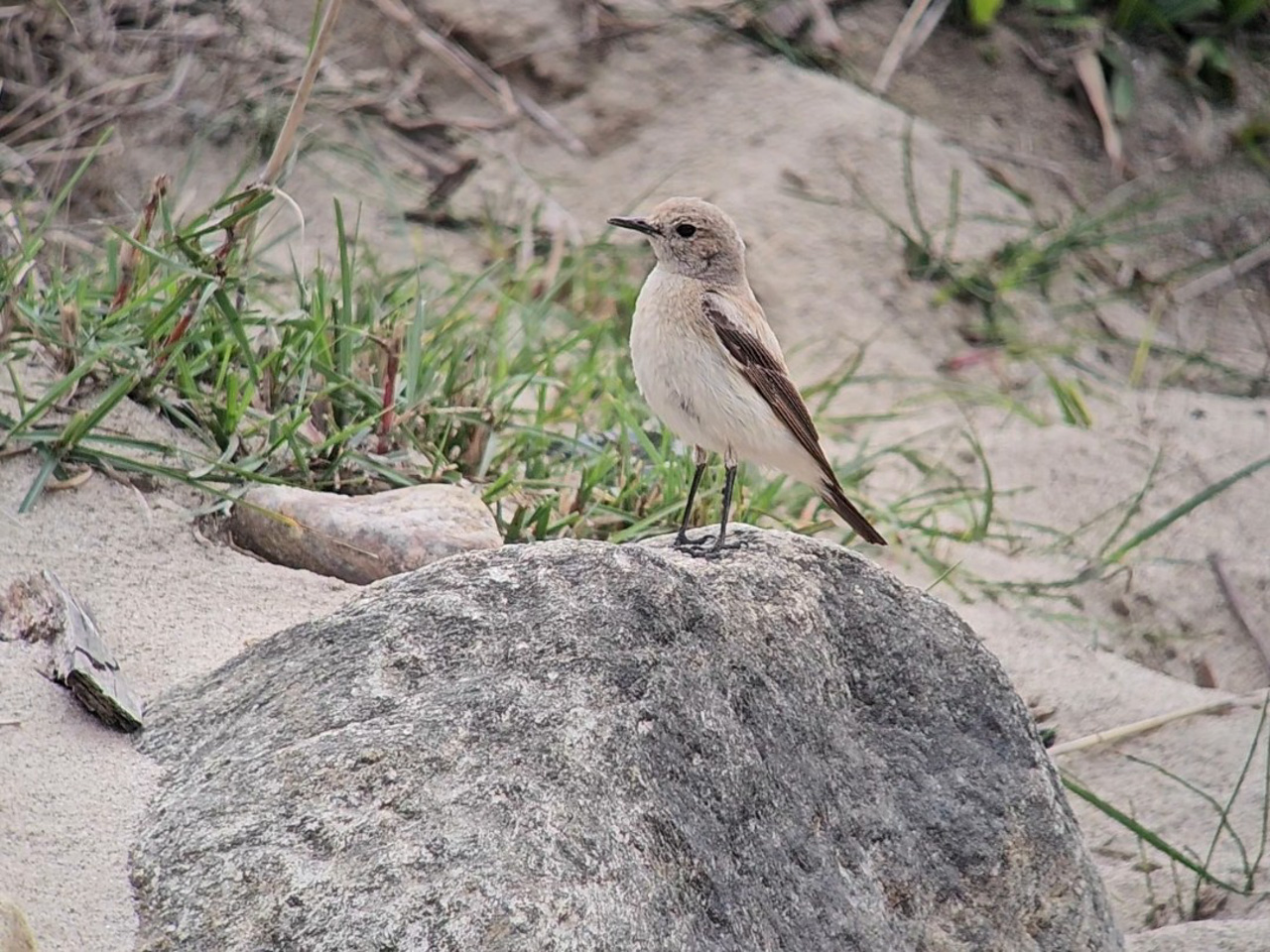
Desert Wheatear Bajo © Mike Hoit
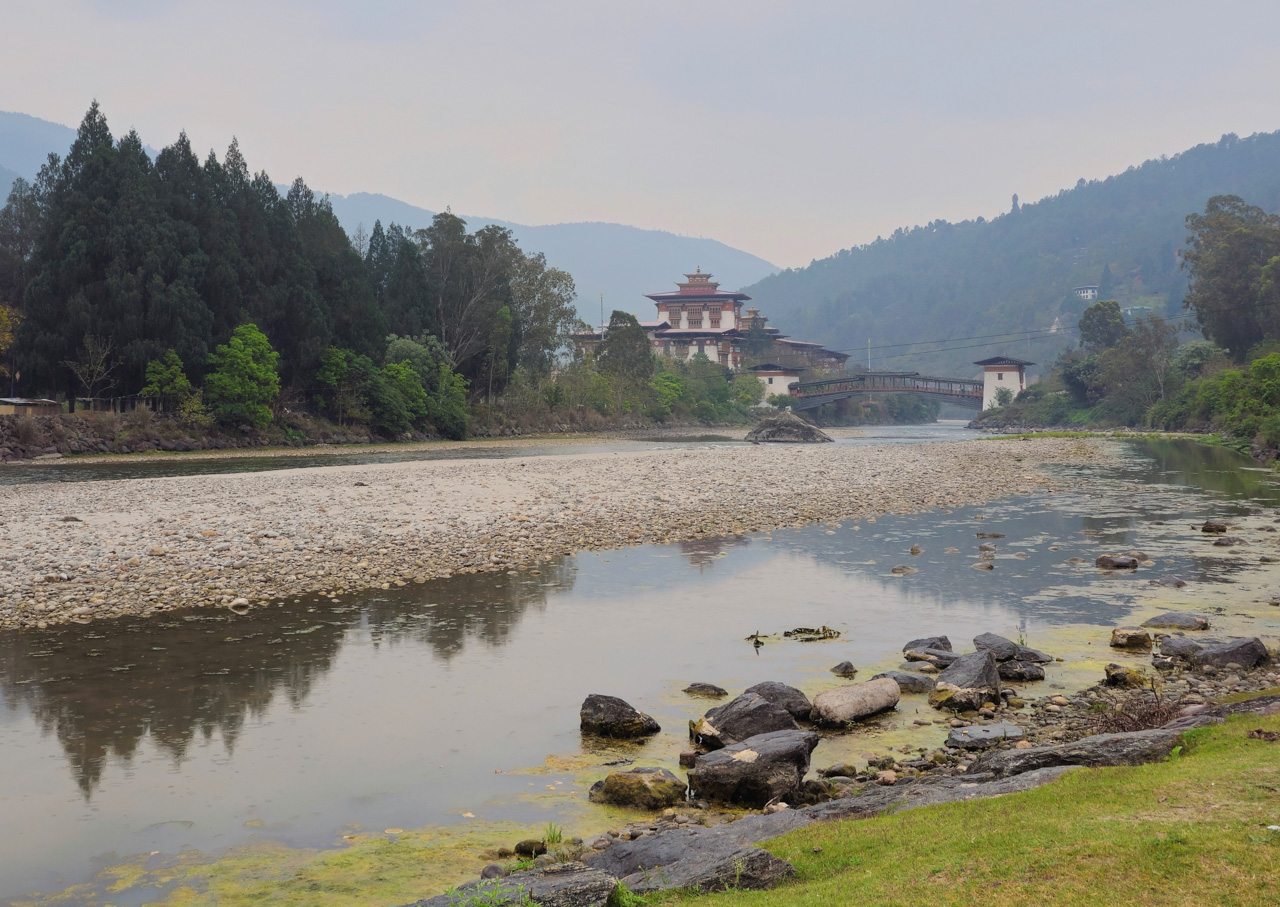
Punakha dzong © Mike Hoit
Day 14: Jigme Dorji National Park, Punakha and on to Thimphu
The lovely Jigme Dorji National Park covers a huge swathe of Bhutan north of Thimpu and Punakha. This morning we visited the latter section by heading up the Mo Chhu valley, for some final birding in mid-elevation broadleaved forest. On the way, we found a migrant flock of Pied Avocets and Crested Kingfishers along the river, before being greeted by Slaty-backed Forktails and Hair-crested Drongos. Birding slowly along the road, large numbers of Nepal House-Martins flew over, we had close views of River Lapwings, Small Niltava, and Dark-sided Flycatchers. After some post-breakfast searching we found a family of brilliant Tawny Fish Owls: one of the adults perched fully in view, while a pair of fully-grown but still fluffy youngsters were among the foliage.
Back in town, the next stop was one of the tour’s cultural highlights. Punkaha Dzong is a magnificent building, for the first three hundred years of its existence the seat of Bhutan’s government, and still an important site.
Tshering gave us a fantastic and insightful tour of the complex, including the awe-inspiring central temple a very special experience. Of course, there were also birds around the dzong, especially in the fragrant lilac trees and around the giant rock bee hives large numbers of Ashy Drongos and Black Bulbuls, and Hodgson’s and Black Redstarts. Lunch was taken on the riverbank nearly, complete with Red-crested Pochard, “Tibetan” Citrine Wagtails and breeding White-browed Wagtails.
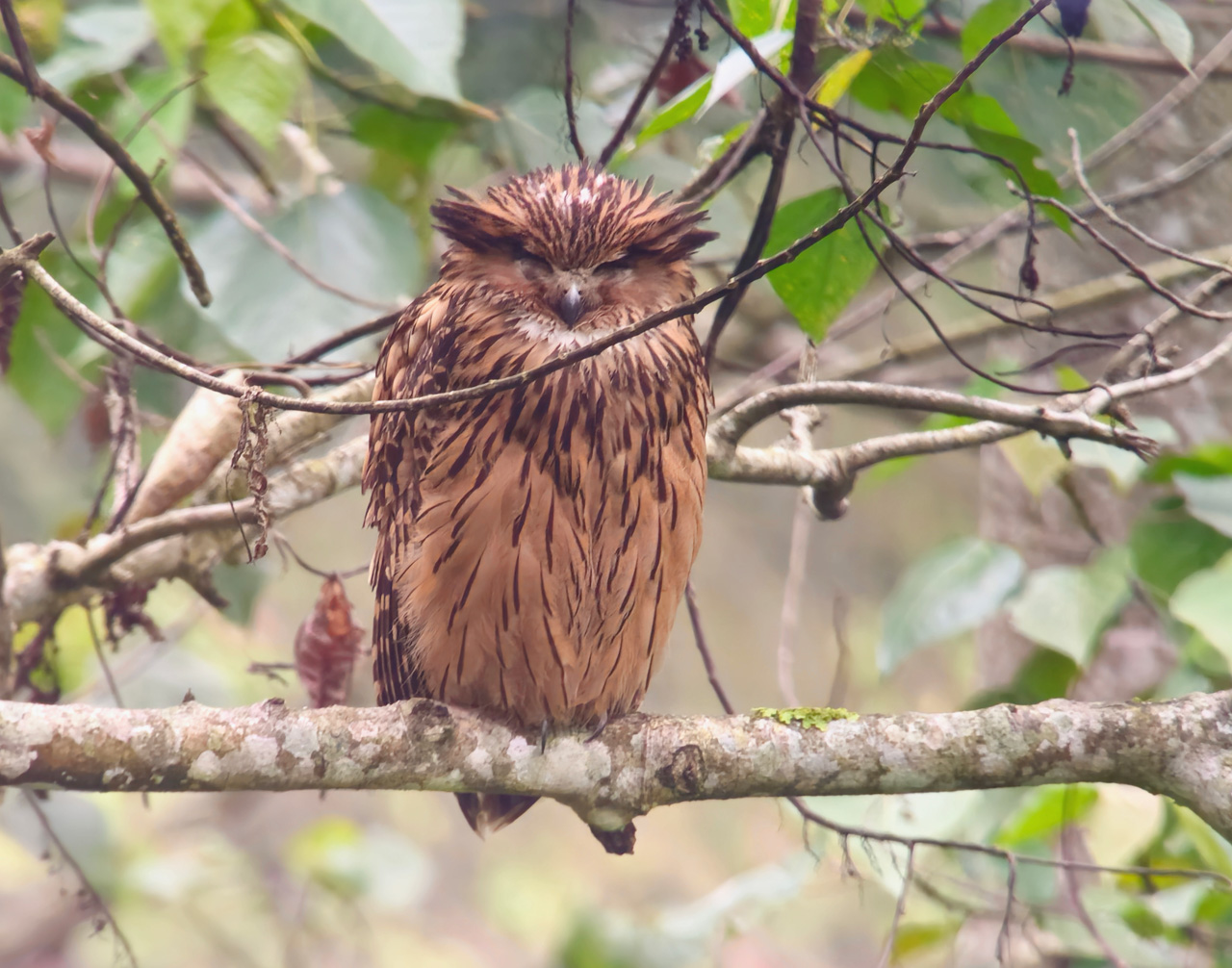
Tawny Fish Owl © Mike Hoit
Our afternoon birding location on this varied day was at the 3100 metre high Dochu La, and unfortunately severely hampered by low cloud. However, we still obtained close views of Spotted, Chestnut-crowned, Black-faced and White-throated Laughingthrushes, and Common Hoopoe, and some particularly fine cakes. From there it was a short journey down into Thimpu on a sunny evening.
Day 15: Cheri Valley and Paro
The morning began in unpromising fashion: cold and increasingly rainy, and with one of our number (ahem) having been separated from their walking boots. Things improved rapidly, however, and a great morning was had in the Cheri Valley section of Jigme Dorji NP. Along the road we had some brilliant views of several Alpine Thrushes, Himalayan Bluetail, Rufous-bellied Niltava, Brown Parrotbill, and a prolonged look at a Siberian Weasel.
Next up was the hike through the forest to Chagri Dorjeden Monastery, perched on a steep slope in a meadow home to habituated Himalayan Brown Gorals; we had close encounters with a few of these endearingly odd goat-antelopes.
Another stunning temple was visited, while seeing birds such as Snow Pigeon, Eurasian Jay, lots of Blue-fronted Redtarts, and White-tailed Nuthatch.
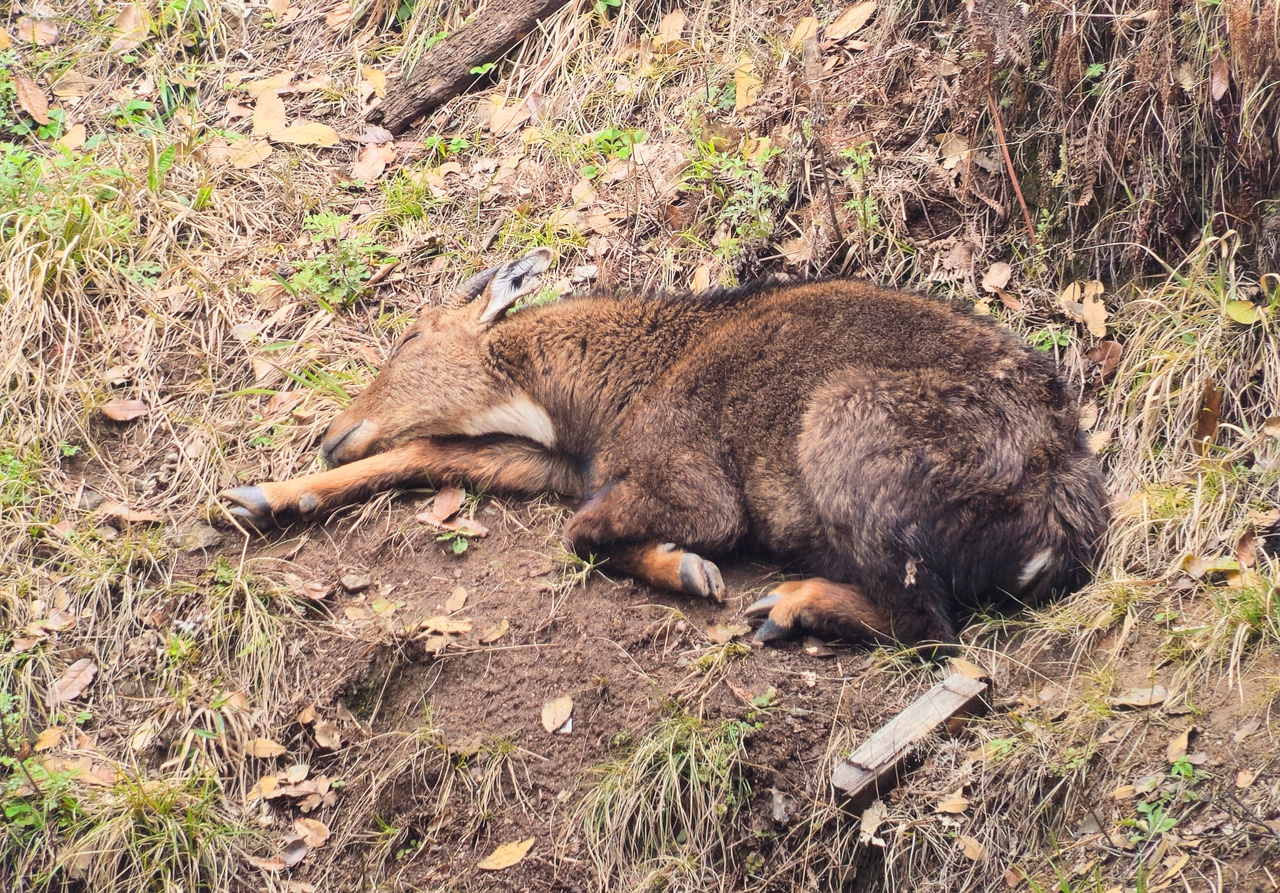
Himalayan Brown Goral © Mike Hoit
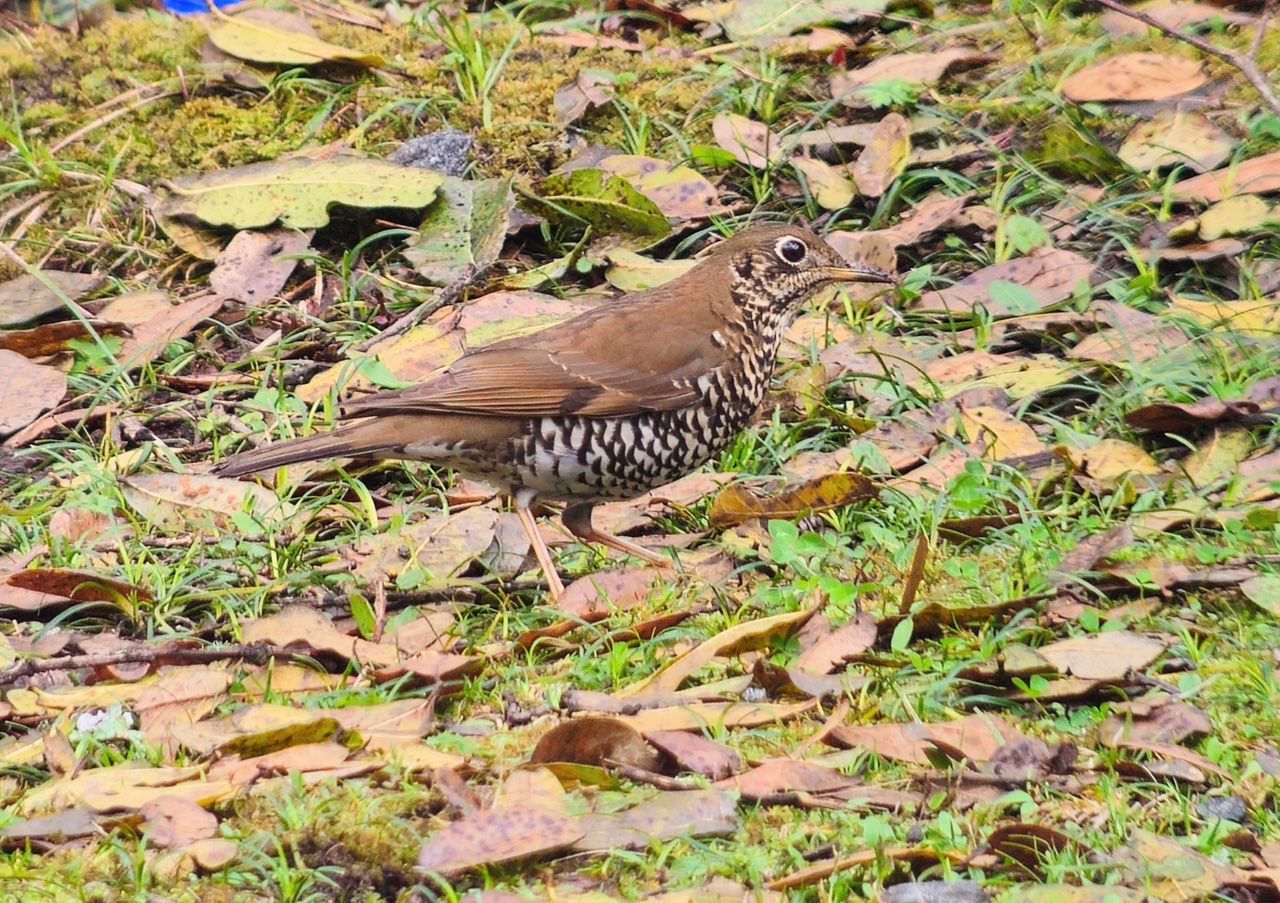
Alpine Thrush © Mike Hoit
The camp crew were, of course, waiting back down on the road to serve up lunch, before we were back on the road again. A drive-by tour of the capital city was a small insight into the most modern corner of Bhutan, before we punctuated the journey with several strategic stops in the Paro Valley.
Two more Tawny Fish Owls were near a convenient restroom break, there were point-blank views of our first Ibisbills, and a Black-tailed Crake performed at a traditional stakeout. It was nice to check into a hotel for no fewer than three nights made even nicer by the resident Eastern Barn Owl still being tucked up at her roost! Another brilliant day in the Himalayas.
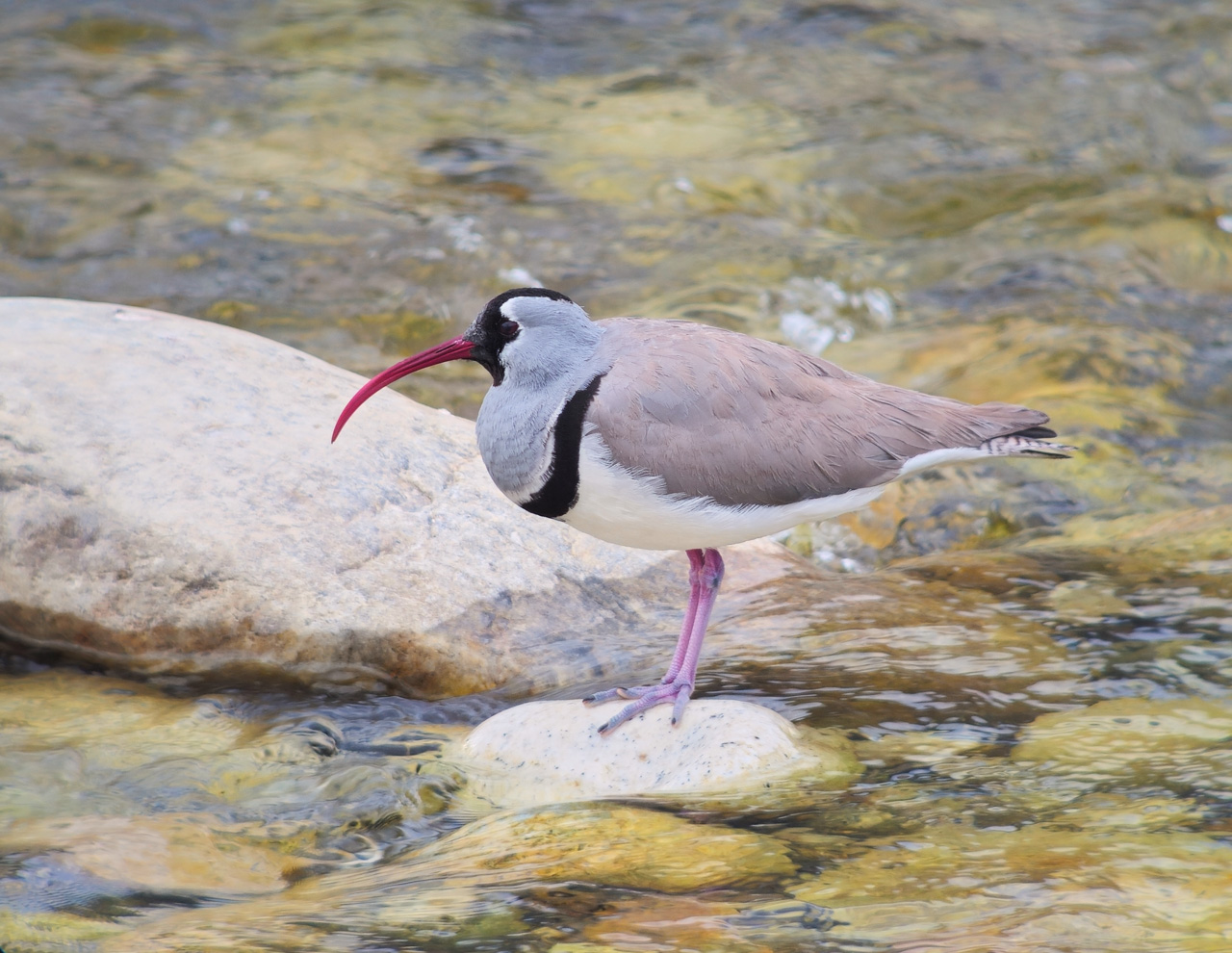
Ibisbill © Mike Hoit
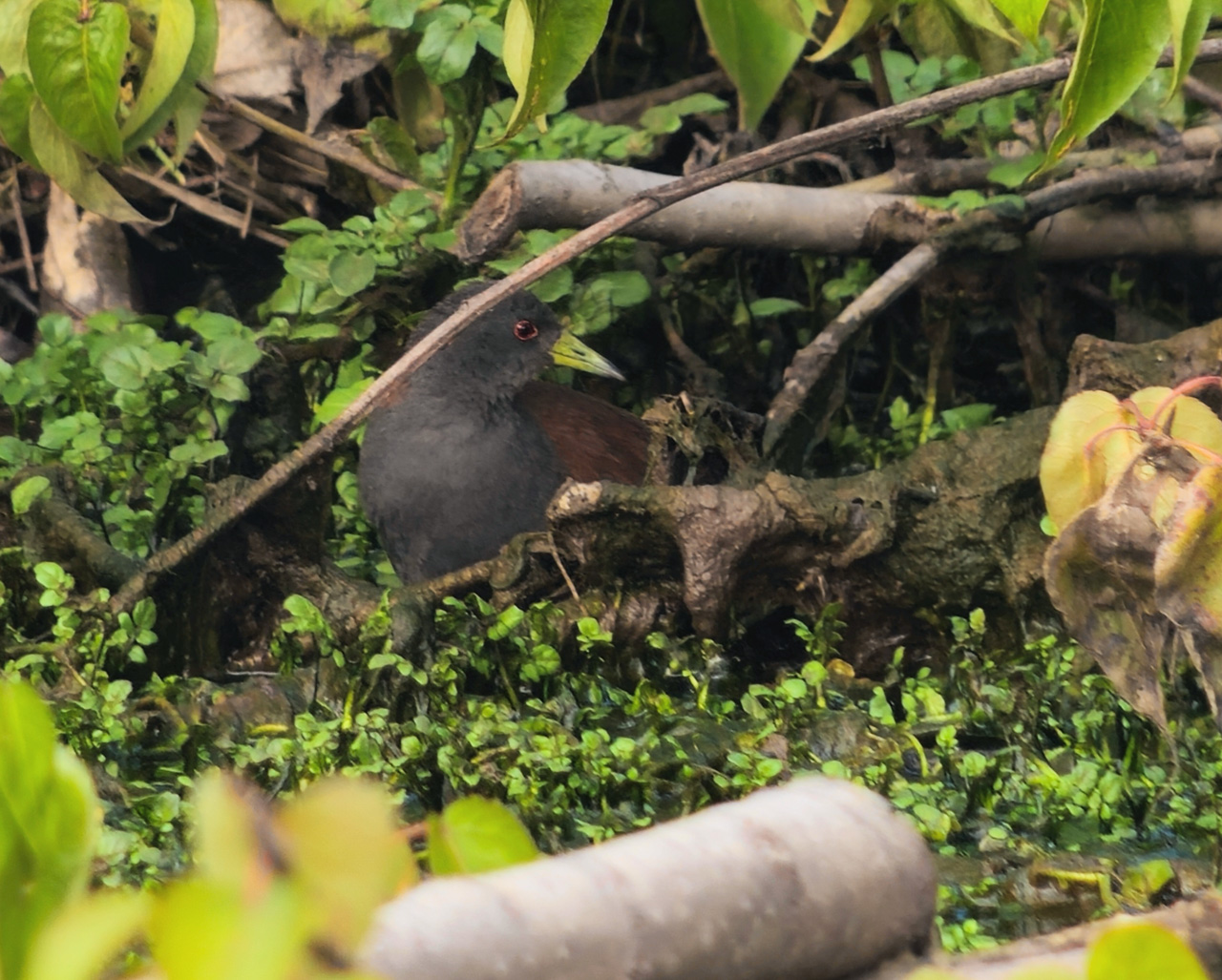
Black-tailed Crake © Mike Hoit
Day 16: Chele La and Paro valley.
This morning we reached the highest altitudes of the trip, just shy of 4000m above sea level; it required an even earlier than usual but before breakfast we had seen four species of pheasant!
A male Satyr Tragopan spent ten minutes strutting the roads, and a Himalayan Monal gave eye-popping views, among the more numerous (but no less good-looking) Blood and Kalij Pheasants.
Other highlights in the alpine zone and coniferous forests around the Chele La included Solitary Snipe, more monals, Upland Buzzard, Hen Harrier, White-browed Bush-robin, Himalayan White-browed Rosefinch, and both White-winged and Collared Grosbeaks, plus views down into the Haa Valley once the clouds had lifted, of course.
Two species of pika were also seen: Sikkim within the forest, and Large-eared above the treeline.
After this came a far sadder moment: the final field lunch provided by the crew, and a farewell with thanks for all their work.
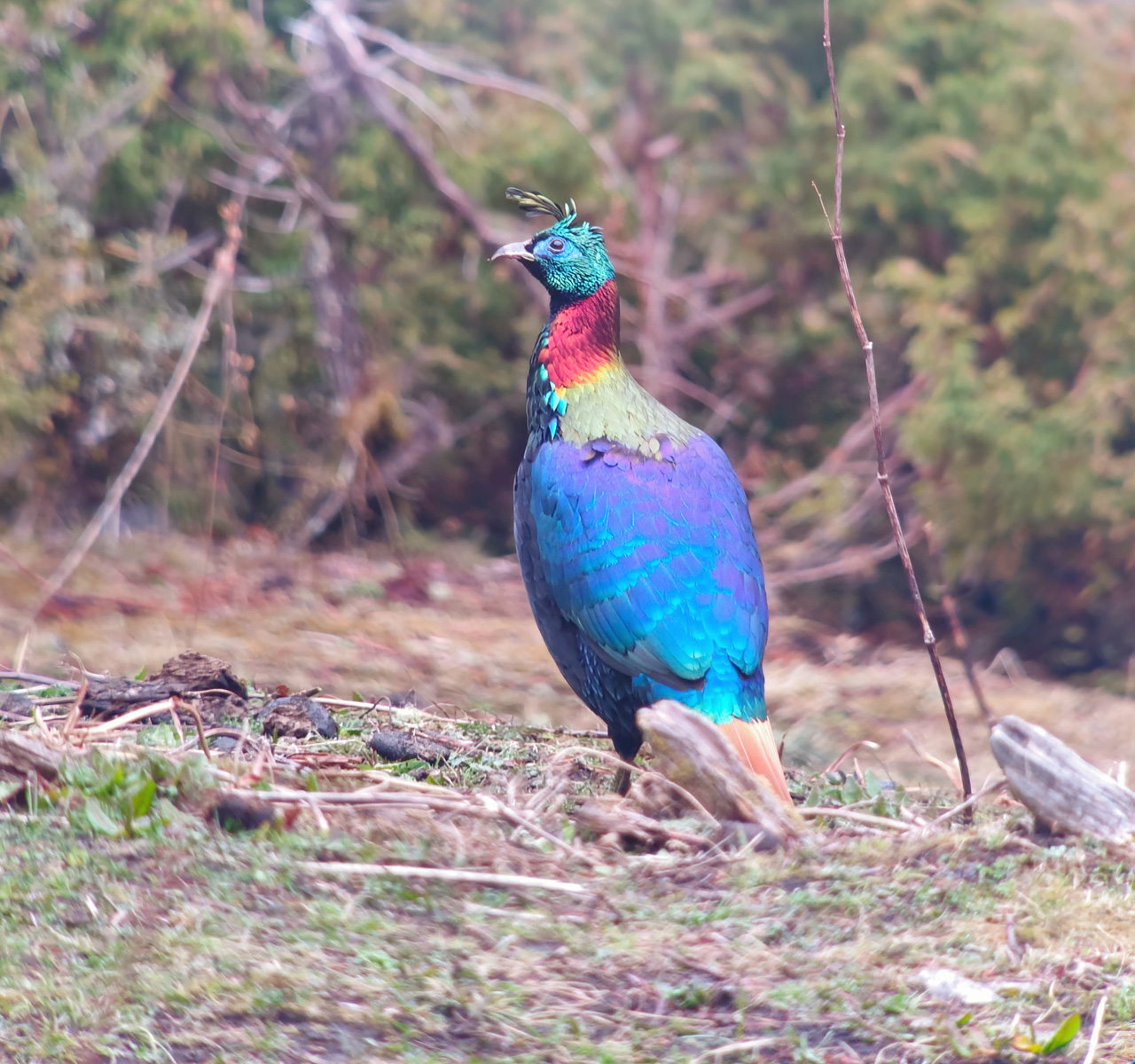
Himalayan Monal Chele La © Mike Hoit
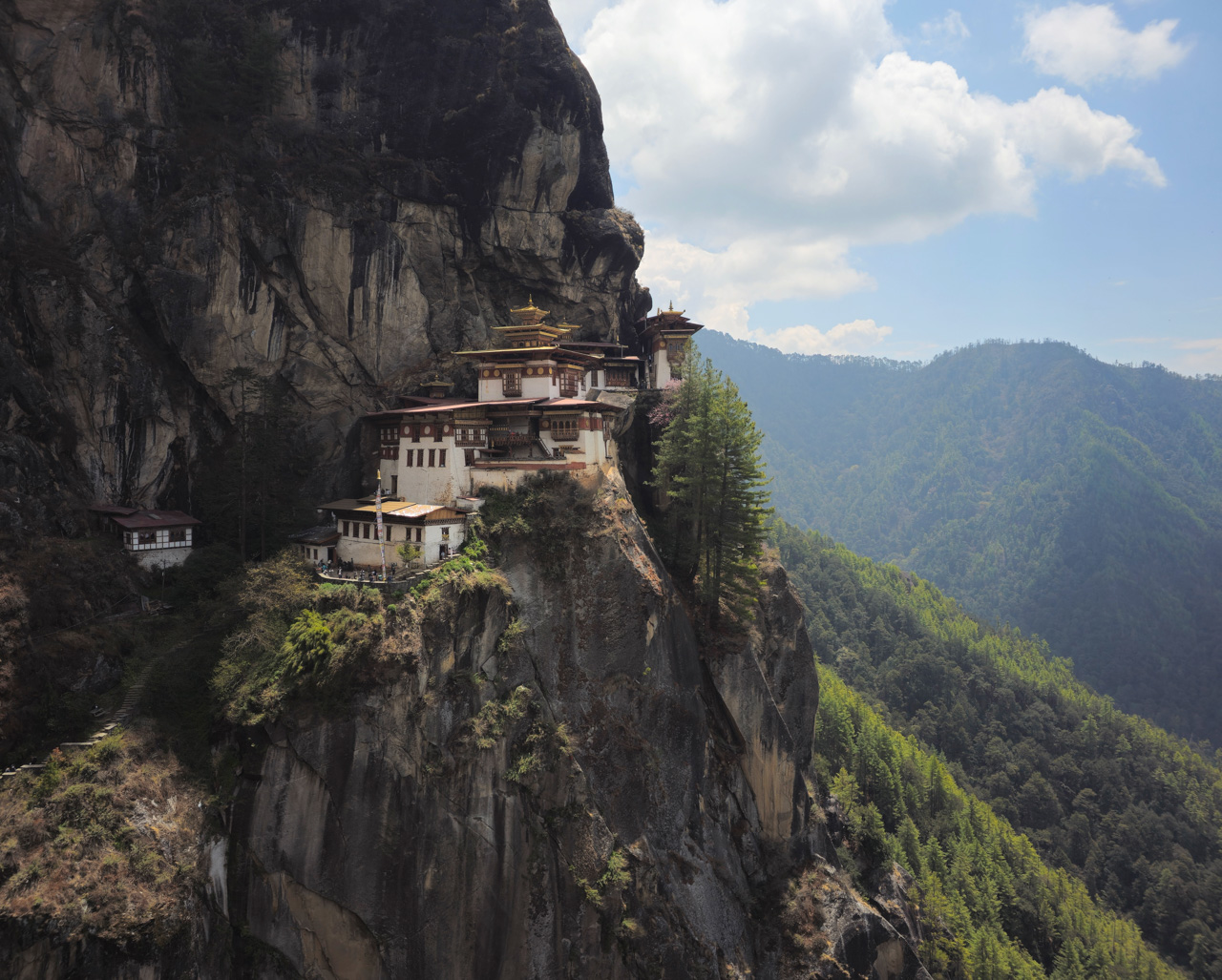
Tiger’s Nest Monastery © Mike Hoit
The afternoon was fairly relaxed, with some casual birding while sightseeing close to Paro. A large flock of Plain Mountain Finch around the beautiful Kyuchi Lhakhang temple was probably the pick, before coffees and ice creams in town distracted some of us.
Day 17: Tiger’s Nest Monastery and Paro Valley.
The final full day of the tour was upon us, and on the agenda was the Buddhist site that draws more visitors to Bhutan than any other: Paro Tkatskang, or Tiger’s Nest Monastery.
Those of us who braved the full 600 metre elevational gain were treated to a tour of the temple complex that is built on, and into, a sheer rock face – quite the experience. The hike to and from this remarkable place, passes through some birdy forest, and many of the inhabitants are quite tame: sightings included Rufous-bellied Woodpeckers, Streak-breasted Scimitar-babbler, Mrs Gould’s Sunbirds, White-throated and Chestnut-crowned Laughingthrushes and Yellow-billed Blue Magpies. On the cliff faces near the monastery itself were nesting Blyth’s Swifts, Asian House-Martins, and Peregrine Falcon.
After slowly making our descent, it was time to refuel at a buffet restaurant before more birding along the Paro Chhu. Diversity isn’t high here, but we managed some extra helpings of Ibisbills (with chicks) and Black-tailed Crake.
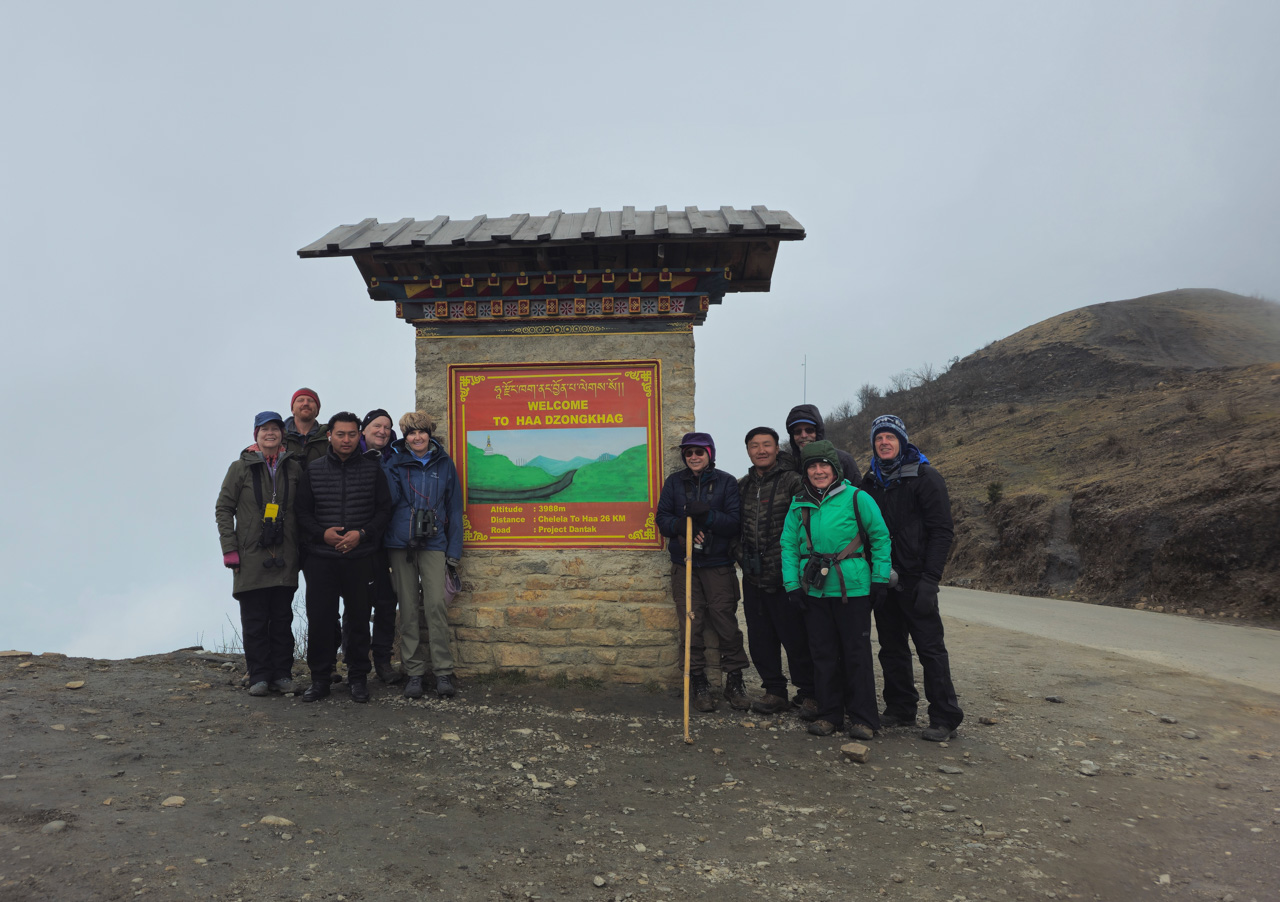
Group and guides Chele La © Mike Hoit
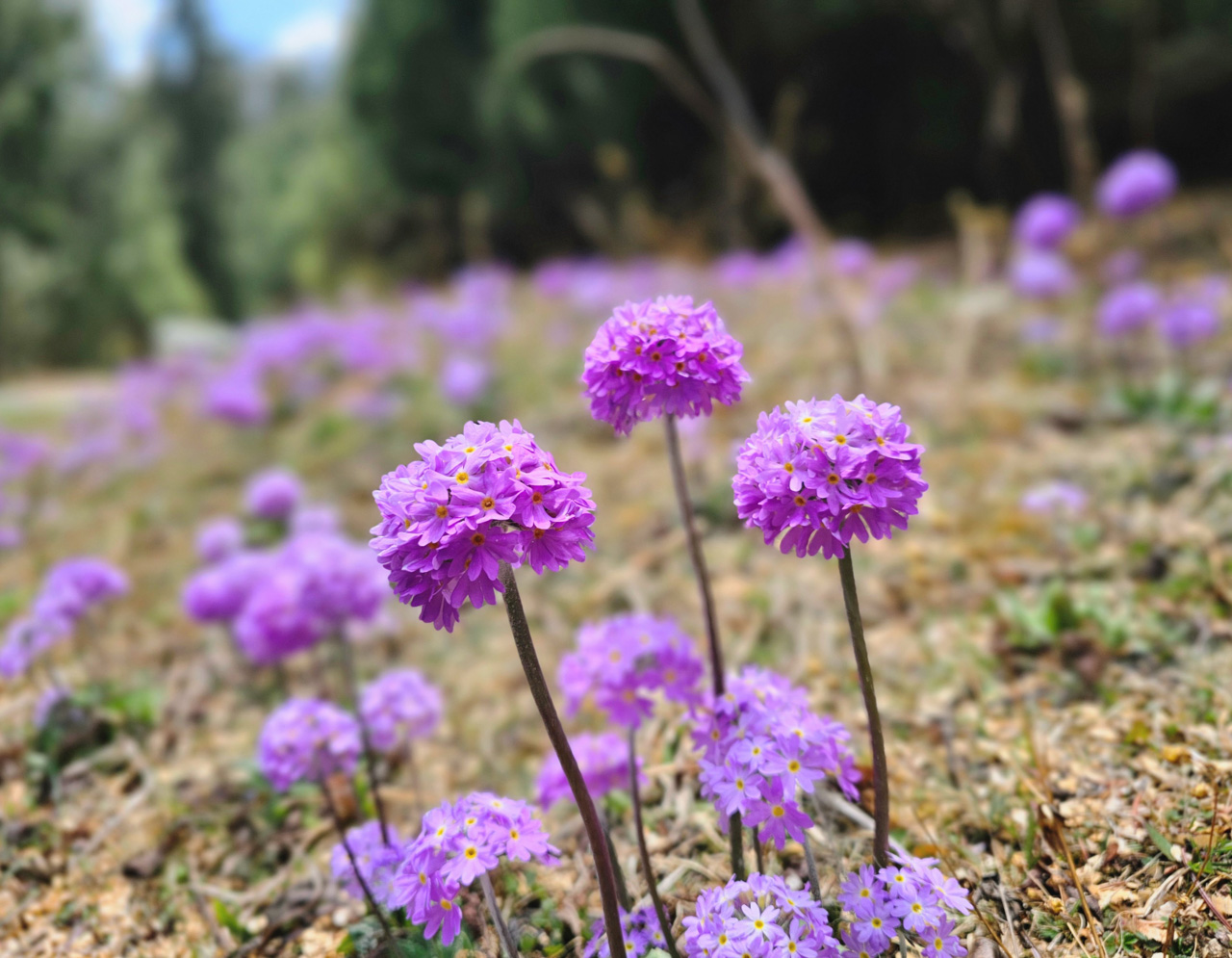
Drumstick Primroses © Mike Hoit
Day 18: Paro to Delhi
Some final birding prior to our flight out of Bhutan turned up a surprise new bird for the trip: singing Yellow-browed Warbler in the hotel grounds.
Some of us had a last look at the Eastern Barn Owl, and some species that we had become well-acquainted with, such as Red-billed Chough, Oriental Turtle Dove, Russet Sparrow and even a Kalij Pheasant.
Over breakfast we reminisced over a few of the many great sightings and experiences of the tour: everyone had a different set of highlights, a testament to just how much cool stuff we had seen! There’s always time for another bird though, and the very last one was a Black Eagle seen just as we arrived at the airport, a fine way to bid farewell to a special place.
Finally it was time to go our separate ways back in the real world of Delhi airport – with enough memories to sustain us through the long journeys home.
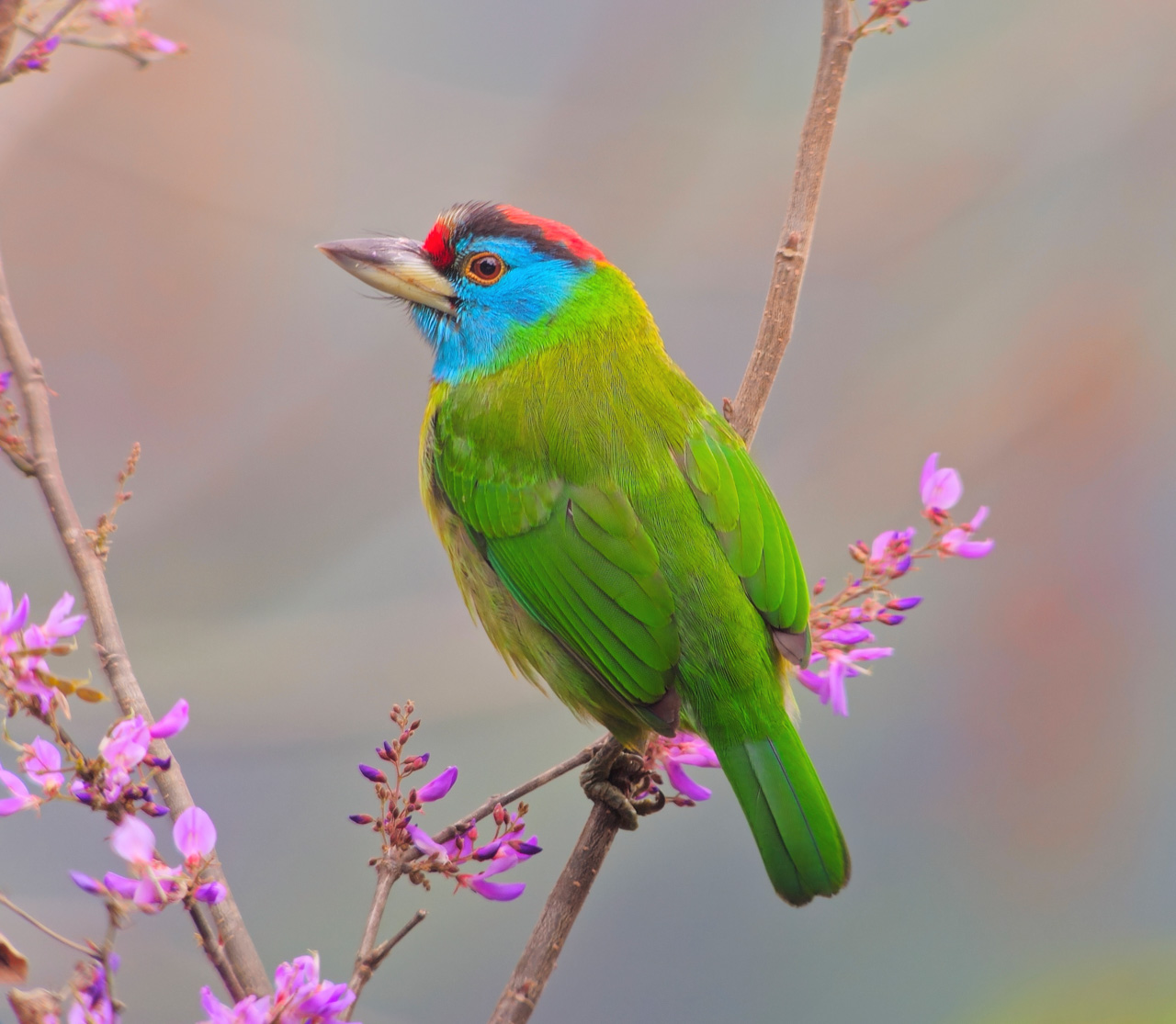
Blue-throated Barbet © Mike Hoit