Alberta Birds and Dinosaurs Trip Report (Jun 3-7, 2026)
Day 1: Meet-and-greet Dinner in Calgary
As always, our trip started with a delicious dinner in Calgary. After a nice evening of getting to know one another, we headed to bed for dreams of the birds to come.
Day 2: Slough Birding our way to the Badlands
There are nice starts to birding trips and then there are incredible starts to birding trips. This is trip started in an incredible manner only 15 minutes from the hotel, at a very unassuming pond on the outskirts of Calgary. Rocky Pond treated us to a good diversity of waterbirds and shorebirds, including 11 species of duck, among them, male Ruddy Ducks preforming their bubble “blowing” displays for only vaguely impressed females. Handsome Canvasbacks also caught the eye of the entire group. Nine species of shorebirds were also counted, with stunning views of Black-necked Stilt and American Avocet: perennial favourites among new and seasoned birders alike. But most notable among the shorebirds were the trio of White-rumped Sandpipers (often a challenging species to track down in Alberta) which foraged along the shore, mixing with Semipalmated Sandpipers and Wilson’s Phalaropes. Four species of gulls were also counted, including our first and best rarity of the trip: a Sabine’s Gull!
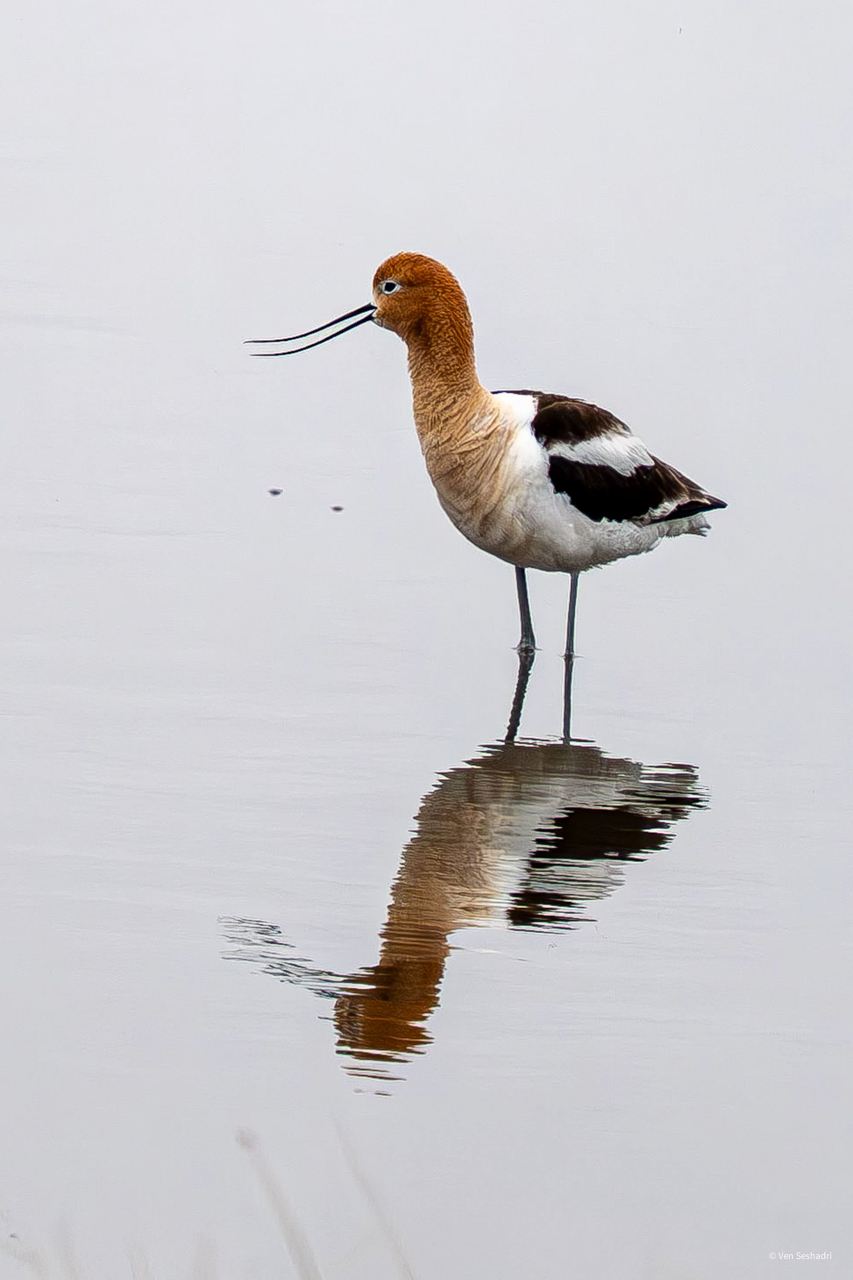
American Avocet © Ven Seshadri
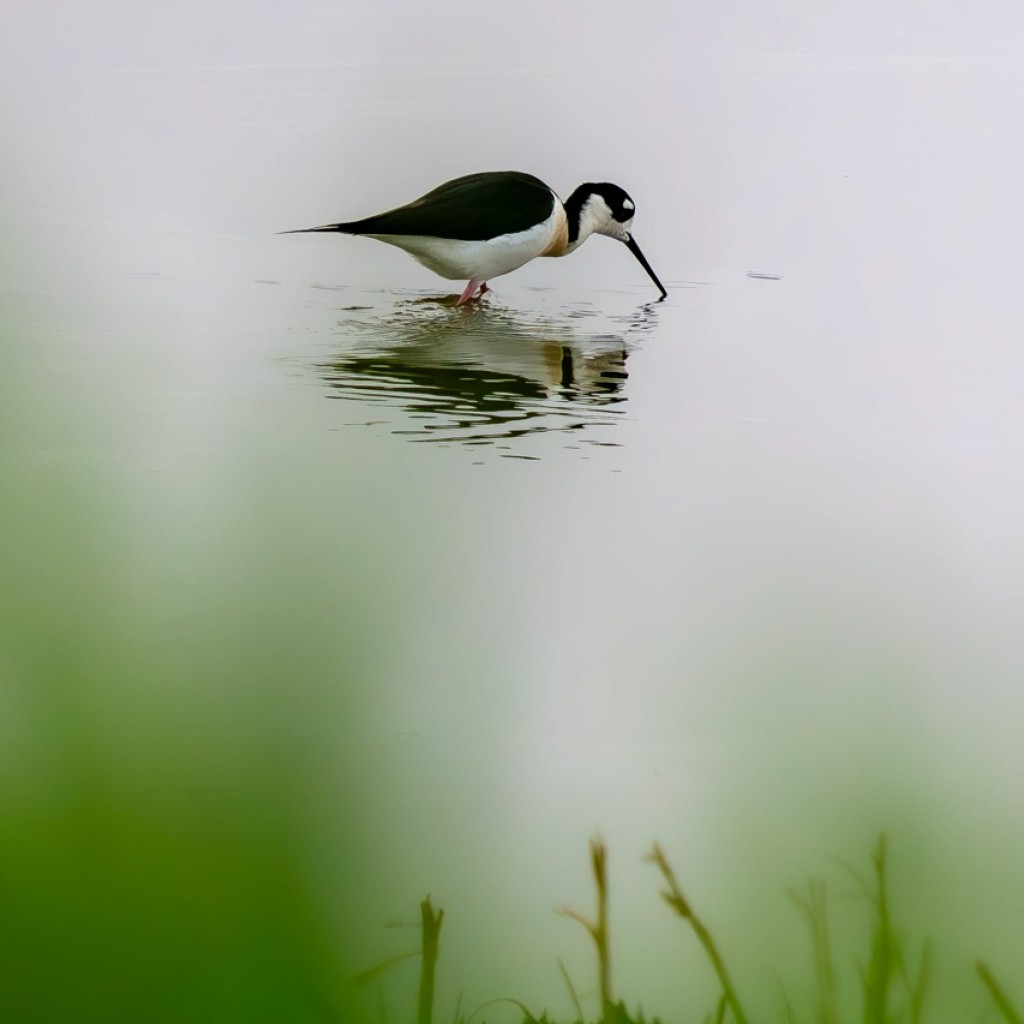
Black-necked Stilt © Ven Seshadri
Sabine’s gull is a most remarkable seabird. They breed on tundra wetlands across the far north before undertaking what must be the longest migration of any gull species, to nutrient-rich waters off western North and South America and southern Africa. One migration route passes over Alberta, with birds moving from the Pacific to the arctic in late spring and early summer. Though they pass over Alberta, presumably a very high altitude, but they tend to be seen mainly only after or during periods of inclement weather. Perhaps the extreme wind and rain that proceeded this trip brough our Sabine’s Gull to Rocky Pond just in time to kick our trip off with a bang?
After a rewarding first stop, we turned east and headed into the agricultural lands between Calgary and the Red Deer River valley. Our first stop, just east of Keoa, brought us our first Long-billed Curlew of the trip. The bird appeared to be a lone male, and we hopped his mate was on a nest nearby.
A stop at Bruce Lake produced an excellent list of 56 species including 10 species of waterfowl, the most notable was perhaps a female Hooded Merganser, which is unusual at this location. The slough was alive with birds, including Black and Forester’s Terns winging overhead, three species of grebes (Eared, Horned, and Pied-billed) among the ducks and American Coots on the water, and lots of passerines in the surrounding vegetation. A large flock of Cliff Swallows sat on the nearby powerlines, while the cattails rang with the songs of Yellow-headed and Red-winged Blackbirds. Baltimore Orioles, a Eurasian Collared-Dove, and a good selection of other species sang from the trees and shrubs flanking the wetlands. A lone Grey Partridge wandered around in plain sight in the wheat stubble beside the road, offering an uncharacteristically good view to the whole group. Five species of sparrow were seen and heard, the most notable of which was a Nelson’s Sparrow – a real rarity at Bruce Lake. While the sparrow remained out of sight, it sang just frequently enough for almost everyone to hear.
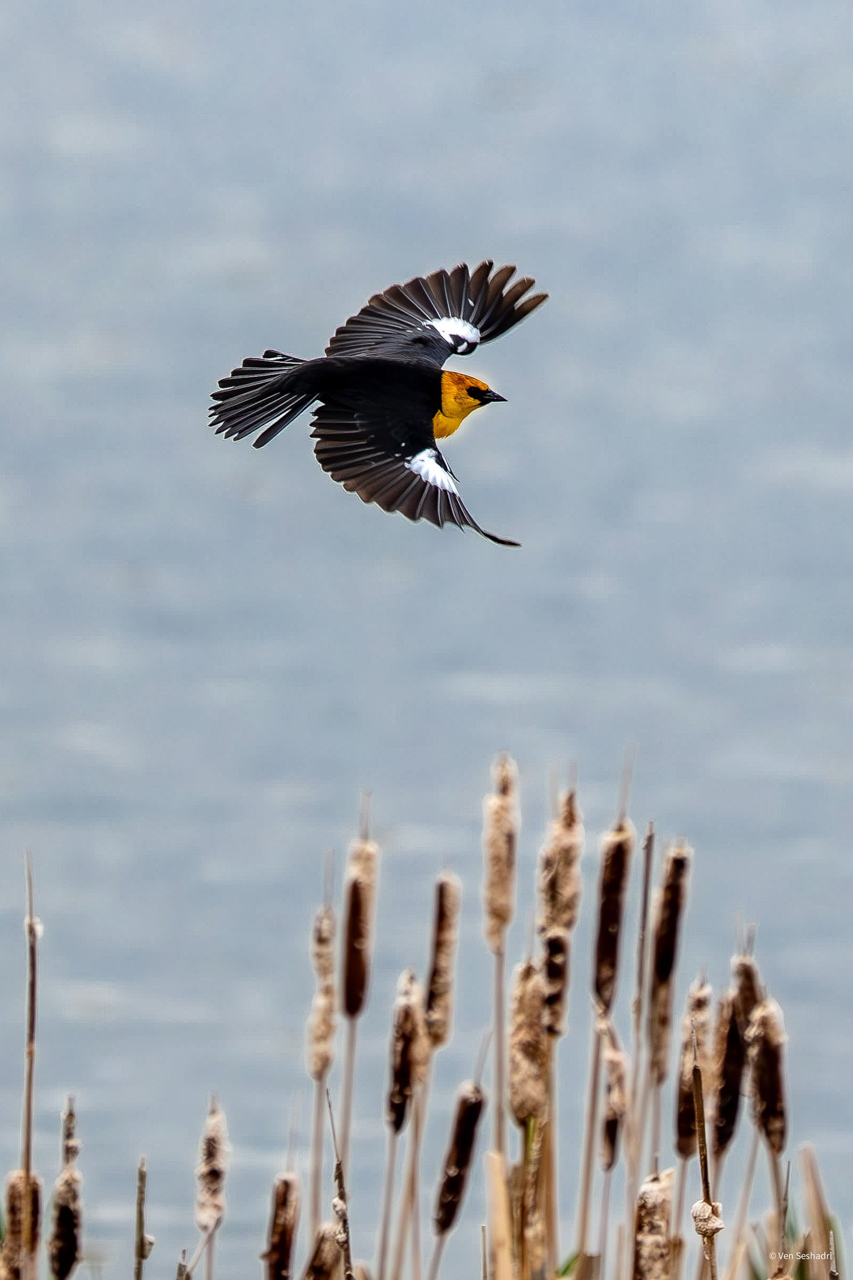
Yellow-headed Blackbird © Ven Seshadri
Another stop in slough country along Range Road 264 was also productive. Many of the same waterbirds were present, but we did add some new species to the list, including a brilliant male Cinnamon Teal and a handsome Northern Pintail. Our first encounter with Eastern Warbling Vireo was also at this stop. Alberta is one of the few places where both Eastern and Western Warbling Vireos occur, with a hybrid zone stretching through parts of central Alberta. Eastern Warbling Vireos are most often found in the province’s deciduous parkland and river valleys, while Western Warbling Vireos are more common in the foothills, mountains, and mixedwood forests of western Alberta. The two species are extremely similar in appearance, making song the most reliable way to tell them apart. Throughout our trip we heard the Eastern Warbling Vireo’s typically longer, smoother, more musical cascade of notes, compared to the Western’s shorter, choppier song with more pauses and buzzy notes.
As we made our way towards the Red Deer River, a Sharp-tailed Grouse crossed the road, giving only the briefest of views; unfortunately, the only one of the trip. Our lunch stop in the riparian woods at Bleriot Ferry made for some good birding. An Osprey circled high overhead, a Cooper’s Hawk buzzed through the riverside cottonwoods, a Brown Thrasher made an appearance, and a variety of songbirds gave voice to the woods. Veerys and Least Flycatchers were particularly vocal. We even found a Least Flycatcher nest under construction. A Western Wood-Pewee gave us fantastic looks, and we took particular note of an intergrade between the yellow-shafted form and the red-shafted form of Northern Flicker. The two forms differ in several plumage traits, including the colour of the underwing, undertail, and face. Where the ranges of the two forms meet in the Canadian prairies they freely interbreed. Alberta is at centre of this broad hybrid zone, and many flickers show a mix of characteristics from both forms. In the Drumheller and Red Deer River valley region, as we saw throughout the trip, most if not all flickers are best described as intergrades rather than “pure” yellow-shafted or red-shafted birds.
After lunch we took the Bleriot Ferry across the Red Deer River, which was flowing high and clouded with sediment, the result of the significant rainfall event that proceeded the trip. At least two Common Nighthawks winged overhead, giving their distinctive “pent” calls. Barn Swallows skimmed over the river while high above them, a flock of ten American White Pelicans circled, their bodies gleamed white in the sunshine, and their effortless soaring impressed everyone.
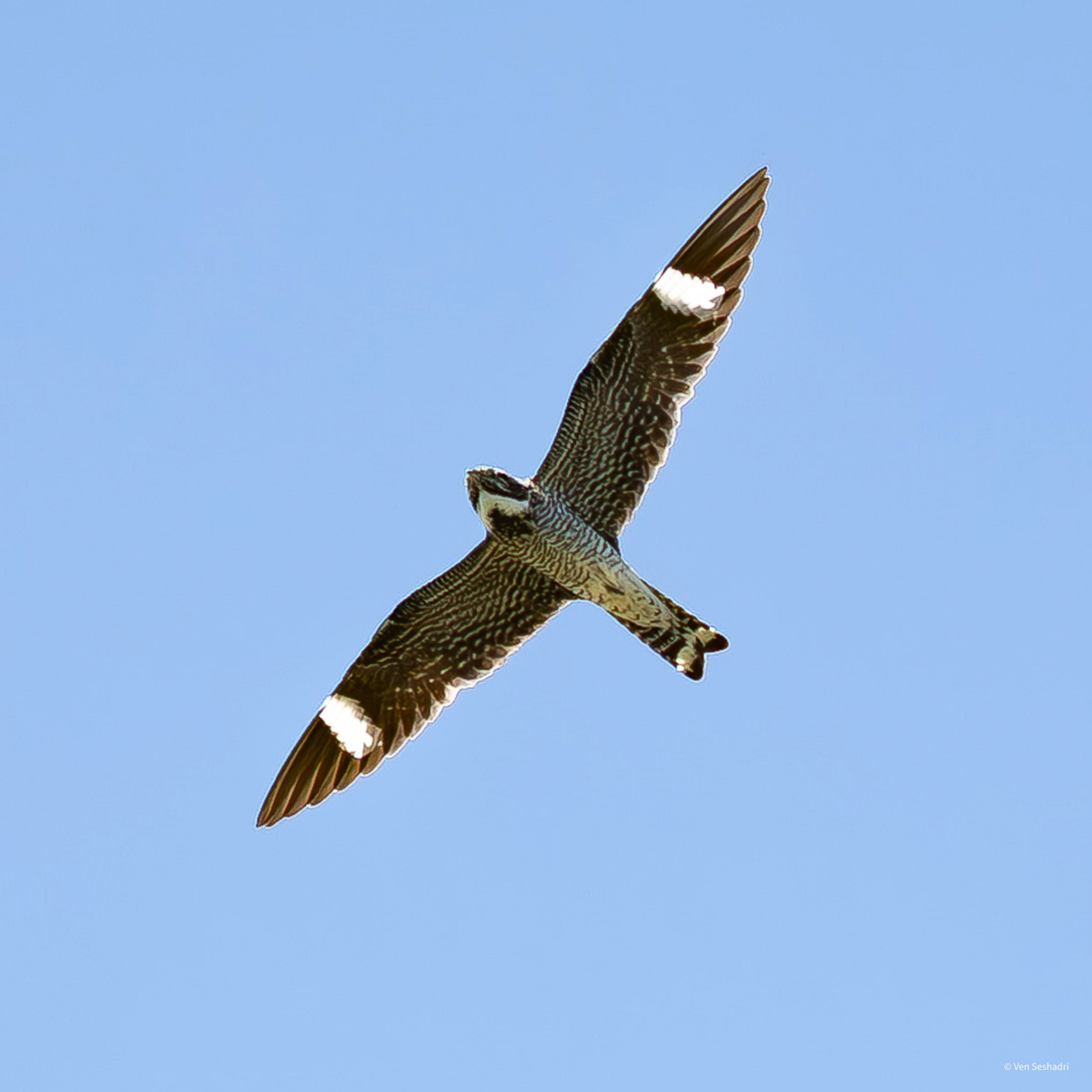
Common Nighthawk © Ven Seshadri
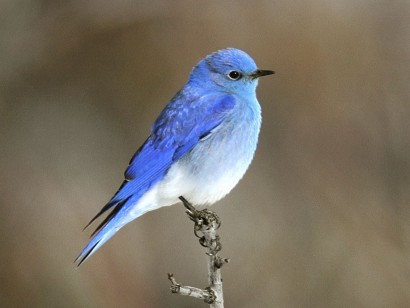
From the ferry crossing we made our way out of the river valley and across the prairie to the scenic Horsethief Canyon, our last birding stop for the day. Horsethief Canyon is one of Alberta’s most spectacular badlands landscapes and offers an exceptional cross-section through rocks of the Late Cretaceous Period. The canyon’s steep walls expose layers of sandstone, mudstone, shale, clay, ironstone, and coal that were deposited on ancient floodplains, river channels, swamps, and estuaries near the shoreline of a vast inland sea. Over millions of years, erosion by water, wind, and frost carved the maze of gullies, ridges, and coulees visible today, revealing a colourful sequence of sediments that preserve a rich fossil record of dinosaurs, prehistoric plants, and other ancient life. As we stood on the canyon edge, we were treated to a remarkable glimpse of the remnants of an ancient subtropical world that existed in Alberta near the end of the Age of Dinosaurs. The breathtaking geology was good, but the birds proved great. A Long-billed Curlew called in the distance, a Rock Wren sang down in the canyon, our first two Turkey Vultures soared overhead, a gorgeous male Mountain Bluebird made a grand appearance in plain view, a migrant Orange-crowned Warbler played hide and seek in the scrub, and to top it all off, a magnificent Golden Eagle wheeled in the sky against distant storm clouds. A Red-tailed Hawk joined the eagle in the flight and was positively dwarfed by the king of the prairie sky.
We finished the day with a great meal in Drumheller, our home for the next two nights.
Day 3: Prairie Birding and Dinosaur Provincial Park
Day three of the trip started off in fog. Thick fog. Fog that at times barely afforded a 100 m viewscape. It was in this fog that we left our hotel and headed south along the Red Deer River towards what we hoped would be clearer environs. Hidden within the fog were the badlands, which hug this part of the Red Deer River and give Drumheller such a unique and scenic character; we would have to wait until the latter part of the day to see the river valley in its full glory.
The fog lifted, for a time, after we climbed out of the valley and back onto the prairie. It was perfect timing because our first birding stop of the day was just ahead. Under clear skies we parked at an unassuming pullout off the highway, named Homestead Coulee. Immediately the birds caught our attention. Both Eastern and Western Kingbirds noisy patrolled the area, chattering and foraging in plain view. A Loggerhead Shrike appeared, its stunning grey, white, and black plumage vibrant in the morning sun. A very distant Upland Sandpiper perched on a fence post. A Baird’s Sparrow sang a handful of times, but remained stubbornly out of sight. The real prize, however, was in a lone tree, about a kilometre away. There sat two Ferruginous Hawks, at their nest. What a great view! A third hawk showed itself as well, but not a distant one, this Ferruginous flew right overhead, low enough that all of the key identifying features could be seen without binoculars. Richardson’s Ground Squirrels froze as their nemesis flew past; Ferruginous Hawks feed nearly exclusively Richard’s Ground Squirrels on the Canadian prairies.
No sooner had we returned to the road than the fog closed in once again. We drove south in a strange word where visibility barely reached the roadside fences. We contented ourselves with roadside birds as we pushed carefully though the fog. At one stop we heard the distant but diagnostic song of an Upland Sandpiper. The ever-present Western Meadowlark’s song sounded even finer than usual as it reached our ears through the fog from some distant unseen perch on the prairie.
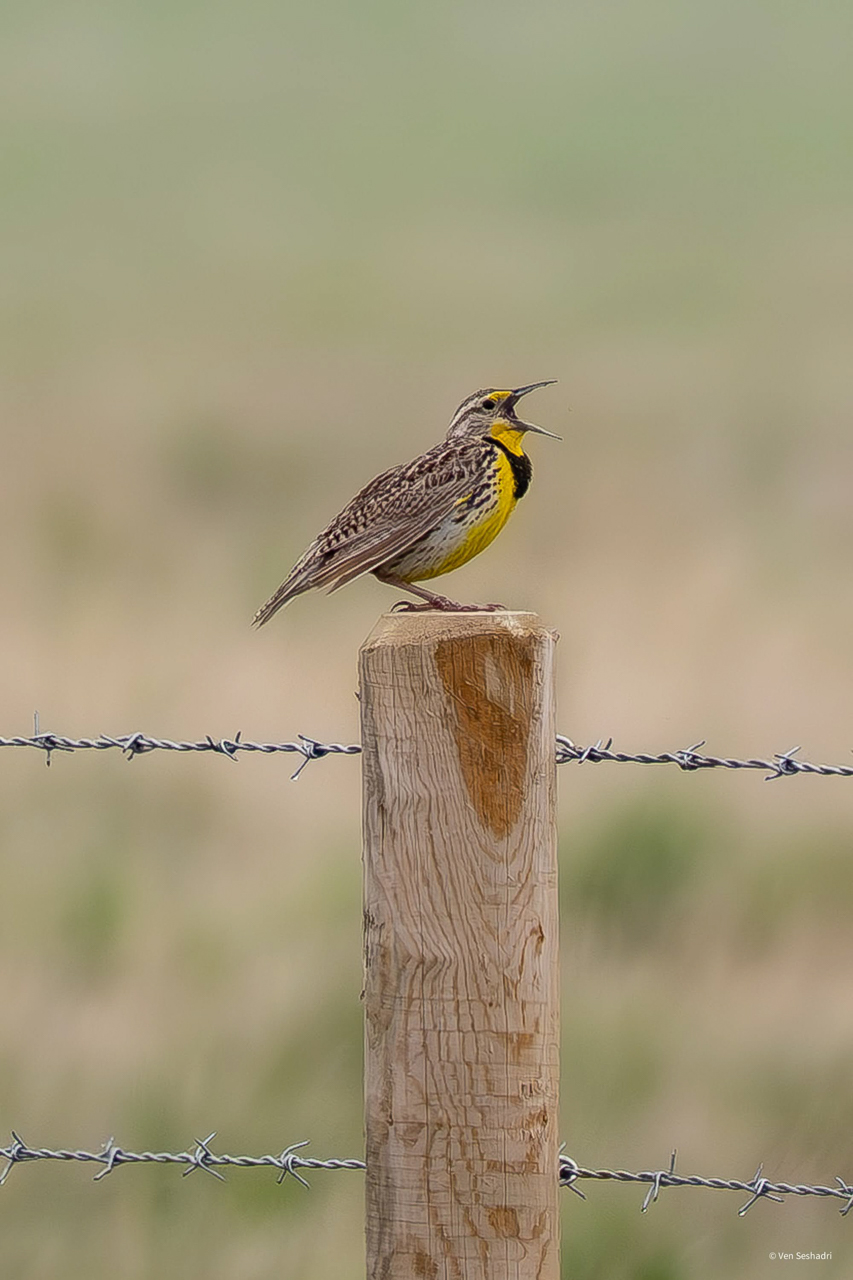
Western Meadowlark © Ven Seshadri
Eventually we reached the hamlet of Cessford, and its surrounding shortgrass prairie. The fog relented somewhat, and we were treated to a banquet of classic prairie birds, which delighted our eyes and ears to no end. Lark Buntings were notably more common than usual. The black and white males preformed their aerial displays and accompanying songs over and over. Lark Buntings are known for their dramatic population eruptions. Rather than returning to the same breeding areas year after year, they are highly nomadic, moving across the Great Plains in response to rainfall, grasshopper abundance, and grass conditions. As a result, southern Alberta can experience years when Lark Buntings are scarce or absent from many traditional sites, followed by sudden influxes, like what seemed to be the case around Cessford this year.
The abundance of Lark Buntings wasn’t the only surprise, Chestnut-collared Longspurs also seemed surprisingly abundant in the Cessford area. This was particularly true near the Cessford Cemetery (which was also the location of our “rustic” bathroom stop), where we made a conservative count of 30 birds. Like the buntings, the male longspurs preformed their aerial displays with gusto and vigour. The prairie air was filled with longspur song – it was remarkable, especially given the 94-96% decline of Chestnut-collared Longspur numbers since the 1970’s! Our longspur-filled morning was like a brief glimpse back in time to the way all of the Canadian shortgrass prairie must have sounded decades ago.
The prairie air rang with the songs of other species too: Vesper Sparrow, Savannah Sparrow, and Baird’s Sparrow added their songs, hidden in the grass. Horned Larks and Sprague’s Pipits sang high above, broadcasting their songs while in hovering flight. Marbled Godwits and Long-billed Curlews were seen and heard, and when a Ferruginous Hawk cruised through the area, one Long-billed Curlew in particular took exception and chased off the hawk in an entertaining (for us, not the hawk) aerial assault. A few Pronghorn also meandered by in the distance.
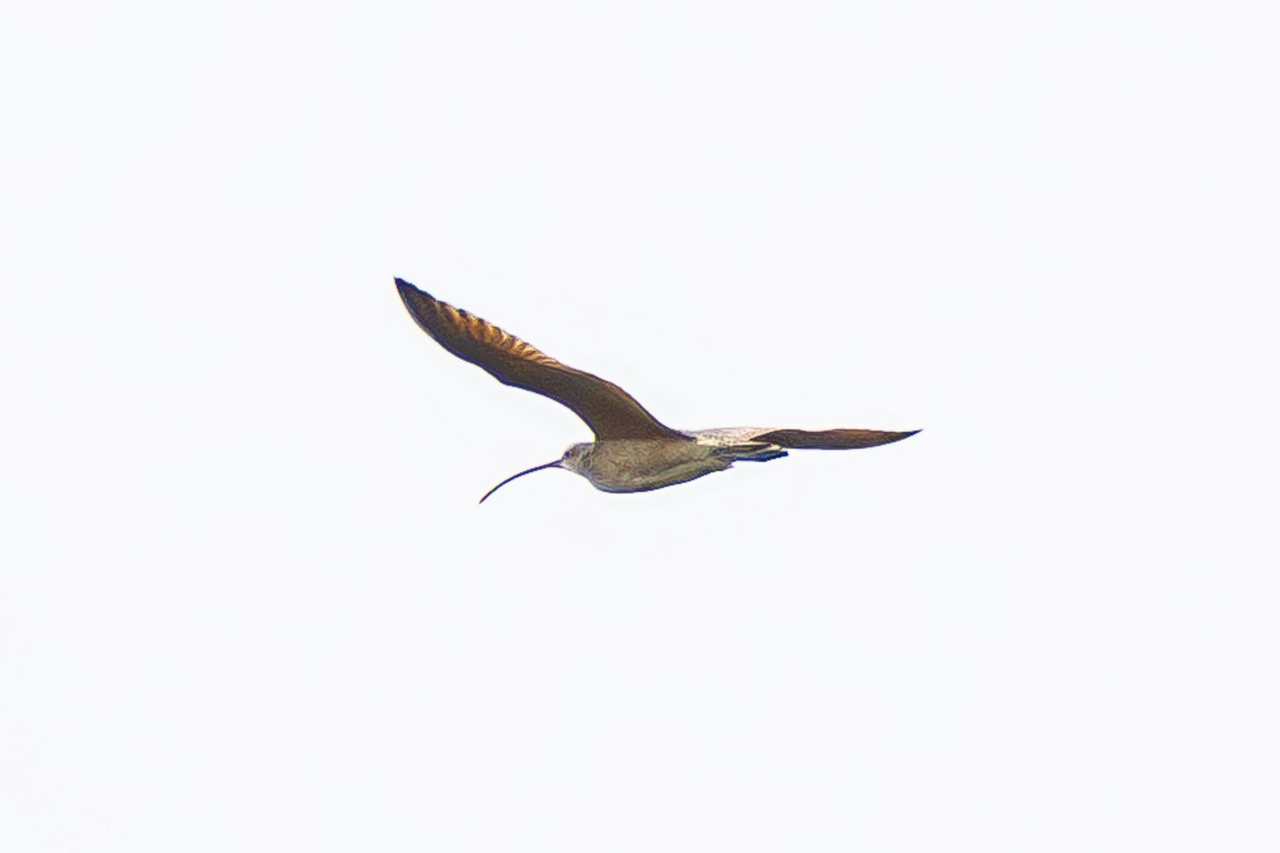
Long-billed Curlew © Ven Seshandri
From Cessford we made our way further south. The fog cleared, the sun shone and the wind picked up enough that we had to hold onto our hats at times while we enjoyed the impressive view over Dinosaur Provincial Park, our final birding destination of the day. The viewpoint, which looked out across a wide valley of strikingly beautiful Badlands featured some brief looks at Rock Wrens and an excellent photo session with a cooperative Lark Sparrow.
The viewpoint over the park was a perfect introduction to what is one of the most important fossil sites in the world and has played a pivotal role in advancing our understanding of dinosaur evolution and Late Cretaceous ecosystems. Before us lay rocks that were deposited about 75 million years ago in a lush river-delta environment teeming with life. Since the late 1800s, thousands of exceptionally preserved fossils have been recovered from the area, representing more than 50 species of dinosaurs as well as ancient crocodiles, turtles, fish, and plants. The extraordinary abundance and diversity of these fossils have allowed scientists to reconstruct entire prehistoric ecosystems and have contributed significantly to research on dinosaur biology, behaviour, and extinction. Recognized as a UNESCO World Heritage Site in 1979, Dinosaur Provincial Park remains one of the richest and most scientifically valuable dinosaur fossil localities ever discovered.
From the viewpoint we descended back into the Red Deer River valley and found a delightful spot for lunch inside the park. Here we were treated to the first of two Bullsnakes of the day, a low flying Cooper’s Hawk, a perched Common Nighthawk, and a cacophony of songbirds. With lunch complete, a short drive through the park brought us to the trailhead of what proved to be a most productive walk.
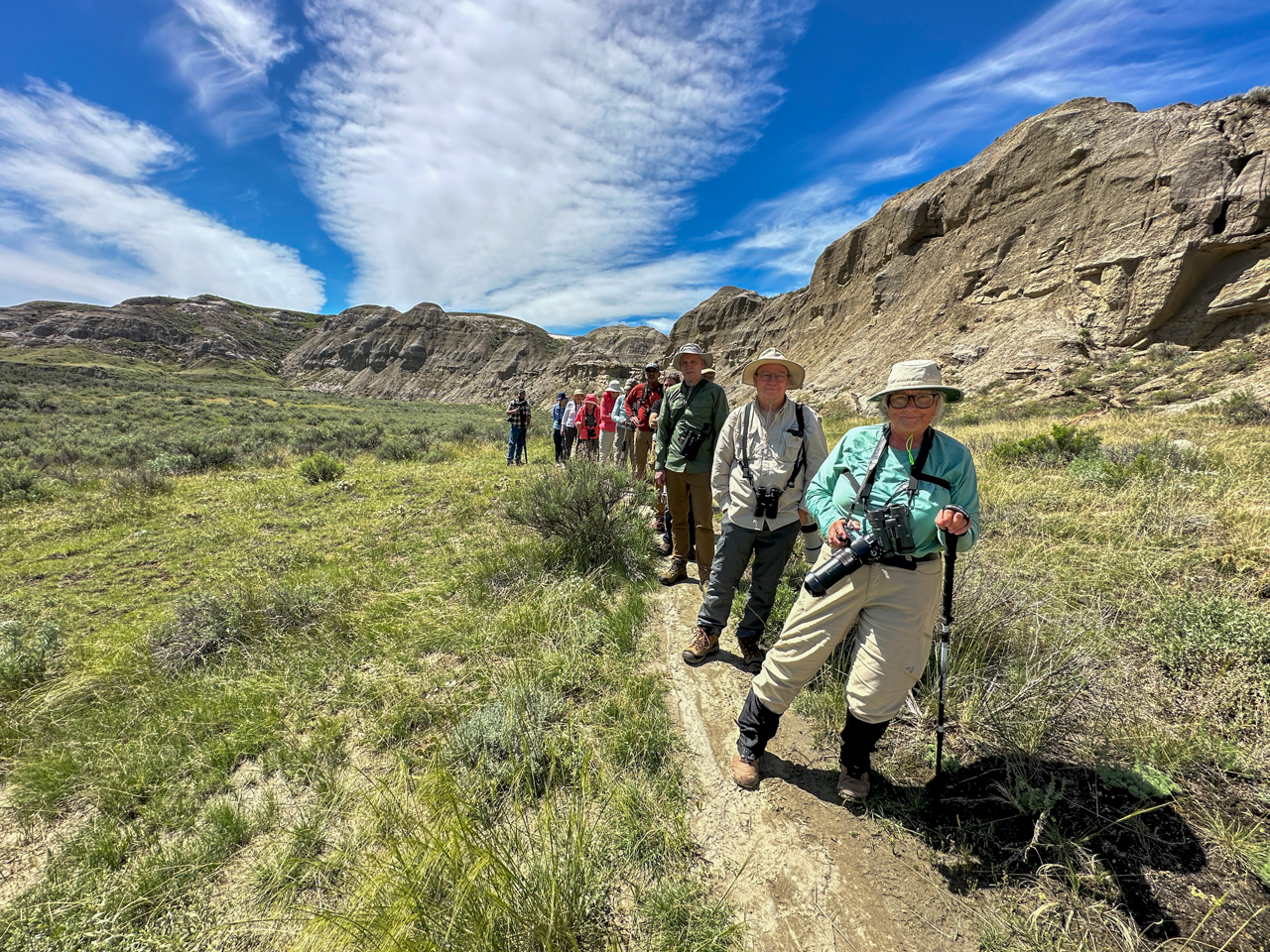
Birding in Dinosaur Provincial Park © Jody Allair
We worked our way between the cliffs and Little Sand Creek, and soon found a sizeable Prairie Rattlesnake sunning at the base of a large rock only metres from the trail. The group afforded her ample space as we enjoyed the view of what is perhaps Alberta’s most iconic and impressive reptile. Further down the trail we encountered another Bullsnake, which also gave us stunning views as it slowly worked its way through the prairie vegetation. Reptiles weren’t the only great finds of the walk, however. We watched a Northern House Wren at its nest which was inside a disused Cliff Swallow nest high up on a cliff face. The Northern House Wren visited another old Cliff Swallow nest, one that had been seen to be in use by a Rock Wren only days before. The Rock Wren was no longer around, which made us wonder if the Northern House Wren had evicted the Rock Wren from its nest. Northern House Wrens can be quite bullish when it comes to their neighbours and will often evict other cavity nesters from their territory. We also had a good look at a male Spotted Towhee as he sang and foraged in the creek-side willows.
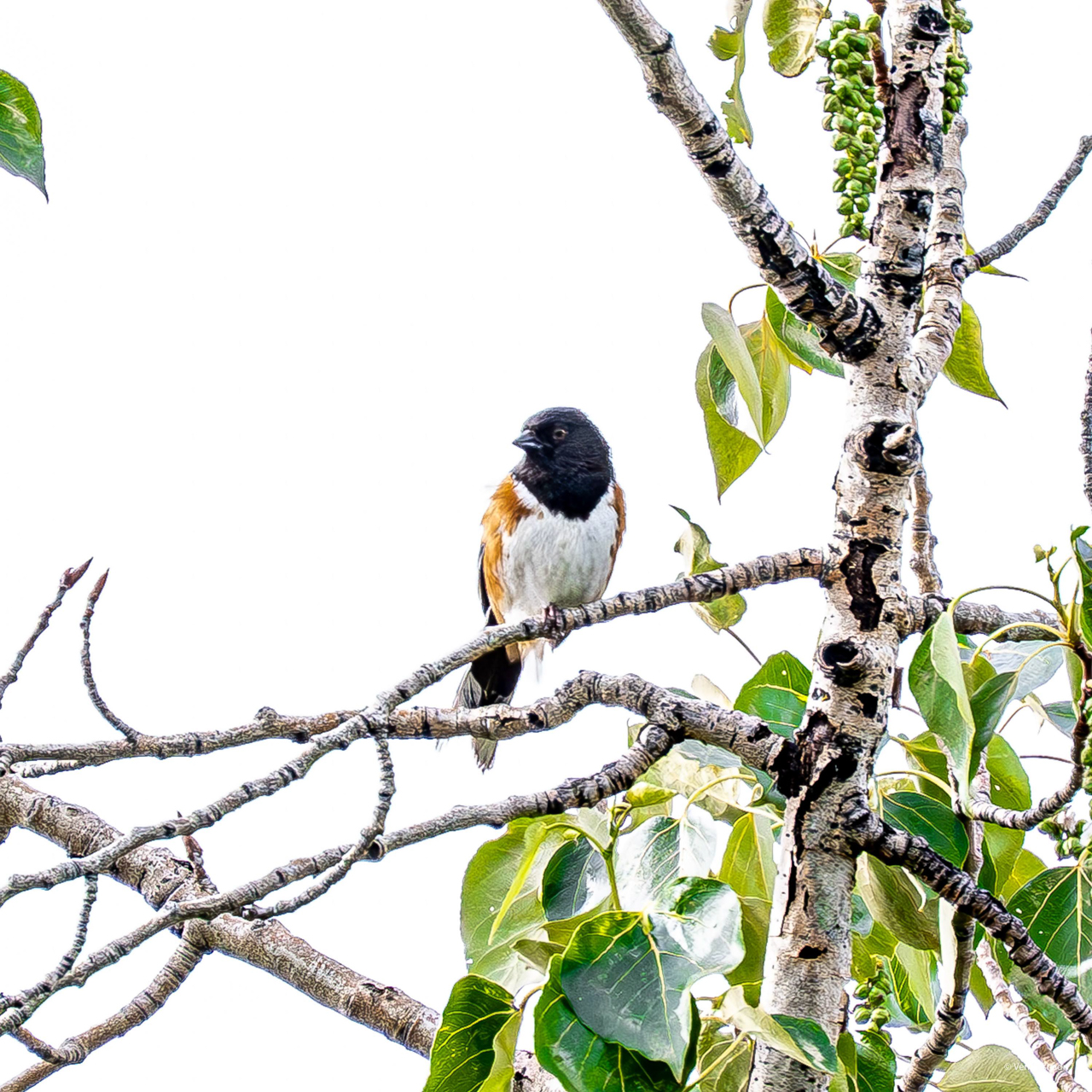
Spotted Towhee © Ven Seshadri
It now came time to return north to Drumheller. The vans pushed their way back north through a vigorous wind. We enjoyed views of the green spring prairie and the badlands that we had missed due to the morning fog. A quick stop at the hoodoos just south of town was a delight to all. These strange geologic formations are endlessly fascinating. Their formation began millions of years ago from layers of sandstone, siltstone, and clay deposited during the Late Cretaceous Period. After the last Ice Age, wind, rain, snow, and frost gradually eroded the softer surrounding sediments, leaving behind narrow pillars protected by harder capstones perched on top. These resistant rock caps act like umbrellas, slowing erosion directly beneath them while the surrounding landscape continues to wear away.
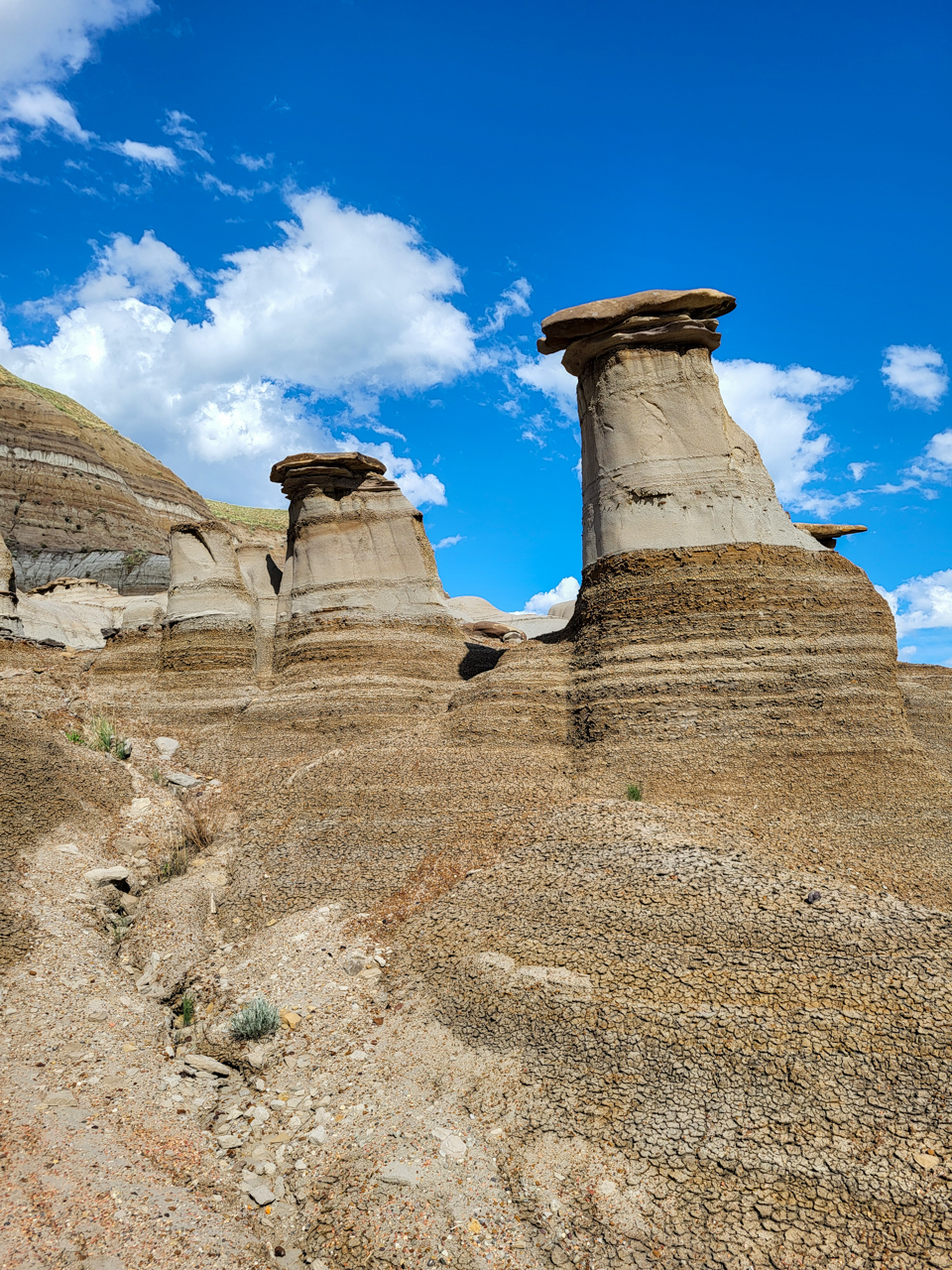
Hoodoos © Mark Conboy
Our dinner for the evening was at the historic Last Change Saloon in Wayne, just southwest of Drumheller. And a delicious meal it was! Our return to Drumheller was marked by a most incredible display of lightning, raucous thunder, and a brief period of blinding rain; it was dramatic finish to an incredible day.
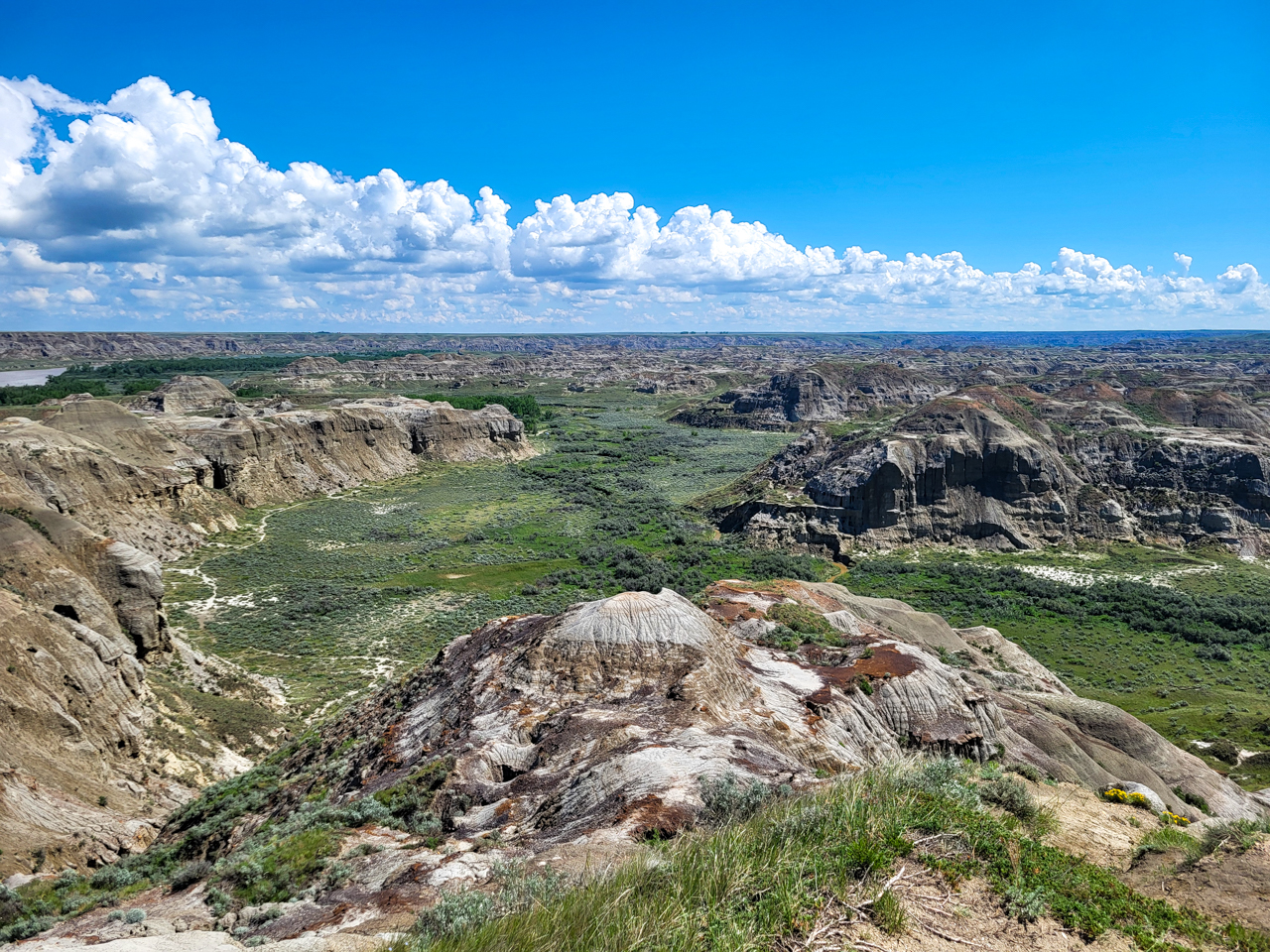
Dinosaur Provincial Park © Mark Conboy
Day 4: McMullen Island and the Royal Tyrell Museum
Our final morning of the trip was spent on McMullen Island, just north of the Drumheller. We recorded an excellent 40 species during our time walking the trails. A Ruby-throated Hummingbird visiting her nest was a particular highlight. We saw nesting behaviour from other species as well, including a Cedar Waxwing and an Eastern Warbling Vireo building. A female Yellow-bellied Sapsucker (with a black crown) gave us great views. A very cooperative Spotted Towhee and an equally cooperative Veery gave us prolonged looks as they sang from the top of trees. All around us the riparian vegetation rang with bird song. It was hard to leave the island behind, but our next stop would prove to be just as marvelous.
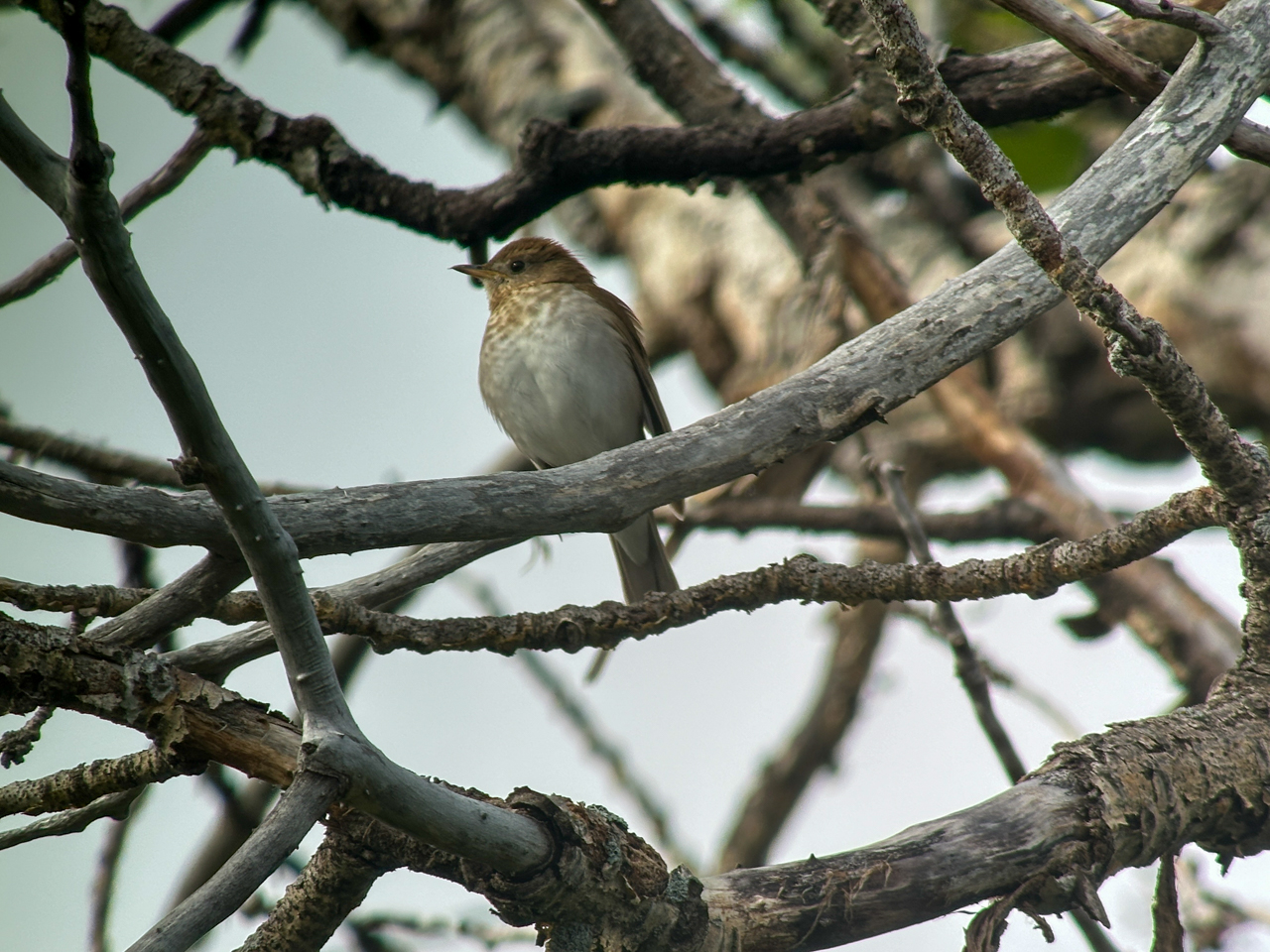
Veery © Jody Allair
Setting our binoculars aside for the time being, we paid a visit to the world-renowned Royal Tyrell. For the next several hours we marveled at the museum’s phenomenal displays.
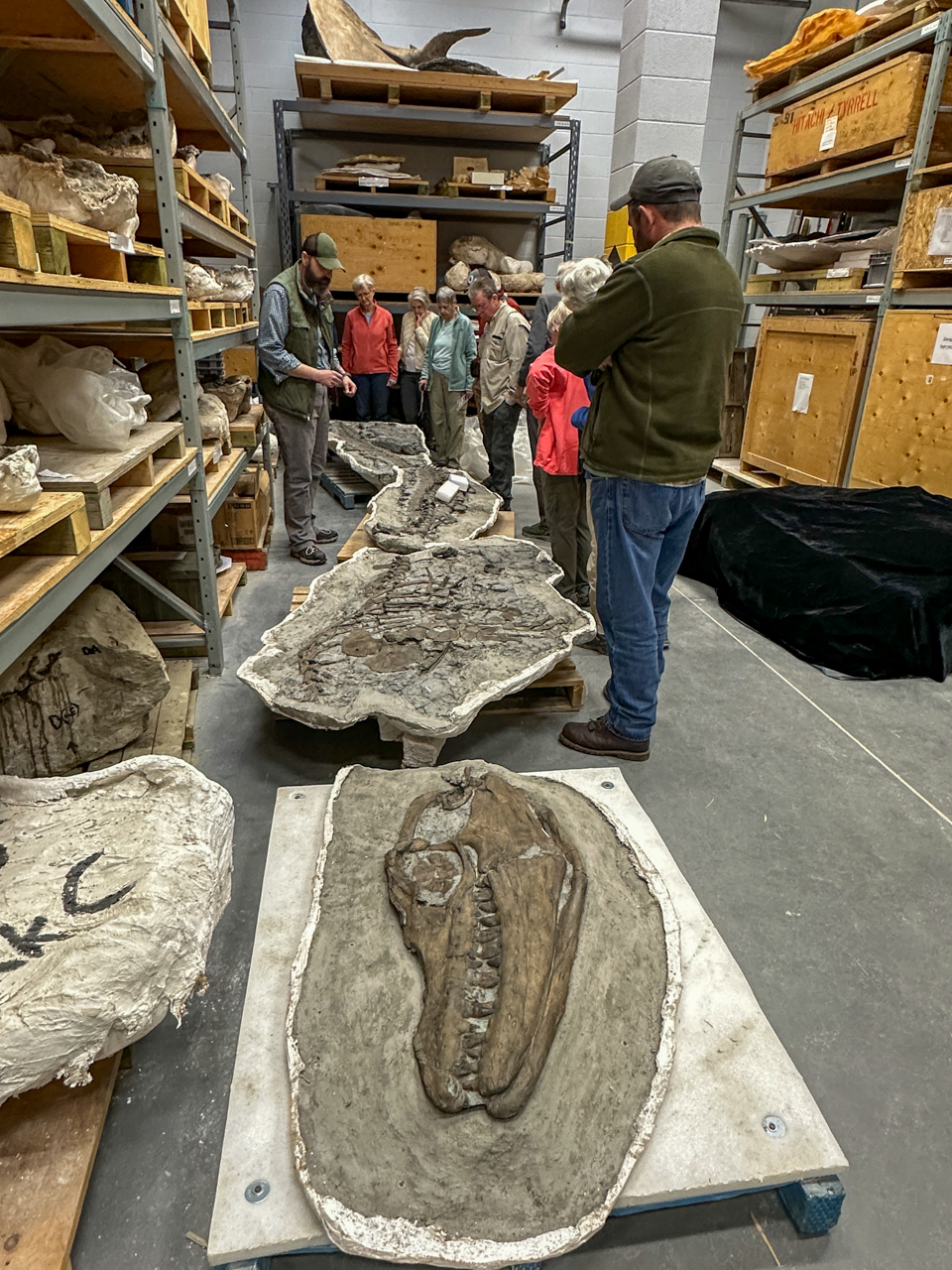
Royal Tyrrell Museum © Jody Allair
The Royal Tyrrell Museum of Palaeontology was established near Drumheller in the heart of Alberta’s fossil-rich badlands and opened to the public on September 25, 1985. It was named in honour of geologist Joseph Burr Tyrrell, who discovered the first documented dinosaur fossil in Alberta’s Red Deer River valley in 1884 while searching for coal deposits. The Royal Tyrrell Museum is recognized as one of the world’s leading centres for palaeontological research and is Canada’s only museum devoted exclusively to the study of ancient life.
With our time at the museum over we began the drive back to Calgary. On the way we made one final birding stop at Horseshoe Canyon. It was our last look at the badlands, and a picturesque one at that. Grey Catbirds serenaded us as we enjoyed the view.
Back in Calgary we enjoyed one last delicious meal.
Day 5: Departure from Calgary
It was a phenomenal trip with 113 bird species total, plus eight mammal species. Wonderful birds, wonderful scenery, and wonderful people!
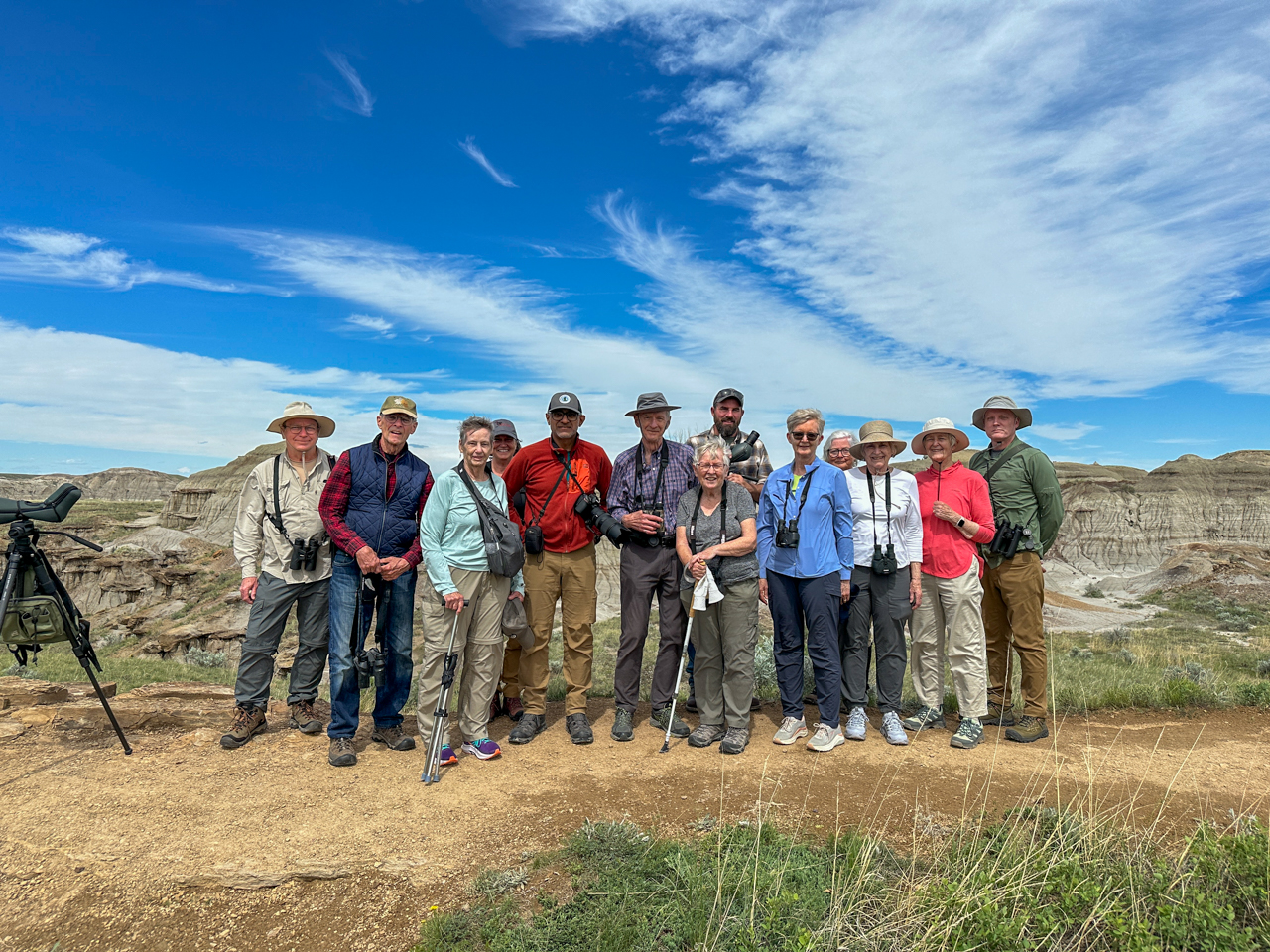
Our group © Jody Allair